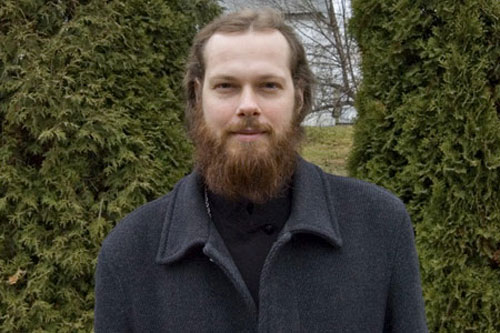
On Veneration of the Latest Saints

St. Symeon the New Theologian ca. 949-1022

A man who does not express desire to link himself to the latest of the saints (in time) in all love and humility owing to a certain distrust of him, will never be linked with the preceding saints and will not be admitted to their succession, even though he thinks he possesses all possible faith and love for God and for all His saints. He will be cast out of their midst, as one who refused to take humbly the place allotted to him by God before all time, and to link himself to that latest saint (in time) as God had disposed. (Writings from the Philokalia on Prayer of the Heart, Faber and Faber, London, 1979, p. 135)

A Prophetic Warning

St. Paisius Velichkovsky 1722-1794

…[I]f you depart from heeding and reading Patristic books you will fall away from the love Christ, that is, from the fulfilling of Christ’s commandments and there will enter into your midst rebellion, tumult, and disorder, disturbance of soul, wavering and hopelessness, murmuring against and judgment of each other; and because the increase of these, the love of many will grow cold, or rather that of almost all; and if such will be, this community will soon be dissolved, first in soul, and with time and body also. (Blessed Paisius Velichkovsky: The Man Behind the Philokalia pg. 123)

On Protestantism in the Early Church

St. Vincent of Lerins died ca. 445

We inveighed also against the wicked presumption of Nestorius in boasting that he was the first and the only one who understood Holy Scripture, and that all those teachers were ignorant, who before him had expounded the sacred oracles, forsooth, the whole body of priests, the whole body of Confessors and martyrs, of whom some had published commentaries upon the Law of God, others had agreed with them in their comments, or had acquiesced in them. In a word, he confidently asserted that the whole Church was even now in error, and always had been in error, in that, as it seemed to him, it had followed, and was following, ignorant and misguided teachers. (The Commonitory Chap. 31.83)

On St. Salvius the Seer of Heavenly Mysteries

St. Gregory of Tours ca. 538-594

The feeling of reverence which I have for him compels me to say something about St. Salvius. He often used to tell how, during his years as a layman, while he was occupying himself with worldly affairs he never permitted himself to be ensnared by the carnal desires which so frequently fill the minds of young people. When the Holy Spirit finally found a place in his heart, he gave up the struggle of worldly existence and entered a monastery. As one now consecrated to Almighty God, he understood that it was better to serve the Lord in poverty and to humble oneself before Him, rather than to strive after the wealth of this transient world. He spent many years in his monastery and observed the rule instituted by the Fathers…

One day when Salvius lay in bed, gasping for breath and weakened by a fever, his cell was suddenly filld with a bright light and the walls seemed to shake. He stretched out his hands to heaven, and as he gave thanks he breathed forth his spirit. The monks, together with his own mother carried his dead body out of the cell with lamentation; then they washed it, vested it and placed it upon a bier. They passed the long night in weeping and singing psalms.

When morning came and all was ready for the funeral, the corpse began to move on the bier. Salvius’ cheeks became flushed, he stirred himself as if awakened from a deep sleep, opened his eyes, raised his hands and spoke: “Oh merciful Lord, why hast Thou done this to me? Why hast Thou decreed that I should return to this dark place where we dwell on earth? I would have been much happier in Thy compassion on high, rather than having to begin once again my profitless life here below.” Those around him were in perplexity. When they asked him the meaning of the miracle which had occurred, he gave no reply. He rose from the bier, feeling no ill effects from the illness which he had suffered, and for three days he remained without food or drink.

On the third day he called the monks, together with his mother. “My most dear friends,” he said, “hear what I am about to say. You must understand that all you see in this world is entirely without value. All is vanity, exactly as the prophet Solomon proclaimed. Blessed is he who behaves in such a way in this earthly existence that he is rewarded by beholding God in His glory in heaven.”

As he said this, he wondered whether he should say more or stop with this. He was silent for a while, but the monks begged him to tell them what he had seen. “When my cell shook four days ago,” he continued, “and you saw me lying dead, I was raised up by two angels and carried to the highest peak of heaven, until I seemed to have beneath my feet not only this miserable earth, but also the sun and moon, the clouds and the stars. Then I was conducted through a gate that shone more brightly than the light of the sun and entered a building where the whole floor shone with gold and silver. The light was impossible to describe. The place was filled with a multitude of people, neither male nor female, stretching so far in all directions that one could not see where it ended. The angels made a way for me through the crowd of people in front of me, and we came to the place towards which our gaze had been directed even when we had been far away. Over this place there hung a cloud more brilliant than any light, and yet no sun or moon or star could be seen; indeed, the cloud shone more brightly than any of these with its own brilliance. A voice came out of the cloud, as the voice of many waters. Sinner that I am, I was greeted with great respect by a number of beings, some dressed in priestly vestments and others in ordinary dress; my guides told me that these were the martyrs and other holy men whom we honor here on earth and to whom we pray with great devotion. As I stood here there was wafted over me a fragrance of such sweetness that, nourished by it, I have felt no need of food or drink until this very moment.”

“Then I heard a voice which said: ‘Let this man go back into the world, for our churches have need of him.’ I heard the voice, but I could not see who was speaking. Then I prostrated myself on the ground and wept. ‘Alas, alas, O Lord!’ I said. ‘Why hast Thou shown me these things only to take them away from me again? Thou dost cast me out today from before Thy face and send me back again to a worldly life without substance, since I am powerless to return on high. I entreat Thee, O Lord: turn not Thy mercy away from me. Let me remain here, I beseech Thee, lest falling once more to the earth, I perish. The voice which had spoken to me said: ‘Go in peace. I will watch over you until I bring you back once more to this place.’ Then my guides left me and I turned back through the gate by which I had entered, weeping as I went.”

As he said this, those who were with him were amazed. The holy man of God wept. Then he said: “Woe to me that I have dared to reveal such a mystery! The fragrance which I smelled in that holy place, and by which I have been nourished for three days without food or drink, has already left me. My tongue is covered with sores and has become so swollen that it fills my whole mouth. It is evident that it has not been pleasing in the eyes of my Lord God that these mysteries should be revealed. Thou knowest well, O Lord, that I have did this in the simplicity of my heart, and not in a spirit of vainglory. Have mercy on me, I beseech Thee, and do not forsake me, according to Thy promise.” When he had said this, Salvius became silent; then he began to eat and drink.

As I write these words, I fear that my account may seem quite incredible to some of my readers; and I am mindful of what the historian Sallust wrote: “When we record the virtue or glory of famous men, the reader will readily accept whatever he considers that he might have done himself; anything which exceeds these bounds of possibility he will regard as untrue.” I call Almighty God to witness that everything that I have related here I have heard from the lips of Salvius himself. (Vita Patrum: The Life of the Fathers by St. Gregory of Tours; trans. by Hieromonk Seraphim Rose. Chap. 21 pp. 295-298)

On the Saints and Their Intercession

St. Silouan the Athonite 1886-1938

To many people the Saints seem far removed from us. But the Saints are far only from people who have distanced themselves – they are very close to them that keep Christ’s commandments and possess the grace of the Holy Spirit. In heaven all things live and move in the Holy Spirit. But this same Holy Spirit is on earth too. The Holy Spirit dwells in our Church; in the sacraments; in the Holy Scriptures; in the souls of the faithful. The Holy Spirit unites all men, and so the Saints are close to us; and when we pray to them they hear our prayers in the Holy Spirit, and our souls feel that they are praying for us.

The Saints live in another world, and there through the Holy Spirit they behold the glory of God and the beauty of the Lord’s countenance. But in the same Holy Spirit they see our lives, too, and our deeds. They know our sorrows and hear our ardent prayers. In their lives they learned of the love of God from the Holy Spirit; and he who knows love on earth takes it with him into eternal life in the Kingdom of Heaven, where love grows and becomes perfect. And if love makes one unable to forget a brother here, how much more do the Saints remember and pray for us!

The holy Saints have attained the Kingdom of Heaven, and there they look upon the glory of our Lord Jesus Christ; but by the Holy Spirit they see, too, the sufferings of men on earth. The Lord gave them such great grace that they embrace the whole world with their love. They see and know how we languish in affliction, how are hearts have withered within us, how despondency has fettered our souls; and they never cease to intercede for us with God.

The Saints rejoice when we repent, and grieve when men forsake God and become like brute beasts. They grieve to see people living on earth and not realizing that if they were to love one another, the world would know freedom from sin; and where sin is absent there is joy and gladness from the Holy Spirit, in such wise that on all sides everything looks pleasing, and the soul marvels that all is so well with her, and praises God.

Call with faith upon the Mother of God and the Saints, and pray to them. They hear our prayers and know even our inmost thoughts. And marvel not at this. Heaven and all the saints live by the Holy Spirit and in all the world there is naught hidden by the Holy Spirit. Once upon a time I did not understand how it was that the holy inhabitants of heaven could see our lives. But when the Mother of God brought my sins home to me I realized that they see us in the Holy Spirit, and know our entire lives.

The Saints hear our prayers and are possessed from God of the strength to help us. The whole Christian race knows this. Father Roman told me that when he was a boy he had to cross the river Don in the winter, and his horse fell through the ice and was just about to go under, dragging the sledge with it. He was a little boy at the time, and he cried at the top of his voice: ‘St.Nicholas, help me pull the horse out!’ And he tugged at the bridle and pulled the horse and sledge out from under the ice. And when Father Matthew, who came from my village, was a little boy he used to graze his father’s sheep, like the prophet David. He was no bigger than a sheep himself. His elder brother was working on the other side of a large field, and suddenly he saw a pack of wolves rushing at Misha – Father Matthew’s name in the world – and little Misha cried out, ‘St. Nicholas, help!’ and no sooner had the words left his lips than the wolves turned back and did no harm either to him or his flock. And for a long time after that the people of the village would smile and say, ‘Our Misha was terribly frightened by a pack of wolves but St. Nicholas rescued him!’

And we know of many an instance where the Saints come to our help the moment we call upon them. Thus it is evident that all heaven hears our prayers. (St. Silouan the Athonite by Archimandrite Sophrony Chap. XII On the Saints pp. 395-397)

Chrysostom on the Purposes of Marriage

St. John Chrysostom ca. 347-407

Marriage, then, was given for childbearing also, but even more so in order to quench nature’s burning. Paul himself bears witness to this, saying, ‘Nevertheless, to avoid fornication, let every man have his own wife,’ – not for childbearing. And again, he commands that couples should come together, not that they might become the parents of many children, but what? ‘Lest Satan tempt you,’ he says. Indeed, after this, he did not say, ‘but if they desire to have children,’ but what? ‘If they cannot abstain, let them marry’ (1 Cor. 7:9). For at the beginning, as I have said, this matter [marriage] had two intentions, but subsequently, when the earth, and sea, and the whole world have been filled [with the human race], one reason alone remains for this bond: the banishment of licentiousness and intemperance. [Emphasis added]. (On Virginity, PG 48:547)

These are the two purposes for which marriage was instituted: to make us chaste and to make us parents. Of these two, the reason of chastity takes precedence. When desire began, then marriage also began. It sets a limit to desire by teaching us to keep to one wife. Marriage does not always lead to procreation, although there is the word of God which says, ‘Be fruitful and multiply, and fill the earth’ (Gen. 1:28). We have as witnesses all those who are married but are childless. So the purpose of chastity takes precedence, especially now, when the whole world is filled with our kind. At the beginning, the procreation of children was desirable, so that each person might leave a memorial of his life. Since there was not yet any hope of resurrection, but death held sway, and those who died thought that they would perish after this life, God gave the comfort of children, so as to leave living images of the departed and to preserve our species. For those who were about to die and for their relatives, the greatest consolation was their offspring. To understand that this was the chief reason for desiring children, listen to the complaint of Job’s wife: ‘See,’ she says, ‘your memory has perished from the earth, your sons and your daughters’ (cf. Job 18:17). Likewise Saul says to David, ‘Swear to me that you will not destroy my seed, and my name along with me’ (I Kings 24:22). But now that the resurrection is at our gates, and we do not speak of death, but advance toward another life better than the present, the desire for posterity is superfluous. If you desire children, you can get much better children now, a nobler childbirth and better help in your old age, if you give birth by spiritual labor. So there remains only one reason for marriage, to avoid fornication, and the remedy is offered for this very purpose. (On the Sacred Institution of Marriage, Homily One)


Elder Cleopa on The Soul’s Journey After Death

Blessed Elder Cleopa Ilie 1912-1998

Brothers, never forget that our soul is immortal. Let me tell you one thing: we are mere strangers and passers-by here on earth. Listen to what the Psalm book says: Unworthy is man on earth and a stranger, just like all his ancestors. Nobody stays in this world. We are not here to stay. Down here is a ceaseless passing-by; we come by birth and leave by death.

Divine Job says: From my mother’s womb I have fallen into the pit. Did you hear? That is all that life on earth seemed to him after 400 years. As after having put him through all that trying time, God gave him another 140 years of life – after having tested him with so much torment and so many illnesses – and that’s all that life seemed to him: that from his mother’s womb he had jumped into a pit. Life seemed like a mere jump to him.

Don’t you know what the Holy Spirit compares us to? Man is like grass; his days are like the flowers of the field; that is how he will bloom. And again: His days pass like shadows. And again: My days have gone down like shadows and I have withered away like grass.

And again: My days have gone like smoke and my bones have dried up like dryness. And again: The days of our years are like the spider-web. The days of our lives are likened to a spider-web. That is, our life on earth is just as fragile as the spider-web; we are shadow, dream, and flower, on earth!

God tells Isaiah: Listen, prophet, call out to the people and tell them: All man’s body is grass and all man’s glory is like the flower of the grass. The grass has wilted and the flower has fallen, yet God’s word remains for ever. So let us not rely on this life, brothers, because it’s nothing but shadow and dream.

But do you know what remains for eternity? Our soul. It is clear that our bodies turn to dust. As we bury and unbury our dead one can see how little time it takes for them to turn into dust. Especially after a while, not even the bones remain; it all turns into nothingness.

This is also the first of God’s commandments, that one is dust and into dust one shall return. Yet the soul never dies. The soul remains unto the ages of ages, because it is spirit and cannot die. That is how God has made it.

But in order for you to know what happens to our soul when man dies, I will tell you about the journey that the soul takes right after death, according to the tradition of the Orthodox Church.

From the moment of our death until 40 days later – when the individual judgement of the soul takes place and God decides where we will go, to the good or the bad places, until the Last Judgement – there is a transition time, for both the righteous and the sinners.

When a person dies and his/her soul is about to depart, there are as many devils that show up before him as the number of sins s/he has had; in the same way, a number of saints appear, according to the number of good deeds he did in his life. This is what St. Ephraim the Syrian indicates.

And there is a big “battle” at that moment. Because the holy powers are fighting with the devils over the soul, as the latter say it’s theirs, that is has more sins, while the angels say it has more good deeds. And there is a big battle over it and hence the soul is afraid to come out of its body. His/her tongue gets all tied up when s/he sees all these things. S/he sees a lot of things then, but cannot describe them. Otherwise s/he would say: “Look how many demons have come here!”

A week before he reposed in the Lord, Father Euthyme at the Agapia Veche Monastery saw how the angels were fighting the demons over his soul and exclaimed: “Look how they’re fighting! God’s angels wear golden wreaths on their head and they’re hitting the demons. Watch how they’re running away!”

This Father knew the time of his death a week before he reposed, as he was a man chosen by God, as nuns were saying. But not everyone gets to see such mysteries and is able to tell others about it; most people see them but cannot speak about them.

At the hour of death, the angel we have from our christening has much boldness. When he shows up, everyone steps aside. The angel that we have from the Holy Christening has much authority. Which is why, when you pray in your homes, after you have done your rule, do a few prayers to your angel, too, and say this: “Holy Angel, guardian of my life, pray to Lord Jesus Christ for me, the sinner!”

Because this angel not only guards us now, but also us at the time of our death. He travels with us through the aerial toll-houses, until 40 days pass; and we have him from our divine Christening as a great protector. If it weren’t for him, the devil would do with us whatever he would want.

Listen to the Psalm book: The one who guards you should never sleep. And again: God’s angel will go upon the ones who are afraid of Him and will deliver them. So it is clear that the angel is the one who guards us in this life and after we die, for 40 days.

So the angel comes and says: “Clear away, you demons. I know the life of this soul, ever since s/he was born.” And he starts speaking to the soul thus: “Don’t be afraid, my soul brother!” St. Gregory of Nyssa explains why he calls it brother. Because the angel and the soul are rational, autonomous, speaking, beings and are also spirits, as the Holy Scripture says: And they will all be like God’s angels.

[And the angel continues:] “Behold your body! There, my soul brother – that is your body, that is the house in which you have lived until now. It’s been within that shell that you were begotten by your mother’s womb; it was within it that you have lived for 20, 60, 80” – whatever number of years God has given us on earth (since all life strings are with God, not with us). “Remember, my soul brother, when the Last Judgement trumpet calls, within the blink of an eye this body will come back to life, just as you see it now, and you will re-enter it and go to the Judgement, as Apostle Paul says: They will all stand before the Judgement Throne of Jesus Christ, to be rewarded according to their deeds, whether good or bad.

The guardian angel reminds him again: “Look, my soul brother, when you were a little child, your mother has sent you to bring a bucketful of water or vegetables from the garden or bring the geese back from the meadow or do this or that little household chore. Look, this is what your thoughts were then; this is what you understood then”. And he starts reminding the soul things from his/her early childhood, good deeds that s/he did in his/her body, as well as bad things. “Look, this is what you did when you were in your first grade, in the second grade, in the third grade; this is what you would do. Once you grew up to be a young girl or lad and went out into the world, and then got married, this is what you did”. And he reminds the soul everything s/he did from early childhood until the moment of his/her death, on every day and in every minute of his/her life. Because once it is out of the body, the soul has a very sharp memory. It is as clear as sunlight. The earth no longer pulls it down and neither does its body, to interfere with its memory. It sees everything as clearly as in a mirror.

So that is what happens on the first day after death.

On the second day, a more fearsome thing happens. The guardian angel takes him to all the places where man has been during his life. It is at this point that what is described in the Psalm book happens: What do I fear on the bad day? That the lawlessness of my heel will surround me.

The whole picture of man’s life is revealed to him on his second day after death. But you will ask me: “Father, how can man’s soul travel in one day to all the places he’s been to during his entire life?”

The soul will go around the whole globe in a blink of an eye. Both our soul and our guardian angel travel faster than lightning bolt, as the Bible says: They will run, oh, God, faster than lightning; the souls of the just will return to You, as we read in Ezekiel and in many other places.

The soul is a thinking being. No sooner than uttering a word and thinking it, I have already done the tour of the earth; like I would say now: Peking, New York, Moscow, Bucharest, Sihăstria [- and I’m already there].

The soul travels so quickly after we leave our bodies. And there is no problem for it whatsoever to travel with its guardian angel and visit all the places he has been to throughout his life. He will only think about the place and he’ll already be there, because it travels with the speed of thought.

So where does the angel take him on the second day? He takes him everywhere the man has been throughout his whole – life and shows him where he has done good things and where he has done bad things. He does nothing but show him the truth.

“Look, over here – you danced, you got drunk, you indulged in debauchery with so many women or men; you swore, you smoked, here you aborted that many children, here you insulted, here you stole, here you sang, here you were lazy, here you took revenge on someone. You have mocked, cursed, beaten. You have not confessed, you have not fasted, and you have taken the Eucharist while being unworthy of it.”

And he also shows him the good deeds: “Look, soul, here you went to Church; here you listened to the word of God, here you gave alms to the poor; here you taught the children about the fear of God; here you read the holy books, here you bore your troubles with joy; here you shared a useful piece of advice with another person; here you dressed the naked, here you gave water to the thirsty, here you received the strangers”.

He shows him everything, everything, and the poor soul cannot say anything, because he is only shown the truth, as the angel cannot lie. He shows him both the good and the bad things.

And the soul wonders at all that and asks the angel: – Holy Angel, how do you know about all these things? – How could I not know, if I have been with you all the time! You have eaten – but I cannot eat; you have slept – but I have not slept; you have drunk – but I cannot drink; you have sat idle – but I cannot do that. I am not a spirit that can eat, drink, or sleep. I have always been awake – as it is said in the Psalm book: Neither does the one who guards you, sleep. Because if I had not been next to you, the devils would have caused much misfortune, along with your seen and unseen enemies. I have defended you and I have always been near you and kept writing down your thoughts. Because I know both your thoughts and what you speak and do – be they good or bad.”

So that is what happens on the second day: the guardian angel takes the soul to all the places s/he has been to during his/her whole life.

But on the third day after death, the soul sees us [the people who have remained on earth]. S/he sees that his/her mother, sister, or husband, or wife weep after him/her and feels sorry for that. Yet s/he no longer cares for us [that much], as what s/he is thinking now is only his/her own welfare and says: “They stay on earth and will repent, because they still have time to do good deeds. But where am I going? Who will help me there?”

And so after having been to all the places that s/he has visited in his life, yet a more fearsome thing happens on the third day. Our soul is given yet more accompanying angels – they are six light-bearing angels, who, together with our guardian angel make seven in all – and their job is to help the soul through the terrifying toll-houses that are in the air.

You have heard of the 24 aerial toll-houses. Services are done for those who want mercy from God and help them escape from the spirits of darkness in the air.

The most important services that are done for the dying persons are the general Confession and the Holy Eucharist, as well as making peace with everyone. And right after death, the Holy Liturgy is served for 40 days, as well as food-sharing commemoration events that are held, along with forgiveness services and almsgiving, which help the soul best when it passes through the toll-houses – because the Church, our spiritual mother, prays at such a time for the poor soul, who is her son since the chrismation, to help it pass through the aerial toll-houses unhampered. 

So what happens until the soul passes through the toll-houses? That is a time when man sees how useful it would have been for him to be confessed clear of his sins. If God had not left the mystery of the Holy Confession between Him and us, no man could be saved. As Apostle Jacob says: We all make many mistakes and no one is without sin.

But the mystery of Confession was left to us, between us and God; as this is the second chrismation, as the priest says – as you heard him say during confession: “Since through the second chrismation you were christened, through the Christian Mysteries”.

It is at this point that the soul realises how useful it would have been for him to have already been confessed, when he goes through the toll-houses.

Which is why I ask you to remember one thing: when you see that your mother, your sister, your brother, your wife, your grandchild, your father, daughter etc has fallen ill – don’t call in the doctor first, but the priest, and have them confess clear of all their sins.

A person must confess four times a year all his life: during the four Lents throughout his/her life, but especially when you see that s/he’s fallen seriously ill. When you see such a thing, have the priest come with no delay, to confess the person. Not when s/he is not able to speak any more or has become unconscious, but early, when their mind is clear and their memory is still working. And tell them: father, mother, my son, tell the priest everything you have done!

Ask them to write it all down, if they know they have done something, and to try to remember everything – because if you’ve managed to cause a successful confession, you will have “won” that person’s soul for redemption. Because listen to what the Holy Fathers say: Even if one has mortal sins, if s/he dies confessed, the Church will take him/her out [of the ensuing punishments]. The soul will then sit in hell only until it will clean off its sin(s), because the Holy Scripture says: Nothing unclean will ever enter the Kingdom of Heaven. Heard what a holy man says?

He saw there a sea of fire and pigeons as white as snow coming out of it and soaring to the sky. That sea was hell and you could hear moaning and crying coming out of it. “How come, oh God, that pigeons would fly out of the fire?” he wondered. What was happening was that the pigeons were the souls of the righteous people who had been purified through their canons while sitting in hell and had paid up everything they had to pay.

Because the Church intervenes on earth the most through the Holy Liturgy, as the sacrifice and our redemption are achieved through the blood of Jesus Christ, just as the Apostle says: His blood cleans all of our sins.

If s/he dies unconfessed and if – God forbid – s/he has heavy sins and has not done his/her canon, the Christian will do that in the beyond, in hell. But it is only the Church that will take him/her out of there, through the Holy Liturgy, through forgiveness services and almsgiving and as a result of that, s/he will go to heaven.

And if someone dies unconfessed from his youth and has had heavy, mortal sins, it is almost like dying without having ever been christened at all. All the services that are done here on earth for such a soul will help it very little, because nothing unclean shall enter the Kingdom of Heaven.

So that is how the devils have set up the toll-houses – so that, if possible, no Christian will go to heaven. Do you know why they have such hatred and envy against people? Because the souls of the righteous are completing their numbers – the numbers of the fallen angels. This is as long as God will keep this world – as St. Symeon the New Theologian shows – until the numbers of the fallen angels shall be completed by the souls of the righteous. Don’t you guys read the Psalm book?

Until the numbers of the fallen angels are completed – because there were very many of them, one third of all the angels, as the Revelation says: I have seen a large, red, devil that took down with its tail the third part of the heaven’s stars and threw them to the ground.

A third of the angels fell from all the Hosts, including from among the Cherubim and the Seraphim – all the angels who entertained Satan’s thought to become like God. And that is why the devils have such hatred against us, because they know that if it goes to Heaven, each soul will accomplish what the Scripture says: they will all be like God’s angels; they will replace them and take over their functions.

Which is why they sit in the air and say: “There, God threw us down from the sky, but these souls down here want to pass through to God and take our places!” So then God allows the devils to stand in the souls’ way and rightfully so, because God is not only merciful, but also just and has made these stations – or toll-houses – between heaven and earth in order to cast the souls of those who died unconfessed and who carry heavy sins, into hell.

This is how the toll-houses are ranged: the first toll-house is for evil-speaking; the second one, for gossiping/chattering; the third one, for anger; then follows the one for gluttony, and so on – from the smallest to the biggest sins.

And who has never badmouthed anyone? Who has never got angry in his life? Who has never been lazy? Who has never drunk a glassful too much? Who has never indulged in one’s thoughts, imagination or even through one’s deeds – in debauchery, drunkenness, in doubting one’s faith and in other bodily or spiritual sins, as we read in St. Theodora’s life?

Did you see St. Theodora’s comment, when she got to the drunkenness toll-house? “I was very surprised that the devils reminded me of all the glasses of wine and brandy that I had had in my life. And they would show me when I had done that, at what moment and who else had been there with me at the time and how many times I had gone drunk and how many times I had drunk. And I kept asking the holy angels:

– How do the devils know all these things?

– They were angels once!”

You should know, however, that ever since our chrismation, besides our good angel, who stands to our right, we also have a servant of the hell masters, a devil that sits on our left shoulder. That devil will write down every bad thing you have done and said and all the sins that you have done all throughout your life. All that time, the good angel will write down both the good and the bad deeds, as the Holy Book says. That is what Christ’s Church holds.

Now let’s see what happens to the soul of a confessed person, when the devil comes along with his “paper-roll” where he has written all the man’s sins. He will not find them there any more! At that point the devils yell, shout, and become furious that the soul, who had big sins, like abortions, debauchery, theft, cursing, drunkenness, and other things, does no longer have anything written in his record. When the Christian is forgiven through the priest on earth, the Holy Spirit erases all his sins in that record-book. Christ’s word that says: Everything that the priest forgives on earth will be forgiven in heaven, too – haven’t you heard that? And whatever he does not forgive on earth will not be forgiven in heaven, either.

Therefore, the mystery that confession is – is so great, that it has the power to cleanse man of any sin and give forgiveness for all his sins. Yet only if man was wise during his life on earth and confessed correctly will s/he cross the terrifying aerial toll-houses easily on the third day.

And his/her good deeds are weighed against the bad deeds. The good deeds are like gems, while the bad deeds are like ordinary stones or other heavy things.

The soul is very wise. He realises by himself where he will go. If at the toll-houses he sees that his sins weigh more than his good deeds, he starts crying heavily and gets sad, especially since he sees that there are thousands of devils that cannot wait snatching him at every toll station. And his guardian angel tells him:

– Don’t be afraid, brother soul, as one never knows God’s judgements. Don’t be afraid!

The soul will tuck under the angels’ wings when he sees so many devils. One devil alone is so ugly, that if he were to come here where we are now and show his face just as it is in hell, none of us will survive the horror. We would all die of such ugliness and terror at the sight of a fallen angel. So the soul, when he sees so many thousands of devils, gets under the angel’s wings and says:

– Please, my good angels, sirs, don’t leave me! I am so afraid of these!

And the angels tell him:

– Don’t be afraid, brother soul, as you are with us! We are God’s guards and our job is to accompany you! May God forbid you from falling into their hands after 40 days! But don’t worry for now, as we are here to guard you!

So on the third day, the soul goes through the toll-houses and it is precisely at that moment, three days after he left his body, that he is presented for the first time before the Throne of the Most Holy and Life-giving Trinity.

And what does he see there? The Holy Scripture says: Nobody has ever seen God. But what does the soul see, then? Since everybody saw Lord Jesus Christ – and wasn’t He God? Abraham saw Him, Moses saw Him; but they saw Him by allowance, as an imagined figure, as He wanted to show Himself. Otherwise, nobody has ever seen God’s Being, neither the Cherubim, nor the Seraphim. God’s Being is inaccessible to any rational mind in heaven and on earth.

So what does our soul see on the third day when he arrives before God’s Throne for the first time? This is what he sees, according to the Holy Fathers’ testimony: an indescribable shining light, which is billions of times stronger than the sun, and feels the scent of the Holy Spirit. He hears the Cherubim and the Seraphim chanting, as some sky-blue and golden clouds appear, drifting eastwards and the angels kneel on them together with the soul.

And the clouds come to a halt, facing eastwards. Because that is why – remember this – that is why we make the sign of the cross facing east when we do our prayers; because God’s throne is in the east. Have you seen what the Holy Scripture says? And they planted the heaven in Eden, eastwards. Haven’t you heard what Isaiah says? East is His name. Haven’t you read what the Psalm book says, that you have in your houses? God climbed above the heavens of heavens, towards east. So the Throne of the Holy Trinity is in the east.

So the clouds halt, with the angels and the soul kneeled on them. And on this third day, they hear this voice, in Abraham’s language: “Take this soul to Heaven for six days.” – as it is for six days that our soul will travel through Heaven, with the speed of thought. So then the angels take the soul away and with lightning speed, they take him to the Gardens of Heaven.

When the soul gets there with the angels, nobody can describe the beauty he sees. It is at such a time that he notices that a flower in Heaven – as St. Andrew says – is more precious than all the peoples of the world and than all the ornaments and riches of our time, because that flower has life and never withers or dies out.

There, the soul sees, as I’ve said, “the Heaven of pleasure”, “the Palace of the New Zion”, “the Heavenly Jerusalem” and all the other things that the Holy Scripture describes. Moreover, an unspeakable joy to the soul is when he hears the chanting of the millions of angels, Cherubim, and righteous souls who sing there. Then he sees the tents of the righteous, about which they say at the Panakide, as St. Cosmas says, who visited Heaven when he was still on earth. There is such beauty that one could admire only in that place alone!

He then arrives at some orchards that cover endless areas. Golden-leaved trees appear, with golden flowers and underneath each tree there is a tent and inside the tent is a golden table, and in those trees birds with wings of indescribable beauty sit, that never die.

And the soul wonders that one soul’s tent is made of silver; another soul’s tent is made of pearls; another one, of jacinth; another one, of onyx; another one yet, of sardonyx; others yet – of amethyst, ruby, sapphire, and all the other precious stones that the Revelation tells about.

He sees that the tables aren’t similar, either. And the trees bear 70 types of fruit on every branch. Even the leaves of the trees sing, as well as their flowers, and birds; and milk and honey streams flow through those orchards that are as clear as mirrors.

There is also a prevailing scent of the Holy Spirit that man cannot describe. But the biggest joy of all, upon the soul’s passage through Heaven is this: the moment he meets with his relatives.

Brothers, let me tell you that in all of our families, we have some members that are in Heaven and others that are in hell, as God is just. Those who have done wrong have gone to hell and those who have done good deeds have gone to Heaven. And when you get to Heaven, you don’t only recognise your grandfather or great-grandfather; but far many more souls than that.

If I asked you now: “Do you know your great-grandfather who lived 300 years ago?” – where would you know that from?! You’re barely familiar with the ones who lived 50 or 60 years ago. But up there in Heaven people recognise one another. St. John Chrysostom says: “Are you asking me if the souls know each other in Heaven? Consider the Scripture about the rich man and poor Lazarus. When did the rich man die and when did Abraham die? At a distance of thousands of years yet they knew each other and talked to each other”.

Up in Heaven, all your relatives who are in a good place – and dwell in golden palaces and precious stones and orchards – come to greet you and say: “You, grandson! You’re X’s son, or Y’s daughter, from that country and that village. We are your relatives. We died 100 or 300 years before you. You are X’s son; you don’t know us, but we know you. We know where you’re going. You’re on your way to your particular/individual judgement. After 40 days a decision will be made on where you will go – to Heaven or hell.

If you find mercy with God and He will send you to the good places, come to our abodes, as look what beauties we have here; what palaces and unimaginably wondrous things.”

And that is how his relatives and angels speak while they accompany him during the six days that they walk through Heaven.

During such moments, the soul completely forgets that s/he ever lived on this planet, that s/he had had a mother, a sister, a brother, etc… Because what s/he sees there are different kinds of joys, which completely surpass our transitory world. And when the guardian angel sees him rejoice so much – as no one can be sad in the joy that reigns everywhere in Heaven – comes to him and says (if he knows the soul is righteous): “My soul brother, look, after 40 days you will come and take a place here!”

And if he knows that he’s sinful, he tells him: “My brother soul, don’t rejoice, as I have not brought you here to stay. I have brought you to see what you have lost during the short time you had on earth, if you did not fear God and did not confess and fast and go to Church and do good things.”

When the soul hears that he will not stay in Heaven – as he initially thought, that he’ll stay there forever – for all the great joy that surrounds him in Heaven, he will become sad and start crying heartily.

– So I will not stay here? he asks his guardian angel.

– No, the angel replies. Your passage here is only to show you briefly what God-fearing people have earned and what the unfaithful ones, who have not honoured God, have lost.

So this is how the soul spends his six days in Heaven – and with the third days until he got to the Throne of the Holy Trinity, that makes nine. And after the nine days, again, the angels will come like lightning on clouds and will take him before the Most Holy Trinity, in the distant, thinking, Light. [Again,] he does not see God, as neither the Cherubim themselves do; there is only light – indescribable light [all around].

And the clouds halt and at that moment, after nine days, the soul hears these words, if he is righteous: “This soul is to receive the boundless joy and happiness of the nine angelic leagues.” And if he is sinful, he will hear: “This soul is not to receive the happiness and glory of the nine angelic leagues.”

At which point the angels take the soul and lead him south-west, to the places of hell, that have no limits. And that is when the soul sees what the Holy Scripture describes as “the lowest Hell”, “the Fountain of the deep”, and “the Lake of Fire” in the Revelation. That is where he sees the sleepless worm, about which our Lord Jesus Christ spoke; he will see the unquenched fire, the hell pit, the black fire that is billions of times hotter than earthly fire and whose depth has no limits.

That is where he sees the inner and outer darkness and hears the gnashing of teeth and sees the Tartar and all the other things you hear mentioned during the Holy Liturgy and read about in the Scripture.

And upon seeing so many kinds of punishments and devils, he also sees relatives of his there, being punished and tormented, just as he saw the others in the good places, earlier, in Heaven. And his relatives know where he is going and they will come out before him and call out to him:

“Our brother, nephew, cousin, uncle – you’re on your way to your particular/individual judgement. Please, remember us and pray to God for us, if He sends you to the good places. Because – look, we have been tormented here for so many years – for 200, 300, 500 years, each!”

Just as the soul was rejoicing earlier upon seeing his relatives in Heaven, so s/he grows sad now, upon seeing these relatives who have been sent to punishments for their sins.

And the 30 days in hell pass and with the 9 since he returned from Heaven, they add up to 39. And on the 40th day, the angels take him to the Throne of the Most Holy and Life-giving Trinity, for the third time, in the distant, thinking light, for worshipping.

And it is then, after the 40 days, that the soul hears the voice speaking to him in Abraham’s Aramaic language, if s/he is righteous: “Take this soul to Gan Eden.”, that is, to the place of boundless happiness and joy; and if, God forbid, s/he is sinful, s/he hears: “Take this soul to Sheol or Hades” – that is, to hell and torment.

For all their kindness and merciful nature, upon hearing God’s command to take the soul to hell, God’s angels will take it there.

If someone were to see at that point how the soul entreats the angels when he sees they will take him to the punishment places, the foundations of the earth will shake with so much crying. He gets under the angels’ wings and says:

– God’s most-holy and most-kind angels, please don’t leave me! Where are you taking me? In whose hands will you give me? Who will get me out of there now? Who will take mercy upon me now? Who on the face of the earth knows to what torments I am going now?

But the angels cry and tell him: – Brother soul, we are God’s servants, we follow His commands. We cannot do anything above what the Creator commanded: to take you to the good or to the bad places.

So if – God forbid – the soul has led a bad, sinful life, without having repented, they take him to the bad places, and if he is good and has observed God’s commands, they take him to Heaven. So it is all up to his good or bad deeds.

That is what happens 40 days after his death. Which is why the Church, our spiritual mother, takes great care in commemorating every reposed person after 3, 9, and 40 days, because that is when the decision is made where our soul will go – to the good or the bad place.

Once the 40 days have passed, there is only one little “exit gate” remaining for the soul. If the soul has lived in the true Orthodox faith and has been a true son of the Church of Christ and if he has not fallen pray to some sect or any other heresies or heavy sins and if he confessed and took the Eucharist, the Church can take him out of its hell punishment through its holy services and almsgiving.

The Church is our spiritual mother, from which we are born through the divine chrismation, through water and Spirit. The Church is the pillar and strengthening of the truth; the Church is the body of Christ; the Church is the Lamb’s Bride, as the Revelation says.

This is why the Church has much boldness before its Head in heaven, Lord Jesus Christ. You have heard what Christ says in the Scripture: I am the stock, the vine – that is, the trunk of the tree – and you are the branches; all the vines that stay within Me will bear much fruit, and those that do not stay within Me, will be cast into fire.

So, mind this! Whoever does not stay within the Church, does not stay within the Body of Christ. Whoever has broken away from the Church – like all these sectarians who have left it and spread throughout the world, since only in Europe alone there are 800 sects – they are all weeds in the wheat; they are Satan’s seeds. God, says the Scripture, haven’t you planted good seed in Your land? Where do the weeds come from? A wrathful man, — that is, the devil, has done that.

Sectarians are weeds that have grown in the shadow of the Church, people of distorted minds and faith, by which Satan wishes to lose others, too. Don’t listen to them! Whoever has broken off with the Church, has severed himself from the body of Christ.

To give you this example: if that tree over there were covered in bloom or fruit – a well-bearing tree – and a small twig fell off under the weight of its fruit, is that twig still going to bear fruit? What will happen to it? It will dry out and it will be thrown into the fire.

The same thing happens to the soul that has broken off with the Church – it has broken away from the body of Christ. Because the Church is – as Apostle Paul says – the body of Christ.

And that little twig, that soul that has broken off with the Church will never ever bear fruit, neither will it gain salvation. Because the Holy Spirit and the sap of the Holy Spirit comes only through the placing of hands, having been handed down all the way from the Apostles to the Bishops, from the Bishops to the Priests, and from the Priests it works down among the faithful, through the Mysteries that God decided that the Priest will prepare, as “economer” of His Mysteries. The Holy Spirit does not come into the Church in any other way.

Beware! Run away as fast as you can – like from the devils, from all of those who teach you not to worship the Holy Cross or to the Holy Mother of God, or not go to church or not listen to the priest. These people come with Satan in their hearts and in their mind, to break you away from the Church, from our dogmatic truth, from our Orthodox faith, which has remained unchanged for 2000 years, since Christ.

Sects mushroom nowadays. Most of them come from the West and originate from individuals that are sick in the mind. I have a sectology paper that was printed in Bucharest and I have shown there their history, where they come from, and their purpose. They come with the purpose of breaking our faith and our nation, and lose our souls!

Do not leave the ship of salvation. Do not leave the Church of Christ. The Church is our spiritual mother. She has born us through water and Spirit, upon chrismation. So, honour the Church and its Priests and Archierarchs, and the Holy Synod.

Stay near the Church that has been always ours. Be good Christians and citizens and fulfil Apostle Paul’s command: Render therefore to all their dues: tribute to whom tribute is due; custom to whom custom; fear to whom fear; honour to whom honour and let no debt remain outstanding.

It is said in the Epistle to the Romans: Let every soul be subject unto the higher powers. For there is no power but of God: the powers that be are ordained of God. And again: Whoever therefore resists the power, resists the ordinance of God.

There is this cursed sect that has appeared, which is very dangerous to the country and the Church, called “Jehovah’s Witnesses”. These are the staunchest opponents of government and Church. Run away from them like from the devils, like from Satan! Not only that these folks aren’t Christian, but they are worse than all pagans – because they neither recognise the Church, nor the government, and they do not believe in Christ.

Watch out for every sect, remain sons of the Church of Christ, just as your parents and your grandparents and your ancestors have been from times immemorial.

Stay within the Church, stay next to our mother, who is the Church. Because – God forbid – even if a man goes to hell for his sins, the Church can still take him out through the holy Liturgy, commemorations, almsgiving, and sacrifice.

There is no salvation outside the Church. Whoever has left the Church no longer has Christ, because the Church is the body of Christ. Whoever has left the Church is no longer a son of God through the Gift of chrismation, but a son of Satan, for having broken off with his spiritual mother and followed his own mind and got lost.

God help you all. With that, I will end and I pray for all of you to have fear of God and never forget to pray – and also please pray for us sinners. Amen.

Source: http://valahia.wordpress.com/2009/11/17/the-soul%E2%80%99s-journey-after-death/

On the Scriptures and Patristics

St. Paisius Velichkovsky 1722-1794

…[A]las for our times, whose woeful state our God-bearing Fathers foresaw by the Holy Spirit, and out of pity, as to their children, set forth for all of us in their holy writings to strengthen us. Thus, the divine Symeon the New Theologian says: ‘Rare are they, in truth, and especially now, who know how to shepherd and treat skillfully rational souls. For many, perhaps, have pretended to acquire, or in deed have acquired, fasting, vigil, and the appearance of reverence, and with ease can speak from the breast and teach how to multiply words; but very few are they who cut off the passions by means of humility of wisdom and constant lamentation and tears, and who acquire the ruling virtues inseparably from themselves.’ In confirmation of his words he quotes the most ancient Holy Fathers, and speaks thus: ‘For our divine Fathers say: he who wishes to acquire virtues, acquires them by means of lamentation. For it is evident that a monk who does not weep every day neither cuts off the passions nor performs the virtues, nor is he ever a partaker of [spiritual] gifts; for one thing,’ he says, ‘is virtue, and another is gifts.’

Likewise, the God-bearing father so near to us, the Russian luminary, Nilus of Sora, having examined all this with much care in the Divine Scriptures and seen the woeful state of these ties and the present unconcern of men, in the foreword to his book counsels zealots in this manner: ‘With great pains one must seek out an undeceived instructor; and if we do not find one, then the Holy Fathers have commanded us,’ he says, ‘to take instruction from the Divine Scriptures and the teaching of the Holy Fathers, hearing the Lord Himself, Who said: Search the Scriptures, and in them ye shall find eternal life’ (Jn. 5:39). And if this saint spoke thus only concerning the mental work [of the Jesus Prayer], then how much more is there need to find a skilled practitioner and undeceived instructor for the deliverance of the soul from all evil passions and instruction in the right path of doing God’s commandments? Wherefore, O brother, we have extreme need now to learn day and night, with much pain and many tears, from the Divine and Patristic writings, and to be instructed in the commandments of God and in the doings of our Holy Fathers by taking counsel of like-minded zealots among our eldest Fathers. And thus, by the mercy of Christ and by forcing ourselves, we can receive salvation. (Blessed Paisius Velichkovsky: The Man Behind the Philokalia pp. 66-67)

On Head Coverings

For some reason headcoverings seem to be a controversial issue within the Church. Do please note that the author of our Divine Liturgy, Saint John Chrysostom, instructs that we adhere to this standard during Divine Liturgy. Since he is indeed the author/editor of the Liturgy, we might want to take what he says about the Liturgy seriously. 

Clement of Alexandria ca. 150-215

Woman and man are to go to church decently attired, with natural step, embracing silence, possessing unfeigned love, pure in body, pure in heart, fit to pray to God. Let the woman observe this, further. Let her be entirely covered, unless she happen to be at home. For that style of dress is grave, and protects from being gazed at. And she will never fall, who puts before her eyes modesty, and her shawl; nor will she invite another to fall into sin by uncovering her face. For this is the wish of the Word, since it is becoming for her to pray veiled. (The Instructor 3.11)

Tertullian ca. 160-220

Arabia’s heathen females will be your judges, who cover not only the head, but the face also… And the modesty of heathen discipline, indeed, is more simple, and, so to say, more barbaric. To us the Lord has, even by revelations, measured the space for the veil to extend over. For a certain sister of ours was thus addressed by an angel, beating her neck, as if in applause: Elegant neck, and deservedly bare! It is well for you to unveil yourself from the head right down to the loins, lest withal this freedom of your neck profit you not! And, of course, what you have said to one you have said to all. But how severe a chastisement will they likewise deserve, who, amid (the recital of) the Psalms, and at any mention of (the name of) God, continue uncovered… (On the Veiling of Virgins 17)

St. Hippolytus of Rome ca. 170-235

When the teacher finishes his instruction, the catechumens shall pray by themselves, apart from the believers.  And [all] women, whether believers or catechumens, shall stand for their prayers by themselves in a separate part of the church.  And when [the catechumens] finish their prayers,  they must not give the kiss of peace, for their kiss is not yet pure.  Only believers shall salute one another, but  men with men and women with women; a man shall not salute a woman.
And let all the women have their heads covered with an opaque cloth, not with a veil of thin linen, for this is not a true covering. (Apostolic Tradition Part II.18)

St. John Chrysostom ca. 347-407

For this cause ought the woman to have a sign of authority on her head.

For this cause: what cause, tell me? For all these which have been mentioned, says he; or rather not for these only, but also because of the angels. For although thou despise your husband, says he, yet reverence the angels.

It follows that being covered is a mark of subjection and authority. For it induces her to look down and be ashamed and preserve entire her proper virtue. For the virtue and honor of the governed is to abide in his obedience.

Again: the man is not compelled to do this; for he is the image of his Lord: but the woman is; and that reasonably. Consider then the excess of the transgression when being honored with so high a prerogative, you put yourself to shame, seizing the woman’s dress. And you do the same as if having received a diadem, you should cast the diadem from your head, and instead of it take a slave’s garment. (Homily 26 on First Corinthians)

Blessed Augustine of Hippo ca. 354-430

[W]hat the apostle meant to signify is plain, and in so far figuratively and mystically, because he was speaking of covering the head of the woman, which will remain mere empty words, unless referred to some hidden sacrament. (On the Trinity Bk. 12.7.11)

 St. Paulinus of Nola ca. 354-431

Let them realize why Paul ordered their heads to be clothed with a more abundant covering: it is because of the angels, that is the angels who are ready to seduce them and whom the saints will condemn…A woman ought to cover her head especially in prayer and prophecy. Then she becomes pregnant with the Spirit, and accordingly rouses the hatred of the tempter all the more when she leaves behind the boundaries of her womanly weakness, and aspires to human perfection…So because a woman becomes spiritually pregnant,…she has a power over her head, so that the wiles and snares of the enemy may not confront her. (Letter 23 to Severus)

An Orthodox Perspective of the Last Days

The following is a sample chapter from the book Ultimate Things: An Orthodox Christian Perspective on the End Times, by D.E. Englemen. Although Orthodoxy does not have an official and dogmatic position on the later times, this book provides very useful information from the Holy Fathers and Scripture.

Chapter 6

The Beginning of the Last Days

“Who places earthly kings on their thrones? He who alone sits on the throne of fire from eternity, and alone, in the true sense, rules over all creation. Authority, power, courage, and wisdom is given the Czar from the Lord to govern his subjects.”

—Saint John of Kronstadt

The prospect of Satan’s thousand-year bondage eventually ending, even though for a short while, has worried people since before it began. It has been an ominous cloud on the horizon which has loomed larger and blacker with each passing century. Though the event was distant for them, the Bible’s Prophets and Apostles described it in the direst terms: “That day is a day of wrath . . . a day of darkness and gloominess” (Zephaniah 1:15); “a time of trouble, such as never was since there was a nation, even to that time” (Daniel 12:1); “in the last days perilous times will come” (2 Timothy 3:1).

[Read more…]

On Orthodox Monarchy and Saint Nicholas II

The battle against Tsar Nicholas II was clearly bound up with the battle against God and faith . . . He became a Martyr, having remained faithful to the Ruler of those who rule, and accepted death in the same way as the martyrs accepted it. Archbishop John Maximovitch.

Very soon after Russia accepted the seed of the Gospel (in the year 988) her soil was sanctified by the blood of martyrs. The pure young sons of Grand Duke Vladimir, Boris and Gleb, accepted death at the hands of a political assassin in order to save their people from civil war and terrible upheaval. They became sufferers for righteousness (I Peter 3:14); being conformed to the innocent suffering of Christ, they became true “Passion-Bearers.

As in the beginning of Holy Russia, so at the end: it pleased God to reveal Himself to the Russian people through the innocent suffering of Saints Boris and Gleb; now, in these latter times, He has again unveiled Himself through the purifying suffering of a Tsar, the Anointed of God and supreme Protector of Christ’s Church in Russia, Nicholas II.

Western writers do not understand Orthodox monarchy. And because America rebelled against the King of England; Americans in particular have no sympathy for the idea of Monarchy. Indeed, it is almost a sacred tradition to applaud any nation that “comes to its senses” and overthrows its king! The Tsars of Russia are viewed in this same man- centered rather than God-centered light.

But; in Orthodox Russia there once existed a society composed not of “church and state” (such as existed in medieval Europe) but of “government and priesthood”-a holy commonwealth. The Tsar was never placed outside the Church or “above the law,” but always within the Church and subject to the law of Christ. He was very much the “servant of the Gospel”: he was required to live by it and rule by it in order to be worthy of the blessings of God upon himself, his family, and his nation. Such a righteous Father to his people was the last Tsar, Nicholas II. And now, in this year of grace, 1981, in spite of more than 60 years of Marxist deception, it pleases God to reveal Nicholas and those that suffered with him, to the Church and to the whole world (if only the world will hear it!).

Blessed Archbishop John Maximovitch has written: “Why was Tsar Nicholas II persecuted, slandered and killed? Because he was Tsar, Tsar by the Grace of God. He was the bearer and incarnation of the Orthodox world view that the Tsar is the servant of God, the Anointed of God, and that to Him he must give an account for the people entrusted to him by destiny…”

In Orthodox teaching, Tsar Nicholas was the last representative of lawful Christian authority in the world, the last one to restrain the mystery of iniquity (2 Thess. 2:27). (And, indeed, from the time of his martyrdom can be dated the unprecedented lawlessness, godlessness, and apostasy of this final age: the complete unleashing of the forces of darkness, which now threaten to completely engulf the world as a preparation for the reign of Antichrist.).

An Orthodox monarch receives his authority from God, but by what means and in what manner does it come to him? Authority to govern in the Name of God and perform the highest earthly ministry descends upon a Tsar in the Sacrament of Anointing, at the time of his coronation. After the crowning he is told that “this visible and material adornment of thy head is to thee a manifest sign that the King of Glory, Christ, invisibly crowneth thee.” The Anointing takes place after the reading of the Gospel in Divine Liturgy. The chief hierarch anoints the Tsar with Holy Chrism on the brow, eyes, nostrils, lips, ears, breast, and hands, saying each time: “The Seal of the Gift of the Holy Spirit.”

Thus, Nicholas II received his authority through a Sacrament. The Holy Spirit was upon him! “By rejecting the Tsar, the people blasphemed the Sacrament and trampled upon the grace of God” (Illustratted History of the Russian Peop1e).

In 1917 Metropolitan Macarius of Moscow saw in a vision the Saviour speaking to Tsar Nicholas: “You see,” said the Lord, “two cups in my hands: one is bitter for your people, and the other is sweet for you.” In the vision the Tsar begged for the bitter cup. The Saviour then took a large glowing coal from the cup and put it in the Tsar’s hands. The Tsar’s whole body then began to grow light, until he was shining like a radiant spirit. Then the vision changed to a field of flowers, in the middle of which Nicholas was distributing manna to a multitude of people. A voice spoke: “The Tsar has taken the guilt of the Russian people upon himself and the Russian people are forgiven.” Nicholas himself once said: “Perhaps an expiatory sacrifice is needed for Russia’s salvation. I will be that sacrifice. May God’s will be done!

He had a very strong sense of his destiny as an Orthodox ruler. Although he had an opportunity to flee the country with his family and seek refuge outside Russia, he and his Empress deliberately chose to stay and accept whatever awaited them. He had been born on the feast of the Prophet Job and because of this he often remarked to his advisors: “I have a secret conviction that I am destined for a terrible trial, that I shall not receive my reward on this earth.” No wonder that our Russian Bishops Abroad wrote (in 1968): “Job the Much-Suffering, on the day of whose commemoration the Tsar was born, said in his grievous suffering, concerning the day of his conception: ‘As for that night, let darkness seize upon it; let it not be joined unto the days of the year” (Job 3:6). Terrible was the night of the murder of the Tsar”!

On that unspeakable night, “the prisoners were all in a deep sleep when they were awakened and ordered to dress in order to leave the city… The Imperial Family descended to the basement where the Sovereign sat down, with his ill son, on a chair in the middle of the room. The Duchesses, the doctor, and three dedicated servants were seated around him. Everyone was waiting for the signal to depart. At the executioner’s announcement (which stunned all the prisoners) of the impending execution, the Empress succeeded in crossing herself. She was killed instantly, together with the Sovereign. God spared them from hearing the groans of the Tsarevitch and the cries of the wounded Grand Duchess Anastasia. The first bullets did not bring death to the youngest ones and they were savagely killed with blows of bayonets and gun-butts and with shots at point-blank range. The most innocent and holy had suffered the greatest torture”? (Illustrated Russian History).

In the words of Fr. Dimitry Dudko, one of the first of that wave of modern confessors to speak out against the betrayal of the Church in Russia: “The Tsar is a saint and, moreover, one of the greatest saints. O great saint of Russia, Great-Martyr Nicholas, pray to God for us!”

From the website of the Eastern Diocese or ROCOR 

On the Duty of All Orthodox Christians

St. Vincent of Lerins died ca. 445

To preach any doctrine therefore to Catholic Christians other than what they have received never was lawful, never is lawful, never will be lawful: and to anathematize those who preach anything other than what has once been received, always was a duty, always is a duty, always will be a duty. (The Commonitory 9.25)

…[I]t is the sure characteristic of Catholics to keep that which has been committed to their trust by the holy Fathers, to condemn profane novelties, and, in the Apostle’s words, once and again repeated, to anathematize every one who preaches any other doctrine than that which has been received. (Gal. 2:9) (ibid. 24.63)

Nicea II 7th Ecumenical Council 787

We gladly embrace the Divine Canons, viz.: those of the Holy Apostles, of the Six Ecumenical Synods, as also of the local synods and of our Holy Fathers, as inspired by one and the same Holy Spirit. Whom they anathematize we also anathematize; whom they depose, we depose; whom they cut off, we cut off; and whom they subject to penalties, we also so subject. (Ancient Epitome of Canon 1)

Encyclical of the Eastern Patriarchs 1848

…[N]either Patriarchs nor Councils could then have introduced novelties amongst us, because the protector of religion is the very body of the Church, even the people themselves, who desire their religious worship to be ever unchanged and of the same kind as that of their fathers. (Paragraph 17)


On the Wrath of God

St. Gregory of Tours ca. 538-594

[T]he heretics upbraid us because the Holy Scripture says that the Lord was angry. Let them know therefore that our God is not angry like a man; for He is aroused in order to inspire fear; He drives away to summon back; He is angry in order to amend. (The History of the Franks Bk. 1.4)

Bede the Venerable ca. 673-735

Wisdom 12:18 But you, O Lord of power, judge with serenity.

Any sort of human judge judges someone failing in his duty with serenity of mind, even if he judges justly; but he is not able to imitate the justice of divine judgement, into which emotion does not know how to enter. (Commentary on James)

On Insensitive Prayer

Ss. Barsanuphius and John ca. 6th cent.

Q: When I pray or occupy myself with psalmody, and I do not feel the power of the words I pronounce, by reason of the insensitivity of the heart; then what profit is there for me from this prayer?

A: Even though you do not feel the power of what you pronounce, still the demons feel it, hear and tremble. And so, do not cease to occupy yourself with psalmody and prayer, and little by little, by God’s help, your insensitivity will be turned to softness. (Answers to Questions of Disciples, 718)

On the Magnificat

St. Cyril of Alexandria ca. 376-444

[pullquote]Lk. 1:51. He hath shewed strength with His arm: He hath scattered the proud in the imagination of their heart.[/pullquote]

The arm enigmatically signifies the Word that was born of her: and by the proud, Mary means the wicked demons who with their prince fell through pride: and the Greek sages, who refused to receive the folly, as it seemed, of what was preached: and the Jews who would not believe, and were scattered for their unworthy imaginations about the Word of God. And by the mighty she means the Scribes and Pharisees, who sought the chief seats. It is nearer the sense, however, to refer it to the wicked demons: for these, when openly claiming mastery over the world, the Lord by His coining scattered, and transferred those whom they had made captive unto His own dominion. For those things all came to pass according to her prophecy, that

Lk. 1:52. He hath put down riders from their thrones, and exalted the humble.

Great used to he the haughtiness of these demons whom He scattered, and of the devil, and of the Greek sages, as I said, and of the Pharisees and Scribes. But He put them down, and exalted those who had humbled themselves under their mighty hand, “having given them authority to tread upon serpents and scorpions, and upon all the power of the enemy:” and made the plots against us of these haughty-minded beings of none effect. The Jews, moreover, once gloried in their empire, but were stripped of it for their unbelief; whereas the Gentiles. who were obscure and of no note, were for their faith’s sake exalted.

Lk. 1:53 He hath filled the hungry with good things, and the rich He hath sent empty away.

By the hungry, she means the human race: for, excepting the Jews only, they were pining with famine. The Jews, however, were enriched by the giving of the law, and by the teaching of the holy prophets. For “to them belonged the giving of the law, the adoption of sons, the worship, the promises.” But they became wanton with high feeding, and too elate at their dignity; and having refused to draw near humbly to the Incarnate One, they were sent empty away, carrying nothing with them, neither faith nor knowledge, nor the hope of blessings. For verily they became both outcasts from the earthly Jerusalem, and aliens from the glorious life that is to be revealed, because they received not the Prince of Life, but even crucified the Lord of Glory, and abandoned the fountain of living water, and set at nought the bread that came down from heaven. And for this reason there came upon them a famine severer than any other, and a thirst more bitter than every thirst: for it was not a famine of the material bread, nor a thirst of water, “but a famine of hearing the Word of the Lord.” But the heathen, who were hungering and athirst, and with their soul wasted away with misery, were filled with spiritual blessings, because they received the Lord. For the privileges of the Jews passed over unto them.

Lk. 1:54. He hath taken hold of Israel His child to remember mercy.

He hath taken hold of Israel,—-not of the Israel according to the flesh, and who prides himself on the bare name, but of him who is so after the Spirit, and according to the true meaning of the appellation;—-even such as look unto God, and believe in Him, and obtain through the Son the adoption of sons, according to the Word that was spoken, and the promise made to the prophets and patriarchs of old. It has, however, a true application also to the carnal Israel; for many thousands and ten thousands of them believed. “But He has remembered His mercy as He promised to Abraham:” and has accomplished what He spake unto him, that “in thy seed shall all the tribes of the earth be blessed.” For this promise was now in the act of fulfilment by the impending birth of our common Saviour Christ, Who is that seed of Abraham, in Whom the Gentiles are blessed. “For He took on Him the seed of Abraham,” according to the Apostle’s words: and so fulfilled the promise made unto the fathers. (Commentary on Luke: Miscellaneous Fragments on Luke Chap. 1)

On How to Entreat the Saints in Prayer

Ss. Barsanuphius and John ca. 6th cent.

Q: How should one entreat the Fathers for the forgiveness of one’s sins. Should one say: “Forgive me”; or: “Entreat forgiveness for me”? And when I entreat the Lord Himself, what should I say?

A: When we entreat the Holy Fathers who have departed to the Lord, we should say: “Forgive me.” But to those who are still with us, one should say: “Pray for us that we may receive forgiveness.” And when you entreat the Lord Himself, speak thus: “Have mercy on me, O Master, for the sake of Thy holy martyrs and for the sake of the Holy Fathers, and by their prayers forgive me my trangressions.” For the Prophet also said: For the sake of Abraham Thy servant (Dan. 3:35), and the Lord Himself said: I will defend this city for My sake, and for the sake of David My servant (IV Kings 19:34). (Answers to the Questions of Disciples, 713)

A Homily on Life After Death

St. John Maximovitch 1896-1966

Limitless and without consolation would have been our sorrow for close ones who are dying, if the Lord had not given us eternal life. Our life would be pointless if it ended with death. What benefit would there then be from virtue and good deed? Then they would be correct who say: “Let us eat and drink, for tomorrow we die!” But man was created for immortality, and by His resurrection Christ opened the gates of the Heavenly Kingdom, of eternal blessedness for those who have believed in Him and have lived righteously. Our earthly life is a preparation for the future life, and this preparation ends with our death. “It is appointed unto man once to die, but after this the judgment” (Heb 9:27). Then a man leaves all his earthly cares; the body disintegrates, in order to rise anew at the General Resurrection. Often this spiritual vision begins in the dying even before death, and while still seeing those around them and even speaking with them, they see what others do not see.

But when it leaves the body, the soul finds itself among other spirits, good and bad. Usually it inclines toward those which are more akin to it in spirit, and if while in the body it was under the influence of certain ones, it will remain in dependence upon them when it leaves the body, however unpleasant they may turn out to be upon encountering them.

For the course of two days the soul enjoys relative freedom and can visit places on earth which were dear to it, but on the third day it moves into other spheres. At this time (the third day), it passes through legions of evil spirits which obstruct its path and accuse it of various sins, to which they themselves had tempted it. According to various revelations there are twenty such obstacles, the so-called “toll-houses,” at each of which one or another form of sin is tested; after passing through one the soul comes upon the next one, and only after successfully passing through all of them can the soul continue its path without being immediately cast into gehenna. How terrible these demons and their toll-houses are may be seen in the fact that Mother of God herself, when informed by the Archangel Gabriel of her approaching death, answering her prayer, the Lord Jesus Christ Himself appeared from heaven to receive the soul of His Most Pure Mother and conduct it to heaven. Terrible indeed is the third day for the soul of the departed, and for this reason it especially needs prayers then for itself.

Then, having successfully passed through the toll-houses and bowed down before God, the soul for the course of 37 more days visits the heavenly habitations and the abysses of hell, not knowing yet where it will remain, and only on the fortieth day is its place appointed until the resurrection of the dead. Some souls find themselves (after the forty days) in a condition of foretasting eternal joy and blessedness, and others in fear of the eternal torments which will come in full after the Last Judgment. Until then changes are possible in the condition of souls, especially through offering for them the Bloodless Sacrifice (commemoration at the Liturgy), and likewise by other prayers.

How important commemoration at the Liturgy is may be seen in the following occurrence: Before the uncovering of the relics of St. Theodosius of Chernigov (1896), the priest-monk (the renowned Starets Alexis of Goloseyevsky Hermitage, of the Kiev-Caves Lavra, who died in 1916) who was conducting the re-vesting of the relics, becoming weary while sitting by the relics, dozed off and saw before him the Saint, who told him: “I thank you for laboring with me. I beg you also, when you will serve the Liturgy, to commemorate my parents” — and he gave their names (Priest Nikita and Maria). “How can you, O Saint, ask my prayers, when you yourself stand at the heavenly Throne and grant to people God’s mercy?” the priest-monk asked. “Yes, that is true,” replied St. Theodosius, “but the offering at the Liturgy is more powerful than my prayer.”

Therefore, panikhidas and prayer at home for the dead are beneficial to them, as are good deeds done in their memory, such as alms or contributions to the church. But especially beneficial for them is commemoration at the Divine Liturgy. There have been many appearances of the dead and other occurrences which confirm how beneficial is the commemoration of the dead. Many who died in repentance, but who were unable to manifest this while they were alive, have been freed from tortures and have obtained repose. In the Church prayers are ever offered for the repose of the dead, and on the day of the Descent of the Holy Spirit, in the kneeling prayers at vespers, there is even a special petition “for those in hell.”

Every one of us who desires to manifest his love for the dead and give them real help, can do this best of all through prayer for them, and particularly by commemorating them at the Liturgy, when the particles which are cut out for the living and the dead are let fall into the Blood of the Lord with the words: “Wash away, O Lord, the sins of those here commemorated by Thy Precious Blood and by the prayers of Thy saints.” We can do nothing better or greater for the dead than to pray for them, offering commemoration for them at the Liturgy. Of this they are always in need, and especially during those forty days when the soul of the deceased is proceeding on its path to the eternal habitations.

The body feels nothing then: it does not see its close ones who have assembled, does not smell the fragrance of the flowers, does not hear the funeral orations. But the soul senses the prayers offered for it and is grateful to those who make them and is spiritually close to them.

O relatives and close ones of the dead! Do for them what is needful for them and within your power. Use your money not for outward adornment of the coffin and grave, but in order to help those in need, in memory of your close ones who have died, for churches, where prayers for them are offered. Show mercy to the dead, take care of their souls. Before us all stands the same path, and how we shall then wish that we would be remembered in prayer! Let us therefore be ourselves merciful to the dead.

As soon as someone has reposed, immediately call or inform a priest, so he can read the Prayers appointed to be read over all Orthodox Christians after death. Try, if it be possible, to have the funeral in Church and to have the Psalter read over the deceased until the funeral. The funeral need not be performed elaborately, but most definitely it should be complete, without abbreviations; think at this time not of yourself and your convenience. Each word of prayer for he reposed ismlike a drop of water to a thirsty man. Most definitely arrange at once for the serving of the forty-day memorial, that is, daily commemoration at the Liturgy for the course of forty days.  Usually, in churches where there are daily services, the deceased whose funerals have been served there are commemorated for forty days and longer. But if the funeral is in a church where there are no daily services, the relatives should take care to order the forty-day memorial wherever there are daily services. It is likewise good to send contributions for commemoration to monasteries, as well as to Jerusalem, where there is constant prayer at the holy places. but the forty-day memorial must be begun immdiately after death, when the soul is especially in need of help in prayer, and therefore one should begin commemoration in the nearest place where there are daily services.

Let us take care for those who have departed into the other world before us, in order to do for them all that we can, remembering that “Blessed are the merciful, for they shall obtain mercy.” (Life After Death, A Homily)

The Eucharist is the Body and Blood of Christ

Abba Daniel ca. 3rd-4th cent.
 
This is what Abba Daniel the Pharanite said, ‘Our father Abba Arsenius told us of an inhabitant of Scetis, of notable life and simple faith; through his naivete he was deceived and said, ‘The bread which we receive is not really the body of Christ, but a symbol.” Two old men having learnt that he uttered this saying, knowing that he was outstanding in his way of life, knew that he had not spoken through malice, but through simplicity. So they came to find him and said ‘Father, we have heard a proposition contrary to the faith on the part of someone who says that the bread which we receive is not really the body of Christ, but a symbol.’ The old man said, ‘It is I who have said that.’ Then the old men exhorted him saying, ‘Do not hold this position, Father, but hold one in conformity with that which the Catholic Church has given us. We believe, for our part, that the bread itself is the body of Christ and that the cup itself is His blood and this in all truth and not a symbol. But as in the beginning, God formd man is His image, taking dust from the earth, without anyone being able to say that it is not the image of God, even though it is not seen to be so; thus it is with the bread of which He said that it is His body; and so we believe that it is really the body of Christ.’ The old man said to them, ‘As long as I have not been persuaded by the thing itself, I shall not be fully convinced.’ So they said, ‘Let us pray God about this mystery throughout the whole of this week and we believe that God will reveal it to us.’ The old man received this saying with joy and he prayed these words, ‘Lord, you know that it is not through malice that I do not believe and so that I may not err through ignorance, reveal this mystery to me, Lord Jesus Christ.’ The old men returned to their cells and they also prayed to God, saying, ‘Lord Jesus Christ, reveal this mystery to the old man, that he may believe and not lose his reward.’ God heard both the prayers. At the end of the week they came to church on Sunday and sat all three on the same mat, the old man in the middle. Then their eyes were opened and when the bread was placed on the holy table, there appeared as it were a little child to these three alone. And when the priest put out his hand to break the bread, behold an angel descended from heaven with a sword and poured the child’s blood into a chalice. When the priest cut the bread into small pieces, the angel cut the child in pieces. When they drew near to receive the sacred elements the old man alone received a morsel of bloody flesh. Seeing this he was afraid and cried out, ‘Lord, I believe that this bread is your flesh and this chalice your blood.’ Immediately the flesh which he held in his hand became bread, according to the mystery and he took it, giving thanks to God. Then the old men said to him, ‘God knows human nature and that man cannot eat raw flesh and that is why he has changed his body into bread and his blood into wine, for those who receive it in faith.’ Then they gave thanks to God for the old man, because he had allowed him not to lose the reward of his labor. So all three returned with joy to their own cells. (The Sayings of the Desert Fathers: The Alphabetical Collection trans. by Benedicta Ward. Daniel 7)

On Holy Scripture in the Church

Confession of Dositheus 1672

We believe the Divine and Sacred Scriptures to be God-taught; and, therefore, we ought to believe the same without doubting; yet not otherwise than as the Catholic Church has interpreted and delivered the same. For every foul heresy accepts the Divine Scriptures, but perversely interprets the same, using metaphors, and homonymies, and sophistries of man’s wisdom, confounding what ought to be distinguished, and trifling with what ought not to be trifled with. For if [we were to accept Scriptures] otherwise, each man holding every day a different sense concerning them, the Catholic Church would not  by the grace of Christ continue to be the Church until this day, holding the same doctrine of faith, and always identically and steadfastly believing. But rather she would be torn into innumerable parties, and subject to heresies. Neither would the Church be holy, the pillar and ground of the truth, (1 Timothy 3:15) without spot or wrinkle; (Eph. 5:27) but would be the Church of the malignant (Psalm 25:5) as it is obvious the church of the heretics undoubtedly is, and especially that of Calvin, who are not ashamed to learn from the Church, and then to wickedly repudiate her.

Wherefore, the witness also of the Catholic Church is, we believe, not of inferior authority to that of the Divine Scriptures. For one and the same Holy Spirit being the author of both, it is quite the same to be taught by the Scriptures and by the Catholic Church. Moreover, when any man speaks from himself he is liable to err, and to deceive, and be deceived; but the Catholic Church, as never having spoken, or speaking from herself, but from the Spirit of God — who being her teacher, she is ever unfailingly rich — it is impossible for her to in any wise err, or to at all deceive, or be deceived; but like the Divine Scriptures, is infallible, and has perpetual authority. (Decree 2)

We believe that the Catholic Church is taught by the Holy Spirit. For He is the true Paraclete; whom Christ sends from the Father, (cf. John 25:26) to teach the truth, (cf. John 26:13) and to drive away darkness from the minds of the Faithful. The teaching of the Holy Spirit, however, does not directly illuminate the Church, but [does so] through the holy Fathers and Leaders of the Catholic Church. All Scripture is, and is called, the word of the Holy Spirit, not that it was spoken directly by Him, but that it was spoken by Him through the Apostles and Prophets. In like manner the Church is taught indeed by the Life-giving Spirit, but through the medium of the holy Fathers and Doctors (whose rule is acknowledged to be the Holy and Ecumenical Synods; for we shall not cease to say this ten thousand times); and, therefore, not only are we persuaded, but do profess as true and undoubtedly certain, that it is impossible for the Catholic Church to err, or at all be deceived, or ever to choose falsehood instead of truth. For the All-holy Spirit continually operating through the holy Fathers and Leaders faithfully ministering, delivers the Church from error of every kind. (Decree 12)

On Scripture, Tradition and the Church

St. Hilarion Troitsky 1886-1929

In defining the essence of Holy Scripture, we can now formulate the following proposition:

Holy Scripture is one of the aspects of the common grace-filled life of the Church, and outside the Church there cannot be any Holy Scripture in the true sense of the word.

If we establish this view of Holy Scripture, then we ought to express our disapproval of the outlook which prevails even in our [Orthodox] academic theology, according to which Holy Scripture is first and foremost a source of Church doctrine. It must be admitted that the question of the sources of doctrine is in an almost hopeless state in our philosophizing dogmatics. Two sources of doctrine are usually spoken of: Holy Scripture and Holy Tradition. Both of these sources are necessary, although preference is often given to Holy Scripture. In disputes with sectarians and Protestants, much effort is made to prove that Holy Scripture alone is insufficient, that besides Scripture Holy Tradition is also needed. But if Holy Scripture is a source of doctrine, how do we extract the doctrine contained within this source? It is enough to remember Arianism and the First Ecumenical Council in order to realize that every heresy is based on Scripture. The question clearly arises: “How are we to understand Scripture so as to obtain from it true doctrine?” “It has to be understood in accordance with Tradition,” they respond to us. “Wonderful! And what sort of tradition should we accept?” “That which does not contradict Scripture.” What do we end up with? Scripture must be interpreted in accordance with Tradition, and Tradition must be verified by Scripture. We end up with circular logic, idem per idem, or, translated somewhat loosely into Russian, the story of the white calf. *

Church doctrine has but one Source: the Holy Spirit, Who lives within the Church, Whom Christ promised would guide the Church into all truth ( John 16:13). Thus, the Church possesses true doctrine not because she draws it from Holy Scripture and Holy Tradition, but only because she is in fact the Church of the Living God, the Pillar and Ground of Truth, guided by the Holy Spirit. It is necessary to speak only about the Church. Both Holy Scripture and Holy Tradition stand or fall together with the Church. A. S. Khomiakov wrote well in his Treatise on the Catechetical Exposition of the Teaching on the Church: “The Spirit of God, alive in the Church, guiding her and making her wise, is manifested in her in multiple forms: in Scripture, in Tradition, and in works; for the Church, performing the works of God, is the Church that preserves Tradition and wrote the Scripture. It is neither individuals nor a multitude of individuals in the Church that preserves Tradition and wrote Scripture, but the Spirit of God, alive in the sum of the Church. Therefore it is impossible and improper to search for the foundations of Tradition in Scripture, or for proofs of Scripture in Tradition, or for justifications of Scripture and Tradition in works. To one who lives outside of the Church neither Scripture, nor Tradition, nor works are comprehensible. To one, however, who remains within the Church and who is in communion with the Spirit of the Church, their unity is evident by the grace that lives in her.” (Holy Scripture and the Church)

* “Story of the white calf “: A Russian saying that usually designates the impossibility of drawing a logical conclusion from something.

On Fundamental Orthodox Exegesis

St. Justin Popovich 1894-1979

The Holy Fathers recommend serious preparation before reading and studying the Bible; but of what does this preparation consist?

First of all in prayer. Pray to the Lord to illuminate your mind–so that you may understand the words of the Bible–and to fill your heart with His grace–so that you may feel the truth and life of those words.

Be aware that these are God’s words, which He is speaking and saying to you personally. Prayer, together with the other virtues found in the Gospel, is the best preparation a person can have for understanding the Bible.

How should we read the Bible? Prayerfully and reverently, for in each word there is another drop of eternal truth, and all the words together make up the boundless ocean of the Eternal Truth.

The Bible is not a book but life; because its words are “spirit and life” (John 6:63). Therefore its words can be comprehended if we study them with the spirit of its spirit, and with the life of its life.

It is a book that must be read with life–by putting it into practice. One should first live it, and then understand it.

Here the words of the Saviour apply: “Whoever is willing to do it–will understand that this teaching is from God” (John 7:17). Do it, so that you may understand it. This is the fun­damental rule of Orthodox exegesis. (How to Read the Bible and Why)

Source: http://www.sv-luka.org/library/howtoread_jp.htm

St. Peter of Damaskos on Sanctification

St. Peter of Damaskos 12th Century

There are four forms of wisdom: first, moral judgment, or the knowledge of what should and should not be done, combined with watchfulness of the intellect; second, self-restraint, whereby our moral purpose is safeguarded and kept free from all acts, thoughts and words that do not accord with God; third, courage, or strength and endurance in sufferings, trials and temptations encountered on the spiritual path; and fourth, justice, which consists in maintaining a proper balance between the first three. These four general virtues arise from the three powers of the soul in the following manner: from the intelligence, or intellect, comes moral judgment and justice, or discrimination; from the desiring power comes self-restraint; and from the soul’s heart comes courage. Book 1, A Treasury of Divine Knowledge, The Four Virtues of the Soul 

St. Maximus on Wealth

St.  Maximus the Confessor 580-662

There are three things which produce love of material wealth: self-indulgence, self-esteem and lack of faith. Lack of faith is more dangerous than the other two. The self-indulgent person loves wealth because it enables him to live comfortably; the person full of self- esteem loves it because through it he can gain the esteem of others; the person who lacks faith loves it because, fearful of starvation, old age, disease, or exile, he can save it and hoard it. He puts his trust in wealth rather than in God, the Creator who provides for all creation, down to the least of living things There are four kinds of men who hoard wealth: the three already mentioned and the treasurer or bursar. Clearly, it is only the last who conserves it for a good purpose – namely, so as always to have the means of supplying each person’s basic needs.

Phillokalia, Volume III

Ante-Nicenes on the Soul After Death

Tertullian ca. 160-220

[I]ndeed, many times it happens that the soul in its actual separation is more powerfully agitated with a more anxious gaze, and a quickened loquacity; while from the loftier and freer position in which it is now placed, it enunciates, by means of its last remnant still lingering in the flesh, what it sees, what it hears, and what it is beginning to know. In Platonic phrase, indeed, the body is a prison, but in the apostle’s it is the temple of God, because it is in Christ. Still, (as must be admitted,) by reason of its enclosure it obstructs and obscures the soul, and sullies it by the concretion of the flesh; whence it happens that the light which illumines objects comes in upon the soul in a more confused manner, as if through a window of horn. Undoubtedly, when the soul, by the power of death, is released from its concretion with the flesh, it is by the very release cleansed and purified: it is, moreover, certain that it escapes from the veil of the flesh into open space, to its clear, and pure, and intrinsic light; and then finds itself enjoying its enfranchisement from matter, and by virtue of its liberty it recovers its divinity, as one who awakes out of sleep passes from images to verities. Then it tells out what it sees; then it exults or it fears, according as it finds what lodging is prepared for it, as soon as it sees the very angel’s face, that arraigner of souls, the Mercury of the poets. (A Treatise on the Soul 53)

St. Hippolytus of Rome ca. 170-235
 
And when those who are conducted by the angels appointed unto the souls have passed through this gate, they do not proceed on one and the same way; but the righteous, being conducted in the light toward the right, and being hymned by the angels stationed at the place, are brought to a locality full of light. And there the righteous from the beginning dwell, not ruled by necessity, but enjoying always the contemplation of the blessings which are in their view, and delighting themselves with the expectation of others ever new, and deeming those ever better than these. And that place brings no toils to them. There, there is neither fierce heat, nor cold, nor thorn; but the face of the fathers and the righteous is seen to be always smiling, as they wait for the rest and eternal revival in heaven which succeed this location. And we call it by the name Abraham’s bosom. But the unrighteous are dragged toward the left by angels who are ministers of punishment, and they go of their own accord no longer, but are dragged by force as prisoners. And the angels appointed over them send them along, reproaching them and threatening them with an eye of terror, forcing them down into the lower parts. And when they are brought there, those appointed to that service drag them on to the confines or hell. And those who are so near hear incessantly the agitation, and feel the hot smoke. And when that vision is so near, as they see the terrible and excessively glowing spectacle of the fire, they shudder in horror at the expectation of the future judgment, (as if they were) already feeling the power of their punishment. And again, where they see the place of the fathers and the righteous, they are also punished there. For a deep and vast abyss is set there in the midst, so that neither can any of the righteous in sympathy think to pass it, nor any of the unrighteous dare to cross it. (Against Plato, On the Cause of the Universe)
 
Origen of Alexandria ca. 185-254
 
Who could follow the soul of a martyr as it passes beyond all the powers of the air and makes its way toward the altar of heaven? Blessed is that soul which, by the crimson of its blood poured out in martyrdom, puts to rout the ranks of the demons of the air advancing toward it. Blessed is he of whom the angels shall sing the prophetic words as he enters into heaven: “Who is this that comes up from Bosra?”(Hom. in Judic., 7.2. excerpted from “The Angels and Their Mission” by Jean Danielou pg. 115)

On The Importance of Godly Upbringing

St. Gregory the Dialogist ca. 540-604

Neither must that be forgotten, which the servant of God before mentioned, called Probus, used to tell of a little sister which he had, called Musa: for he said that one night our blessed Lady appeared unto her in vision, shewing her sundry young maids of her own years, clothed all in white: whose company she much desiring, but yet not presuming to go amongst them, the Blessed Virgin asked her whether she had any mind to remain with them, and to live in her service: to whom she answered that willingly she would. Then our blessed Lady gave her in charge, not to behave herself lightly, nor to live any more like a girl, to abstain also from laughing and pastime, telling her that after thirty days she should, amongst those virgins which she then saw, be admitted to her service. After this vision, the young maid forsook all her former behaviour: and with great gravity reformed the levity of her childish years: which thing her parents perceiving, and demanding from whence that change proceeded, she told them what the blessed Mother of God had given her in commandment, and upon what day she was to go unto her service. Five and twenty days after, she fell sick of an ague; and upon the thirtieth day, when the hour of her departure was come, she’ beheld our blessed Lady, accompanied with those virgins which before in vision she saw to come unto her, and being called to come away, she answered with her eyes modestly cast downward, and very distinctly spake in this manner: “Behold, blessed Lady, I come, behold, blessed Lady, I come”: in speaking of which words she gave up the ghost, and her soul departed her virgin’s body, to dwell for ever with the holy virgins in heaven.

PETER. Seeing mankind is subject to many and innumerable vices, I think that the greatest part of heaven is replenished with little children and infants.

GREGORY. Although we ought not to doubt, but believe that all infants which be baptized, and die in their infancy, go to heaven; yet no point of our belief it is, that all little ones which can speak do come unto that holy place: because some little children are kept from heaven by their parents, which bring them up wickedly and in lewd life. For a certain man in this city, well known to all, some three years since had a child, as I think five years old, which upon too much carnal affection he brought up very carelessly: in such sort that the little one (a lamentable case to speak of) so soon as anything went contrary to his mind, straightways used to blaspheme the name of God.

This child, in that great mortality which happened three years since, fell sick, and came to the point of death: and his father holding him at that time in his arms, the child (as they say, which were then present) beheld with trembling eyes certain wicked spirits coming towards him: at which sight he began to cry out in this manner: “Keep them away, father, keep them away”: and crying so out, he turned away his face, and would have hid himself in his father’s bosom: who demanding why he was so afraid, and what he saw: “O father,” quoth he, “there be blackamoors come to carry me away “: after which words straightways he blasphemed God, and so gave up the ghost. For to the end God might make it known to the world for what sin he was delivered to such terrible executioners, he permitted him at his very death to iterate that sin, for which his father, whiles he lived, would not correct him: so that he which through God’s patience had long lived a blasphemer, did at length, by his just judgment, blaspheming end his life, that the father might both know his own sin, and also how, by neglecting the soul of his little son, he nourished and brought up not a little sinner for hell fire. But now to surcease from further speech of this sad and melancholy matter, let us prosecute, as we have begun, our former joyful narration. (Dialogues Bk. IV:17-18)

On Three Celebrated Mysteries

St. Ignatius of Antioch died ca. 115

Now the virginity of Mary was hidden from the prince of this world, as was also her offspring, and the death of the Lord; three mysteries of renown, which were wrought in silence by God. How, then, was He manifested to the world? A star shone forth in heaven above all the other stars, the light of which was inexpressible, while its novelty struck men with astonishment. And all the rest of the stars, with the sun and moon, formed a chorus to this star, and its light was exceedingly great above them all. And there was agitation felt as to whence this new spectacle came, so unlike to everything else [in the heavens]. Hence every kind of magic was destroyed, and every bond of wickedness disappeared; ignorance was removed, and the old kingdom abolished, God Himself being manifested in human form for the renewal of eternal life. And now that took a beginning which had been prepared by God. Henceforth all things were in a state of tumult, because He meditated the abolition of death. (Epistle to the Ephesians 19)

Building The New City: St. Basil’s Social Vision

By Paul Schroeder

In St. Gregory the Theologian’s funeral oration for St. Basil the Great, St. Gregory describes the legacy of St. Basil’s philanthropic endeavors in this way: “Go forth a little way from the city, and behold the New City, the storehouse of piety, the common treasury of the wealthy … where disease is regarded in a religious light, and disaster is thought a blessing, and sympathy is put to the test.”

St. Gregory is referring to the Basiliad, the great philanthropic foundation established by St. Basil where the poor, the diseased, orphans and the aged could receive food, shelter, and medical care free of charge from monks and nuns who lived out their monastic vocation through a life of service, working with physicians and other lay people. The New City was in many ways the culmination of St. Basil’s social vision, the fruit of a lifetime of effort to develop a more just and humane social order within the region of Caesarea, where he grew up and later served as a priest and a bishop.

The story of Basil’s life centers around two profound shifts. The first, a spiritual awakening so decisive as to be called a conversion, occurred shortly after he completed his studies at the great university at Athens. As a result of this experience, Basil chose to be baptized, a decision that in his day was often postponed until late in life. He then sold his inheritance, distributed the funds to the poor, and embarked upon a journey to see the monastic communities that were flourishing throughout Palestine, Syria, and Egypt.

[Read more…]

On the Mystery of Paradise and Hell

Fr. George Metallinos

The mystery of paradise-hell is also experienced in the life of the Church in the world. During the holy mysteries/sacraments, there is a participation of the faithful in divine grace, so that grace may be activated in our lives, by our course towards Christ. Especially during the Holy Eucharist, the uncreated (Holy Communion) becomes either paradise or hell within us, depending on our condition. Primarily, our participation in Holy Communion is a participation in either paradise or hell, in our own time and place. That is why we beseech God, prior to receiving Holy Communion, to render the Precious Gifts “not as judgment or condemnation” within us, “for the healing of soul and body,” not as “condemnation. ”

This is why participation in Holy Communion is linked to the overall spiritual course of life of the faithful. When we approach Holy Communion uncleansed and unrepentant, we are condemned (burnt). Holy Communion inside us becomes the “inferno” and “spiritual death” (see 1Cor.11:30, etc.). Not because it is transformed into those things of course, but because our own uncleanliness cannot accept Holy Communion as “paradise.” Given that Holy Communion is called “the medicin of immortality” (Saint Ignatius the God-bearer, 2nd century), the same thing exactly occurs as with any medication. If our organism does not have the prerequisites to absorb the medication, then the medication will produce side-effects and can kill instead of heal. It is not the medication that is responsible, but the condition of our organism. It must be stressed, that if we do not accept Christianity as a therapeutic process, and its holy mysteries/sacraments as spiritual medication, then we are led to a “religionisation” of Christianity; in other words, we “idolatrize” it. And unfortunately, this is a frequent occurrence when we perceive Christianity as a “religion.”

Besides, this lifetime is evaluated in the light of the twin criterion of paradise-hell. “Seek first for the kingdom of God and His righteousness,” Christ teaches us (Mt.6:33). Saint Basil the Great says in To The Youth (ch.3) “Everything we do is in preparation of another life.” Our life must be a continuous preparation for our participation in paradise – our communion with the Uncreated (Jn.17:3). Everything begins from this lifetime. That is why Apostle Paul says: “Behold, now is the opportune time. Behold, now is the day of redemption.” (2Cor.6:2) Every moment of our lives is of redemptive importance. Either we gain eternity, the eternal community with God, or we lose it. This is why oriental religions and cults that preach reincarnations are injuring mankind: they are virtually transferring the problem to other, (nonexistent of course) lifetimes.

The thing is, however, that only one life is available to each of us, whether we are saved or condemned. This is why Basil the Great continues: “We must proclaim that those things therefore that lead us towards that life should be cherished and pursued with all our strength; and those that do not lead us to that destination, we should disregard, as something of no value.” Such are the criteria of the Christian life. A Christian continuously chooses whatever favours his salvation. We gain paradise or lose it and end up in hell, already during our lifetime. That is why John the Evangelist says: “For God sent not his Son into the world to condemn the world; but that the world through him might be saved. He that believeth on him is not condemned: but he that believeth not is condemned already, because he hath not believed in the name of the only begotten Son of God (Jn3:17-18).

Consequently, the work of the Church is not to “send” people to paradise or to hell, but to prepare them for the final judgment. The work of the clergy is therapeutic and not moralistic or character-shaping, in the temporal sense of the word. The purpose of the theraphy offered by the Church is not to create “useful” citizens and essentially “usable” ones, but citizens of the celestial (uncreated) kingdom. Such citizens are the Confessors and the Martyrs and the true faithful, the saints…

However, this is also the way that our mission is directed: What are we inviting people to? To the Church as a [spiritual] hospital/therapy Centre, or just an ideology that is labelled “Christian”? More often than not, we strive to secure a place in “paradise”, instead of striving to be healed. That is why we focus on the rites and not on therapy. This of course does not signify a devaluing of worship. But, without ascesis (spiritual exercise, ascetic lifestyle, acts of therapy), worship cannot sanctify us. The grace that pours forth from it remains inert inside us. Orthodoxy doesn’t make any promises to send mankind to any sort of paradise or hell; but it does have the power — as evidenced by the incorruptible and miracle-working relics of our saints (incorruptibility=theosis) — to prepare man, so that he may forever look upon the Uncreated Grace and the Kingdom of Christ as Paradise, and not as Hell. (Paradise and Hell According to the Orthodox Tradition)

Source: http://www.stgeorgegreenville.org/OurFaith/Articles/Paradise&Hell%20-Mellitos.pdf

For various sources on Orthodox Eschatology:

http://www.stgeorgegreenville.org/OurFaith/Foundation%20of%20Faith/Eschatology.html

Podvig or Prelest

St.Theophan the Recluse 1815-1894

From the minute of his new life, the repentant sinner commences his podvig, struggle, and labor, and begins to bear the burden, the yoke. This is so essential that all the saints accept the only true path to virtue to be pain and hard work. On the contrary, lightness and ease are a sign of a false path, for the kingdom of God suffereth violence, and the violent take it by force (Matt. 11:12). Anyone who is not struggling, not in podvig [spiritual struggle], is in prelest [spiritual delusion]. The Apostle says: whoever does not endure is not a son. (Heb. 12:8) (The Path to Salvation: A Manual of Spiritual Transformation pg. 209)

St. John of Damascus on Dragons

For we trust the teaching of Moses, and, more exactly, the Holy Spirit, having spoken through [the prophet]. This [teaching] reads: And God brought them unto Adam to see what he would call them; and whatsoever [Adam] called every living creature, that was the name thereof (cf. Gen. 2:19). Hence, a dragon was one of the animals. I am not telling you, after all, that there are no dragons; dragons exist but they are serpents borne of other serpents. Being just born and young, they are small; but when they grow up and get mature, they become big and fat so that exceed the other serpents in length and size. It is said they grow up more than thirty cubits; as for their thickness, they get as thick as a big log. Dio the Roman (A.D. 155 – 236) who wrote the history of Roman empire and republic, reports the following: one day, when Regulus, a Roman consul, was fighting against Carthage, a dragon suddenly crept up and settled behind the wall of the Roman army. The Romans killed it by order of Regulus, excoriated it and sent the hide to the Roman senate. When the dragon’s hide, as Dio says, was measured up by order of the senate, it happened to be, amazing, one hundred and twenty feet long, and the thickness was fitting to the length.”

“There is one more kind of dragon; those have wide head, goldish eyes and horny protuberances on the back of the head. They also have a beard [protruding] out of the throat; this kind of dragons is called “agaphodemons” and it is said they have no faces. This dragon is a sort of beasts, like the rest of the animals, for it has a beard, like a goat, and horn at the back of its head. Its eyes are big and goldish. These dragons can be both big and small. All serpent kinds are poisonous, except dragons, for they do not emit poison.”

– St. John of Damascus, On Dragons (unavailable in English, but excerpted in an English article here)

The Greatest of All Impediments to Salvation

Of the many things which impede our salvation the greatest of all is that when we commit any transgression we do not at once turn back to God and ask forgiveness. Because we feel shame and fear we think that the way back to God is difficult, and that He is angry and ill-tempered towards us, and that there is need of great preparation if we wish to approach Him. But the loving-kindness of God utterly banishes this thought from the soul. What can prevent anyone who clearly knows how kind He is and that, as it is said, “While you are yet speaking, He will say, ‘Here I am'” (Isa. 58:9), from approaching Him at once for the pardon of the sins which he has committed?

This is a scheme and device against us on the part of our common enemy, that he moves him whom he leads into sin with rashness and daring, but inspires men with shame and groundless fear once they have ventured on the most terrible deeds. Thus in the former case he prepares their fall, in the latter he does not permit them to rise anew, but rather both leads them away from God and prevents them from returning to Him. So he leads to the same ruin by opposite paths.

– St. Nicholas Cabasilas, The Life in Christ

What does true repentance demand?

True repentance demands that a man turn away from sins and from the vanity of this world and turn toward God with all his heart, that he be changed within, and that he become different from what he was before, and so work out his salvation with fear and trembling (cf. Phil. 2:12), and so endeavor to do nothing else but only to please God and so be saved. For if you wish to be in true repentance and so be saved, change yourself and be renewed, and become different from what you were before, and take care for nothing else but only to please God and be saved, and so shall you be a new creature in Christ. For every Christian that wishes to be a true Christian, and not false, ought to be a new or renewed man or a new creature. Do not, then, indulge your flesh, and do not do everything it may desire. It must be crucified with its affections and lusts (Gal. 5:24) when you wish to be a Christian, that is, Christ’s. Much effort and labor is needed, for a man to be changed and to be the good tree that brings forth good fruit. Strive, then, for nothing else but to change, renew, and correct yourself. And pray for this, and sigh often and with all zeal to Christ the Lord, that He Himself might renew you and make you good, for without Him our renewal and correction cannot take place. And when you are renewed inwardly and good, then your outward life and works shall also be good.

– St. Tikhon the Wonderworker of Voronezh and Zadonsk (1724-1783), Journey to Heaven 

The Ladder of Perfection: Love of Enemies

St. Tikhon the Wonderworker of Voronezh and Zadonsk 1724-1783

This is the ladder by which Christians ascend toward perfection, that is toward love of enemies. What, then, Christian? When you are commanded to love your enemies, and to do good to those that hate you– commanded by Him Who created you and redeemed the lost by His blood and death, and Who holds your death and life in His hand– will you consent and forgive him who offended you? If an earthly king had commanded you not only to forgive your neighbor his offense, but also to serve him, or else be put to death, which had you better choose? To die or to forgive your neighbor? I hope that you would rather wish to forgive and serve your neighbor than to die. The Heavenly King commands you not only to forgive him that offended you, but also to love your enemies, and to do good to those that hate you. Otherwise eternal death will follow those that do not hear the commandment of the Heavenly King. Not everyone that saith unto Me, Lord, Lord, shall enter into the Kingdom of Heaven, but he that doeth the will of My Father which is in heaven (Mt. 7:21).

 Journey to Heaven

On the Meaning of “Without Spot or Wrinkle”

St. Gregory of Tours ca. 538-594

In the beginning the Lord shaped the heaven and the earth in His Christ, Who is the beginning of all things, that is, in His Son; and after creating the elements of the whole universe, taking a frail clod He formed man after His own image and likeness, and breathed upon his face the breath of life and he was made into a living soul. And while he slept a rib was taken from him and the woman, Eve, was created. There is no doubt that this first man Adam before he sinned typified the Redeemer. For as the Redeemer slept in the stupor of suffering and caused water and blood to issue from His side, He brought into existence the virgin and unspotted Church, redeemed by blood, purified by water, having no spot or wrinkle, that is, washed with water to avoid a spot, stretched on the cross to avoid a wrinkle. (History of the Franks Bk. 1.1)

Faith in the Church is Mental Asceticism

St. Hilarion Troitsky 1886-1929

Faith in the Church is a podvig [spiritual struggle; an ascetic feat], and not an easy one, and sometimes it is beyond the strength of our contemporaries. Living within the Church means, first of all, to love, to live by love; and to live by love means to struggle against sinful self-love, from which people suffer a great deal. In particular, faith in the Church is a podvig for the mind, because the Church demands its submission. To make one’s reason submit to the Church is especially difficult, because this submission unfailingly affects one’s whole life. With regard to the Church, the podvig of the mind is connected with the podvig of the will. Imagine for a moment that people completely submit to the Church. How many idols, how many gods and graven images must they cast down? Not only the Dnieper, but an entire sea would be needed to sink all those idols. And yet, not even one podvig of the mind comes easily to a man whose reason makes him proud. Bishop Theophan the Recluse says: “It is remarkable how Wisdom calls to herself the foolish: Whoso is foolish, let him turn aside to me (Prov. 9:4). Accordingly, the clever are barred from entering into the House of Wisdom, or the Holy Church. One must lay aside every kind of cleverness at the very entrance of this House. On the other hand, if all wisdom and knowledge are to be found within the House of Wisdom, then outside this House, outside the Holy Church, only foolishness, ignorance and blindness prevail. How wondrous is that which God has established! When you enter the Church, put aside your own mind, and you will become truly wise; cast away your self-centered activity, and you will become truly active; renounce your own self, and you will truly become master over yourself. Ah, if only the world could grasp this wisdom! But this is hidden from it. Not understanding the wisdom of God, the world clamors against it, and the world keeps these senseless sensible ones in their blindness.” (Holy Scripture and the Church)

St. Niphon Prophesy

St. Niphon of Constantia, 4th Century 

“But in the last times those who truly will serve God will succeed in hiding themselves from men and will not perform in their midst signs and wonders as at the present time, but they will travel by a path of activity intermixed with humility, and in the Kingdom of Heaven they will be greater than the Fathers who have been glorified by signs. For at that time no one will perform before the eyes of men miracles which would inflame men and inspire them to strive with zeal for ascetic labors.” St. Niphon of Constantia, Cyprus, writing of St. Baranuphius the Great and John, Moscow,  1855, pp.654-55

On Classical Christianity

St. Nectarios of Aegina 1846-1920

Christianity is a religion of revelation. The Divine reveals its glory only to those who have been perfected through virtue. Christianity teaches perfection through virtue and demands that its followers become holy and perfect. It disapproves of and opposes those who are under the influence of the imagination. He who is truly perfect in virtue becomes through Divine help outside the flesh and the world, and truly enters another, spiritual world; not, however, through the imagination, but through the effulgence of Divine grace. Without grace, without revelation, no man, even the most virtuous, can transcend the flesh and the world. (“Modern Orthodox Saints, St. Nectarios of Aegina”, by Dr. Constantine Cavarnos)

Source: http://www.serfes.org/writtings/stnectarios.htm

On the Fourth Century Jerusalem Liturgy

St. Cyril of Jerusalem ca. 313-386

By the loving-kindness of God you have heard sufficiently at our former meetings concerning Baptism, and Chrism, and partaking of the Body and Blood of Christ; and now it is necessary to pass on to what is next in order, meaning today to set the crown on the spiritual building of your edification.

You have seen then the Deacon who gives to the Priest water to wash , and to the Presbyters who stand round God’s altar. He gave it not at all because of bodily defilement; it is not that; for we did not enter the Church at first with defiled bodies. But the washing of hands is a symbol that you ought to be pure from all sinful and unlawful deeds; for since the hands are a symbol of action, by washing them, it is evident, we represent the purity and blamelessness of our conduct. Did you not hear the blessed David opening this very mystery, and saying, I will wash my hands in innocency, and so will compass Your Altar, O Lord ? The washing therefore of hands is a symbol of immunity from sin.

Then the Deacon cries aloud, “Receive ye one another; and let us kiss one another!” Think not that this kiss is of the same character with those given in public by common friends. It is not such: but this kiss blends souls one with another, and courts entire forgiveness for them. The kiss therefore is the sign that our souls are mingled together, and banish all remembrance of wrongs. For this cause Christ said, If you are offering your gift at the altar, and there rememberest that your brother has anything against time, leave there your gift upon the altar, and go your way; first be reconciled to your brother, and then come and offer your gift. The kiss therefore is reconciliation, and for this reason holy: as the blessed Paul somewhere cried, saying, Greet ye one another with a holy kiss 1 Cor. 16:20; and Peter, with a kiss of charity 1 Pet. 3:15 .

After this the Priest cries aloud, “Lift up your hearts.” For truly ought we in that most awful hour to have our heart on high with God, and not below, thinking of earth and earthly things. In effect therefore the Priest bids all in that hour to dismiss all cares of this life, or household anxieties, and to have their heart in heaven with the merciful God. Then ye answer, “We lift them up unto the Lord”: assenting to it, by your avowal. But let no one come here, who could say with his mouth, We lift up our hearts unto the Lord, but in his thoughts have his mind concerned with the cares of this life. At all times, rather, God should be in our memory but if this is impossible by reason of human infirmity, in that hour above all this should be our earnest endeavour.

Then the Priest says, “Let us give thanks unto the Lord”. For verily we are bound to give thanks, that He called us, unworthy as we were, to so great grace; that He reconciled us when we were His foes; that He vouchsafed to us the Spirit of adoption. Then ye say, “It is meet and right”: for in giving thanks we do a meet thing and a right; but He did not right, but more than right, in doing us good, and counting us meet for such great benefits.

After this, we make mention of heaven, and earth, and sea ; of sun and moon; of stars and all the creation, rational and irrational, visible and invisible; of Angels, Archangels, Virtues, Dominions, Principalities, Powers, Thrones; of the Cherubim with many faces: in effect repeating that call of David’s Magnify the Lord with me. We make mention also of the Seraphim, whom Esaias in the Holy Spirit saw standing around the throne of God, and with two of their wings veiling their face, and with two their feet, while with two they did fly, crying Holy, Holy, Holy, is the Lord of Sabaoth. Isa. 6:2-3 For the reason of our reciting this confession of God , delivered down to us from the Seraphim, is this, that so we may be partakers with the hosts of the world above in their Hymn of praise.

Then having sanctified ourselves by these spiritual Hymns, we beseech the merciful God to send forth His Holy Spirit upon the gifts lying before Him; that He may make the Bread the Body of Christ, and the Wine the Blood of Christ ; for whatsoever the Holy Ghost has touched, is surely sanctified and changed.

Then, after the spiritual sacrifice, the bloodless service, is completed, over that sacrifice of propitiation we entreat God for the common peace of the Churches, for the welfare of the world ; for kings; for soldiers and allies; for the sick; for the afflicted; and, in a word, for all who stand in need of succour we all pray and offer this sacrifice.

Then we commemorate also those who have fallen asleep before us, first Patriarchs, Prophets, Apostles, Martyrs, that at their prayers and intercessions God would receive our petition. Then on behalf also of the Holy Fathers and Bishops who have fallen asleep before us, and in a word of all who in past years have fallen asleep among us, believing that it will be a very great benefit to the souls , for whom the supplication is put up, while that holy and most awful sacrifice is set forth.

And I wish to persuade you by an illustration. For I know that many say, what is a soul profited, which departs from this world either with sins, or without sins, if it be commemorated in the prayer? For if a king were to banish certain who had given him offense, and then those who belong to them should weave a crown and offer it to him on behalf of those under punishment, would he not grant a remission of their penalties? In the same way we, when we offer to Him our supplications for those who have fallen asleep, though they be sinners, weave no crown, but offer up Christ sacrificed for our sins , propitiating our merciful God for them as well as for ourselves.

Then, after these things, we say that Prayer which the Saviour delivered to His own disciples, with a pure conscience entitling God our Father, and saying, Our Father, which art in heaven. O most surpassing loving-kindness of God! On them who revolted from Him and were in the very extreme of misery has He bestowed such a complete forgiveness of evil deeds, and so great participation of grace, as that they should even call Him Father…

After this the Priest says, “Holy things to holy men”. Holy are the gifts presented, having received the visitation of the Holy Ghost; holy are you also, having been deemed worthy of the Holy Ghost; the holy things therefore correspond to the holy persons. Then ye say, One is Holy, One is the Lord, Jesus Christ. For One is truly holy, by nature holy; we too are holy, but not by nature, only by participation, and discipline, and prayer.

After this ye hear the chanter inviting you with a sacred melody to the communion of the Holy Mysteries, and saying, O taste and see that the Lord is good. Trust not the judgment to your bodily palate no, but to faith unfaltering; for they who taste are bidden to taste, not bread and wine, but the anti-typical Body and Blood of Christ.

In approaching therefore, come not with your wrists extended, or your fingers spread; but make your left hand a throne for the right, as for that which is to receive a King. And having hollowed your palm, receive the Body of Christ, saying over it, Amen. So then after having carefully hallowed your eyes by the touch of the Holy Body, partake of it; giving heed lest you lose any portion thereof ; for whatever you lose, is evidently a loss to you as it were from one of your own members. For tell me, if any one gave you grains of gold, would you not hold them with all carefulness, being on your guard against losing any of them, and suffering loss? Will you not then much more carefully keep watch, that not a crumb fall from you of what is more precious than gold and precious stones?

Then after you have partaken of the Body of Christ, draw near also to the Cup of His Blood; not stretching forth your hands, but bending , and saying with an air of worship and reverence, Amen, hallow yourself by partaking also of the Blood of Christ. And while the moisture is still upon your lips, touch it with your hands, and hallow your eyes and brow and the other organs of sense. Then wait for the prayer, and give thanks unto God, who has accounted you worthy of so great mysteries.

Hold fast these traditions undefiled and, keep yourselves free from offense. Sever not yourselves from the Communion; deprive not yourselves, through the pollution of sins, of these Holy and Spiritual Mysteries. And the God of peace sanctify you wholly; and may your spirit, and soul, and body be preserved entire without blame at the coming of our Lord Jesus Christ 1 Thess. 5:23:— To whom be glory and honour and might, with the Father and the Holy Spirit, now and ever, and world without end. Amen. (Catchetical Lectures 23)

N.A. Motovilov’s Unfortunate Illness

Nikolas Alexandrovitch Motovilov, “Seraphim’s servant” as he liked to call himself, had been granted a miraculous healing and the further privilege of seeing with his own eyes St. Seraphim’s illumination by the light of Tabor or, in other words, by the grace of the Holy Spirit. Being a fervent and sincere man, he wanted to perpetuate Father Seraphim’s memory. So he decided to visit Kursk (the saint’s birth-place) personally in order to collect information about his childhood and youth; he also wanted to visit the Kiev-Florovsky Monastery. The journey had very sad consequences for Nikolas Alexandrovitch. Through the permissive will of God, the enemy inflicted upon him an illness in revenge for his literary labours; for his writings served to enhance the fame of one of God’s Saints — Father Seraphim — to a very considerable extent.

Certain circumstances which preceded N.A. Motovilov’s illness throw light on its origin. Once during a talk with St. Seraphim the question somehow arose as to the reality of diabolic assaults on men. Motovilov who had had a worldly upbringing did not fail, of course, to doubt the existence of the evil power. Then the saint told him of his terrible fight with the devils for one thousand days and nights, and by the power of his word, by the authority of his holiness which excluded all possibility of even the shadow of a lie or exaggeration, he convinced Motovilov of the existence of devils, not as phantoms or figments of the imagination, but as a stark and bitter reality. The impetuous Motovilov was so stirred by the elder’s talk that he cried from the depths of his soul:

“Father, how I should like to have a bout with the devils!”

Father Seraphim, in alarm, cut him short:

“What on earth are you talking about, your Godliness! You don’t know what you are saying. If you knew that the least of them can turn the world upside down with it’s claw, you would never challenge them to a fight.”

“But Father, have the devils really got claws?”

“Ah, your Godliness, whatever do they teach you at the university? Don’t you know that the devils have no claws? They have been represented with hoofs, horns and tails becuase it is impossible for the human imagination to conceive of anything more hideous. And they really are hideous, for their conscious desertion of God and their voluntary resistance to divine grace made them, who before the Fall, were angels of light, angels of such darkness and abomination that they cannot be portrayed in any human likeness. Still some likeness is necessary; that is why they are represented as black and ugly. But having been created with the powers and properties of angels, they possess such indomitable might against man and everything earthly that, as I told you already, the least of them can turn the world upside down with its nail. Only the divine grace of the Holy Spirit which has been given to us Orthodox Christians as a free gift through the merits of the God-Man, our Lord Jesus Christ —  only this frustrates all the wiles and artifices of the enemy.”

An uncanny feeling crept over Motovilov. While he was still under the saint’s protection he could defy Satan’s malice. But, by the permissive will of God, his reckless challenge did not remain unanswered. It was accepted.

When Motovilov went to Kursk afer Father Seraphim’s death, he did not get much information about the childhood and youth of the saint. Of the near relatives who had known Father Seraphim as a child, some were dead, while others had forgotten the facts. Even the house where the saint was born and brought up was destroyed, and new buildings had sprung up in its place. However, one old man was found who was a contemporary of Father Seraphim, and who supplied Motovilov with the facts which have been included in all the editions of the saint’s life. The actual journey to Kursk and his stay there were without mishap. The storm broke out on his way back to Voronezh.

Motovilov was obliged to spend a night at one of the post-stations on the road from Kursk. As he was quite alone in the room for travelers, he took his manuscripts out of his suitcase and began to sort them out by the dim light of a single candle which scarcely lit up the spacious room. One of the first records he discovered contained a description of the cure of possessed lady of noble parentage called Eropkin at the Shrine of St. Metrophan of Voronezh.

“I wondered,” writes Motovilov, “how it could happen that an Orthodox Christian who partook of the most pure and life-giving Mysteries of the Lord could suddenly be possessed by a devil, and morever, for such a long period as over thirty years. And I thought Nonsense! It is impossible! I should like to see how the devil would dare to make his abode in me, especially  when I frequently have recourse to the Sacrament of Holy Communion.”

At that very moment he was surrounded by a horrible, cold, evil-smelling cloud which began to makes its way into his mouth, while he made convulsive efforts to keep it tightly shut.

The unhappy Motovilov struggled desperately, trying to protect himself from the stench and icy cold cloud of the cloud which was gradually creeping into him. In spite of all his efforts it got into him completely.

His hands became exactly as if they were paralyzed, and he could not make the Sign of the Cross; his mind became frozen with terror and he could not remember the saving name of Jesus. Something terrible and repulsive had happened, and Nikolas Alexandrovitch experienced a time of dreadful torture. A manuscript in his own handwriting gives us the following description of the torments he experienced:

“The Lord granted me to experience in my own body, and not in a dream or apparition, the three torments of hell. The first was that of the fire which gives no light and which can be extinguished only by the grace of the Most Holy Spirit. This agony lasted for three days. I felt myself burning, yet I was not consumed. Ten or eleven times a day they had to scrape off the hellish soot which covered my whole body and was visible to all. This torture ceased only after Confession and Holy Communion, through the prayers of Archbishop Anthony of Voronezh who ordered litanies to be said for the suffering servant of God Nikolas in the forty-seven churches and monasteries of his diocese.

Then I was tormented for two days by the unbearable cold of Tartarus, so that fire could neither burn nor warm me. According to the wish of His Grace, Archbishop Anthony of Voronezh, I held my hand over a candle for about half an hour, and though it was thickly coated with soot, it did not get warm in the least. I described this experiment on a whole sheet of paper and signed it by stamping it with my sooty hand. Both these torments were visible to all; yet with the help of Holy Communion I could partake of food, drink and sleep to some extent.

But the third torment of Gehenna, though it was still shorter by half a day, for it lasted only a day and a half (possibly a little more), caused me the greatest terror and suffering as it was something indescribable and incomprehensible. It is a wonder that I remained alive! This torment also disappeared after Confession and Holy Communion. This time Archbishop Anthony himself administered the Holy Sacrament to me with his own hands. This torment was the undying worm of Gehenna. The worm in this case was visible only to Archbishop Anthony and myself. But my whole body was riddled with this pernicious worm which crawled through the whole of me and in an indescribably frightful manner gnawed at my vitals. Though it crawled out through my nose, mouth and ears, yet it went back in again. However, God gave me some power of it, and  I could take it into my hands and stretch it like rubber.

I feel myself compelled to make this declaration, for God did not grant me this vision for nothing. Let no one think that I dare take the Lord’s name in vain. No! On the day of the Lord’s awful judgment, He Himself — my God, my Helper and my Protector — will testify that I did not lie against Him, my Lord, and against the operation of His Divine Providence which was accomplished in me.”

Soon after this terrible test which is beyond the experience of ordinary men, Motovilov had a vision of his patron St. Seraphim who had comforted the sufferer with the promise that he would be cured at the exposition of the relics of St. Tikhon of Zadonsk and that until that time the devil residing in him would not torment him so cruelly.

The expostiton of the relics of St. Tikhon actually took place thirty years later, and Motovilov lived to see it and was in fact cured according to his great faith.

On the day of the exposition of the relics of St. Tikhon of Zadonsk (1865), Motovilov was standing in the sanctuary praying and weeping bitterly because the Lord had not granted him a cure for which his tortured soul was waiting according to the promise of St. Seraphim of Sarov. During the Song of the Cherubim, he glanced at the bishop’s throne in the apse and saw St. Tikhon there. The holy prelate blessed the weeping Motovilov and vanished from sight. Motovilov was healed instantly. (St. Seraphim of Sarov: A Spiritual Biography by Archimandrite Lazarus Moore. Chapter IX: Are the Torments of Hell a Reality? pp. 209-215)

Concerning Heresies and Schisms

St. John Moschos ca. 550-619

A true saying of Abba Palladius: “Believe me children, heresies and schisms have done nothing for the holy Church except make us love God and each other very much less than before.” (The Spiritual Meadow, 74)

On Despair

St. Seraphim of Sarov 1759-1833

Just as the Lord is solicitous about our salvation, so too the murderer of men, the devil, strives to lead a man into despair.
A lofty and sound soul does not despair over misfortunes, of whatever sort they may be. Our life is as it were a house of temptations and trails; but we will not renounce the Lord for as long as He allows the tempter to remain with us and for as long as we must wait to be revived through patience and secure passionlessness!

Judas the betrayer was fainthearted and unskilled in battle, and so the enemy, seeing his despair, attacked him and persuaded him to hang himself; but Peter, a firm rock, when he fell into great sin, like one skilled in battle did not despair nor lose heart, but shed bitter tears from a burning heart, and the enemy, seeing these tears, his eyes scorched as by fire, fled from him wailing in pain. And so, brothers, St Antioch teaches, when despair attacks us let us not yield to it, but being strengthened and protected by the light of faith, with great courage let us say to the evil spirit: “What are you to us, estranged from God, a fugitive from Heaven and evil servant? You dare do nothing to us. Christ, the Son of God, has authority both over us and over everything. It is against Him that we have sinned, and before Him that we will be justified. And you, destroyer, leave us. Strengthened by His venerable Cross, we trample under foot your serpent’s head.(St. Antioch, Discourse 27).

St. Seraphim of Sarov (Spiritual Instructions no. 14, Little Russian Philokalia Vol. 1

On the Benefit of Prayers for the Dead

St. Seraphim of Sarov 1759-1833

Two nuns, who had both been abbesses, died. The Lord revealed to me how their souls had been subjected to the aerial tests, how they had been tried and then condemned. For three days and nights I prayed, wretched as I am, entreating the Mother of God for them, and the Lord in His goodness pardoned them through the prayers of the Mother of God; they passed all the aerial tests and received forgiveness through God’s mercy. (St. Seraphim of Sarov: A Spiritual Biography by Archimandrite Lazarus Moore. Chapter XV “Amazing Wonderworker” pg. 396)


On the “Patristic” Age

Fr. Georges Florovsky 1893-1979

It is misleading to single out particular statements of the Fathers and to detach them from the total perspective in which they have been actually uttered, just as it is misleading to manipulate with detached quotations from the Scripture. It is a dangerous habit “to quote” the Fathers, that is, their isolated sayings and phrases, outside of that concrete setting in which only they have their full and proper meaning and are truly alive. “To follow” the Fathers does not mean just “to quote” them. “To follow” the Fathers means to acquire their “mind,” their phronema.

Now, we have reached the crucial point. The name of “Church Fathers” is usually restricted to the teachers of the Ancient Church. And it is currently assumed that their authority depends upon their “antiquity,” upon their comparative nearness to the “Primitive Church,” to the initial “Age” of the Church. Already St. Jerome had to contest this idea. Indeed, there was no decrease of “authority,” and no decrease in the immediacy of spiritual competence and knowledge, in the course of Christian history. In fact, however, this idea of “decrease” has strongly affected our modern theological thinking. In fact, it is too often assumed, consciously or unconsciously, that the Early Church was, as it were, closer to the spring of truth. As an admission of our own failure and inadequacy, as an act of humble self-criticism, such an assumption is sound and helpful. But it is dangerous to make of it the starting point or basis of our “theology of Church history,” or even of our theology of the Church. Indeed, the Age of the Apostles should retain its unique position. Yet, it was just a beginning. It is widely assumed that the “Age of the Fathers” has also ended, and accordingly it is regarded just as an ancient formation, “antiquated” in a sense and “archaic.” The limit of the “Patristic Age” is variously defined. It is usual to regard St. John of Damascus as the “last Father” in the East, and St. Gregory the Dialogos or Isidore of Seville as “the last” in the West. This periodization has been justly contested in recent times. Should not, for instance, St. Theodore of Studium, at least, be included among “the Fathers”? Mabillon has suggested that Bernard of Clairvaux, the Doctor mellifluous, was “the last of the Fathers, and surely not unequal to the earlier ones.” [4] Actually, it is more than a question of periodization. From the Western point of view “the Age of the Fathers” has been succeeded, and indeed superseded, by “the Age of the Schoolmen,” which was an essential step forward. Since the rise of Scholasticism “Patristic theology” has been antiquated, has become actually a “past age,” a kind of archaic prelude. This point of view, legitimate for the West, has been, most unfortunately, accepted also by many in the East, blindly and uncritically. Accordingly, one has to face the alternative. Either one has to regret the “backwardness” of the East which never developed any “Scholasticism” of its own. Or one should retire into the “Ancient Age,” in a more or less archeological manner, and practice what has been wittily described recently as a “theology of repetition.” The latter, in fact, is just a peculiar form of imitative “scholasticism.”

Now, it is not seldom suggested that, probably, “the Age of the Fathers” has ended much earlier than St. John of Damascus. Very often one does not proceed further than the Age of Justinian, or even already the Council of Chalcedon. Was not Leontius of Byzantium already “the first of the Scholastics”? Psychologically, this attitude is quite comprehensible, although it cannot be theologically justified. Indeed, the Fathers of the Fourth century are much more impressive, and their unique greatness cannot be denied. Yet, the Church remained fully alive also after Nicea and Chalcedon. The current overemphasis on the “first five centuries” dangerously distorts theological vision, and prevents the right understanding of the Chalcedonian dogma itself. The decree of the Sixth Ecumenical Council is often regarded as a kind of an “appendix” to Chalcedon, interesting only for theological specialists, and the great figure of St. Maximus the Confessor is almost completely ignored. Accordingly, the theological significance of the Seventh Ecumenical Council is dangerously obscured, and one is left to wonder, why the Feast of Orthodoxy should be related to the commemoration of the Church’s victory over the Iconoclasts. Was it not just a “ritualistic controversy”? We often forget that the famous formula of the Consensus quinquesaecularis [agreement of five centuries], that is, actually, up to Chalcedon, was a Protestant formula, and reflected a peculiar Protestant “theology of history.” It was a restrictive formula, as much as it seemed to be too inclusive to those who wanted to be secluded in the Apostolic Age. The point is, however, that the current Eastern formula of “the Seven Ecumenical Councils” is hardly much better, if it tends, as it usually does, to restrict or to limit the Church’s spiritual authority to the first eight centuries, as if “the Golden Age” of Christianity has already passed and we are now, probably, already in an Iron Age, much lower on the scale of spiritual vigour and authority. Our theological thinking has been dangerously affected by the pattern of decay, adopted for the interpretation of Christian history in the West since the Reformation. The fullness of the Church was then interpreted in a static manner, and the attitude to Antiquity has been accordingly distorted and misconstrued. After all, it does not make much difference, whether we restrict the normative authority of the Church to one century, or to five, or to eight. There should he no restriction at all. Consequently, there is no room for any “theology of repetition.” The Church is still fully authoritative as she has been in the ages past, since the Spirit of Truth quickens her now no less effectively as in the ancient times. (St. Gregory Palamas and the Tradition of the Fathers)

Three Perspectives on the Heterodox

Metropolitan Philaret (Voznesensky) 1903-1985

Question: “If the Orthodox faith is the only true faith, can Christians of other confessions be saved? May a person who has led a perfectly righteous life on earth be saved on the strength of his ancestry, while not being baptized as Christian?

Answer: “For He saith to Moses, I will have mercy on whom I will have mercy, and I will have compassion on whom I will have compassion. So then it is not of him that willeth, nor of him that runneth [struggleth], but of God that showeth mercy” (Rom. 9:15-16). In the Orthodox Church we have the path of salvation indicated to us and we are given the means by which a person maybe morally purified and have a direct promise of salvation. In this sense St. Cyprian of Carthage says that “outside the Church there is no salvation.” In the Church is given that of which Apostle Peter writes to Christians (and only Christians): “According as His divine power hath given unto us all things that pertain unto life and godliness, through the knowledge of Him that hath called us to glory and virtue: Whereby are given unto us exceeding great and precious promises: that by these ye might be partakers of the divine nature, having escaped the corruption that is in the world through lust. And beside this, giving all diligence, add to your faith virtue; and to virtue knowledge, and to knowledge temperance; and to temperance patience, and to patience godliness; and to godliness brotherly kindness; and to brotherly kindness charity. For if these things be in you, and abound, they make you that ye shall neither be barren nor unfruitful in the knowledge of our Lord Jesus Christ” (2 Pet. 1:3-8). And what should one say of those outside the Church, who do not belong to her? Another apostle provides us with an idea: “For what have I to do to judge them also that are without? Do not ye judge them that are within? But them that are without God judgeth” (1 Cor. 5:12-13). God “will have mercy on whom He will have mercy” (Rom 9:18). It is necessary to mention only one thing: that to “lead a perfectly righteous life,” as the questioner expressed it, means to live according to the commandments of the Beatitudes—which is beyond the power of one, outside the Orthodox Church, without the help of grace which is concealed within it.

The question: Can the heterodox, i.e. those who do, not belong to Orthodoxy—the One, Holy, Catholic, and Apostolic Church—be saved, has become particularly painful and acute in our days.

In attempting to answer this question, it is necessary, first of all, to recall that in His Gospel the Lord Jesus Christ Himself mentions but one state of the human soul which unfailingly leads to perdition—i.e. blasphemy against the Holy Spirit (Matt. 12:1-32). The Holy Spirit is, above all, the Spirit of Truth, as the Saviour loved to refer to Him. Accordingly, blasphemy against the Holy Spirit is blasphemy against the Truth, conscious and persistent opposition to it. The same text makes it clear that even blasphemy against the Son of Man—i.e. the Lord Jesus Christ, the incarnate Son of God Himself may be forgiven men, as it may be uttered in error or in ignorance and, subsequently may be covered by conversion and repentance (an example of such a converted and repentant blasphemer is the Apostle Paul. (See Acts 26:11 and I Tim. 1:13.) If, however, a man opposes the Truth which he clearly apprehends by his reason and, conscience, he becomes blind and commits spiritual suicide, for he thereby likens himself to the devil, who believes in God and dreads Him, yet hates, blasphemes, and opposes Him. Thus, man’s refusal to accept the Divine Truth and his opposition thereto makes him a son of damnation. Accordingly, in sending His disciples to preach, the Lord told them: “He that believeth and is baptized shall be saved, but he that believeth not shall be damned” (Mk. 16:16), for the latter heard the Lord’s Truth and was called upon to accept it, yet refused, thereby inheriting the damnation of those who “believed not the truth, but had pleasure in unrighteousness” (II Thes. 2:12).

The Holy Orthodox Church is the repository of the divinely revealed Truth in all its fullness and fidelity to apostolic Tradition. Hence, he who leaves the Church, who intentionally and consciously falls away from it, joins the ranks of its opponents and becomes a renegade as regards apostolic Tradition. The Church dreadfully anathematized such renegades, in accordance with the words of the Saviour Himself (Matt. 18:17) and of the Apostle Paul (Gal. 1:8-9), threatening them with eternal damnation and calling them to return to the Orthodox fold. It is self evident, however, that sincere Christians who are Roman Catholics, or Lutherans, or members, of other non-Orthodox confessions, cannot be termed renegades or heretics—i.e. those who knowingly pervert the truth…* They have been born and raised and are living according to the creed which they have inherited, just as do the majority of you who are Orthodox; in their lives there has not been a moment of personal and conscious renunciation of Orthodoxy. The Lord, “Who will have all men to be saved” (I Tim. 2:4) and “Who enlightens every man born into the world” (Jn. 1.43), undoubtedly is leading them also towards salvation In His own way.

With reference to the above question, it is particularly instructive to recall the answer once given to an inquirer by the Blessed Theophan the Recluse. The blessed one replied more or less thus: “You ask, will the heterodox be saved… Why do you worry about them? They have a Saviour Who desires the salvation of every human being. He will take care of them. You and I should not be burdened with such a concern. Study yourself and your own sins… I will tell you one thing, however: should you, being Orthodox and possessing the Truth in its fullness, betray Orthodoxy, and enter a different faith, you will lose your soul forever.”
We believe the foregoing answer by the saintly ascetic to be the best that can be given in this matter.

* The Greek word for “heresy” is derived from the word for “choice” and hence inherently implies conscious, willful rejection or opposition to the Divine Truth manifest in the Orthodox Church.

(From Orthodox Life, Vol. 34, No. 6 [Nov.-Dec., 1984], pp. 33-36)

Protopresbyter Michael Pomazansky 1888-1988

The Orthodox teaching of the Church, which in itself is quite clear and rests upon Sacred Scripture and Sacred Tradition, is to be contrasted with another concept which is widespread in the contemporary Protestant world and has penetrated even into Orthodox circles. According to this different concept, all the various existing Christian organizations, the so-called “confessions” and “sects,” even though they are separated from each other, still comprise a single “invisible Church,” inasmuch as each of them confesses Christ as Son of God and accepts His Gospel.

The dissemination of such a view is aided by the fact that side by side with the Orthodox Church there exists outside of her a number of Christians that exceeds by several times the number of members of the Orthodox Church. Often we can observe in this Christian world outside the Church a religious fervor and faith, a worthy moral life, a conviction—all the way to fanaticism—of one’s correctness, an organization and a broad charitable activity. What is the relation of all of them to the Church of Christ?

Of course, there is no reason to view these confessions and sects as on the same level with non-Christian religions. One cannot deny that the reading of the word of God has a beneficial influence upon everyone who seeks in it instruction and strengthening of faith, and that devout reflection on God the Creator, the Provider and Saviour, has an elevating power there among Protestants also. We cannot say that their prayers are totally fruitless if they come from a pure heart, for in every nation he that feareth Him… is accepted with Him (Acts 10:3-5). The Omnipresent Good Provider God is over them, and they are not deprived of God’s mercies. They help to restrain moral looseness, vices, and crimes; and they oppose the spread of atheism.

But all this does not give us grounds to consider them as belonging to the Church. Already the fact that one part of this broad Christian world outside the Church, namely the whole of Protestantism, denies the bond with the heavenly Church, that is, the veneration in prayer of the Mother of God and the saints, and likewise prayer for the dead, indicates that they themselves have destroyed the bond with the one Body of Christ which unites in itself the heavenly and the earthly. Further, it is a fact that these non-Orthodox confessions have “broken” in one form or another, directly or indirectly, with the Orthodox Church, with the Church in its historical form; they themselves have cut the bond, they have “departed’ from her. Neither we nor they have the right to close our eyes to this fact.

The teachings of the non-Orthodox confessions contain heresies which were decisively rejected and condemned by the Church at her Ecumenical Councils. In these numerous branches of Christianity there is no unity, either outward or inward—either with the Orthodox Church of Christ or between themselves. The supra-confessional unification (the “ecumenical movement!’) which is now to be observed does not enter into the depths of the life of these confessions, but has an outward character. The term ” invisible” can refer only to the Heavenly Church. The Church on earth, even though it has its invisible side, like a ship a part of which is hidden in the water and is invisible to the eyes, still remains visible, because it consists of people and has visible forms of organization and sacred activity.

Therefore it is quite natural to affirm that these religious organizations are societies which are “near,” or “next to,” or ” close to,” or perhaps even” adjoining” the Church, but sometimes ” against” it; but they are all “outside” the one Church of Christ. Some of them have cut themselves off, others have gone far away. Some, in going away, all the same have historical ties of blood with her; others have lost all kinship, and in them the very spirit and foundations of Christianity have been distorted. None of them find themselves under the activity of the grace which is present in the Church, and especially the grace which is given in the Mysteries of the Church. They are not nourished by that mystical table which leads up along the steps of moral perfection.

The tendency in contemporary cultural society to place all confessions on one level is not limited to Christianity; on this same all-equalling level are placed also the non-Christian religions, on the grounds that they all “lead to God,” and besides, taken all together, they far surpass the Christian world in the number of members who belong to them.

All of such “uniting” and “equalizing” views indicate a forgetfulness of the principle that there can be many teachings and opinions, but there is only one truth. And authentic Christian unity—unity in the Church—can be based only upon oneness of mind, and not upon differences of mind. The Church is the pillar and ground of the Truth (I Tim. 3:15). (From Orthodox Dogmatic Theology, trans. by Fr. Seraphim Rose (Platina, CA: St. Herman of Alaska Brotherhood, 1994), pp. 243-246)

Hieromonk Seraphim Rose 1934-1982

I was happy to receive your letter—happy not because you are confused about the question that troubles you, but because your attitude reveals that in the truth of Orthodoxy to which you are drawn you wish to find room also for a loving, compassionate attitude to those outside the Orthodox Faith.

I firmly believe that this is indeed what Orthodoxy teaches….

I will set forth briefly what I believe to be the Orthodox attitude towards non-Orthodox Christians.

1. Orthodoxy is the Church founded by Christ for the salvation of mankind, and therefore we should guard with our life the purity of its teaching and our own faithfulness to it. In the Orthodox Church alone is grace given through the sacraments (most other churches don’t even claim to have sacraments in any serious sense). The Orthodox Church alone is the Body of Christ, and if salvation is difficult enough within the Orthodox Church, how much more difficult must it be outside the Church!

2. However, it is not for us to define the state of those who are outside the Orthodox Church. If God wishes to grant salvation to some who are Christians in the best way they know, but without ever knowing the Orthodox Church—that is up to Him, not us. But when He does this, it is outside the normal way that He established for salvation—which is in the Church, as a part of the Body of Christ. I myself can accept the experience of Protestants being ‘born-again’ in Christ; I have met people who have changed their lives entirely through meeting Christ, and I cannot deny their experience just because they are not Orthodox. I call these people “subjective” or “beginning” Christians. But until they are united to the Orthodox Church they cannot have the fullness of Christianity, they cannot be objectively Christian as belonging to the Body of Christ and receiving the grace of the sacraments. I think this is why there are so many sects among them—they begin the Christian life with a genuine conversion to Christ, but they cannot continue the Christian life in the right way until they are united to the Orthodox Church, and they therefore substitute their own opinions and subjective experiences for the Church’s teaching and sacraments.

About those Christians who are outside the Orthodox Church, therefore, I would say: they do not yet have the full truth—perhaps it just hasn’t been revealed to them yet, or perhaps it is our fault for not living and teaching the Orthodox Faith in a way they can understand. With such people we cannot be one in the Faith, but there is no reason why we should regard them as totally estranged or as equal to pagans (although we should not be hostile to pagans either—they also haven’t yet seen the truth!). It is true that many of the non-Orthodox hymns contain a teaching or at least an emphasis that is wrong—especially the idea that when one is “saved” he does not need to do anything more because Christ has done it all. This idea prevents people from seeing the truth of Orthodoxy which emphasizes the idea of struggling for one’s salvation even after Christ has given it to us, as St. Paul says: Work out your own salvation with fear and trembling [Phil. 2:12]. But almost all of the religious Christmas carols are all right, and they are sung by Orthodox Christians in America (some of them in even the strictest monasteries!).

The word “heretic” (as we say in our article on Fr. Dimitry Dudko) is indeed used too frequently nowadays. It has a definite meaning and function, to distinguish new teachings from the Orthodox teaching; but few of the non-Orthodox Christians today are consciously “heretics,” and it really does no good to call them that.

In the end, I think, Fr. Dimitry Dudko’s attitude is the correct one: We should view the non-Orthodox as people to whom Orthodoxy has not yet been revealed, as people who are potentially Orthodox (if only we ourselves would give them a better example!). There is no reason why we cannot call them Christians and be on good terms with them, recognize that we have at least our faith in Christ in common, and live in peace especially with our own families. St. Innocent’s attitude to the Roman Catholics in California is a good example for us. A harsh, polemical attitude is called for only when the non-Orthodox are trying to take away our flocks or change our teaching… (From Father Seraphim Rose: His Life and Works [Platina, CA: St. Herman Press], pp. 843-852. Copyright 2003 by the St. Herman of Alaska Brotherhood, Platina, California.)

On Judging the Heterodox

St. Maximus the Confessor ca. 580-662

“They have repeatedly excommunicated themselves from the Church and are completely unstable in the faith. Additionally, they have been cut off and stripped of priesthood… What Mysteries, then, can they perform? And what spirit descends on those whom they ordain?”

“So then, you alone will be saved, and all others will perish?” the Emperor’s men objected.

The saint explained, “When the people in Babylon worshipped the golden idol, the Three Holy Youths condemned no one. Their concern was not for the doings of others, but that they themselves should not fall away from piety. When Daniel was cast into the lion’s den, he did not condemn those who, obeying Darius, failed to worship God, but kept in mind his own duty. He preferred to die rather than sin against conscience and transgress God’s law. God forbid that I should judge anyone or say that I alone will be saved! Nevertheless, I would rather die than violate my conscience by betraying the Orthodox faith in any particular.” (St. Dimitri Rostov, The Life of St. Maximus the Confessor)

Not by the Orthodox Faith Alone

St. Paisius Velichkovsky 1722-1794

Without the diligent keeping of all Christ’s commandments, solely by Orthodoxy of faith it is not at all possible to be saved. (Blessed Paisius Velichkovsky: The Man Behind the Philokalia pg. 29)

On Perpetual Virginity and the Term “Firstborn”

Luke 2:7 And she gave birth to her firstborn Son…

St. Cyril of Alexandria ca. 376-444

In what sense then her firstborn? By firstborn she here means, not the first among several brethren, but one who was both her first and only son: for some such sense as (his exists among the significations of “firstborn.” For sometimes also the Scripture calls that the first which is the only one; as “I am God, the First, and with Me there is no other.” To shew then that the Virgin did not bring forth a mere man, there is added the word firstborn; for as she continued to be a virgin, she had no other son but Him Who is of the Father: concerning Whom God the Father also proclaims by the voice of David, “And I will set Him Firstborn high among the kings of the earth.” Of Him also the all-wise Paul makes mention, saying, “But when He brought the First-begotten into the world, He saith, And let all the angels of God worship Him.” How then did He enter into the world? For He is separate from it, not so much in respect of place as of nature; for it is in nature that He differs from the inhabitants of the world: but He entered into it by being made man, and becoming a portion of it by the Incarnation. For though He is the Only-begotten as regards His divinity, yet as having become our brother, He has also the name of Firstborn; that, being made the first-fruits as it were of the adoption of men, He might; make us also the sons of God. (Sermon 1: Luke 2:1-7)

Know Thyself

This is the knowledge of the perfect saints: (it is not as some people explain it, but it has its own special power) to put it simply, one must confess that even when one is at the heavenly height of virtue, it is possible– if God abandons him– for him to fall into the abyss of corruption and debauchery! It is not a matter of just saying this with empty words, but one must really feel this way. But one cannot say this with conviction if one does not first pass through the Babylonian furnace of temptations, and if one’s human nature does not slip by God’s permission, so that he realizes his weak constitution. He then sees with whom he has to wrestle, what the wickedness and malice of his adversary (the devil) is, and how difficult it is to rise after a fall! In brief, this is what “know thyself” means.
– Elder Ephraim of Philotheou, (Counsels from the Holy Mountain)

On Being Theologically Traditional

Fr. Georges Florovsky 1893-1979

It is not enough to keep a “Byzantine Liturgy,” as we do, to restore Byzantine iconography and Byzantine music, as we are still reluctant to do consistently, and to practice certain Byzantine modes of devotion. One has to go to the very roots of this traditional “piety,” and to recover the “Patristic mind”. Otherwise we may be in danger of being inwardly split—as many in our midst actually are—between the “traditional” forms of “piety” and a very untraditional habit of theological thinking. It is a real danger. As “worshippers” we are still in “the tradition of the Fathers.” Should we not stand, conscientiously and avowedly, in the same tradition also as “theologians,” as witnesses and teachers of Orthodoxy? Can we retain our integrity in any other way? (St. Gregory Palamas and the Tradition of the Fathers)

A must read article: http://orthodoxinfo.com/phronema/florov_palamas.aspx

St. Paisy Velichkovsky on Demonic Activity

There is a crucial aspect of Orthodox theology that we, as “modern folk” need to concern ourselves with: the study and nature of demonic influence. All throughout the Scripture we see how Christ and the Apostles speak of us battling demons. We see Christ cast them out of people. We see Saint Paul insist, in Ephesians 6:12, that our battle is not against earthly things but against rulers of darkness (demons). He also warns us to avoid the “fiery darts” of the wicked one. Saint James warns us in James 3:14-16 that even bitterness is from demonic forces.

Our baptismal rite speaks of casting out demons through the baptism. The fathers spoke often of demonic activity. Saint Chrysostom mentions them in many of his sermons, and Saint Paisy Velichkovsky gives us a wonderful breakdown of demonic forces, as we have posted below.

We battle against demonic activity. As we will see from Saint Paisy Velichkovsky, the demons are standing by, waiting for an opportunity to pull the right puppet string, the string that we first raised up to them through our partaking with secularism and other demonic avenues. America is full of these avenues! Just turn on the TV or the radio and you will certainly be able to begin “shooting strings” up for the demons to grab hold of.

Demons need to be fed! They thrive on a symbolic life of paganism and other anti-Christ philosophies such as secularism, but they also fall by the symbolic. The fathers tell us that the simple sign of the cross wards them off. But certainly we cannot live an “unequally yoked” (as St. Paul says) anti-Christ life and expect our symbols to work on their own. That, I think, is a problem that we have in this modern society! Church on Sunday, and then secularism throughout every other day. Our rich symbolic Traditions are not just for Sunday worship, they should encompass our entire lives: How we decorate our houses, what we listen to and watch, and what we wear on our bodies.

Our iconic and festive avenues give us much to grasp on to! Other ways to conquer demonic force is to be closely connected to a spiritual father, confessing to him on a frequent basis, at least once a month. Confessing, fasting, prayer, worship, alms-giving, and giving your ear to a spiritual father scare the demons away due to the strong dose of humility it takes to accomplish this.

We will be posting more on demonic influence on the site in the future, under the Demonic Activity tab, under Early Fathers. We think you will be somewhat jolted (in a good way, of course) on how much the fathers support this reality and also how relative it is to our lives.


St. Paisy Velichkovsky  1722–1794

Pay heed to yourself, O monk, sensibly and diligently, with a vigilant mind, as to when the demons come, by what means they catch one, and by what means they themselves are vanquished. Guard yourself with great caution, because every hour you walk in the midst of passions and nets. Everywhere the passions surround one. Everywhere are set out their traps. Pay heed lest you be attracted by the enemy into his will through passions and traps. There is a great need for us, even essential for us men of flesh, to fight with the fleshless ones—one man with ten thousand enemies. Many tears, much patience, much suffering and caution, and a thousand eyes everywhere are required, for the evil spirits rise up maliciously against us like a lion. They would destroy us if we did not have the Lord with us. They have been very skilled in the art of catching men for more than seven thousand years. Without sleep, food, and rest, constantly, every hour, and by all means, they seek our perdition with every trick and with great effort. Having turned out to be powerless in one way, they think up something else. They start one thing, and contemplate yet another. And they roar about everywhere looking where they might find doors to enter and from where they might begin the battle, and, as it were, trick us into doing evil. Do you not know with whom you battle? How legions of invisible enemies surround you, and every one of them wages his own battle? They sound numberless voices, and desire to swallow up your soul. Should you not be cautious? Is it possible that having drunk your fill and given yourself over to sleep, lying down and constantly consoling yourself, that you can with all this receive salvation? If you will not be attentive to this, you will not escape their traps. We have come to struggle, as it were, stepping into the fire. If we desire to be true warriors of the King of Heaven and not false participants, then let us put far away from us every passion or other. And according to our desire and fervor they tighten their traps, for the occasion to sin belongs to us ourselves, our attachment, weakness; and let us put away from ourselves every negligence and faintheartedness and effeminate weakness, and thus we shall stand against the cunningness of the demons. Let us labor in prayers and other virtues with all fervor and power, with soul, heart, and mind, just as someone might run swiftly on a road without looking around, or as a stingy man might fast, for such is the cunningness of the evil demons. They are constantly occupied with us. Like watchmen they notice our inclinations and our desires, what we are thinking about and what we love, what we are occupied with besides these. Whatever passion they notice in us, they arouse this in us, and thus they place their nets for us. In this way, we ourselves, first of all, arouse against ourselves every passion, being ourselves the cause of it. Therefore the demons seek in us occasion that through our own inclination and desire we might the sooner be caught. They do not compel us to do what we do not desire, to do that from which our mind inclines away and our will does not agree, knowing that we will not obey them. Rather, they test us some, whether we will accept some passion or other, And according to our desire and fervor they tighten their traps, for the occasion to sin belongs to us ourselves, our attachment, weakness, and negligence. We do not cut off the beginning of every passion, but the final cause of every evil is the demons. Through the demons we fall into every sin, and no kind of evil comes to us apart from them.

Thus the demons cast us into every passion. They compel us to fall to every sin, and we are tangled in every net. By nets I mean the first thought of desires and various foul thoughts through which we bind ourselves with every passion, and fall into every sin. This is the door of demons and passions, by which they enter into us and rob our spiritual treasury. Immoderate sleep, laziness, eating not at the proper time are a cause of the entrance of demons. And having come, they first of all knock on the doors of the heart secretly, like thieves. They introduce a thought, and they notice whether there is a watchman or not, that is, they see if the thought will be received or not. If it will be received, then they begin to cause passion and arouse us to it, and they steal our spiritual treasure. If they find a watchman at the doors of the heart who is accustomed to belittle and banish their suggestions, if one turns away in mind from the first mental impulse and has one’s mind deaf and dumb to their barking and directed towards the depths of the heart and so does not at all agree with them, then to such a one they cannot do any evil, since his mind is sober. Then they begin to scheme and place various nets to catch us in passion, for example: forgetfulness, anger, foolishness, self-love, pride, love of glory, love of pleasure, overeating, gluttony, fornication, unmercifulness, anger, remembrance of wrongs, blasphemy, sorrow, brazenness, vainglory, much speaking, despondency, fearfulness, sleep, laziness, heaviness, fright, jealousy, envy, hatred, hypocrisy, deception, murmuring, unbelief, disobedience, covetousness, love of things, egotism, faintheartedness, duplicity, bitterness, ambition, and laughter. then they arouse a great storm of thoughts of fornication and blasphemy so that the ascetic might become frightened and despondent, or so that he might leave off his struggle and prayer. But if the enemies after raising all this cannot hold and take away from his struggle a firm soul and an unwavering soldier of Christ who, like a passion-bearer, has placed his foundation on the rock of faith, so that the rivers of sorrows do not cause him to waver, then they try to rob him by some seeming good, considering it more convenient under the appearance of good to introduce something of their own and in this way to deprive one of perfect virtue and struggle. Thus they try to compel us to make spiritual conversations for the sake of love, to teach men, or to sweeten the food a little for the sake of a friend or for the Feast, for they know, the deceptive ones, that Adam fell for the love of sweet things. First they begin to darken the purity of the mind and heedfulness to oneself, and by this path they suddenly throw us into the pit of sexual sins or into some other passion. If even by this way they do not cause one to waver who is sober in mind, then they arm themselves with false visions and offend and disturb him by various afflictions. A most skillful warrior lets all this go by him and regards it as nothing, as if it has no relation to him, for he knows that all this is the device of the devil.

If even thus they do not conquer, then they battle by means of highmindedness. They introduce they thought that the man is holy, saying to him secretly, “How many afflictions you have endured!” The demons, like a clever hunter, when their first means turns out to be powerless, abandon it, go away, hide themselves, and pretend to be conquered. But beware, O man, pay heed, do not be lax, for they will not depart from you until the grave. But they will prepare a great sedge and will look attentively by what means they can again begin to rise up against you, for they do not rest. When the warmth of fervor grows cold in a struggler, they then secretly, having prepared some net, come again and lay them out and try to catch him. In all the paths of virtue, the devils establish their nets and hindrances when we fulfill heedfully every deed for our salvation and not out of pleasing men, or from some other idea. But if in virtue there is hidden some kind of impurity, pride, vainglory, and highmindedness, then in such a matter the devils do not hinder us, but they even inspire us, so that we might labor without benefit. The demons strive for nothing so much as by every crafty means to steal time and make it idle. In everything that the demons do, they strive to dig three pits for us. First of all, they act against us and hinder us so that there will be no good in all our acts of virtue. In the second place, they strive so that the good will not be for the sake of God. That is, having no opportunity to bring us away from good, they make efforts through vainglory to destroy all our labors. In the third place, they praise us as if we turn out in everything to be God-pleasing. That is, being unable to confuse us by vainglory, they strive by highmindedness to destroy our labors and deprive us of rewards. Every demonic battle against us is in three forms. First, the devils darken our mind and a man becomes forgetful and dispersed in all his works. Then they introduce an idle thought, so that through it we might lose time. Finally, they bring various temptations and afflictions. Therefore, of us it is demanded that at all times we should be very sober of mind, for the enemies ceaselessly are making tricks and acting against us. If one struggles for many years, the enemy seeks a convenient time, so as in a single hour to destroy his labors. Not many men see the numberless traps, devices, and tricks of the demons. As a fleshless spirit the demon does not require rest, and through a long life he has learned to catch men. Therefore, no one can escape the tricks, the ruinous nets, and pitfalls of them, except one who remains in bodily infirmity from constant struggle, and who lives in spiritual poverty, that is, with a contrite heart and in humble thoughts. Such a one will conquer them.

Most of all, the Divine Help cooperates with us. However, in us, as we have said previously, is the beginning of all passions, attachment, weakness, and negligence, because we do not renounce in soul and thought and do not cut off the first impulse of every passion that comes. And the demons add yet more. Seek within yourself the reason for every passion, and finding it, arm yourself and dig out its root with the sword of suffering. And if you do not uproot it, again it will push out sprouts and grow. Without this means you cannot conquer passions, come to purity, and be saved. Therefore, if we desire to be saved, we must cut off the first impulse of the thought and desire of every passion. Conquer small things so as not to fall into big ones. It is evident that God allows one to be overthrown in battle by the demons or some stubborn passion because of our pride and highmindedness, when one considers himself to be holy, or strong, and trusts in himself, and exalts himself above those who are weak. Let such a one acknowledge his own infirmity, acknowledge the Help of God, and be enlightened. Let him understand that without God’s Help he can do nothing, and thus he will humble his thought. Or again, this is allowed as a chastisement for sins, so that we might repent and be more experienced in struggle. Or it is allowed for the sake of crowns of victory. However, in that in which you are conquered and from which you suffer, before all other passions you must arm yourself against it and for this use all your fervor. Every passion and suffering is conquered by undoubting faith, by labor of heart and tears, by warm fervor and quick striving to oppose the present passion. This is a high and praiseworthy struggle, as taught by the Holy Fathers. Every warfare of the demons against us comes from and is reinforced by four causes: from negligence and laziness, from self-love, from love of pleasure, and from the envy of the demons. May the Lord preserve us by His Grace from all nets of the enemy and passionate works, unto the ages of ages. Amen.

Ch. XXXV from Field Flowers.

St. John of Kronstadt’s Preparation for Confession

I, a sinful soul, confess to our Lord God and Savior Jesus Christ, all of my evil acts which I have done, said or thought from baptism even unto this present day.

I have not kept the vows of my baptism, but have made myself unwanted before the face of God.

I have sinned before the Lord by lack of faith and by doubts concerning the Orthodox Faith and the Holy Church; by ungratefulness for all of God’s great and unceasing gifts; His long-suffering and His providence for me, a sinner; by lack of love for the Lord, as well as fear, through not fulfilling the Holy Commandments of God and the canons and rules of the Church.

I have not preserved a love for God and for my neighbor nor have I made enough efforts, because of laziness and lack of care, to learn the Commandments of God and the precepts of the Holy Fathers.

I have sinned: by not praying in the morning and in the evening and in the course of the day; by not attending the services or by coming to Church only half-heartedly, lazily and carelessly; by conversing during the services, by not paying attention, letting my mind wander and by departure from the Church before the dismissal and blessing.

I have sinned by judging members of the clergy.

I have sinned by not respecting the Feasts, breaking the Fasts, and by immoderation in food and drink.

I have sinned by self-importance, disobedience, willfulness, self-righteousness, and the seeking of approval and praise.

I have sinned by unbelief, lack of faith, doubts, despair, despondency, abusive thoughts, blasphemy and swearing.

I have sinned by pride, a high opinion of my self, narcissism, vanity, conceit, envy, love of praise, love of honors, and by putting on airs.

I have sinned: by judging, malicious gossip, anger, remembering of offenses done to me, hatred and returning evil for evil; by slander, reproaches, lies, slyness, deception and hypocrisy; by prejudices, arguments, stubbornness, and an unwillingness to give way to my neighbor; by gloating, spitefulness, taunting, insults and mocking; by gossip, by speaking too much and by empty speech.

I have sinned by unnecessary and excessive laughter, by reviling and dwelling upon my previous sins, by arrogant behavior, insolence and lack of respect.

I have sinned by not keeping my physical and spiritual passions in check, by my enjoyment of impure thoughts, licentiousness and unchastity in thoughts, words and deeds.

I have sinned by lack of endurance towards my illnesses and sorrows, a devotion to the comforts of life and by being too attached to my parents, children, relatives and friends.

I have sinned by hardening my heart, having a weak will and by not forcing myself to do good.

I have sinned by miserliness, a love of money, the acquisition of unnecessary things and immoderate attachment to things.

I have sinned by self-justification, a disregard for the admonitions of my conscience and failing to confess my sins through negligence or false pride.

I have sinned many times by my Confession: belittling, justifying and keeping silent about sins.

I have sinned against the Most-holy and Life-creating Mysteries of the Body and Blood of our Lord by coming to Holy Communion without humility or the fear of God.

I have sinned in deed, word and thought, knowingly and unknowingly, willingly and unwillingly, thoughtfully and thoughtlessly, and it is impossible to enumerate all of my sins because of their multitude. But I truly repent of these and all others not mentioned by me because of my forgetfulness and I ask that they be forgiven through the abundance of the Mercy of God.

On the Death of the Saints

Wis 3:1 But the souls of the just are in the hand of God, and the torment of death shall not touch them.

Abba Sisoes ca. 4th-5th cent.

It was said of Abba Sisoes that when he was at the point of death, while the Fathers were sitting beside him, his face shone like the sun. He said to them, ‘Look, Abba Anthony is coming.’ A little later he said, ‘Look, the choir of prophets is coming.’ Again his countenance shone with brightness and he said, ‘Look, the choir of apostles is coming.’ His countenance increased in brightness and lo, he spoke with someone. Then the old men ask him, ‘With whom are you speaking, Father?’ He said, ‘Look, the angels are coming to fetch me, and I am begging them to let me do a little penance.’ The old man said to him, ‘You have no need to do penance, Father.’ But the old man said to him, ‘Truly, I do not think I have even made a beginning yet.’ Now they all knew that he was perfect. Once more his countenance suddenly became like the sun and they were all filled with fear. He said to them, ‘Look, the Lord is coming and He’s saying, “Bring me the vessel from the desert.”’ Then there was as a flash of lightning and all the house was filled with a sweet odour. (The Sayings of the Desert Fathers: Sisoes, Saying 14)

St.Gregory the Dialogist ca. 540-604

Neither must I forget that which the reverent Abbot Stephen (who not long since died in this city, and whom you knew very well) told me to have happened in the same province of Nursia. For he said that a Priest dwelt in that country, who in the fear of God governed the church committed to his charge: and although, after he had taken orders, he did still love his old wife as his sister, yet did he avoid her as his enemy: and never would he permit her to come near him upon any occasion, abstaining wholly from all intercourse of familiarity. For this is a thing proper to holy men, oftentimes to deprive themselves of those things which be lawful, to the end they may remain the more free from such as be unlawful: and therefore this man, not to fall into any sin, utterly refused all necessary and requisite service at her hands.

When this reverent man had long lived in this world, the fortieth year after he was made priest, by a great and vehement ague [he] was brought to the last cast: his old wife, beholding him so far spent, and to lie as though he had been dead, put her head near unto him, to see whether he did breathe or no: which he perceiving, having yet a little life left, enforced himself to speak as well as he could, and in great fervour of spirit brake out into these words: “Get thee away, woman: a little fire is yet left, away with the straw.” After she was gone, his strength somewhat increasing, he began with great joy to cry out: “Welcome, my Lords, welcome, my Lords: why have you vouchsafed to visit me, your unworthy servant? I come, I come: I thank you, I thank you”: and when he did often repeat these and the like words, his friends that were present asked him to whom he spake, to whom with a kind of admiration he answered: “What? do you not here behold the holy Apostles? Do you not see the chief of them, St. Peter and St. Paul?” And so, turning himself again towards them, he said: “Behold I come, behold I come”: and in speaking those words, he gave up his happy ghost. And that he did indeed verily behold the holy Apostles, he testified by that his departure with them. And thus it doth often fall out, by the sweet providence of God, that good men at their death do behold his Saints going before them, and leading as it were the way, to the end they should not be afraid at the pangs thereof; and that whiles their souls do see the Saints in heaven, they may be discharged from the prison of this body, without all fear and grief. (Dialogues Bk. IV.11)

On the Mother of God

St. Cyril of Alexandria ca. 376-444

Let not any be troubled, hearing the holy Virgin called Mother of God, nor let them fill their souls with Jewish unbelief, yea rather with Gentile impiety. For the Jews attacked Christ saying, For a good work we stone Thee not but for blasphemy because Thou, being a Man, makest Thyself God: and the children of the Greeks, hearing the doctrines of the Church that God hath been born of a woman, laugh.

But they shall eat the fruit of their own impiety, and shall hear of us, The fool will utter folly and his heart imagine vain things. But the plan of our Mystery, albeit to the Jews it be an offence, to the Gentiles folly, yet to us who know it, verily admirable is it and saving and far removed from being to be disbelieved by any. For if there were any whatever who should dare to say that this flesh made of earth had become mother of the bare Godhead, and that she bare out of her own self the Nature which is over the whole creation, the thing would be madness and nothing else: for not of earth has the Divine Nature been made, nor will that which is subject to decay become the root of immortality nor that which is subject to death bear the Life of all things, nor yet the Unembodied be the fruit of the palpable body, that which is subject to birth [bear] that which is superior to birth, that which hath its beginning in time, that which is without beginning.

But since we affirm that the Word became as we and took a body like to our bodies and united this of a truth unto Himself, in a way namely beyond understanding and speech, and that He was thus too made Man and born after the flesh, what is there incredible therein or worthy of disbelief? albeit the human soul (as we have already full often said) being of other nature than the body, is yet born with it, just as we say that it too has been united therewith. Yet will no one (I deem) suppose that the soul has the nature of the body as the beginning of its own existence, but God inplaces it ineffably in the body and it is born along with it; yet do we define as one the animal that is made up out of both, i. e., man. Therefore the Word was God but was made Man too, and since He has been born after the flesh by reason of the human nature, she who bare Him is necessarily Mother of God. For if she have not borne God, let not Him Who is born of her be called God; but if the God-inspired Scriptures call Him God, as God Incarnate and made Flesh, and it be not possible in any other way to be Incarnate, save through birth of a woman, how is she not Mother of God, who bare Him? (Scholia on the Incarnation 28)

Doctors and Medicine Come from God

“Honor a physician with the honor due unto him for the uses which ye may have of him: for the Lord hath created him. For of the most High cometh healing, and he shall receive honor of the king. The skill of the physician shall lift up his head: and in the sight of great men he shall be in admiration. The Lord hath created medicines out of the earth; and he that is wise will not abhor them. Was not the water made sweet with wood, that the virtue thereof might be known? And he hath given men skill, that he might be honoured in his marvelous works.With such doth he heal men, and taketh away their pains. Of such doth the apothecary make a confection; and of his works there is no end; and from him is peace over all the earth. My son, in thy sickness be not negligent: but pray unto the Lord, and he will make thee whole. Leave off from sin, and order thine hands aright, and cleanse thy heart from all wickedness. Give a sweet savour, and a memorial of fine flour; and make a fat offering, as not being. Then give place to the physician, for the Lord hath created him: let him not go from thee, for thou hast need of him. There is a time when in their hands there is good success. For they shall also pray unto the Lord, that he would prosper that which they give for ease and remedy to prolong life. He that sinneth before his Maker, let him fall into the hand of the physician.”
–  Ecclesiasticus (or The Wisdom of Jesus, Son of Sirach)

On Authority in the Church

Blessed Augustine of Hippo ca. 354-430 

…[I]f you acknowledge the supreme authority of Scripture, you should recognise that authority which from the time of Christ Himself, through the ministry of His apostles, and through a regular succession of bishops in the seats of the apostles, has been preserved to our own day throughout the whole world, with a reputation known to all. (Against Faustus Bk. 33.9)

On the Patristic Old Testament Canon

Following the rule of the Catholic Church, we call Sacred Scripture …”The Wisdom of Solomon,” “Judith,” “Tobit,” “The History of the Dragon” [Bel and the Dragon], “The History of Susanna,” “The Maccabees,” and “The Wisdom of Sirach.” For we judge these also to be with the other genuine Books of Divine Scripture genuine parts of Scripture. For ancient custom, or rather the Catholic Church, which has delivered to us as genuine the Sacred Gospels and the other Books of Scripture, has undoubtedly delivered these also as parts of Scripture, and the denial of these is the rejection of those. And if, perhaps, it seems that not always have all of these been considered on the same level as the others, yet nevertheless these also have been counted and reckoned with the rest of Scripture, both by Synods and by many of the most ancient and eminent Theologians of the Catholic Church. All of these we also judge to be Canonical Books, and confess them to be Sacred Scripture. (Confession of Dositheus 1672, Question 3)

The Didache ca. 80

My child, him that speaks to you the word of God remember night and day; and you shall honour him as the Lord; for in the place whence lordly rule is uttered, there is the Lord. And you shall seek out day by day the faces of the saints, in order that you may rest upon their words. You shall not long for division, but shall bring those who contend to peace. You shall judge righteously, you shall not respect persons in reproving for transgressions. You shall not be undecided whether it shall be or no. Be not a stretcher forth of the hands to receive and a drawer of them back to give. (Sirach 4:36) (Didache 4)

Pope St. Clement of Rome fl. 96

Many women also, being strengthened by the grace of God, have performed numerous manly exploits. The blessed Judith, when her city was besieged, asked of the elders permission to go forth into the camp of the strangers; and, exposing herself to danger, she went out for the love which she bare to her country and people then besieged; and the Lord delivered Holofernes into the hands of a woman. (Judith 8:30)Esther also, being perfect in faith, exposed herself to no less danger, in order to deliver the twelve tribes of Israel from impending destruction. For with fasting and humiliation she entreated the everlasting God, who sees all things; and He, perceiving the humility of her spirit, delivered the people for whose sake she had encountered peril. (To the Corinthians 55)

Now women prophesied also. Of old, Miriam the sister of Moses and Aaron, Exodus 15:20 and after her Deborah, Judges 4:4 and after these Huldah 2 Kings 22:14 and Judith Judith 8 — the former under Josiah, the latter under Darius. The mother of the Lord did also prophesy, and her kinswoman Elisabeth, and Anna; and in our time the daughters of Philip; Acts 21:9 yet were not these elated against their husbands, but preserved their own measures. (Apostolic Constitutions 8.2)

St. Polycarp of Smyrna ca. 69-155

Stand fast, therefore, in these things, and follow the example of the Lord, being firm and unchangeable in the faith, loving the brotherhood, 1 Peter 2:17 and being attached to one another, joined together in the truth, exhibiting the meekness of the Lord in your intercourse with one another, and despising no one. When you can do good, defer it not, because alms delivers from death. (Tobit 4:10, Tobit 12:9) Be all of you subject one to another 1 Peter 5:5 having your conduct blameless among the Gentiles, 1 Peter 2:12 that you may both receive praise for your good works, and the Lord may not be blasphemed through you. But woe to him by whom the name of the Lord is blasphemed! Isaiah 52:5 (Epistle to the Philippians 10)

St. Irenaeus of Lyons died ca. 202

For who is the God of the living unless He who is God, and above whom there is no other God? Whom also Daniel the prophet, when Cyrus king of the Persians said to him, Why do you not worship Bel? did proclaim, saying, Because I do not worship idols made with hands, but the living God, who established the heaven and the earth and has dominion over all flesh. (Bel and the Dragon 1:4-5) Again did he say, I will adore the Lord my God, because He is the living God. (Against Heresies 4.5.2)

St. Athenagoras of Athens ca. 133-190

But, since the voices of the prophets confirm our arguments— for I think that you also, with your great zeal for knowledge, and your great attainments in learning, cannot be ignorant of the writings either of Moses or of Isaiah and Jeremiah, and the other prophets, who, lifted in ecstasy above the natural operations of their minds by the impulses of the Divine Spirit, uttered the things with which they were inspired, the Spirit making use of them as a flute-player breathes into a flute—what, then, do these men say? The Lord is our God; no other can be compared with Him. (Baruch 3:36) And again: I am God, the first and the last, and besides Me there is no God. (Isa. 44:6) (Plea for Christians 9)

Clement of Alexandria ca. 150-215

Excellently, therefore, the Divine Scripture, addressing boasters and lovers of their own selves, says, “Where are the rulers of the nations, and the lords of the wild beasts of the earth, who sport among the birds of heaven, who treasured up silver and gold, in whom men trusted, and there was no end of their substance, who fashioned silver and gold, and were full of care? There is no finding of their works. They have vanished, and gone down to Hades.” (Bar. 3:16-19) (The Instructor Bk. 2.3)

Tertullian of Carthage ca. 160-220

Then, if God had been unable to make all things of nothing, the Scripture could not possibly have added that He had made all things of nothing (2 Macc. 7:28): (there could have been no room for such a statement,) but it must by all means have informed us that He had made all things out of Matter, since Matter must have been the source; because the one case was quite to be understood, if it were not actually stated, whereas the other case would be left in doubt unless it were stated. (Against Hermogenes 21)

St. Hippolytus of Rome ca. 170-236

I produce now the prophecy of Solomon, which speaks of Christ, and announces clearly and perspicuously things concerning the Jews; and those which not only are befalling them at the present time, but those, too, which shall befall them in the future age, on account of the contumacy and audacity which they exhibited toward the Prince of Life; for the prophet says, The ungodly said, reasoning with themselves, but not aright, that is, about Christ, Let us lie in wait for the righteous, because he is not for our turn, and he is clean contrary to our doings and words, and upbraids us with our offending the law, and professes to have knowledge of God; and he calls himself the Child of God. And then he says, He is grievous to us even to behold; for his life is not like other men’s, and his ways are of another fashion. We are esteemed of him as counterfeits, and he abstains from our ways as from filthiness, and pronounces the end of the just to be blessed. And again, listen to this, O Jew! None of the righteous or prophets called himself the Son of God. And therefore, as in the person of the Jews, Solomon speaks again of this righteous one, who is Christ, thus: He was made to reprove our thoughts, and he makes his boast that God is his Father. Let us see, then, if his words be true, and let us prove what shall happen in the end of him; for if the just man be the Son of God, He will help him, and deliver him from the hand of his enemies. Let us condemn him with a shameful death, for by his own saying he shall be respected. (Wisdom 2:12-20) (Against the Jews 9)

Origen ca. 185-254

Then, knowing that there was a secret and mystical meaning in the passage, as was becoming in one who was leaving, in his Epistles, to those who were to come after him words full of significance, he subjoins the following, Behold, I show you a mystery; which is his usual style in introducing matters of a profounder and more mystical nature, and such as are fittingly concealed from the multitude, as is written in the book of Tobit: It is good to keep close the secret of a king, but honourable to reveal the works of God, — in a way consistent with truth and God’s glory, and so as to be to the advantage of the multitude. (Contra Celsum 5.19)

Solomon, e.g., declaring in one passage, that instruction unquestioned goes astray; and Jesus the son of Sirach, who has left us the treatise called Wisdom, declaring in another, that the knowledge of the unwise is as words that will not stand investigation. Our methods of discussion, however, are rather of a gentle kind; for we have learned that he who presides over the preaching of the word ought to be able to confute gainsayers. (Contra Celsum 6.7)

St. Cyprian of Carthage died ca. 258

This law of prayer the three children observed when they were shut up in the fiery furnace, speaking together in prayer, and being of one heart in the agreement of the spirit; and this the faith of the sacred Scripture assures us, and in telling us how such as these prayed, gives an example which we ought to follow in our prayers, in order that we may be such as they were: Then these three, it says, as if from one mouth sang an hymn, and blessed the Lord. (Song of the Three Children 27) (Treatises 4.8)

St. Methodius of Olympus died ca. 311

But it is not satisfactory to say that the universe will be utterly destroyed, and sea and air and sky will be no longer. For the whole world will be deluged with fire from heaven, and burnt for the purpose of purification and renewal; it will not, however, come to complete ruin and corruption. For if it were better for the world not to be than to be, why did God, in making the world, take the worse course? But God did not work in vain, or do that which was worst. God therefore ordered the creation with a view to its existence and continuance, as also the Book of Wisdom confirms, saying, For God created all things that they might have their being; and the generations of the world were healthful, and there is no poison of destruction in them. Wisdom 1:14 And Paul clearly testifies this, saying, For the earnest expectation of the creature waits for the manifestation of the sons of God. For the creature was made subject to vanity, not willingly, but by reason of him that subjected the same in hope: because the creature itself also shall be delivered from the bondage of corruption into the glorious liberty of the children of God. (Rom. 8:19-21) (Discourse on the Resurrection 8)

St. Athanasius the Great ca. 297-373

There are, then, of the Old Testament, twenty-two books in number; for, as I have heard, it is handed down that this is the number of the letters among the Hebrews; their respective order and names being as follows…then Jeremiah with Baruch, Lamentations, and the epistle, one book… (39th Festal Epistle)

Pope Damasus I ca. 305-384

Now indeed we must treat of the divine Scriptures, what the universal Catholic Church accepts and what she ought to shun. The order of the Old Testament begins here: Genesis, one book; Exodus, one book; Leviticus, one book; Numbers, one book; Deuteronomy, one book; Joshua [son of] Nave, one book; Judges, one book; Ruth, one book; Kings [1 & 2 Samuel, 1& 2 Kings], four books; Paralipomenon [Chronicles], two books; Psalms, one book; Solomon, three books: Proverbs, one book; Ecclesiastes, one book; Canticle of Canticles, one book; likewise Wisdom, one book; Ecclesiasticus [Sirach], one book. Likewise is the order of the Prophets: Isaias, one book; Jeremias, one book…Lamentations, Ezechiel, one book; Daniel, one book; Osee…Nahum…Habacuc…Sophonias…Aggeus…Zacharias…Malachias…likewise the order of the historical [books]: Job, one book; Tobit, one book; Esdras, two books; Esther, one book; Judith, one book; Maccabees, two books. (The Decree of Damasus)

St. Cyril of Jerusalem ca. 313-386

For when they speak against the ascension of the Saviour, as being impossible, remember the account of the carrying away of Habakkuk: for if Habakkuk was transported by an Angel, being carried by the hair of his head , (Bel and the Dragon) much rather was the Lord of both Prophets and Angels, able by His own power to make His ascent into the Heavens on a cloud from the Mount of Olives. (Catechetical Lectures 14.25)

St. Epiphanius of Salamis ca. 315-403

For if thou were begotten of the Holy Ghost, and taught by the Apostles and Prophets, this should you do: Examine all the sacred codices from Genesis to the times of Esther, which are twenty-seven books of the Old Testament, and are enumerated as twenty-two; then the four Holy Gospels… the books of Wisdom, that of Solomon, and the Son of Sirach, and in fine all the books of Scripture [Gk. divine writings]. (Adversus Haereses, Haeres 76.5)

St. Basil the Great ca. 330-379

What Scripture says is very true, As for a fool he changes as the moon. (Sirach 27:12) (Hexaemeron 6.10)

St. Ambrose of Milan ca. 337-397

For it is written: Hedge your ears about with thorns; Sirach 28:28 and again: Beware of dogs, beware of evil workers; Phil. 3:2 and yet again: A man that is an heretic, avoid after the first reproof, knowing that such an one is fallen, and is in sin, being condemned of his own judgment. Tit. 3:10-11 So then, like prudent pilots, let us set the sails of our faith for the course wherein we may pass by most safely, and again follow the coasts of the Scriptures. (De Fide Bk. 1.6.47)

The prophets say: In Your light we shall see light; and again: Wisdom is the brightness of everlasting light, and the spotless mirror of God’s majesty, the image of His goodness. Wisdom 7:26 See what great names are declared! (ibid. Bk. 1.7.49)

St. John Chrysostom ca. 347-407

But why does he call it old? Either because our former life was of this sort, or because that which is old is ready to vanish away, (Hebrews 8:13) and is unsavory and foul; which is the nature of sin. For He neither simply finds fault with the old, nor simply praises the new, but with reference to the subject matter. And thus elsewhere He says, (Sirach 9:15) New wine is as a new friend: but if it become old, then with pleasure shall you drink it: in the case of friendship bestowing his praise rather upon the old than the new… Elsewhere the Scripture takes the term old in the sense of blame; for seeing that the things are of various aspect as being composed of many parts, it uses the same words both in a good and an evil import, not according to the same shade of meaning. Of which you may see an instance in the blame cast elsewhere on the old: Psalm 17:46. ap. Septuagint They waxed old, and they halted from their paths. And again, Psalm 6:7 ap. Septuagint I have become old in the midst of all mine enemies. And again, O you that are become old in evil days. (Daniel 13:52. Hist. Susannah) So also the Leaven is often taken for the kingdom of Heaven , although here found fault with. But in that place it is used with one aspect, and in this with another. (Homilies on First Corinthians, 15.10)

Blessed Jerome ca. 347-420

Among the Hebrews the Book of Judith is found among the Hagiographa, the authority of which toward confirming those which have come into contention is judged less appropriate. Yet having been written in Chaldean words, it is counted among the histories. But because this book is found by the Nicene Council to have been counted among the number of the Sacred Scriptures, I have acquiesced to your request, indeed a demand, and works having been set aside from which I was forcibly curtailed, I have given to this (book) one short night’s work translating more sense from sense than word from word. (Preface to Judith)

St John Cassian ca. 360-435

And so far do all who perish, perish against the will of God, that God cannot be said to have made death, as Scripture itself testifies: For God made not death, neither rejoices in the destruction of the living. (Wisdom 1:13) (Conference 13.7)

St. Vincent of Lerins died ca. 445

…[W]hereas the divine Oracles cry aloud, Remove not the landmarks, which your fathers have set, (Prov. 22:28) and Go not to law with a Judge, (Sirach 8:14) and Whoso breaks through a fence a serpent shall bite him, (Ecclesiastes 10:8) and that saying of the Apostle wherewith, as with a spiritual sword, all the wicked novelties of all heresies often have been, and will always have to be, decapitated, O Timothy, keep the deposit, shunning profane novelties of words and oppositions of the knowledge falsely so called, which some professing have erred concerning the faith. (1 Tim.6:20) (Commonitory 21.51)

St. Cyril of Alexandria ca. 376-444

Since the holy seraphim offered hymns of praise with pure and holy mouths, you see, he [Isaiah the Prophet] for his part was fearful, being instructed by God and not unaware that no appealing hymn is found in the mouth of a sinner, (Sirach 15:9) as Scripture says. (Commentary on Isaiah, Chap. 6)

St. Patrick of Ireland ca. 387-493

“The Almighty turns away from the gifts of wicked men.” “He who offers sacrifice from the goods of the poor, is like a man who sacrifices a son in the sight of his own father.” (Sirach 34:24) “Those riches,” it is written, “which he has gathered in unjustly will be vomited out of his belly.” “And now the angel of death comes to drag him away. He will be mauled by angry dragons, killed by the serpent’s tongue. Moreover, everlasting fire is consuming him.” So, “Woe to those who feast themselves on things that are not their own.” Or, “What does it profit a man if he gains the whole world and suffers the loss of his own soul?” (Letter to Coroticus 8)

And so, now you, Coroticus-and your gangsters, rebels all against Christ, now where do you see yourselves? You gave away girls like prizes: not yet women, but baptized. All for some petty temporal gain that will pass in the very next instant. “Like a cloud passes, or smoke blown in the wind,” (Wisdom 5:15) so will “sinners, who cheat, slip away from the face of the Lord. But the just will feast for sure” with Christ. “They will judge the nations” and unjust kings “they will lord over” for world after world. Amen. (Letter to Coroticus 19)

St. Benedict of Nursia ca. 480-547

As for self-will, we are forbidden to do our own will by the Scripture, which says to us, “Turn away from your own will” (Sirach 18:30), and likewise by the prayer in which we ask God that His will be done in us. (Rule of St. Benedict: 7)

St. Justinian the Emperor ca. 483-565

We marvel at how empty their minds are, for they dare to oppose themselves to the divine Scripture which says quite plainly, “Both the godless and their wickedness are equally abhorrent to God.” (Wisdom 14:9) (The Edict on the True Faith)

St. John Damascene ca. 676-749

And although the holy Scripture says, Therefore God, your God, has anointed you with the oil of gladness , it is to be observed that the holy Scripture often uses the past tense instead of the future, as for example here: Thereafter He was seen upon the earth and dwelt among men. (Baruch 3:38) For as yet God was not seen nor did He dwell among men when this was said. And here again: By the rivers of Babylon, there we sat down; yea wept. For as yet these things had not come to pass. (Exact Exposition of the Orthodox Faith Bk. 4.6)

The divine Scripture likewise says that the souls of the just are in God’s hand (Wisdom 3:1) and death cannot lay hold of them. (Exact Exposition of the Orthodox Faith Bk.4.15)

St. Gregory Palamas ca. 1296-1359

Scripture tells us, ‘God did not create death’ (Wisdom 1:13). Rather, He impeded its inception in so far as this was fitting, and in so far as it was consistent with His justice to obstruct those to whom He Himself had given free will when He created them. For from the beginning God gave them a counsel that would lead to immortality, and so that they would be safeguarded as far as possible He made His life-generating counsel a commandment. (Topics of Natural and Theological Science and on the Moral and Ascetic Life: One Hundred and Fifty Texts, 47)

For more information on the Old Testament canon of the Church:

Fasting Angers Evil Spirits

Fasting is a good teacher: (1) It soon makes everybody who fasts understand that a man requires very little food and drink, and that in general we are greedy and eat a great deal more than is necessary– that is, than our nature requires. (2) Fasting clearly shows or discloses all the infirmities of our soul, all its weaknesses, deficiencies, sins, and passions; just as when muddy, standing water is beginning to be cleaned it shows what reptiles and what sort of dirt it contains. (3) It shows us all the necessity of turning to God with the whole heart, and of seeking His mercy, help, and salvation. (4) Fasting shows all the craftiness, cunning, and malice of the bodiless spirits, whom we have hitherto unwittingly served, and whose cunning, now that we are enlightened by the light of God’s grace, becomes clear, and who now maliciously persecute us for having left their ways.”

– St. John of Kronstadt, My Life in Christ p. 314


St. Seraphim of Sarov on Grace and Works


The true goal of our Christian life consists of acquiring God’s Holy Spirit. Fasting and vigil, prayer, mercy, and every other good deed performed for Christ — are means for acquiring the Holy Spirit of God. Only deeds performed for Christ give us the fruits of the Holy Spirit.

Some say that the foolish virgins lacking enough oil in their lamps is meant to be understood as a lack of good deeds (see Mt. 25:1-12). Such an understanding is not completely correct. How could there have been a lack of good deeds when they, though foolish, are still called virgins? For virginity is the highest virtue, as a state equal to the angels, and could by itself serve in place of all other virtues. I, the wretched, think that they did not have enough of the grace of the All-Holy Spirit of God. These virgins, because of their spiritual injudiciousness, supposed in performing good deeds that it is only necessary to do good works to be a Christian: “We performed a good deed and thus did God’s will.” Whether or not they had received the grace of the Holy Spirit, whether they had attained it, they did not even bother to find out … But, this acquiring of the Holy Spirit is in fact that oil which the foolish virgins lacked. They are called foolish because they forgot about the essential fruit of virtue — the grace of the Holy Spirit — without which there is no salvation for anyone and cannot be. For “through the Holy Spirit every soul is quickened, and through its purification, it is exalted and illumined by the Triune Unity in a Holy mystery.” The Holy Spirit Himself settles in our souls, and this occupation of our souls by Him, the All-Ruling, and this coexistence of our spirit with His One Trinity, is granted only through the diligent acquiring, on our part, of the Holy Spirit, which prepares, in our soul and body, the throne for the coexistence of God the All-Creator with our spirit, by the immutable word of God: “And I will walk among you and will be your God, and ye shall be my people” (Lev. 26:12).

This is the very oil in the lamps of the wise virgins, which burned brightly and steadily; the virgins with these burning lamps could await the Groom coming at midnight, and enter the chamber of joy with him. The foolish ones, seeing their lamps going out, though they went to the market to buy oil, did not manage to return in time, for the doors were already locked. The market is our life; the doors of the bridal chamber — locked and not permitting entrance to the Groom — human death, the virgins wise and foolish, Christian souls; the oil, not deeds, but the grace of the All Holy Spirit of God received through them, transforming from decay to incorruption, from emotional death into spiritual life, from darkness to light, from the manger of our existence, where our passions are tied like beasts and animals, into a church of God, into the all-lighted chamber of eternal joy in Jesus Christ.”

– St. Seraphim of Sarov (emphasis mine)


The Balance of Fear and Love in the Christian Life

“’A monk must love God as a son and fear him as a slave.’ says Evagrius. In fact, this is so of every Christian, even if he is not a monk. It is a great art to unite love for God to fear of Him. Many other of the Holy Fathers also, when they speak of love for God, speak at the same time of fear of Him- and vice versa…the greatest love towards God of which man is capable can be turned into pride if it is not accompanied by a sense of fear- and great fear without love leads to despair.” – St. Nikolai Velimirovic

St. Theophan the Recluse on Modern Cosmogeny

theophanrecluse“The Sadducees had a seemingly insoluble objection to the resurrection; but the Lord resolved it with a few words to them, and so clearly that everyone understood and acknowledged the Sadducees to have been beaten by the truth of His word. What the Sadducees were then, unbelievers of all sorts are now. They have heaped up a multitude of fanciful suppositions for themselves, elevated them to the status of irrefutable truths and plumed themselves on them, assuming that nothing can be said against them. In fact, they are so ungrounded that it is not even worthwhile speaking against them. All of their sophistry is a house of cards– blow on it and it flies apart. There is no need to refute it in its parts; it is enough to regard it as one regards dreams. When speaking against dreams, people do not prove the absurdity in their composition or in their individual parts, but only say, “It’s a dream,” and with that they resolve everything. It is the same with the theory of the formation of the world from a nebula and its supports, with the theory of abiogenesis and Darwin’s origin of genera and species, and with his last dream about the descent of man. It’s all like delirium. When you read them you are walking in the midst of shadows. And scientists? Well, what can you do with them? Their motto is, ‘If you don’t like it, don’t listen, but don’t prevent me from lying.'”
– St. Theophan the Recluse (source, Thoughts for Each Day of the Year, Monday after the 28th Sunday after Pentecost)

Understanding Orthodox Worship

Many who either do not understand or who despise the traditional/liturgical worship service of the Orthodox Church do so because, for one reason, they do not understand the very nature of worship. Christ says in Matthew 16 that nothing will prevail against the Church. This is how the Church worships: without being prevailed against by the non-Orthodox’ unbelief.

Many Evangelicals say that liturgical worship is “canned” and “dry.” Liturgical celebration is only canned and dry to those that do not involve themselves in it. The Orthodox Church worships regardless of who is and is not worshiping. It does not take a break, slow down or change its form because of one man or many men’s unbelief.

A problem with our society today is that many men have begun to fabricate their own worship service based on their lack of belief. They believe that the worship of the Church should spontaneously interact with where they are currently in their level of spirituality. There happens to be hundreds of thousands of these types of Christians in our society, today. They are completely unaware of the historical reality of the Church and how we are to worship, so they attend whichever church they feel comfortable at – usually the one that connects with their secular culture.

Most non-Christians and modern Christians are not comfortable worshiping  liturgically. The entire service seems canned to them! But it is not the service that is canned, it is the unbeliever that is canned. They are canned because they were taught not to grow and become one with the entirety of the kingdom of Christ. They are canned because someone has limited their capacity to know and give to God. A modern teacher has infiltrated their soul with doctrine and polemics that create a top-stop in their minds and hearts. 

The Orthodox Church worships regardless of how you worship; regardless of whether you worship or not! The Orthodox Church assumes a worship service for the Christian who desires to grow in Christ, to come into full communion with Him. Non-Orthodox and immature Christians should first learn about worship before they jump to conclusions about its nature. If they do jump to conclusions without being discipled they risk being lost to the spirit of contemporary “Christianity.” Contemporary Christianity’s worship is geared for the non-Christian (in the name of evangelism), therefore any non-Christian or new Christian will inherit the feeling of being whole within their service. They can indeed be filled, but in their very limited capacity. 

Orthodox worship is not what Protestants refer to as “discipleship,” or even, in many ways, “evangelism;” although both certainly do happen within the service. In discipleship the Church comes down to the new believer’s level, giving certain amounts of attention and information as the person grows: a one-on-one relationship. But worship does not involve the Church fragmenting DOWN to the catechumen’s spiritual level, it involves raising the Church UP to God. This is why the calling of the priest is so important! He is bringing us up to God, to worship and serve God – to give Him our hearts, hence the Anaphora within the Liturgy: “Priest: Lift up your hearts. People: We lift them up unto the Lord. Priest: Let us give thanks to the Lord our God. It is meet and right so to do.”

St. John Chrysostom on Abortion and Birth Control

“[I]n truth, all men know that they who are under the power of this disease [the sin of covetousness] are wearied even of their father’s old age [wishing him to die so they can inherit]; and that which is sweet, and universally desirable, the having of children, they esteem grievous and unwelcome. Many at least with this view have even paid money to be childless, and have mutilated nature, not only killing the newborn, but even acting to prevent their beginning to live” (Homilies on Matthew 28:5 [A.D. 391]). – John Chrysostom

The so-called “birth control” pill – shown above – is indeed an abortifacient. It actually performs an embryonic abortion. This has been proven by medical doctors across the world. Randy Alcorn has a short article on it here.

There is what some in the west call Natural Family Planing, which is perfectly ethical and godly. It has to do with identifying the signs of a woman’s fertility. Here is information on that.

Regarding how Chrysostom ties receiving inheritances to abortion, I would say that the same thing is happening in our day but from a different angle. Many couples now would rather NOT have children so that they can enjoy the inheritance of their culture – hobbies and luxury. There are legitimate reasons for not having children but I think that the “we cannot afford them” clause is grossly abused today. What I think many people mean to say when they refer to not affording children is that they cannot afford the lifestyle of their choice if they have children.


On the Last Christians


Rev. 2:24-25,29 But to the rest of you…who have not learned what some call the deep things of Satan, to you I say, I do not lay on you any other burden. Only hold fast what you have until I come…He who has an ear, let him hear what the Spirit says to the churches.

Abba Ischyrion ca. 4th-5th cent.

The holy Fathers were making predictions about the last generation. They said, ‘What have we ourselves done?’ One of them, the great Abba Ischyrion replied, ‘We ourselves have fulfilled the commandments of God.’ The others replied, ‘And those who come after us, what will they do?’ He said, ‘They will struggle to achieve half our works.’ They said, ‘And to those who come after them, what will happen?’ He said, ‘The men of that generation will not accomplish any works at all and temptation will come upon them; and those who will be approved in that day will be greater than either us or our fathers.’ (The Sayings of the Desert Fathers, Ischyrion)

On Holy Scripture and Spiritual Books

St. Epiphanius of Salamis ca. 315-403

The acquisition of Christian books is necessary for those who can use them. For the mere sight of these books renders us less inclined to sin, and incites us to believe more firmly in righteousness.

Reading the Scriptures is a great safeguard against sin.

It is a great treachery to salvation to know nothing of the divine law.

Ignorance of the Scriptures is a precipice and a deep abyss.

(The Sayings of the Desert Fathers, Sayings 8-11)

St. Benedict of Nursia ca. 480-547

But for those who would hasten to the perfection of that life there are the teaching of the holy Fathers, the observance of which leads to the height of perfection. For what page or what utterance of the divinely inspired books of the Old and New Testaments is not a most unerring rule for human life? Or what book of the holy Catholic Fathers does not loudly proclaim how we may come by a straight course to our Creator? Then the Conferences and the Institutes and the Lives of the Fathers, as also the Rule of our holy Father Basil — what else are they but tools of virtue for right-living and obedient monks? But for us who are lazy and ill-living and negligent they are a source of shame and confusion. (Rule of St. Benedict, Chap. 73)

Marriage and Monasticism

Metropolitan of Nafpakos, Hierotheos

“Indeed we know very well that the Church praises both ways of life, both the monastic life and the married life. But this does not mean that one is praised at the expense of the other. And at this point we must say that the interpretation of the Parable of the Talents applies, which we mentioned before.

It can be maintained that in the Church the people are not divided simply into unmarried and married, but into people who live in Christ and people who do not live in Christ. Thus on the one hand we have people who have the Holy Spirit and on the other hand people who do not have the Holy Spirit. Moreover, in the early Church, as it seems in the Epistles of the Apostle Paul, all the Christians, unmarried and married, lived like monks, because even marriage has its asceticism. Therefore, if some monk criticises marriage in Christ, he shows that he has a problem with the monastic life, and if a married person criticises and looks askance at the monastic life, it means that he has a problem with the way in which he is living his life. A good monk never criticises what God praises and a good married person never criticises anything that God praises, such as the monastic life.”

The Mind of the Orthodox Church, p.157

On Confessing

St. John of Kronstadt 1829-1908

“The longer we remain without confessing, the worse it is for us, the more entangled we become in the bonds of sin, and therefore the more difficult it is to give an account.”

“He who is accustomed to give account of his life at confession here will not fear to give an answer at the terrible judgment-seat of Christ. It is for this purpose that the mild tribunal of penitence was here initiated, in order that we, being cleansed and amended through penitence here below, may give an answer without shame at the terrible judgment-seat of Christ.”

My Life in Christ: Part II, Holy Trinity Monastery pg.280


St. John Cassian 360-435 

“All the corners of our heart must… be examined thoroughly and the marks of all that rise up into them must be investigated with the utmost wisdom. And all this must be done in case some beast of mind, some lion or serpent, has passed through and has left its dangerous hidden marks there, marks by which, as a result of the way we neglect our thoughts, a way into the sanctuary of our heart may be made available to others. Every hour and every moment working over the earth of our heart with the plough of Scripture, that is, with the memory of the Lord’s cross, we shall manage to destroy the lairs of the wild beasts within us and the hiding places of the venomous serpents.” Conferences, Conf. One sect. 22; Paulist Press pg. 57

On Orthodox and Roman Catholic Differences

Blessed Father Seraphim Rose 1934-1982

Question: Something I don’t know much about, and probably a lot of other people don’t is: what are some of the concrete differences and similarities between, say the Russian Orthodox Church and, say, the Roman Catholic Church with regard to different doctrines and ideas, like about the Trinity or whether priests marry or not – all those million and one little differences.

Fr. Seraphim: There are a lot of little differences. There is one main difference, I think; and I would explain it precisely in connection with the Holy Spirit. The Church of Christ is that which gives grace to people; and in the West, when Rome broke off from this Church, this grace was actually lost (maybe people individually found it here and there, but from their whole Church the grace was cut off). I look at modern Roman Catholicism as an attempt to substitute, by human ingenuity, the grace which is lost. Therefore, it makes the Pope “infallible”, having to give an answer to the question of “where is truth?”

There are some who look at our Orthodox Church and say, “It’s impossible for people to find truth there. You say you don’t believe in any one pope or bishop, and thus there is no guarantee; you don’t believe in the Scriptures like a Protestant might and say that they are the absolutely ‘infallible’ word. If you have a controversy, where is the final word?” And we say that the Holy Spirit will reveal Himself. This happens especially when bishops come together in council, but even then there can be a false council. One might then say, “There’s no hope!” But we say that the Holy Spirit guides the Church, and therefore He will not be false to the Church. If you haven’t got the feeling that this is so, then you devise things like making the Bible infallible, making the Pope infallible. Also, you make Orthodox things – as the Roman Catholics did – into some kind of “law”, so that everything is nicely defined: if you break this law you go your confessor, get such-and-such a penance, and you’re all “set” again. Orthodoxy does not believe; from this came the whole idea of indulgences, which is a totally legalistic perversion of the idea of repentance. If you repent, like the thief on the cross, you can be saved at that moment.

Orthodoxy always emphasizes this spiritual aspect of the relationship of one’s own soul to God; and all the sacraments and discipline of the Church are only a means of getting one’s soul right with God: this is the whole of our Faith. In the Roman Church until very recently when things began to dissolve, the emphasis was rather on obeying a whole set of laws and thereby getting “right” with God in a legalistic sense, which is a substitute for the Holy Spirit. (God’s Revelation to the Human Heart: Questions and Answers, pg 48)

On the Power of Love and Faith in the Soul

St. John of Karpathos ca. 7th cent.

When the soul leaves the body, the enemy advances to attack it fiercely reviling it and accusing it of its sins in a harsh and terrifying manner. But if a soul enjoys the love of God and has faith in Him, even though in the past it has often been wounded by sin, it is not frightened by the enemy’s attacks and threats. Strenghtened by the Lord, winged by joy, filled with courage by the holy angels that guide it, encircled and protected by the light of faith, it answers the malicious devil with great boldness: ‘Enemy of God, fugitive from heaven, wicked slave, what have I to do with you? You have no authority over me; Christ the Son of God has authority over me and all things. Against Him have I sinned, before Him shall I stand on trial, having His precious Cross as a sure pledge of His saving love towards me. Flee far from me destroyer! You have nothing to do with the servants of Christ.’ When the soul says all this fearlessly, the devil turns his back, howling aloud and unable to withstand the name of Christ. Then the soul swoops down on the devil from above, attacking him like a hawk attacking a crow. After this it is brought rejoicing by the holy angels to the place appointed for it in accordance with its inward state. (Philokalia Vol I, pg. 304: Texts for the Monks of India 25)

Wisdom Hath Builded Her House

St. Hippolytus of Rome ca. 170-235

On Prov. IX. 1, “Wisdom Hath Builded Her House.”

Christ, he means, the wisdom and power of God the Father, has built His house, i.e., His nature in the flesh derived from the Virgin, even as he (John) has said beforetime, The Word became flesh, and dwelt among us. As likewise the wise prophet testifies: Wisdom that was before the world, and is the source of life, the infinite Wisdom of God, has built her house by a mother who knew no man—to wit, as He assumed the temple of the body. And has raised her seven pillars; that is, the fragrant grace of the all-holy Spirit, as Isaiah says: And the seven spirits of God shall rest upon Him, But others say that the seven pillars are the seven divine orders which sustain the creation by His holy and inspired teaching; to wit, the prophets, the apostles, the martyrs, the hierarchs, the hermits, the saints, and the righteous. And the phrase, She has killed her beasts, denotes the prophets and martyrs who in every city and country are slain like sheep every day by the unbelieving, in behalf of the truth, and cry aloud, For your sake we are killed all the day long, we were counted as sheep for the slaughter. And again, She has mingled her wine in the bowl, by which is meant, that the Saviour, uniting his Godhead, like pure wine, with the flesh in the Virgin, was born of her at once God and man without confusion of the one in the other. And she has furnished her table: that denotes the promised knowledge of the Holy Trinity; it also refers to His honoured and undefiled body and blood, which day by day are administered and offered sacrificially at the spiritual divine table, as a memorial of that first and ever-memorable table of the spiritual divine supper. And again, She bath sent forth her servants: Wisdom, that is to say, has done so— Christ, to wit— summoning them with lofty announcement. Whoever is simple, Let him turn to me, she says, alluding manifestly to the Holy Apostles, who traversed the whole world, and called the nations to the knowledge of Him in truth, with their lofty and divine preaching. And again, And to those that want understanding she said— that is, to those who have not yet obtained the power of the Holy Ghost— Come, eat of my bread, and drink of the wine which I have mingled for you; by which is meant, that He gave His divine flesh and honoured blood to us, to eat and to drink it for the remission of sins. (Second Fragment on Proverbs 9:1)

St. Benedict on Jacob’s Ladder

St. Benedict of Nursia ca. 480-547

Hence, brethren, if we wish to reach the very highest point of humility and to arrive speedily at that heavenly exaltation to which ascent is made through the humility of this present life, we must by our ascending actions erect the ladder Jacob saw in his dream, on which Angels appeared to him descending and ascending. By that descent and ascent we must surely understand nothing else than this, that we descend by self-exaltation and ascend by humility. And the ladder thus set up is our life in the world, which the Lord raises up to heaven if our heart is humbled. For we call our body and soul the sides of the ladder, and into these sides our divine vocation has inserted the different steps of humility and discipline we must climb. (Rule of St. Benedict Chap. 7)

Keep the Traditions

St. John Damascene ca. 676-749

We do not change the boundaries marked out by our Fathers (Prov. 22.28): we keep the Tradition we have received. If we begin to lay down the law to the Church, even in the smallest thing, the whole edifice will fall to the ground in no short time. (Apologia Against Those Who Decry Holy Images Bk II)

St. Jerome on the Saints

Blessed Jerome ca. 347-420

For you say that the souls of Apostles and martyrs have their abode either in the bosom of Abraham, or in the place of refreshment, or under the altar of God, and that they cannot leave their own tombs, and be present where they will. They are, it seems, of senatorial rank, and are not subjected to the worst kind of prison and the society of murderers, but are kept apart in liberal and honourable custody in the isles of the blessed and the Elysian fields. Will you lay down the law for God? Will you put the Apostles into chains? So that to the day of judgment they are to be kept in confinement, and are not with their Lord, although it is written concerning them, Rev. 14:4 They follow the Lamb, wherever he goes. If the Lamb is present everywhere, the same must be believed respecting those who are with the Lamb. And while the devil and the demons wander through the whole world, and with only too great speed present themselves everywhere; are martyrs, after the shedding of their blood, to be kept out of sight shut up in a coffin, from whence they cannot escape? You say, in your pamphlet, that so long as we are alive we can pray for one another; but once we die, the prayer of no person for another can be heard, and all the more because the martyrs, though they Rev. 6:10 cry for the avenging of their blood, have never been able to obtain their request. If Apostles and martyrs while still in the body can pray for others, when they ought still to be anxious for themselves, how much more must they do so when once they have won their crowns, overcome, and triumphed? A single man, Moses, oft wins pardon from God for six hundred thousand armed men; and Acts 7:59-60 Stephen, the follower of his Lord and the first Christian martyr, entreats pardon for his persecutors; and when once they have entered on their life with Christ, shall they have less power than before? The Apostle Paul Acts 27:37 says that two hundred and seventy-six souls were given to him in the ship; and when, after his dissolution, he has begun to be with Christ, must he shut his mouth, and be unable to say a word for those who throughout the whole world have believed in his Gospel? Shall Vigilantius the live dog be better than Paul the dead lion? (Against Vigilantius 6)

Orthodox Calendar on the Sidebar!

Take a look on the right side of the page!

St. Mark the Ascetic on Living

St. Mark the Ascetic 5th Century

“Think nothing and do nothing without a purpose directed to God. For to journey without direction is wasted effort.”

“He who chooses maltreatment and dishonor for the sake of truth is walking on the apostolic path; he has taken up the cross and is bound in chains (cf. Mt. 16:24; Acts 28:20). But when he tries to concentrate his attention on the heart without accepting these two, his intellect wanders from the path and he falls into the temptations and snares of the devil.”

The Philokalia Vol. 1

On How to Read the Scriptures and the Fathers

St. Athanasius of Alexandria ca. 293-373

…[F]or the searching of the Scriptures and true knowledge of them, an honourable life is needed, and a pure soul, and that virtue which is according to Christ; so that the intellect guiding its path by it, may be able to attain what it desires, and to comprehend it, in so far as it is accessible to human nature to learn concerning the Word of God. For without a pure mind and a modelling of the life after the saints, a man could not possibly comprehend the words of the saints. For just as, if a man wished to see the light of the sun, he would at any rate wipe and brighten his eye, purifying himself in some sort like what he desires, so that the eye, thus becoming light, may see the light of the sun; or as, if a man would see a city or country, he at any rate comes to the place to see it—thus he that would comprehend the mind of those who speak of God must needs begin by washing and cleansing his soul, by his manner of living, and approach the saints themselves by imitating their works; so that, associated with them in the conduct of a common life, he may understand also what has been revealed to them by God, and thenceforth, as closely knit to them, may escape the peril of the sinners and their fire at the Day of Judgment, and receive what is laid up for the saints in the Kingdom of Heaven, which eye has not seen, nor ear heard, neither have entered into the heart of man, whatsoever things are prepared for them that live a virtuous life (1 Cor. 2:9), and love the God and Father, in Christ Jesus our Lord: through Whom and with Whom be to the Father Himself, with the Son Himself, in the Holy Spirit, honour and might and glory for ever and ever. Amen. (On the Incarnation of the Word, 57)

On Zeal for the Truth

Metropolitan Philaret (Voznesensky) of New York 1903-1985

Let us grant that modern preachers of heresy are not so belligerent towards the Orthodox Church as the ancient ones were. However, that is not because their doctrines are nearer to Orthodox teaching, but because Protestantism and Ecumenism have built up in them the conviction that there is no One and True Church on earth, but only communities of men who are in varying degrees of error. Such a doctrine kills any zeal in professing what they take to be the truth, and therefore modern heretics appear to be less obdurate than the ancient ones. But such indifference to truth is in many respects worse than the capacity to be zealous in defense of an error mistaken for truth. Pilate, who said “What is truth?” could not be converted; but Saul, the persecutor of Christianity, became the Apostle Paul. That is why we read in the Book of Revelation the menacing words to the Angel of the Church of Laodicea: “I know thy works, that thou art neither cold nor hot: I would thou wert cold or hot. So then because thou art lukewarm, and neither cold nor hot, I will spew thee out of my mouth.” (Rev. 3:15-16) (First Sorrowful Epistle)

On the King of Glory and the Angelic Gates

St. Justin the Philosopher ca. 103-165

The Psalm of David is this:

The earth is the Lord’s, and the fullness thereof; the world, and all that dwell therein. He has rounded it upon the seas, and prepared it upon the floods. Who shall ascend into the hill of the Lord? Or who shall stand in His holy place? He that is clean of hands and pure of heart: who has not received his soul in vain, and has not sworn guilefully to his neighbour: he shall receive blessing from the Lord, and mercy from God his Saviour. This is the generation of them that seek the Lord, that seek the face of the God of Jacob. Lift up your gates, you rulers; and be lifted up, you everlasting doors; and the King of glory shall come in. Who is this King of glory? The Lord strong and mighty in battle. Lift up your gates, you rulers; and be lifted up, you everlasting doors; and the King of glory shall come in. Who is this King of glory? The Lord of hosts, He is the King of glory.

Accordingly, it is shown that Solomon is not the Lord of hosts; but when our Christ rose from the dead and ascended to heaven, the rulers in heaven, under appointment of God, are commanded to open the gates of heaven, that He who is King of glory may enter in, and having ascended, may sit on the right hand of the Father until He make the enemies His footstool, as has been made manifest by another Psalm. For when the rulers of heaven saw Him of uncomely and dishonoured appearance, and inglorious, not recognising Him, they inquired, ‘Who is this King of glory?’ And the Holy Spirit, either from the person of His Father, or from His own person, answers them, ‘The Lord of hosts, He is this King of glory.’ (Dialogue with Trypho 36)

St. Irenaeus of Lyons died ca. 202

And the same says David again: Lift up your gates, ye rulers; and be ye lift up, ye everlasting gates, and the King of glory shall come in. For the everlasting gates are the heavens. But because the Word descended invisible to created things, He was not made known in His descent to them. Because the Word was made flesh, He was visible in His ascension; and, when the powers saw Him, the angels below cried out to those who were on the firmament: Lift up your gates; and be ye lift up, ye everlasting gates, that the King of glory may come in. And when they marvelled and said: Who is this? those who had already seen Him testified a second time: The Lord strong and mighty, he is the King of glory. (Proof of Apostolic Preaching 84)

St. Hippolytus of Rome ca. 170-235

He comes to the heavenly gates: angels accompany Him: and the gates of heaven were closed. For He has not yet ascended into heaven. Now first does He appear to the powers of heaven as flesh ascending. Therefore to these powers it is said by the angels, who are the couriers of the Saviour and Lord: <!––>Lift up your gates, you princes; and be lifted up, you everlasting doors: and the King of glory shall come in. (On Psalm 23)

Eusebius of Caesarea ca. 263-339

The Virtues of Heaven, seeing Him begin to rise, surrounded Him to form His escort, proclaiming His Ascension as they cried, “Rise up, gates everlasting and the King of Glory will enter.” These things were accomplished in what the book of Acts record for us: ‘And when He had said these things He was lifted up before their eyes.’” (Comm. In Ps. 17)

It was fitting that the angels who had served Him during His life on earth should precede the Son of God in His Ascension into Heaven, fling wide the gates of Heaven and breaking forth into the angelic words that the psalmist calls jubilation and sound of triumph: ‘God is ascended with jubilee, and the Lord with the sound of trumpet.’” (Comm. In Ps. 23)

St. Athanasius the Great ca. 297-373

The angels of the Lord who followed Him upon earth, seeing Him arise, announced His coming to the Virtues of Heaven, so that they might open their gates. The Powers were filled with amazement at seeing Him in the flesh. That is why they cried, ‘Who is this?’ – astounded by this mysterious order of salvation. And the angels rising with Christ answered them, ‘The Lord of Powers, He is the King of Glory who teaches the great mystery to those who are in heaven: that the King of Glory has won victory of the spiritual enemy.’ (Exp. In Ps. 23)

St. Cyril of Jerusalem ca. 313-386

The Mount of Olives bears witness, that holy mount from which He ascended to the Father: the rain-bearing clouds are His witnesses, having received their Lord: yea, and the gates of heaven bear witness [having received their Lord ], concerning which the Psalmist said, Lift up your doors, O you Princes, and be lifted up you everlasting doors; and the King of Glory shall come in. (Catechetical Lectures 10.19)

St. Gregory the Theologian ca. 329-389

And if He ascend up into Heaven, Lk. 24:51 ascend with Him. Be one of those angels who escort Him, or one of those who receive Him. Bid the gates be lifted up, or be made higher, that they may receive Him, exalted after His Passion. Answer to those who are in doubt because He bears up with Him His body and the tokens of His Passion, which He had not when He came down, and who therefore inquire, Who is this King of Glory? that it is the Lord strong and mighty, as in all things that He has done from time to time and does, so now in His battle and triumph for the sake of Mankind. And give to the doubting of the question the twofold answer. And if they marvel and say as in Isaiah’s drama Who is this that comes from Edom and from the things of earth? Or How are the garments red of Him that is without blood or body, as of one that treads in the full wine-press? Isa. 63:1 set forth the beauty of the array of the Body that suffered, adorned by the Passion, and made splendid by the Godhead, than which nothing can be more lovely or more beautiful. (Oration 45.25)

St. Ambrose of Milan ca. 339-397

The angels, too, were in doubt when Christ arose; the powers of heaven were in doubt when they saw that flesh was ascending into heaven. Then they said: Who is this King of glory? And while some said Lift up your gates, O princes, and be lifted up, you everlasting doors, and the King of glory shall come in. In Isaiah, too, we find that the powers of heaven doubted and said: Who is this that comes up from Edom, the redness of His garments is from Bosor, He who is glorious in white apparel? Isa. 63:1 (On the Mysteries 7.36)

Blessed Augustine of Hippo ca. 354-430

Take away your gates, you princes Psalm 23:7. All you, that seek rule among men, remove, that they hinder not, the entrances which you have made, of desire and fear. And be lifted up, you everlasting gates. And be lifted up, you entrances of eternal life, of renunciation of the world, and conversion to God. And the King of glory shall come in. And the King, in whom we may glory without pride, shall come in: who having overcome the gates of death, and having opened for Himself the heavenly places, fulfilled that which He said, Be of good cheer, for I have overcome the world. Jn. 16:33

Who is this King of glory? Mortal nature is awe-struck in wonder, and asks, Who is this King of glory? The Lord strong and mighty. He whom you deemed weak and overwhelmed. The Lord mighty in battle Ps. 23:8. Handle the scars, and you will find them made whole, and human weakness restored to immortality. The glorifying of the Lord, which was owing to earth, where It warred with death, has been paid.

Take away your gates, you princes. Let us go hence straightway into heaven. Again, let the Prophet’s trumpet cry aloud, Take away too, you princes of the air, the gates, which you have in the minds of men who ‘worship the host of heaven.’ 2 Kgs. 17:16 And be lifted up, you everlasting gates. And be lifted up, you doors of everlasting righteousness, of love, and chastity, through which the soul loves the One True God, and goes not a-whoring with the many that are called gods. And the King of glory shall come in Ps. 23:9. And the King of glory shall come in, that He may at the right hand of the Father intercede for us.

Who is this King of glory? What! Do you too, prince of the power of this air, Eph. 2:2 marvel and ask, Who is this King of glory? The Lord of powers, He is the King of glory Ps. 23:10. Yea, His Body now quickened, He who was tempted marches above you; He who was tempted by the angel, the deceiver, goes above all angels. Let none of you put himself before us and stop our way, that he may be worshipped as a god by us: neither principality, nor angel, nor power, separates us from the love of Christ. Rom. 8:39 It is good to trust in the Lord, rather than to trust in a prince; that he who glories, should glory in the Lord. 1 Cor. 1:31 These indeed are powers in the administration of this world, but the Lord of powers, He is the King of glory. (Exposition on Psalm 24)

St. Cyril of Alexandriaca. 376-444

[T]he Psalmist, though he speaks mysteries by the Spirit, says, Clap your hands, all ye people: then he explained the occasion of the festival, and introduced the Ascension of the Saviour into heaven, saying, God is gone up with a shout, the Lord with the sound of a trump: meaning by the shout and the trump the piercing and clear voice of the Spirit, when He bade the powers above open the gates, and named Him Lord of Hosts, as we said just now. On the same occasion moreover, we shall find the choir of the Saints rejoicing with great joy of heart. Then too he said in one place, The Lord reigneth, let the earth rejoice; and in another, The Lord reigneth: the Lord hath put on glorious apparel, the Lord hath put on and girded Himself with might. For He that was with us as a man before His resurrection from the dead, when He ascended to His Father in the heavens, then put on His own glorious apparel, and girded Himself with the might that was His from the beginning, for He sat and reigneth with the Father. (Commentary on the Gospel of John Bk. 10, Chap. 1)

Saint Dorotheos on Self-Indulgence

Saint Dorotheos of Gaza 505-565 

“Self-indulgence takes many forms. A man may be self-indulgent in speech, in touch, in sight. From self-indulgence a man comes to idle speech and worldly talk, to buffoonery and cracking indecent jokes. There is self-indulgence in touching without necessity, making mocking signs with the hands, pushing for a place, snatching up something for oneself, approaching someone else shamelessly. All these things come from not having the fear of God in the soul and from these a man comes little by little to perfect contempt.” Discourses and Sayings; Cistercian Publications pg.114

The Sixth Ecumenical Council on Free Will

Constantinople III, Sixth Ecumenical Council 680-681

For should we say that the human nature of our Lord is without will and operation, how could we affirm in safety the perfect humanity? For nothing else constitutes the integrity of human nature except the essential will, through which the strength of free-will is marked in us; and this is also the case with the substantial operation. For how shall we call Him perfect in humanity if He in no wise suffered and acted as a man? For like as the union of two natures preserves for us one subsistence without confusion and without division; so this one subsistence, showing itself in two natures, demonstrates as its own what things belong to each. (Prosphneticus to the Emperor)

On the Power of Repentance

St. John Moschos ca. 550-619

One of the fathers said that in Thessalonica there was a monastery of virgins. One of them was coerced by the operation of the evil one into going out of the monastery. She went and fell into porneia by the machinations of the demon who scoffed at her until she left the monastery. Once she had fallen, she remained some time in sin then finally, undergoing a change of heart by the cooperation of God the good, she came to repentance. Re-entering her community in order to repent, she fell before the gateway of the monastery — and she died. Her death was revealed to one of the holy bishops. He saw holy angels coming to receive her soul and demons in attendance; he witnessed a dialogue taking place between them. The angels were saying: ‘She came in repentance’, but the demons said: ‘She served us so long a time she is ours’. Their altercation lasted some time and then the demons, those who obstruct the good, said: ‘She did not get as far as entering the monastery; how can you say she repented?” In answer to this the holy angles said: ‘Insofar as God saw her intention tending in that direction, He accepted her repentance. And she was a mistress of repentance by virtue of the goal she set for herself: the Lord the and Master of all.’ Put to shame by these words, the demons withdrew. (The Spiritual Meadow: Supplementary Tales. Cistercian Publications trans. by John Wortley, pg. 200)

Fr. Seraphim Rose on Eternal Perspective

Blessed Fr. Seraphim Rose (1934 – 1982)

Our Christianity is a religion which tells us about what we are going to be doing in eternal life, that is, to prepare us for something eternal, not of this world. If we think only about this world, our horizon is very limited, and we don’t know what’s after death, where we came from, where w’re going, what’s the purpose of life. When we talk about the beginning of things, or the end of things, we find out what our whole life is about. Not of This World, p.823

St. Jerome on the Historicity of Paradise

Blessed Jerome ca. 347-420

Ezekiel…had seen a great vision beside a river, the Chebar (Ezek. 1). And it was by the stream of the Jordan that the heavens were opened to the gaze of our Lord and Savior and also to John the Baptist (Mat. 3). Therefore those critics should leave off their foolish objections who raise questions about the presence of shadows and symbols in a matter of historical truth and attempt to destroy the truth itself by imagining that they should employ allegorical methods to destroy the historicity of rivers and trees and of Paradise [mentioned in Scripture]. (Commentary on Daniel, Chap. 10)

What is Orthodoxy?

Fr. Seraphim Rose 1934-1982

We can define Orthodoxy in no better way than in the words of the great 18th-century Russian Father, St. Tikhon of Zadonsk — a Saint whose fervent spirit is needed very much today by Orthodox Christians. We should read him more and practice what he teaches. St. Tikhon calls Orthodoxy “the true Christianity,” and he wrote a whole book under this title. But “true Christianity” does not mean just having the right opinions about Christianity — this is not enough to save one’s soul.

St. Tikhon in his book, in the chapter on “The Gospel and Faith,” says: “If someone should say that true faith is the correct holding and confession of correct dogmas, he would be telling the truth, for a believer absolutely needs the Orthodox holding and confession of dogmas. But this knowledge and confession by itself does not make a man a faithful and true Christian. The keeping and confession of Orthodox dogmas is always to be found in true faith in Christ, but the true faith of Christ is not always to be found in the confession of Orthodoxy… The knowledge of correct dogmas is in the mind, and it is often fruitless, arrogant, and proud… The true faith in Christ is in the heart, and it is fruitful, humble, patient, loving, merciful, compassionate, hungering and thirsting for righteousness; it withdraws from worldly lusts and clings to God alone, strives and seeks always for what is heavenly and eternal, struggles against every sin, and constantly seeks and begs help from God for this.” And he then quotes Blessed Augustine, who teaches: “The faith of a Christian is with love; faith without love is that of the devil” (“True Christianity,” ch. 287, p. 469). St. James in his Epistle tells us that “the demons also believe and tremble” (James 3:19).

St. Tikhon, therefore, gives us a start in understanding what Orthodoxy is: it is something first of all of the heart, not just the mind, something living and warm, not abstract and cold, some thing that is learned and practiced in life, not just in school. (Orthodoxy in America)

Source: http://www.stxenia.org/files/history/ortham.html

On the Power of Silence and Fasting

St. Isaac of Syria died ca. 700

Silence is a mystery of the age to come, but words are instruments of this world. A faster endeavors to liken his soul to the nature of spiritual beings. Through silence and continual fasting a man sets himself apart so as to perservere in his divine labor within his hidden self. In these very mysteries the invisible hosts perform the liturgy that is filled with divine mysteries and the holiness of the Supreme Being Who rules the ages. Some of the saints set themselves apart in order to enter into the mysteries of God and were marked by this seal; some were entrusted with the governance of a strong people; others were entrusted to receive authority over the elements and by a great wonder the natures of created things were obedient to the command of their words; and some of them were entrusted to reveal hidden things, concealed in the secret silence of the Lord, for the renewing of those who are in the middle state. Indeed, it would not have been fitting that such mysteries should be administered by men whose belly is full and whose intellect is confused because of intemperance. The saints, however, did not dare to converse with God or raise themselves toward His hidden mysteries, unless their limbs were weak, their color pale by reason of gnawing hunger, and their intellect quiet in its perceptivity through renunciation of every earthly thought. (The Ascetical Homilies, Homily 65)

The New Heresy

St. Symeon the New Theologian ca. 949-1022

[T]he men of whom I speak and whom I call heretics are those who say that there is no one in our times and in our midst who is able to keep the Gospel commandments and become like the holy Fathers. That is to say, they should believe and practice, for faith is shown by deeds (cf. Jas. 2:18), just as the features of the face in a mirror. Further, that they may be both great contemplatives and see God, by the illumination and reception of the Holy Ghost, through whom the Son is perceived together with the Father. Now those who say that this is impossible have not fallen into one particular heresy, but rather all of them, if I may say so, since this one surpasses and covers them all in impiety and abundance of blasphemy. He who makes this claim subverts all the divine Scriptures. I think (that by making this claim) this vain person states that the Holy Gospel is now recited in vain, that the writings of Basil the Great and our other priests and holy fathers are irrelevant or have been frivolously written. If, then, it is impossible for us to carry out in action and observe without fail all the things that God says, and all the saints after first practicing them have left in writing for our instruction (cf. 1 Cor. 10:11), why did they at that time trouble to write them down and why do read them in church?

It would appear to me that you ascribe salvation solely to your cloak, cowl, and scapular – in some cases, to a very heavy and impressive beard – and so, as you put your trust in them you take pride in them! But ne of good cheer, you who are naked and exposed (Heb. 4:13)! Even though you refuse to hear the divine Scripture as it daily shouts at you with a loud voice, we shall yet stand before the judgment seat of Christ (Rom. 14:10), so that each one may receive good or evil, according to what he has done in the body (2 Cor. 5:10). (The Discourses XXIX:4,8)

“When I am Weak, then I am Strong”

Saint John Chrysostom (347-407)

Afflications,  illnesses, ill health and the pains that our bodies experience…are counted for the remission of our trespasses…[They are the] furnace in which we are purified.”

Homily on the Paralytic 2.


Saint Cyprian (200-258)

What makes us different from those who do not know God is that they grumble and complain about their misfortunes,  whereas for us tribulation, far from turning us from true courage and authentic faith, fortifies us through suffering. Thus whether we are exhausted from the tearing of our innards, or a violent interior burning consumes us from the stomach to the throat, or our strength is constantly sapped because of vomiting, or our eyses are shot through with blood, or we are eaten by gangrene and forced to amputate a member of our body,  or some infirmity suddenly deprives us of the use of our legs, our sight or our hearing: all of these afflictions are just so many opportunities to deepen our faith.

On Death 13-14


Saint Diadochus of Photike (400-486?)

AS long as the athlete in the realm of piety is at the mid-stage of spiritual experience, it is the infirmities of the body that lead him to develop humility.

One Hundred Chapters 95; cf. St. Nicetas Stehatos, Centuries I.87


Saint Nicetas Stethatos (1000-1090)

Illnesses are useful to those who are taking their first steps in the virtuous life. They help them exhaust and humble the burning desires of the flesh. For they weaken the vigor of the flesh and lessen the earthly temptations of the soul.

Centuries I.87

St. Justinian on Divine Monarchy

St. Justinian the Great

“The two greatest gifts which God in His infinite goodness has granted men are the Priesthood and the Empire. The priesthood takes care of divine interests and the empire of human interests of which is has supervision. Both powers emanate from the same principle and bring human life to its perfection. It is for this reason that emperors have nothing closer to their hearts than the honor of priests because they pray continually to God for the emperors. When the clergy shows a proper spirit and devotes itself entirely to God, and the emperor governs the state which is entrusted to him, then a harmony results which is most profitable to the human race. So it is then that the true divine teachings and the honor of the clergy are the first among our preoccupations.” Saint Justinian, Novella Six

On Healing and Illness

Saint Isaac the Syrian (d. 700)  

[When you are] afflicted by illness and agonies of the body, be vigilant over yourself and consider the multitude of remedies that the true Physician sends to you for the health of your inner man. God brings illness for the health of the soul. Ascetic Discourse 8

Saint John Chrysostom (347–407)

The physician is not only a physician when he orders baths, adequate nourishment, and when he orders the patient to walk through flower gardens, but also when he burns and cuts…Thus knowing that God loves us more than all the physicians combined, we need not worry nor have any need to ask him to justify the means he employs. Rather, whether he wants to be indulgent or severe, let us abandon ourselves to him. For by either of these means, his desire is always to save us and to unite us to himself. Homily on the Paralytic

Saint John Climacus (6th Century)

Properly speaking, afflictions are not evils; but they appear to be such in the eyes of those who are struck by them for their own good…In fact, however salutary iron and fire may be for treating a gangrenous wound, and however charitable the hand of the doctor may be who uses them, in the eyes of the patient their use in an evil. Every teaching seems bitter at the time to those it is intended to form, just as the apostle declares: “For the moment all discipline seems painful rather than pleasant; later it yields the peaceful fruit of righteousness to those who have been trained by it” (Hebrews 12:11). Conferences VI.3.

Saint Gregory of Nazianzus (329-390)

Let us respect the illness that accompanies sanctity and offer homage to those whose sufferings have led to victory; for it may be that among these ill persons there is hidden another Job.

Oration XXIV.34.

Against the Dispensationalists

St. Gregory of Nyssa ca. 335-395

Now if we loudly preach all this, and testify to all this, namely that Christ is the power of God and the wisdom of God, always changeless, always imperishable, though He comes in the changeable and the perishable; never stained Himself, but making clean that which is stained; what is the crime that we commit, and wherefore are we hated? And what means this opposing array of new Altars? Do we announce another Jesus? Do we hint at another? Do we produce other Scriptures? Have any of ourselves dared to say Mother of Man of the Holy Virgin, the Mother of God: which is what we hear that some of them say without restraint? Do we romance about three Resurrections? Do we promise the gluttony of the Millennium? Do we declare that the Jewish animal-sacrifices shall be restored? Do we lower men’s hopes again to the Jerusalem below, imagining its rebuilding with stones of a more brilliant material? (Letter 17)

St. Seraphim on Stillness

St. Seraphim of Sarov 1759-1833

Many explain that this stillness refers only to worldly matters; in other words, that during prayerful converse with God you must ‘be still’ with regard to worldly affairs. But I will tell you in the name of God that not only is it necessary to be dead to them at prayer, but when by the omnipotent power of faith and prayer our Lord God the Holy Spirit condescends to visit us, and comes to us in the plenitude of His unutterable goodness, we must be dead to prayer too.

The soul speaks and converses during prayer, but at the descent of the Holy Spirit we must remain in complete silence, in order to hear clearly and intelligibly all the words of eternal life which He will then deign to communicate. Complete soberness of both soul and spirit, and chaste purity of body is required at the same time. The same demands were made at Mount Horeb, when the Israelites were told not even to touch their wives for three days before the appearance of God on Mount Sinai. For our God is a fire which consumes everything unclean, and no one who is defiled in body or spirit can enter into communion with Him. (St. Seraphim of Sarov: A Spiritual Biography by Archimandrite Lazarus Moore, Chap. 8)

Saint Macarius on Heart and Mind

 Saint Macarius the Great

When those who are rich in the Holy Spirit, really having the heavenly wealth and the fellowship of the Spirit in themselves, speak to any the word of truth…it is out of their own wealth and their own treasure, which they posess within themselves when they speak, and out of this that they gladden the souls of the hearers of the spiritual discourse…But one who is poor, and does not posses the wealth of Christ in his soul…even if he wishes to speak a word of truth and to gladden some of his hearers, yet not possessing within himself the Word of God in power and reality but only repeating from memory and borrowing words from various parts of the book of Scripture, or what he has heard from spiritual men, and relating and teaching this -see, he seems to gladden others…but after he has gone through it, each word goes back to the source from which it was taken, and he himself remains once more naked and poor…For this reason we should seek first from God with pain of heart and in faith, that he would grant us to find this wealth, the true treasure of Christ in our hearts, in the power and effectual working of the Spirit. In this way, first finding in ourselves the Lord to be our profit and salvation and eternal life, we may then profit others also, according to our strength and opportunity, drawing upon Christ, the treasure within.” (Spiritual Homilies of Saint Marcius the Great – Translated by Fr. Seraphim Rose)

On the Death of Goliath

St. Gregory the Wonderworker ca. 213-270

Hades and the devil have been despoiled, and stripped of their ancient armour, and cast out of their peculiar power. And even as Goliath had his head cut off with his own sword, so also is the devil, who has been the father of death, put to rout through death; and he finds that the selfsame thing which he was wont to use as the ready weapon of his deceit, has become the mighty instrument of his own destruction. (On All the Saints)

On Eating Fire and Spirit

St. Ephrem the Syrian ca. 306-373

Our Lord Jesus took in His hands what in the beginning was only bread; and He blessed it, and signed it, and made it holy in the name of the Father and in the name of the Spirit; and He broke it and in His gracious kindness He distributed it to all His disciples one by one. He called the bread His living Body, and did Himself fill it with Himself and the Spirit.

And extending His hand, He gave them the Bread which His right hand had made holy: “Take, all of you eat of this, which My word has made holy. Do not now regard as bread that which I have given you; but take, eat this Bread, and do not scatter the crumbs; for what I have called My Body, that it is indeed. One particle from its crumbs is able to sanctify thousands and thousands, and is sufficient to afford life to those who eat of it. Take, eat, entertaining no doubt of faith, because this is My Body, and whoever eats it in belief eats in it Fire and Spirit. But if any doubter eat of it, for him it will be only bread. And whoever eats in belief the Bread made holy in My name, if he be pure, he will be preserved in his purity; and if he be a sinner, he will be forgiven.” But if anyone despise it or reject it or treat it with ignominy, it may be taken as a certainty that he treats with ignominy the Son, who called it and actually made it to be His Body. (Songs of Praise 4.4)

Fasting Averts Disasters

Pope St. Leo the Great ca. 400-461

Of what avail, dearly-beloved, are religious fasts in winning the mercy of God, and in renewing the fortunes of human frailty, we know from the statements of the holy Prophets, who proclaim that justice of God, Whose vengeance the people of Israel had again and again incurred through their iniquities, cannot be appeased save by fasting. Thus it is that the Prophet Joel warns them, saying, Thus says the Lord your God, turn to Me with all your heart, with fasting and weeping and mourning, and rend your hearts and not your garments, and turn to the Lord your God, for He is merciful and patient, and of great kindness, and very merciful , and again, sanctify a fast, proclaim a healing, assemble the people, sanctify the church. (Joel 2:12-16) And this exhortation must in our days also be obeyed, because these healing remedies must of necessity be proclaimed by us too, in order that in the observance of the ancient sanctification Christian devotion may gain what Jewish transgression lost. (Sermon 88)

Serpents and Doves

Amma Syncletica died ca. 375

It is written, “Be wise as serpents and innocent as doves.” (Mat. 10:16) Being like serpents means not ignoring attacks and wiles of the devil. Like is quickly known to like. The simplicity of the dove denotes purity of action. (Sayings of the Desert Fathers, Amma Syncletica:18)

St. Hesychios on Watchfulness

St. Hesychios the Priest ca. 8th-9th cent.?

Just as a man blind from birth does not see the sun’s light, so one who fails to pursue watchfulness does not see the radiance of divine grace. He cannot free himself from evil thoughts, words and actions, and because of these thoughts and actions he will not be able to freely pass the lords of hell when he dies. (Philokalia Vol. 1, pg. 163: On Watchfulness and Holiness 4)

On Tradition and Holy Icons

St. John Damascene ca. 676-749

It is not in writing only that they have bequeathed to us the Tradition of the Church, but also in certain unwritten examples. In the twenty-seventh book of his work, in thirty chapters addressed to Amphilochios concerning the Holy Spirit, St Basil says, “In the cherished teaching and dogmas of the Church, we hold some things by written documents; others we have received in mystery from the apostolical tradition. Both are of equal value for the soul’s growth. No one will dispute this who has considered even a little the discipline of the Church. For if we neglect unwritten customs, as not having much weight we bury in oblivion the most pertinent facts connected with the Gospel.” These are the great Basil’s words. How do we know the Holy place of Calvary, or the Holy Sepulchre? Does it not rest on a tradition handed down from father to son? It is written that our Lord was crucified on Calvary, and buried in a tomb, which Joseph hewed out of the rock; (Mt. 27:60) but it is unwritten tradition which identifies these spots, and does more things of the same kind. Whence come the three immersions at baptism, praying with face turned towards the east, and the tradition of the Mysteries? Hence St Paul says, “Therefore, brethren, stand fast, and hold the traditions which you have learned either by word, or by our epistle.” (II Thess. 2.15) As, then, so much has been handed down in the Church, and is observed down to the present day, why disparage images?

If you bring forward certain practices, they do not inculpate our worship of images, but the worship of heathens who make them idols. Because heathens do it foolishly, this is no reason for objecting to our pious practice. If the same magicians and sorcerers use supplication, so does the Church with catechumens; the former invoke devils, but the Church calls upon God against devils. Heathens have raised up images to demons, whom they call gods. Now we have raised them to the one Incarnate God, to His servants and friends, who are proof against the diabolical hosts. (Apologia Against Those Who Decry Holy Images Bk. I)

Monasticism a Living Standard

‎”Angels are a light to monks, and monks are a light to all men.” – Saint John Climacus – Ladder of Divine Ascent

St. Mark of Ephesus on Prayer

St. Mark of Ephesus ca. 1392-1444

True prayer is the sweet, continuous and unceasing memory of Jesus in the heart and the ineffable illumination, which results from it.

It is for this reason that a time and a place for prayer was instituted by our holy and divine fathers, as they received it from Christ Himself and the Apostles, for those, who do not live their lives entirely like beasts. This is a sort of necessary and instituted liturgy to be offered to God, which entails a scheme of bodily posture, a direction to look towards in prayer and, before these, a condition of the soul of the person, who is to pray.

Now, what concerns the place, the scheme and the condition of the soul, is specified by the Apostle, who says: “I want men to pray in every place raising holy hands without anger and evil thoughts” (1 Tim. 2:8).What is said about the place is in agreement with that prophetic statement, which says, “In every place incense is offered to me, says the Lord, incense which is pure” (Mal. 1:11); because incense denotes prayer and sacrifice of rational praise. “Sacrifice to God a sacrifice of praise and return your offerings to the Most High” (Ps. 49:14).

What is said about the scheme is similar to what is said in the Psalms, “The raising of my hands is an evening sacrifice” (Ps. 140:2).

What is said about the condition of the soul is reminiscent of what the Savior said: “When you stand in prayer, leave aside whatever you may hold against anyone, so your Father may forgive your transgressions” (Mat. 6:14).

What concerns the direction to look towards in obviously connected with turning eastwards, as both the ancient tradition wants and Solomon teaches in the book of Wisdom: “As it is known that the sun should fall on your thanksgiving and the light from the east should attend to you” (Wisdom 16:28).

Every place, then, is appropiate for prayer but better perhaps, is that specified part of the house, which is more modest and more precious. Indeed, it seems that in this manner that the following verse should be taken: “When you pray, enter into your secret (precious) place” (Mat. 6:6).

Better still is to go to sacred edifices and temples, since they are called houses of prayer, and there is in them the holy places of the holy people, in which the mystical and bloodless ceremony is done, where the angels desire to delve into, and where they are sealed with the holy myrrh and are sanctified by the relics of the martyrs and which contribute greatly to those, who pray. Indeed, it is the Psalmist, who says, “Worship the Lord in His holy court” (Ps. 95:9), as if worshipping outside the court is not something, which is easily forgiven.

Now, there is also the need to bend the knees from time to time, and wherever it is proved necessary, as the Apostle says: “For this reason, I bend my knees to the Father, from whom every Fatherhood in heaven and on earth is named” (Eph. 3:15); and elsewhere, “Bending the knees he prayed with them all” (Acts 20:36).

Furthermore, in addition to the hands, it is also appropiate to raise the eyes to heaven as the Lord indicated when He prayed for Lazarus, since He clearly indicated by the former the raising of the soul to God and to depart from earthly things, and the by the latter, the fall, which followed immediately, and the servile supplication.

This is how these things are, but the time of prayer is divided by the divine Fathers into seven times each day. The Fathers have taken this from David’s saying: “Seven times a day I praised Thee, for the just rulings of Thy righteousness” (Ps. 118:164). Day here is used conventionally to denote the day and the night as it is also the case in Genesis: “And it became evening and it became morning…”; while the number seven is meant to describe the need for us to pray to God throughout our whole life. (An Exposition of the Church’s Daily Prayer)

Saint John of San Francisco on Icons

Saint John of San Francisco

“Iconography began on the day our Lord Jesus Christ pressed a cloth to His face and imprinted His divine-human image thereon. According to tradition, Luke the Evangelist painted the image of the Mother of God; and, also according to tradition, there still exist today many icons which were painted by him. An artist, he painted not only the first icons of the Mother of God, but also those of the Holy Apostles Peter and Paul and, possibly, others which have not come down to us.

Icons are precisely the union between painting and those symbols and works of art which replaced icons during the time of persecution. The icon is not simply a representation, a portrait. In later times only has the bodily been represented, but an icon is still supposed to remind people of the spiritual aspect of the person depicted. An icon is an image which leads us to a Holy, God-pleasing person, or raises us up to Heaven, or evokes a feeling of repentance, of compunction, of prayer, a feeling that one must bow down before this image. The value of an icon lies in the fact that, when we approach it, we want to pray before it with reverence. If the image elicits this feeling, it is an icon.

In calling to mind the saints and their struggles, an icon does not simply represent the saint as he appeared upon the earth. No, the icon depicts his inner spiritual struggle; it portrays how he attained to that state where he is now considered an angel on earth, a heavenly man. This is precisely the manner in which the Mother of God and Jesus Christ are portrayed. Icons should depict that transcendent sanctity which permeated the saints.”

Excerpt From Orthodox Life, Vol. 30, No. 1 (Jan-Feb 1980)

Incarnation Proven by the Eucharist and Almsgiving

Pope St. Leo the Great ca. 400-461

Dearly-beloved, utter this confession with all your heart and reject the wicked lies of heretics, that your fasting and almsgiving may not be polluted by any contagion with error: for then is our offering of the sacrifice clean and our gifts of mercy holy, when those who perform them understand that which they do. For when the Lord says, unless you have eaten the flesh of the Son of Man, and drunk His blood, you will not have life in you Jn. 6:53, you ought so to be partakers at the Holy Table, as to have no doubt whatever concerning the reality of Christ’s Body and Blood. For that is taken in the mouth which is believed in Faith, and it is vain for them to respond “Amen” who dispute that which is taken. But when the Prophet says, Blessed is he, who considers the poor and needy, he is the praiseworthy distributor of clothes and food among the poor, who knows he is clothing and feeding Christ in the poor: for He Himself says, as long as you have done it to one of My brethren, you have done it to Me Mat. 25:40. And so Christ is One, True God and True Man, rich in what is His own, poor in what is ours, receiving gifts and distributing gifts, Partner with mortals, and the Quickener of the dead, so that in the name of Jesus every knee should bow, of things in heaven, of things on earth, and of things under the earth, and that every tongue should confess that the Lord Jesus Christ is in the glory of God the Father Philippians 2:10-11, living and reigning with the Holy Spirit for ever and ever. Amen. (Sermon 91.3)

On Money

St. Cyril of Jerusalem ca. 313-386

Riches, and gold, and silver are not, as some think, the devil’s: for the whole world of riches is for the faithful man, but for the faithless not even a penny. Now nothing is more faithless than the devil; and God says plainly by the Prophet, The gold is Mine, and the silver is Mine, and to whomsoever I will I give it. Do thou but use it well, and there is no fault to be found with money: but whenever you have made a bad use of that which is good, then being unwilling to blame your own management, thou impiously throwest back the blame upon the Creator. A man may even be justified by money: I was hungry, and you gave Me meat Mat. 25:35-36: that certainly was from money. I was naked, and you clothed Me: that certainly was by money. And would you learn that money may become a door of the kingdom of heaven? Sell, says He, that you have, and give to the poor, and you shall have treasure in heaven.

Now I have made these remarks because of those heretics who count possessions, and money, and men’s bodies accursed. For I neither wish you to be a slave of money, nor to treat as enemies the things which God has given you for use. Never say then that riches are the devil’s: for though he say, All these will I give you, for they are delivered unto me , one may indeed even reject his assertion; for we need not believe the liar: and yet perhaps he spoke the truth, being compelled by the power of His presence: for he said not, All these will I give you, for they are mine, but, for they are delivered unto me. He grasped not the dominion of them, but confessed that he had been entrusted with them, and was for a time dispensing them. But at a proper time interpreters should inquire whether his statement is false or true. (Catechetical Lectures 8:6-7)

The Incredible Vision of St. Fursey

Bede the Venerable ca. 673-735
 
Whilst Sigebert still governed the kingdom, there came out of Ireland a holy man called Fursey renowned both for his words and actions, and remarkable for singular virtues, being desirous to live a stranger for our Lord, wherever an opportunity should offer. On coming into the province of the East Saxons, he was honorably received by the aforesaid king, and performing his usual employment of preaching the Gospel, by the example of his virtue and the efficacy of his discourse, converted many unbelievers to Christ, and confirmed in his faith and love those that already believed.
 
In short, he built himself the monastery, wherein he might with more freedom indulge his heavenly studies. There, falling sick, as the book about his life informs us, he fell into a trance, and quitting his body from the evening till the cock crew, he was found worthy to behold the choirs of angels, and to hear the praises which are sung in heaven. He was wont to declare, that among other things he distinctly heard this: “The saints shall advance from one virtue to another.” And again, “The God of gods shall be seen in Sion.” Being restored to his body at that time, and again taken from it three days after, he not only saw the greater joys of the blessed, but also extraordinary combats of evil spirits, who by frequent accusations wickedly endeavored to obstruct his journey to heaven; but the angels protecting him, all their endeavors were in vain. Concerning which particulars, if any one desires to be more fully informed, that is, with what subtle fraud the devils represented both his actions and superfluous words, and even his thoughts, as if they had been written down in a book; and what pleasing or disagreeable things he was informed of by the angels and saints, or just men who appeared to him among the angels; let him read the little book of his life which I have mentioned, and I believe he will thereby reap much spiritual profit.

But there is one thing among the rest, which we have thought may be beneficial to many if inserted in this history. When he had been lifted up on high, he was ordered by the angels that conducted him to look back upon the world. Upon which, casting his eyes downward, he saw, as it were, a dark and obscure valley underneath him. He also saw four fires in the air, not far distant from each other. Then asking the angels, what fires those were? he was told, they were the fires which would kindle and consume the world. One of them was of falsehood, when we do not fulfil that which we promised in baptism, to renounce the Devil and all his works. The next of covetousness, when we prefer the riches of the world to the love of heavenly things. The third of discord, when we make no difficulty to offend the minds of out neighbors even in needless things. The fourth of iniquity, when we look upon it as no crime to rob and to defraud the weak. These fires, increasing by degrees, extended so as to meet one another, and being joined, became an immense flame. When it drew near, fearing for himself, he said to the angel, “Lord, behold the fire draws near me.” The angel answered, “That which you did not kindle shall not burn you; for though this appears to be a terrible and great fire, yet it tries every man according to the merits of his works; for every man’s concupiscence shall burn in the fire; for as every one burns in the body through unlawful pleasure, so when discharged of the body, he shall burn in the punishment which he has deserved.”

Then he saw one of the three angels, who had been his conductors throughout both visions, go before and divide the flame of fire, whilst the other two, flying about on both sides, defended him from the danger of that fire. He also saw devils flying through the fire, raising conflagrations of wars against the just. Then followed accusations of the wicked spirits against him, the defense of the good angels in his favor, and a more extended view of the heavenly troops; as also of holy men of his own nation, who, as he had long since been informed, had been deservedly advanced to the degree of priesthood, from whom he heard many things that might be very salutary to himself, or to all others that would listen to them. When they had ended their discourse, and returned to heaven with the angelic spirits, the three angels remained with the blessed Fursey, of whom we have spoken before, and who were to bring him back to his body. And when they approached the aforesaid immense fire, the angel divided the flame, as he had done before; but when the man of God came to the passage so opened amidst the flames, the unclean spirits, laying hold of one of those whom they tormented in the fire, threw him at him, and, touching his shoulder and jaw, burned them. He knew the man, and called to mind that he had received his garment when he died; and the angel, immediately laying hold, threw him back into the fire, and the malignant enemy said, “Do not reject him whom you before received; for as you accepted the goods of him who was a sinner, so you must partake of his punishment.” The angel replying, said, “He did not receive the same through avarice, but in order to save his soul.” The fire ceased, and the angel, turning to him, added, “That which you kindled burned in you; for had you not received the money of this person that died in his sins, his punishment would not burn in you.” And proceeding in his discourse, he gave him wholesome advice for what ought to be done towards the salvation of such as repented.

Being afterwards restored to his body, throughout the whole course of his life he bore the mark of the fire which he had felt in his soul, visible to all men on his shoulder and jaw; and the flesh publicly showed, in a wonderful manner, what the soul had suffered in private. He always took care, as he had done before, to persuade all men to the practice of virtue, as well by his example, as by preaching. But as for the matter of his visions, he would only relate them to those who, from holy zeal and desire of reformation, wished to learn the same. An ancient brother of our monastery is still living, who is wont to declare that a very sincere and religious man told him, that he had seen Fursey himself in the province of the East Angles, and heard those visions from his mouth; adding, that though it was in most sharp winter weather, and a hard frost, and the man was sitting in a thin garment when he related it, yet he sweated as if it had been in the greatest heat of summer, either through excessive fear, or spiritual consolation. (Ecclesiastical History Bk. 3.19) 

On Following the Holy Fathers

Constantinople II 553 Fifth Ecumenical Council

We further declare that we hold fast to the decrees of the four Councils, and in every way follow the holy Fathers, Athanasius, Hilary, Basil, Gregory the Theologian, Gregory of Nyssa, Ambrose, Theophilus, John (Chrysostom) of Constantinople, Cyril, Augustine, Proclus, Leo and their writings on the true faith. (Session I: Extracts from the Acts, Letter from the Emperor)

St. Symeon on Obeying Your Spiritual Father

St. Symeon the New Theologian ca. 949-1022

Those who with fear and trembling have laid a good foundation of faith and hope in the court of devotion; who have planted their feet firmly on the rock of obedience to their spiritual father; who listen to his counsel as if it came from the mouth of God; and who with humility of soul build all this on the basis of obedience — such people will succeed immediately. They will achieve that great and primary task of denying themselves. For to fulfill the will of another and not one’s own entails not only the denial of one’s own soul, but also mortification towards the whole world.

The demons rejoice when a person argues with his spiritual father, but angels marvel at him when he humbles himself to the point of death. For them he performs God’s work, making himself like the Son of God who was obedient to to His Father unto death, the death on the cross (cf. Phil. 2:8). (Practical and Theological Texts, 44-45)

On Storing Up Faith In Our Age!

” [In this apocalyptic age] Here in the West we’re living in a fool’s paradise which can and prob­ably will soon be lost. Let’s start to prepare—not by storing food or such outward things that some are already doing in America, but with the inward preparation of Orthodox Christians.” ~ Blessed Fr. Seraphim Rose, Not Of This World, P. 877.

I don’t think Fr. Seraphim Rose was opposed to  “storing food,” but I do think he was trying to make a point to his readers at the time; and that is, if we do not guard our faith from the heresies and secular philosophies of our time and begin to experience the ascetic nature of Orthodoxy, as it was lived in previous times, we will lose much more than any amount of financial preparation can handle. God will always provide for our needs, but it will always be through the nature of faith! Anything else will  fail us.

On Monasticism

‎”Christ gave the whole world to the Church, and she has no right to renounce its spiritual edification and transfiguration. And for that she needs a strong army. That army is monasticism.”

~ St. Mother Maria of Paris

On Leaves and Fruit

Abba Agathon ca. 4th cent.

Someone asked Abba Agathon, ‘Which is better, bodily asceticism or interior vigilance?’ The old man replied, ‘Man is like a tree, bodily asceticism is the foliage, interior vigilance the fruit. According to that which is written, “Every tree that bringeth not forth good fruit shall be cut down and cast into the fire” (Mat. 3:10) it is clear that all our care should be directed towards the fruit, that is to say, guard the spirit; but it needs bodily protection and the embellishment of the foliage, which is bodily asceticism.’ (Sayings of the Desert Fathers, Abba Agathon: 8)

On the Origin of Single Immersion Baptism

Constantinople I 381, 2nd Ecumenical Council 
 
Those who from heresy turn to orthodoxy, and to the portion of those who are being saved, we receive according to the following method and custom: Arians, and Macedonians, and Sabbatians, and Novatians, who call themselves Cathari or Aristori, and Quarto-decimans or Tetradites, and Apollinarians, we receive, upon their giving a written renunciation [of their errors] and anathematize every heresy which is not in accordance with the Holy, Catholic, and Apostolic Church of God. Thereupon, they are first sealed or anointed with the holy oil upon the forehead, eyes, nostrils, mouth, and ears; and when we seal them, we say, The Seal of the gift of the Holy Ghost. But Eunomians, who are baptized with only one immersion, and Montanists, who are here called Phrygians, and Sabellians, who teach the identity of Father and Son, and do sundry other mischievous things, and [the partisans of] all other heresies— for there are many such here, particularly among those who come from the country of the Galatians:— all these, when they desire to turn to orthodoxy, we receive as heathen. On the first day we make them Christians; on the second, catechumens; on the third, we exorcise them by breathing thrice in their face and ears; and thus we instruct them and oblige them to spend some time in the Church, and to hear the Scriptures; and then we baptize them. (Canon 5)
 
International Standard Bible Encyclopedia (ISBE): Trine (Triune) Immersion 

Eunomius (circa 360) introduced single immersion “into the death of Christ.” This innovation was condemned. Apostolical Constitutions, 50, says, “If any presbyter or bishop does not perform the one initiation with three immersions, but with giving one immersion only into the death of the Lord, let him be deposed.” Single immersion was allowed by Gregory the Great (circa 691) to the church in Spain in opposition to the Arians who used a trine (not triune) immersion (Epis., i. 43). This was exceptional.  


On the Difference Between Veneration and Worship

Nicea II 787, 7th Ecumenical Council

St. Tarasios of Constantinople ca. 730-806

And as the hands and feet are moved in accordance with the directions of the mind, so likewise, we, having received the grace and strength of the Spirit, and having also the assistance and co-operation of your royal authority, have with one voice declared as piety and proclaimed as truth: that the sacred icons of our Lord Jesus Christ are to be had and retained, inasmuch as he was very man; also those which set forth what is historically narrated in the Gospels; and those which represent our undefiled Lady, the holy Mother of God; and likewise those of the Holy Angels (for they have manifested themselves in human form to those who were counted worthy of the vision of them), or of any of the Saints. [We have also decreed] that the brave deeds of the Saints be portrayed on tablets and on the walls, and upon the sacred vessels and vestments, as hath been the custom of the holy Catholic Church of God from ancient times; which custom was regarded as having the force of law in the teaching both of those holy leaders who lived in the first ages of the Church, and also of their successors our reverend Fathers. [We have likewise decreed] that these images are to be reverenced ( proskunein ), that is, salutations are to be offered to them. The reason for using the word is, that it has a two-fold signification. For kunein in the old Greek tongue signifies both “to salute” and “to kiss.” And the preposition pros gives to it the additional idea of strong desire towards the subject; as for example, we have fero and prosfero , kuro and proskuro , and so also we have kuneo and proskuneo . Which last word implies salutation and strong love; for that which one loves he also reverences ( proskunei ) and what he reverences that he greatly loves, as the everyday custom, which we observe towards those we love, bears witness, and in which both ideas are practically illustrated when two friends meet together. The word is not only made use of by us, but we also find it set down in the Divine Scriptures by the ancients. For it is written in the histories of the Kings, “And David rose up and fell upon his face and did reverence to ( prosekunhse ) Jonathan three times and kissed him” (1 Kings xx., 41). And what is it that the Lord in the Gospel says concerning the Pharisees? “They love the uppermost rooms at feasts and greetings ( aspasmous ) in the markets.” It is evident that by “greetings” here, he means reverence ( prosekunhsin ) for the Pharisees being very high-minded and thinking themselves to be righteous were eager to be reverenced by all, but not [merely] to be kissed. For to receive salutations of this latter sort savoured too much of lowly humility, and this was not to the Pharisees’ liking. We have also the example of Paul the divine Apostle, as Luke in the Acts of the Apostles relates: “When we were come to Jerusalem, the brethren received us gladly, and the day following Paul went in with us unto James, and all the presbyters were present. And when he had saluted ( aspasamenos ) them, he declared particularly what things God had wrought among the Gentiles by his ministry” (Acts 21:17,18,19). By the salutation here mentioned, the Apostle evidently intended to render that reverence of honour which we shew to one another, and of which he speaks when he says concerning Jacob, that “he reverenced the top of his staff” (Heb. 11:21). With these examples agrees what Gregory surnamed Theologian says: “Honour Bethlehem, and reverence the manger.”

Now who of those rightly and sincerely understanding the Divine Scriptures, has ever supposed that these examples which we have cited speak of the worship in spirit? [Certainly no one has ever thought so] except perhaps some persons utterly bereft of sense and ignorant of all knowledge of the Scriptures and of the teaching of the Fathers. Surely Jacob did not adore the top of his staff; and surely Gregory the Theologian does not bid us to adore the manger? By no means. Again, when offering salutations to the life-giving Cross, we together sing: “We reverence, thy cross, O Lord, and we also reverence the spear which opened the life-giving side of thy goodness.” This is clearly but a salutation, and is so called, and its character is evinced by our touching the things mentioned with our lips. We grant that the word proskynesis is frequently found in the Divine Scriptures and in the writings of our learned and holy Fathers for the worship in spirit, since, being a word of many significations, it may be used to express that kind of reverence which is service. As there is also the veneration of honour, love and fear. In this sense it is, that we venerate your glorious and most noble majesty. So also there is another veneration which comes of fear alone, thus Jacob venerated Esau. Then there is the veneration of gratitude, as Abraham reverenced the sons of Heth, for the field which he received from them for a burying place for Sarah his wife. And finally, those looking to obtain some gift, venerate those who are above them, as Jacob venerated Pharaoh. Therefore because this term has these many significations, the Divine Scriptures teaching us, “Thou shalt venerate the Lord thy God, and him only shalt thou serve,” says simply that veneration is to be given to God, but does not add the word “only;” for veneration being a word of wide meaning is an ambiguous term; but it goes on to say “thou shalt serve ( latreuseis ) him only,” for to God alone do we render latria. (The Letter of the Synod to the Emperor and Empress)

On Gaining Love Through Confession

1 Jn 4:18 There is no fear in love, but perfect love casts out fear. For fear has to do with punishment, and whoever fears has not been perfected in love.

St. Diadochos of Photiki ca. 5th cent.

If we do not confess our involuntary sins as we should, we shall discover an ill-defined fear in ourselves at the hour of our death. We who love the Lord should pray that we should be without fear at that time; for if we are afraid then, we will not be able to freely pass the rulers of the nether-world.  They will have as their advocate to plead against us the fear which our soul experiences because of its own wickedness. But the soul which experiences the love of God, at the hour of its departure, is lifted with the angels of peace above all the hosts of darkness. (Philokalia Vol. 1, pg. 295: On Spiritual Knowledge, 100)

Patristics Are a Little Safer

Abba Amoun of Nitria ca. 295-353

‘When I am obliged to speak to my neighbor, do you prefer me to speak of the Scriptures or of the sayings of the Fathers?’ The old man [Abba Poemen the Great] answered him, ‘If you can’t be silent, you had better talk about the sayings of the Fathers than about the Scriptures; it is not so dangerous.’ (The Saying of the Desert Fathers, Abba Amoun: 2)

On Iconoclasm

Nicea II 787, 7th Ecumenical Council

This heresy is the worst of all heresies. Woe to the iconoclasts! It is the worst of heresies, as it subverts the Economy of our Saviour. (Session 1: Extracts from the Acts)

On the Wings of Virginity

St. Methodius of Olympus died ca. 311

Now it is not right that the wing of virginity should, by its own nature, be weighed down upon the earth, but that it should soar upwards to heaven, to a pure atmosphere, and to the life which is akin to that of angels. Whence also they, first of all, after their call and departure hence, who have rightly and faithfully contended as virgins for Christ, bear away the prize of victory, being crowned by Him with the flowers of immortality. For, as soon as their souls have left the world, it is said that the angels meet them with much rejoicing, and conduct them to the very pastures already spoken of, to which also they were longing to come, contemplating them in imagination from afar, when, while they were vet dwelling in their bodies, they appeared to them divine. (Banquet of the Ten Virgins 8.2)

On Liturgical Spirits

Tob 12:12, 15 When thou didst pray with tears, and didst bury the dead, and didst leave thy dinner, and hide the dead by day in thy house, and bury them by night, I offered thy prayer to the Lord…For I am the angel Raphael, one of the seven, who stand before the Lord.  
 
Psa 141:2 Let my prayer be set forth before You as incense; the lifting up of my hands as an evening sacrifice.

Heb. 1:14 Are they not all ministering (Grk. λειτουργικὰ: liturgical) spirits sent out to serve for the sake of those who are to inherit salvation?

Rev 8:3-4 And another angel came and stood at the altar with a golden censer, and he was given much incense to offer with the prayers of all the saints on the golden altar before the throne, and the smoke of the incense, with the prayers of the saints, rose before God from the hand of the angel.

St. Hilary of Poitiers ca. 300-368

There is positive grounds to the teaching that the angels preside over the prayers of the faithful. They offer to God every day the prayers of those who have been saved. (Comm. in Matt. 18,5)

St. Martin of Tours

Sulpitius Severus ca. 363-425

Accordingly, at a certain period, when he had nothing except his arms and his simple military dress, in the middle of winter, a winter which had shown itself more severe than ordinary, so that the extreme cold was proving fatal to many, he happened to meet at the gate of the city of Amiens a poor man destitute of clothing. He was entreating those that passed by to have compassion upon him, but all passed the wretched man without notice, when Martin, that man full of God, recognized that a being to whom others showed no pity, was, in that respect, left to him. Yet, what should he do? He had nothing except the cloak in which he was clad, for he had already parted with the rest of his garments for similar purposes. Taking, therefore, his sword with which he was girt, he divided his cloak into two equal parts, and gave one part to the poor man, while he again clothed himself with the remainder. Upon this, some of the by-standers laughed, because he was now an unsightly object, and stood out as but partly dressed. Many, however, who were of sounder understanding, groaned deeply because they themselves had done nothing similar. They especially felt this, because, being possessed of more than Martin, they could have clothed the poor man without reducing themselves to nakedness. In the following night, when Martin had resigned himself to sleep, he had a vision of Christ arrayed in that part of his cloak with which he had clothed the poor man. He contemplated the Lord with the greatest attention, and was told to own as his the robe which he had given. Ere long, he heard Jesus saying with a clear voice to the multitude of angels standing round — “Martin, who is still but a catechumen, clothed Me with this robe.” The Lord, truly mindful of His own words (who had said when on earth — “Inasmuch as ye have done these things to one of the least of these, ye have done them unto Me”), declared that He himself had been clothed in that poor man; and to confirm the testimony He bore to so good a deed, He condescended to show him Himself in that very dress which the poor man had received. After this vision the sainted man was not puffed up with human glory, but, acknowledging the goodness of God in what had been done, and being now of the age of twenty years, he hastened to receive baptism. (The Life of St. Martin of Tours, 3)

No Lambs Allowed

Council of Trullo ca. 692

In some pictures of the venerable icons, a lamb is painted to which the Precursor points his finger, which is received as a type of grace, indicating beforehand through the Law, our true Lamb, Christ our God. Embracing therefore the ancient types and shadows as symbols of the truth, and patterns given to the Church, we prefer grace and truth, receiving it as the fulfilment of the Law. In order therefore that that which is perfect may be delineated to the eyes of all, at least in coloured expression, we decree that the figure in human form of the Lamb who takes away the sin of the world, Christ our God, be henceforth exhibited in images, instead of the ancient lamb, so that all may understand by means of it the depths of the humiliation of the Word of God, and that we may recall to our memory His conversation in the flesh, His passion and salutary death, and His redemption which was wrought for the whole world. (Canon 82)

On the King and the Fox

St. Irenaeus of Lyons died ca. 202

[T]hey disregard the order and the connection of the Scriptures, and so far as in them lies, dismember and destroy the truth. By transferring passages, and dressing them up anew, and making one thing out of another, they succeed in deluding many through their wicked art in adapting the oracles of the Lord to their opinions. Their manner of acting is just as if one, when a beautiful image of a king has been constructed by some skilful artist out of precious jewels, should then take this likeness of the man all to pieces, should rearrange the gems, and so fit them together as to make them into the form of a dog or of a fox, and even that but poorly executed; and should then maintain and declare that this was the beautiful image of the king which the skilful artist constructed, pointing to the jewels which had been admirably fitted together by the first artist to form the image of the king, but have been with bad effect transferred by the latter one to the shape of a dog, and by thus exhibiting the jewels, should deceive the ignorant who had no conception what a king’s form was like, and persuade them that that miserable likeness of the fox was, in fact, the beautiful image of the king. (Against Heresies Bk. 1.8.1)

A Snapshot Of Our Declining Western Culture

A World Split Apart — Commencement Address Delivered At Harvard University, June 8, 1978

Alexander I. Solzhenitsyn

Solzhenitsyn’s warning of Western decline is as relevant today as it was twenty-five years ago. [In some ways  it is even more relevant today!]

Iam sincerely happy to be here with you on the occasion of the 327th commencement of this old and illustrious university. My congratulations and best wishes to all of today’s graduates.

Harvard’s motto is “VERITAS.” Many of you have already found out and others will find out in the course of their lives that truth eludes us as soon as our concentration begins to flag, all the while leaving the illusion that we are continuing to pursue it. This is the source of much discord. Also, truth seldom is sweet; it is almost invariably bitter. A measure of truth is included in my speech today, but I offer it as a friend, not as an adversary.

Three years ago in the United States I said certain things that were rejected and appeared unacceptable. Today, however, many people agree with what I said . . .

[Read more…]

Fr. Seraphim Rose’s Orthodox World-View

The Orthodox World-View

by Father Seraphim Rose of Platina

Before beginning my talk, a word or two on why it is important to have an Orthodox world-view, and why it is more difficult to build one today than in past centuries.


In past centuries—for example, in 19th century Russia—the Orthodox world-view was an important part of Orthodox life and was supported by the life around it. There was no need even to speak of it as a separate thing—you lived Orthodoxy in harmony with the Orthodox society around you, and you had an Orthodox world-view provided by the Church and society. In many countries the government itself confessed Orthodoxy; it was the center of public functions and the king or ruler himself was historically the first Orthodox layman with a responsibility to give a Christian example to all his subjects. Every city had Orthodox churches, and many of them had services every day, morning and evening. There were monasteries in all the great cities, in many cities, outside the cities, and in the countryside, in deserts and wildernesses. In Russia there were more than 1000 officially organized monasteries, in addition to other more unofficial groups. Monasticism was an accepted part of life. Most families, in fact, had somewhere in them a sister or brother, uncle, grandfather, cousin or someone who was a monk or a nun, in addition to all the other examples of Orthodox life: people who wandered from monastery to monastery, and fools for Christ. The whole way of life was permeated with Orthodox kinds of people, of which, of course, monasticism is the center. Orthodox customs were a part of daily life. Most books that were commonly read were Orthodox. Daily life itself was difficult for most people: they had to work hard to survive, life expectancy was not great, death was a frequent reality—all of which reinforced the Church’s teaching on the reality and nearness of the other world. Living an Orthodox life in such circumstances was really the same thing as having an Orthodox world-view, and there was little need to talk of such a thing.

[Read more…]

The Books Will Be Opened

Rev. 20:12 and I saw the dead, small and great, standing before God, and scrolls were opened, and another scroll was opened, which is that of the life, and the dead were judged out of the things written in the scrolls — according to their works.

Bede the Venerable ca. 673-735

In the reign of Coenred, who succeeded Ethelred, there was a layman in a military employment, no less acceptable to the king for his worldly industry, than displeasing to him for his private neglect of himself. The king often admonished him to confess and amend, and to forsake his wicked courses, before he should lose all time for repentance and amendment by a sudden death. Though frequently warned, he despised the words of salvation, and promised he would do penance at some future time. In the meantime, falling sick he was confined to his bed, and began to feel very severe pains. The king coming to him (for he loved the man), earnestly exhorted him, even then, before death, to repent of his offences. He answered, “He would not then confess his sins, but would do it when he was recovered of his sickness, lest his companions should upbraid him of having done that for fear of death, which he had refused to do in health.” He thought he then spoke very bravely, but it afterwards appeared that he had been miserable deluded by the wiles of the Devil.

The distemper still increasing, when the king came again to visit and instruct him, he cried out with a lamentable voice, “What will you have now? What are ye come for? for you can no longer do me any good.” The king answered, “Do not talk so; behave yourself like a man in his right mind.” “I am not mad,” replied he, “but I have now all the guilt of my wicked conscience before my eyes.” – “What is the meaning of that? ” rejoined the king. “Not long since,” said he, “there came into this room two most beautiful youths, and sat down by me, the one at my head and the other at my feet. One of them produced a very small and most curious book, and gave it me to read; looking into it, I there found all the good actions I had ever done in my life written down, and they were very few and inconsiderable. They took back the book and said nothing to me. Then, on a sudden, appeared an army of wicked and deformed spirits, encompassing this house without, and filling it within. Then he, who, by the blackness of his dismal face, and his sitting above the rest, seemed to be the chief of them, taking out a book horrid to behold, of a prodigious size, and of almost insupportable weight, commanded one of his followers to bring it to me to read. Having read it, I found therein most plainly written in black characters, all the crimes I ever committed, not only in word and deed, but even in the least thought; and he said to those men in white, who sat by me, ‘Why do you sit here, since you most certainly know that this man is ours?’ They answered, ‘You are in the right; take and add him to the number of the damned.’ This said, they immediately vanished, and two most wicked spirits rising, with forks In their hands, one of them struck me on the head, and the other on the foot. These strokes are now with great torture penetrating through my bowels to the inward parts of my body, and as soon as they meet I shall die, and the devils being ready to snatch me away I shall be dragged into hell.”

Thus talked that wretch in despair, and dying soon after, he is now in vain suffering in eternal torments that penance which he refused to suffer during a short time, that he might obtain forgiveness. Of whom it is manifest, that (as the holy Pope Gregory writes of certain persons) he did not see these things for his own sake, since they availed him only for the instruction of others, who, knowing of his death, should be afraid to put off the time of repentance, whilst they have leisure, lest, being prevented by sudden death, they should depart impenitent. His having books laid before him by the good or evil spirits, was done by Divine dispensation, that we may keep in mind that our actions and thoughts are not lost in the wind, but are all kept to be examined by the Supreme Judge, and will in the end be shown us either by friendly or hostile angels. As to the angels first producing a white book, and then the devils a black one; the former a very small one, the latter one very large; it is to be observed, that in his first years he did some good actions, all which he nevertheless obscured by the evil actions of his youth. If, on the contrary, he had taken care in his youth to correct the errors of his more tender years, and to cancel them in God’s sight by doing well, he might have been associated to the number of those of whom the Psalm says, “Blessed are those whose iniquities are forgiven, and whose sins are hid.” This story, as I learned it of the venerable Bishop Pechthelm, I have thought proper to relate in a plain manner, for the salvation of my hearers. (Ecclesiastical History Bk. 5.13)

Interestingly, these “books” in which the unrighteous deeds of man are inscribed are also present in pre-Christian Jewish tradition. Here are two instances from the Book of Enoch (ca. 300-100 b.c.?):

Chap. 81:4 And after that I said: ‘Blessed is the man who dies in righteousness and goodness, Concerning whom there is no book of unrighteousness written, and against whom no day of judgement shall be found.’

Chap. 98: 7-8 And do not think in your spirit nor say in your heart that ye do not know and that ye do not see that every sin is every day recorded in heaven in the presence of the Most High. From henceforth ye know that all your oppression wherewith ye oppress is written down every day till the day of your judgement.

On St. Scholastica

St. Gregory the Dialogist ca. 540-604

GREGORY. What man is there, Peter, in this world, that is in greater favour with God than St. Paul was: who yet three times desired our Lord to be delivered from the prick of the flesh, and obtained not his petition? Concerning which point also I must needs tell you, how there was one thing which the venerable father Benedict would have done, and yet he could not.

For his sister called Scholastica, dedicated from her infancy to our Lord, used once a year to come and visit her brother. To whom the man of God went not far from the gate, to a place that did belong to the Abbey, there to give her entertainment. And she coming thither on a time according to her custom, her venerable brother with his monks went to meet her, where they spent the whole day in the praises of God and spiritual talk: and when it was almost night they supped together, and as they were yet sitting at the table, talking of devout matters, and darkness came on, the holy Nun his sister entreated him to stay there all night, that they might spend it in discoursing of the joys of heaven. But by no persuasion would he agree unto that, saying that he might not by any means tarry all night out of his Abbey.

At that time, the sky was so clear that no cloud was to be seen. The Nun, receiving this denial of her brother, joining her hands together, laid them upon the table: and so, bowing down her head upon them, she made her prayers to almighty God: and lifting her head from the table, there fell suddenly such a tempest of lightning and thundering, and such abundance of rain, that neither venerable Benedict, nor his monks that were with him, could put their head out of door: for the holy Nun, resting her head upon her hands, poured forth such a flood of tears upon the table, that she drew the clear air to a watery sky, so that after the end of her devotions, that storm of rain followed: and her prayer and the rain did so meet together, that as she lifted up her head from the table, the thunder began, so that in one and the very same instant, she lifted up her head and brought down the rain. The man of God, seeing that he could not by reason of such thunder and lightning and great abundance of rain return back to his Abbey, began to be heavy and to complain of his sister, saying: “God forgive you, what have you done?” to whom she answered: “I desired you to stay, and you would not hear me, I have desired our good Lord, and he hath vouchsafed to grant my petition: wherefore if you can now depart, in God’s name return to your monastery, and leave me here alone.”

But the good father, being not able to go forth, tarried there against his will, where willingly before he would not stay. And so by that means they watched all night, and with spiritual and heavenly talk did mutually comfort one another: and therefore by this we see, as I said before, that he would have had that thing, which yet he could not: for if we respect the venerable man’s mind, no question but he would have had the same fair weather to have continued as it was, when he set forth, but he found that a miracle did prevent his desire, which, by the power of almighty God, a woman’s prayers had wrought. And it is not a thing to be marvelled at, that a woman which of long time had not seen her brother, might do more at that time than he could, seeing, according to the saying of St. John, God is charity and therefore of right she did more which loved more.

PETER. I confess that I am wonderfully pleased with that which you tell me.

GREGORY. The next day the venerable woman returned to her Nunnery, and the man of God to his Abbey: who three days after, standing in his cell, and lifting up his eyes to heaven, beheld the soul of his sister (which was departed from her body), in the likeness of a dove to ascend into heaven: who rejoicing much to see her great glory, with hymns and lauds gave thanks to Almighty God, and did impart the news of this her death to his monks, whom also he sent presently to bring her corpse to his Abbey, to have it buried in that grave which he had provided for himself: by means whereof it fell out that, as their souls were always one in God whiles they lived, so their bodies continued together after their death. (Dialogues Bk. 2.33-34)

St. Isaac on Venerating the Cross

St. Isaac of Syria died ca. 700

The limitless power of God dwells in the Cross, just as it resided in an incomprehensible way in the Ark which was venerated amidst great honor and awe by the Jewish people, performing by it miracles and awesome signs in the midst in the midst of those who were not ashamed to call it ‘God’ (see Num. 10:35-36, where Moses addresses the Ark as ‘Lord’) that is, they would gaze upon it in awe as though God, because the glory of God’s honored name was upon it. The Ark was honored with this name not only by Jewish people, but by foreign peoples, their enemies: “Woe to us, for the God of the People has come to the camp today”. (cf. 1 Sam. 4:7) That power which existed in the Ark is believed by us to exist in this revered form of the Cross, which we hold in honor in great awareness of God.

Did not Moses and the People prostrate before the Ark in great awe and trembling? Did not Joshua the son of Nun lie stretched out on his face before morning until evening? (Jos. 7:6) Were not God’s fearsome revelations manifested there, as if to afford honor to this object, seeing that the Shekhina of God was residing in it?

Blessed is God who uses corporeal objects continually to draw us close in a symbolic way to a knowledge of His invisible nature. (The Spiritual World of St. Isaac the Syrian by Hilarion Alfeyev, pp. 164-165, 170)

St. Gregory the Dialogist on Icons

St. Gregory the Dialogist ca. 540-604

Furthermore we notify to you that it has come to our ears that your Fraternity, seeing certain adorers of images, broke and threw down these same images in Churches. And we commend you indeed for your zeal against anything made with hands being an object of adoration; but we signify to you that you ought not to have broken these images. For pictorial representation is made use of in Churches for this reason; that such as are ignorant of letters may at least read by looking at the walls what they cannot read in books. Your Fraternity therefore should have both preserved the images and prohibited the people from adoration of them, to the end that both those who are ignorant of letters might have wherewith to gather a knowledge of the history, and that the people might by no means sin by adoration of a pictorial representation. (Bk. 9, Epistle 105: To Serenus Bishop of Massilia [Marseilles])

On Holy Icons

Nicea II 787, 7th Ecumenical Council

To make our confession short, we keep unchanged all the ecclesiastical traditions handed down to us, whether in writing or verbally, one of which is the making of pictorial representations, agreeable to the history of the preaching of the Gospel, a tradition useful in many respects, but especially in this, that so the incarnation of the Word of God is shown forth as real and not merely phantastic, for these have mutual indications and without doubt have also mutual significations.

We, therefore, following the royal pathway and the divinely inspired authority of our Holy Fathers and the traditions of the Catholic Church (for, as we all know, the Holy Spirit indwells her), define with all certitude and accuracy that just as the figure of the precious and life-giving Cross, so also the venerable and holy images, as well in painting and mosaic as of other fit materials, should be set forth in the holy churches of God, and on the sacred vessels and on the vestments and on hangings and in pictures both in houses and by the wayside, to wit, the figure of our Lord God and Saviour Jesus Christ, of our spotless Lady, the Mother of God, of the honourable Angels, of all Saints and of all pious people. For by so much more frequently as they are seen in artistic representation, by so much more readily are men lifted up to the memory of their prototypes, and to a longing after them; and to these should be given due salutation and honourable reverence, not indeed that true worship of faith which pertains alone to the divine nature; but to these, as to the figure of the precious and life-giving Cross and to the Book of the Gospels and to the other holy objects, incense and lights may be offered according to ancient pious custom. For the honour which is paid to the image passes on to that which the image represents, and he who reveres the image reveres in it the subject represented. For thus the teaching of our holy Fathers, that is the tradition of the Catholic Church, which from one end of the earth to the other hath received the Gospel, is strengthened. Thus we follow Paul, who spake in Christ, and the whole divine Apostolic company and the holy Fathers, holding fast the traditions which we have received. So we sing prophetically the triumphal hymns of the Church, “Rejoice greatly, O daughter of Sion; Shout, O daughter of Jerusalem. Rejoice and be glad with all thy heart. The Lord hath taken away from thee the oppression of thy adversaries; thou art redeemed from the hand of thine enemies. The Lord is a King in the midst of thee; thou shalt not see evil any more, and peace be unto thee forever.”

Those, therefore who dare to think or teach otherwise, or as wicked heretics to spurn the traditions of the Church and to invent some novelty, or else to reject some of those things which the Church hath received (e.g., the Book of the Gospels, or the image of the cross, or the pictorial icons, or the holy reliques of a martyr), or evilly and sharply to devise anything subversive of the lawful traditions of the Catholic Church or to turn to common uses the sacred vessels or the venerable monasteries, if they be Bishops or Clerics, we command that they be deposed; if religious or laics, that they be cut off from communion.

The holy Synod cried out: So we all believe, we all are so minded, we all give our consent and have signed. This is the faith of the Apostles, this is the faith of the orthodox, this is the faith which hath made firm the whole world. Believing in one God, to be celebrated in Trinity, we salute the honourable images ! Those who do not so hold, let them be anathema. Those who do not thus think, let them be driven far away from the Church. For we follow the most ancient legislation of the Catholic Church. We keep the laws of the Fathers. We anathematize those who add anything to or take anything away from the Catholic Church. We anathematize the introduced novelty of the revilers of Christians. We salute the venerable images. We place under anathema those who do not do this. Anathema to them who presume to apply to the venerable images the things said in Holy Scripture about idols. Anathema to those who do not salute the holy and venerable images. Anathema to those who call the sacred images idols. Anathema to those who say that Christians resort to the sacred images as to gods. Anathema to those who say that any other delivered us from idols except Christ our God. Anathema to those who dare to say that at any time the Catholic Church received idols. (The Decree)

St. Cyril On Water

St. Cyril of Jerusalem ca. 313-386

But if any one wishes to know why the grace is given by water and not by a different element, let him take up the Divine Scriptures and he shall learn. For water is a grand thing, and the noblest of the four visible elements of the world. Heaven is the dwelling-place of Angels, but the heavens are from the waters : the earth is the place of men, but the earth is from the waters: and before the whole six days’ formation of the things that were made, the Spirit of God moved upon the face of the water. Gen. 1:2 The water was the beginning of the world, and Jordan the beginning of the Gospel tidings: for Israel deliverance from Pharaoh was through the sea, and for the world deliverance from sins by the washing of water with the word Eph. 5:26 of God. Where a covenant is made with any, there is water also. After the flood, a covenant was made with Noah: a covenant for Israel from Mount Sinai, but with water, and scarlet wool, and hyssop. Heb. 9:19 Elias is taken up, but not apart from water: for first he crosses the Jordan, then in a chariot mounts the heaven. The high-priest is first washed, then offers incense; for Aaron first washed, then was made high-priest: for how could one who had not yet been purified by water pray for the rest? Also as a symbol of Baptism there was a laver set apart within the Tabernacle. (Catechetical Lectures, 3.5) 

.

St. Athanasius on Fasting

St. Athanasius the Great ca. 297-373

And indeed that which I am about to say is wonderful, yea it is of those things which are very miraculous; yet not far from the truth, as you may be able to learn from the sacred writings. That great man Moses, when fasting, conversed with God, and received the law. The great and holy Elijah, when fasting, was thought worthy of divine visions, and at last was taken up like Him who ascended into heaven. And Daniel, when fasting, although a very young man, was entrusted with the mystery, and he alone understood the secret things of the king, and was thought worthy of divine visions. But because the length of the fast of these men was wonderful, and the days prolonged, let no man lightly fall into unbelief; but rather let him believe and know, that the contemplation of God, and the word which is from Him, suffice to nourish those who hear, and stand to them in place of all food. For the angels are no otherwise sustained than by beholding at all times the face of the Father, and of the Saviour who is in heaven. And thus Moses, as long as he talked with God, fasted indeed bodily, but was nourished by divine words. When he descended among men, and God had gone up from him, he suffered hunger like other men. For it is not said that he fasted longer than forty days— those in which he was conversing with God. And, generally, each one of the saints has been thought worthy of similar transcendent nourishment. (Festal Letter 1)

On a Sure Foundation

St. Athanasius of Alexandria ca. 297-373

But do you, having your foundation sure, even Jesus Christ our Lord, and the confession of the fathers concerning the faith, avoid those who wish to say anything more or less than that, and rather aim at the profit of the brethren, that they may fear God and keep His commandments, in order that both by the teaching of the fathers, and by the keeping of the commandments, they may be able to appear well-pleasing to the Lord in the day of judgment. (Letter 62)

.

On Infant Baptism

Council of Carthage ca. 419

Likewise it seemed good that whosoever denies that infants newly from their mother’s wombs should be baptized, or says that baptism is for remission of sins, but that they derive from Adam no original sin, which needs to be removed by the laver of regeneration, from whence the conclusion follows, that in them the form of baptism for the remission of sins, is to be understood as false and not true, let him be anathema.

For no otherwise can be understood what the Apostle says, By one man sin has come into the world, and death through sin, and so death passed upon all men in that all have sinned, than the Catholic Church everywhere diffused has always understood it. For on account of this rule of faith (regulam fidei) even infants, who could have committed as yet no sin themselves, therefore are truly baptized for the remission of sins, in order that what in them is the result of generation may be cleansed by regeneration. (Canon 110)

St. Gregory Palamas on Free Will

St. Gregory Palamas ca. 1296-1359

If, then, the time of this life is time for repentance, the very fact that a sinner still lives is a pledge that God will accept whoever desires to return to Him. Free will is always part and parcel of this present life. And it lies within the power of free will to choose or to reject the road of life or the road of death that we have described above; for it can pursue whichever it wishes. Where, then, are the grounds of despair, since all of us can at all times lay hold of eternal life whenever we want to? (To the Most Reverend Nun Xenia, 17)

St. Gregory of Nyssa on the Origin of Evil

St. Gregory of Nyssa ca. 335-395

This reasoning and intelligent creature, man, at once the work and the likeness of the Divine and Imperishable Mind (for so in the Creation it is written of him that God made man in His image Gen. 1:27 ), this creature, I say, did not in the course of his first production have united to the very essence of his nature the liability to passion and to death. Indeed, the truth about the image could never have been maintained if the beauty reflected in that image had been in the slightest degree opposed to the Archetypal Beauty. Passion was introduced afterwards, subsequent to man’s first organization; and it was in this way. Being the image and the likeness, as has been said, of the Power which rules all things, man kept also in the matter of a Free-Will this likeness to Him whose Will is over all. He was enslaved to no outward necessity whatever; his feeling towards that which pleased him depended only on his own private judgment; he was free to choose whatever he liked; and so he was a free agent, though circumvented with cunning, when he drew upon himself that disaster which now overwhelms humanity. He became himself the discoverer of evil, but he did not therein discover what God had made; for God did not make death. Man became, in fact, himself the fabricator, to a certain extent, and the craftsman of evil. All who have the faculty of sight may enjoy equally the sunlight; and any one can if he likes put this enjoyment from him by shutting his eyes: in that case it is not that the sun retires and produces that darkness, but the man himself puts a barrier between his eye and the sunshine; the faculty of vision cannot indeed, even in the closing of the eyes, remain inactive , and so this operative sight necessarily becomes an operative darkness rising up in the man from his own free act in ceasing to see. Again, a man in building a house for himself may omit to make in it any way of entrance for the light; he will necessarily be in darkness, though he cuts himself off from the light voluntarily. So the first man on the earth, or rather he who generated evil in man, had for choice the Good and the Beautiful lying all around him in the very nature of things; yet he wilfully cut out a new way for himself against this nature, and in the act of turning away from virtue, which was his own free act, he created the usage of evil. For, be it observed, there is no such thing in the world as evil irrespective of a will, and discoverable in a substance apart from that. Every creature of God is good, and nothing of His to be rejected; all that God made was very good. But the habit of sinning entered as we have described, and with fatal quickness, into the life of man; and from that small beginning spread into this infinitude of evil. (On Virginity 12)

St. Macarius on the Soul After Death

St. Macarius the Great ca. 300-391
 
When the soul of a man departs from the body, a certain great mystery is there enacted. If a person is under the guilt of sin, bands of demons and fallen angels approach along with the powers of darkness which capture the soul and drag it as a captive to their place. No one should be suprised by this fact. For if, while a man lived in this life, he was subject to them and was their obedient slave, how much more, when he leaves this world, is he captured and controlled by them? (The Fifty Spiritual Homilies, Homily 22) 
 
Like the tax collectors who sit along the narrow streets and snatch at passers-by and extort from them, so also the demons watch carefully and grab hold of souls. And when they pass out of the body, if they are not completely purified, they are not permitted to go up into the mansions of Heaven there to meet their Master. For they are driven down by the demons of the air. But if, while they still live in the flesh, they shall, because of their hard toil and much struggle, obtain from the Lord on high grace, they, along with those who through virtuous living are at rest, shall go to the Lord, as He promised. “Where I am, there also shall My servant be.” (Jn. 12:26) (ibid., Homily 43)

St. Irenaeus on the Four Gospels

St. Irenaeus of Lyons died ca. 202

It is not possible that the Gospels can be either more or fewer in number than they are. For, since there are four zones of the world in which we live, and four principal winds, while the Church is scattered throughout all the world, and the pillar and ground 1 Tim. 3:15 of the Church is the Gospel and the spirit of life; it is fitting that she should have four pillars, breathing out immortality on every side, and vivifying men afresh. From which fact, it is evident that the Word, the Artificer of all, He that sits upon the cherubim, and contains all things, He who was manifested to men, has given us the Gospel under four aspects, but bound together by one Spirit. As also David says, when entreating His manifestation, You that sits between the cherubim, shine forth. For the cherubim, too, were four-faced, and their faces were images of the dispensation of the Son of God. For, [as the Scripture] says, The first living creature was like a lion, Rev. 4:7 symbolizing His effectual working, His leadership, and royal power; the second [living creature] was like a calf, signifying [His] sacrificial and sacerdotal order; but the third had, as it were, the face as of a man,— an evident description of His advent as a human being; the fourth was like a flying eagle, pointing out the gift of the Spirit hovering with His wings over the Church. And therefore the Gospels are in accord with these things, among which Christ Jesus is seated. For that according to John relates His original, effectual, and glorious generation from the Father, thus declaring, In the beginning was the Word, and the Word was with God, and the Word was God. Jn. 1:1 Also, all things were made by Him, and without Him was nothing made. For this reason, too, is that Gospel full of all confidence, for such is His person. But that according to Luke, taking up [His] priestly character, commenced with Zacharias the priest offering sacrifice to God. For now was made ready the fatted calf, about to be immolated for the finding again of the younger son. Matthew, again, relates His generation as a man, saying, The book of the generation of Jesus Christ, the son of David, the son of Abraham; and also, The birth of Jesus Christ was on this wise. This, then, is the Gospel of His humanity; for which reason it is, too, that [the character of] a humble and meek man is kept up through the whole Gospel. Mark, on the other hand, commences with [a reference to] the prophetical spirit coming down from on high to men, saying, The beginning of the Gospel of Jesus Christ, as it is written in Esaias the prophet,— pointing to the winged aspect of the Gospel; and on this account he made a compendious and cursory narrative, for such is the prophetical character. And the Word of God Himself used to converse with the ante-Mosaic patriarchs, in accordance with His divinity and glory; but for those under the law He instituted a sacerdotal and liturgical service. Afterwards, being made man for us, He sent the gift of the celestial Spirit over all the earth, protecting us with His wings. Such, then, as was the course followed by the Son of God, so was also the form of the living creatures; and such as was the form of the living creatures, so was also the character of the Gospel. For the living creatures are quadriform, and the Gospel is quadriform, as is also the course followed by the Lord. For this reason were four principal (καθολικαί) covenants given to the human race: one, prior to the deluge, under Adam; the second, that after the deluge, under Noah; the third, the giving of the law, under Moses; the fourth, that which renovates man, and sums up all things in itself by means of the Gospel, raising and bearing men upon its wings into the heavenly kingdom. (Against Heresies Bk. 3.11.8)

On Faith With and Without Writing

St. Gregory the Theologian ca. 329-389

I desire to learn what is this fashion of innovation in things Concerning the Church, which allows anyone who likes, or the passerby, as the Bible says, to tear asunder the flock that has been well led, and to plunder it by larcenous attacks, or rather by piratical and fallacious teachings. For if our present assailants had any ground for condemning us in regard of the faith, it would not have been right for them, even in that case, to have ventured on such a course without giving us notice. They ought rather to have first persuaded us, or to have been willing to be persuaded by us (if at least any account is to be taken of us as fearing God, labouring for the faith, and helping the Church), and then, if at all, to innovate; but then perhaps there would be an excuse for their outrageous conduct. But since our faith has been proclaimed, both in writing and without writing, here and in distant parts, in times of danger and of safety, how comes it that some make such attempts, and that others keep silence? (Epistle 101: To Cledonius)

The Effects of Heresy and Schism on Morality

Alexander of Lycopolis fl. 4th cent.

The philosophy of the Christians is termed simple. But it bestows very great attention to the formation of manners, enigmatically insinuating words of more certain truth respecting God; the principal of which, so far as any earnest serious purpose in those matters is concerned, all will have received when they assume an efficient cause, very noble and very ancient, as the originator of all things that have existence. For Christians leaving to ethical students matters more toilsome and difficult, as, for instance, what is virtue, moral and intellectual; and to those who employ their time in forming hypotheses respecting morals, and the passions and affections, without marking out any element by which each virtue is to be attained, and heaping up, as it were, at random precepts less subtle— the common people, hearing these, even as we learn by experience, make great progress in modesty, and a character of piety is imprinted on their manners, quickening the moral disposition which from such usages is formed, and leading them by degrees to the desire of what is honourable and good.

But this being divided into many questions by the number of those who come after, there arise many, just as is the case with those who are devoted to dialectics, some more skilful than others, and, so to speak, more sagacious in handling nice and subtle questions; so that now they come forward as parents and originators of sects and heresies. And by these the formation of morals is hindered and rendered obscure; for those do not attain unto certain verity of discourse who wish to become the heads of the sects, and the common people is to a greater degree excited to strife and contention. And there being no rule nor law by which a solution may be obtained of the things which are called in question, but, as in other matters, this ambitious rivalry running out into excess, there is nothing to which it does not cause damage and injury. (Of the Manichaens)

Different Theologies Involve Different Paradigms

Many times there is confusion within Orthodox and western conversation that seems to be somewhat of bandit; that is, there is a problem that swiftly and frequently snatches an important state of solitude from the minds of those discussing and even considering Orthodoxy. What seems to happen is that the western Christian presupposes paradigms that use various words found in the Bible as if they were originally written as dogma words with exclusive meanings. Many times we begin to take on these presuppositions of the western Christian without even knowing we are doing such a thing. If not caught right away within conversations, this adoption of presuppositions creates this confusion.

Within western theology certain words are capitalized on to become dominant words, thus creating particular western paradigms, whereas other paradigms such as that of Eastern Orthodoxy use less of a “capitalistic” framework and rely more on layering information – more prerequisites to reach final points of dogma, which enables Orthodoxy to cover much more ground with much deeper concentration. But it does not fit in the pocket very well! This is the harsh reality of Orthodoxy. It is not your processed and packaged Christianity that so many western people adore. Many times, with Orthodoxy, you have to literally build a relationship with people to help layer the amounts of information for them to digest. There really is no condensed Bible paradigm that offers a quick  systematic theology. Our paradigms are wide and cease from placing too much weight on language itself, presupposing the concept and very doctrine of faith. The words we use within our theology do not carry the authority as many western Christians suppose they do.

[Read more…]

Heresy as Intellectual Temptation

Heresy involves many temptations. But one that I wish to discuss is the temptation of intellectual simplicity! Simplicity is a double-edged sword. We need simplicity when referring to the Gospel and its theology but we need this simplicity to be orthodox. This is not “simple.” Really, the simplicity that we need is not so much simple as it is concise. There is a huge difference. When one is simple in theology one overlooks many suppositions in order to arrive at the simplistic plain. This is what heresy does! It paints a picture without prepping the canvas. The paint will not hold up under time or examination and thus peel right off. But being concise means prepping the canvas while painting the picture, a skill reserved for those with experience and calling in a particular spiritual field.

Heresy many times speaks to the undereducated and lower classes – or, simply put, people without proper resources (many times even the “educated” do not have proper resource). Heresy makes a theologian out of just about anyone, giving them quick access to “theology” through a minimal amount of study. An exception to this rule would be heresies that demand extensive linguistic studies, which seem to be primarily designed to replace the Church itself.

Heresy usually involves denying much of the Church’s teachings throughout history in order to show how some type of modern – even in the medieval sense – prophet or teacher has suddenly found the truth. They tend to imply that the Church was hiding for the past thousand or so years and this person or group has suddenly found it in the form of new doctrine and practice.

Heresy spreads very fast due to the despondent crowd that is targeted by the master heretic. These hopeless and uninformed people will eat the heresy straight from the palm of their new master’s hand, desperately panting for intellectual status. When the desperate soul is found by the heretic and proselytized to, they usually feel very enlightened and enriched, at first, believing that they have finally discovered what God has intended for them. The propositions begin to hit them very fast and hard, leading them to feel overwhelmed yet also joyful, due to the nature of what is being pitched. It is overwhelming because of many reasons but it is joyful because it has just the right amount of historical revelation – usually in the form of Bible verses – sprinkled throughout the recipe. It’s laced with truth.

These sprinkles of truth that the heresy is laced with is usually very easy to understand and speaks to the flesh in many ways. Instant supposed sanctification through knowledge is many times the culprit. The ancient heresy of Gnosticism was like this. It appealed to people because it immediately stimulated their intellect. It appeased their need for knowledge.

The Gospel does not sanctify like Gnosticism or its contemporary counterparts. The Gospel works through humility, submission, pain, and even turmoil. One must become “childlike” to receive the Gospel. After one receives it one can or may begin to exhaustively study its implications, but for the most part Gospel sanctification involves just a lot of hard work and dying to one’s self! One submits to the Church and then bathes in grace.

God said in Matthew that nothing would EVER penetrate His Church. We all know by looking at history who the Church is, but some insist that there “is more” than what the Church can immediately offer them and thus begin to revert to some sort of reformed model where the Church is being reinvented every couple years – ultimately excommunicating itself – sometimes unknowingly – from the historical Church. The Church is the safe-house for God’s elect. It is the “pillar of truth,” as St. Paul says in 1 Timothy 3:15. The Church will indeed let you down at times but it will never kill your soul. Only your arrogant desire for “truth” will do that.

On Sinners in the Hands of an Angry God

St. Anthony the Great ca. 251-356

God is good, dispassionate and immutable. Now someone who thinks it reasonable and true to affirm that God does not change, may well ask how, in that case, it is possible to speak of God as rejoicing over those who are good and showing mercy to those who honor Him, while turning away from the wicked and being angry with sinners. To this it must be answered that God neither rejoices nor grows angry, for to rejoice and to be offended are passions; nor is He won over by the gifts of those who honor Him, for that would mean He is swayed by pleasure. It is not right to imagine that God feels pleasure or displeasure in a human way. He is good, and He only bestows blessings and never does harm, remaining always the same. We men, on the other hand, if we remain good by resembling God we are united to Him; but if we become evil through not resembling God, we are seperated from Him. By living in holiness we cleave to God; but by becoming wicked we make Him our enemy. It is not that He grows angry with us in an arbitrary way, but it is our own sins that prevent God from shining within us, and expose us to demons who punish us. And if through prayer and acts of compassion we gain release from our sins, this does not mean that we have won God over and made Him change, but that through our actions and turning to God we have cured our wickedness and so once more have enjoyment of God’s goodness. Thus to say that God turns away from the wicked is like saying that the sun hides itself from the blind. (Philokalia Vol. 1: On the Character of Men 150)

On the Holy Virgin

St. Gregory Thaumaturgus ca. 213-270

The Holy Virgin is herself both an honourable temple of God and a shrine made pure, and a golden altar of whole burnt offerings. By reason of her surpassing purity [she is] the Divine incense of oblation, and oil of the holy grace, and a precious vase bearing in itself the true nard; [yea and] the priestly diadem revealing the good pleasure of God, whom she alone approacheth holy in body and soul. [She is] the door which looks eastward, and by the comings in and goings forth the whole earth is illuminated. The fertile olive from which the Holy Spirit took the fleshly slip (or twig) of the Lord, and saved the suffering race of men. She is the boast of virgins, and the joy of mothers; the declaration of archangels, even as it was spoken: “Be thou glad and rejoice, the Lord with thee”; and again, “from thee”; in order that He may make new once more the dead through sin.

Thou didst allow her to remain a virgin, and wast pleased, O Lord, to lie in the Virgin’s womb, sending in advance the archangel to announce it [to her]. But he from above, from the ineffable hosts, came unto Mary, and first heralded to her the tidings: “Be thou glad and rejoice.” And he also added, “The Lord with thee. Blessed art thou among women, and blessed is the fruit of thy womb.” But she was in tumult, and pondered in her mind what sort of tidings was this. But then in seemly fashion, I ween, the grace chose out the Holy Virgin; for she was wise in all ways, nor was there her like among women of all nations. (Homily Concerning the Mother of God, 13-14)

Chrysostom on Economics

SAINT JOHN CHRYSOSTOM

“Should we look to kings and princes to put right the inequalities between rich and poor? Should we require soldiers to come and seize the rich person’s gold and distribute it among his destitute neighbors? Should we beg the emperor to impose a tax on the rich so great that it reduces them to the level of the poor and then to share the proceeds of that tax among everyone? Equality im­posed by force would achieve nothing, and do much harm. Those who combined both cruel hearts and sharp minds would soon find ways of making themselves rich again. Worse still, the rich whose gold was taken away would feel bitter and resentful; while the poor who received the gold from the hands of soldiers would feel no gratitude, because no generosity would have prompted the gift. Far from bringing moral benefit to society, it would actually do moral harm. Material justice cannot be accomplished by compulsion, a change of heart will not follow. The only way to achieve true justice is to change people’s hearts first—and then they will joyfully share their wealth.”

~ On Living Simply

On Obeying God Rather Than Man

SAINT JOHN CHRYSOSTOM

“Is every ruler elected by God to the throne he occupies? Is every emperor, king, and prince chosen by
rule? If so, is every law and decree promulgated by a ruler to be regarded as good, and thus to be obeyed without question? The answer to all these questions is, no. God has ordained that every society should have rulers, whose task it is to maintain order, so that people may live in peace. God allows rulers to employ soldiers, whose task it is to capture and imprison those who violate social order. Thus
God will bless and guide any ruler and any soldier who acts according to these principles. But many rulers abuse their authority by amassing huge wealth for themselves at the expense of their people, by unjustly punishing those who dare to speak against their evil, and by making unjust wars against neighbors. Such rulers have not been elected by God, but rather have usurped the position which a
righteous ruler should occupy. And if their laws are wrong, we should not obey them. The supreme authority in all matters is not the law of the land, but the law of God; and if one conflicts with the other, we must obey God’s law.”

~ On Living Simply

St. Dionysius on Apostolic Tradition

St. Dionysius the Great died ca. 265

If then it was from the Apostles, as we said above, that this custom took its beginning, we must adjust ourselves thereto, whatsoever may have been their reasons and the grounds on which they acted; to the end that we too may observe the same in accordance with their practice. For as to things which were written afterwards and which are until now still found, they are ignored by us ; and let them be ignored, no matter what they are. How can these comply with the customs of the ancients ? And in a word I have deemed certain disquisitions about these matters superfluous ; and I feel that to pay attention to them is noisy and vain. For as we are told after a first and second admonition to avoid them, so must we admonish and converse about them, and after brief inculcation and talk in common we must desist. On points, however, of prime importance and great weight we must insist. For if anyone utters any impiety about God, as do those who say He is without mercy; or if anyone introduces the worship of strange gods, such an one the law has commanded to stone. But we with the vigorous words of our faith will stone them unless they approach the mystery of Christ; or [if] anyone alter or destroy [it], or [say] that He was either not God or not man, or that He did not die or rise again, or that He is not coming again to judge the quick and the dead ; or if he preach any other gospel than we have preached, let him be accursed, says Paul. But if anyone despises the doctrine of the resurrection of the body, let such an one be at once ranked with the dead. For these reasons, that we may be in accord, church with church and bishop with bishop and elder with elder, let us be careful in our utterances. Moreover in judging of and dealing with particular cases,—as to how it is proper to admit those who come to us from without, and how to supervise those who are within,—we give instructions to the local primates who under divine imposition of hands were appointed to discharge these duties ; for they shall give a summary account to the Lord of whatsoever they do. (Blessed Dionysius, Bishop of Alexandria to Pope Stephen of Rome)

The Bible of the Fifth Century Roman Church

Pope St. Innocent I ca. died ca. 417

Which books really are received in the canon, this brief addition shows. These therefore are the things of which you desired to be informed. Five books of Moses, that is, Genesis, Exodus, Leviticus, Numbers, and Deuteronomy, and Joshua the son of Nun, and Judges, and the four books of Kings together with Ruth, sixteen books of the Prophets, five books of Solomon, and the Psalms. Also of the historical books, one book of Job, one of Tobit, one of Esther, one of Judith, two of Maccabees, two of Ezra, two of Chronicles. And of the New Testament: of the Gospels four. Epistles of the apostle Paul fourteen. Epistles of John three. Epistles of Peter two. Epistle of Jude. Epistle of James. Acts of the Apostles. John’s Apocalypse. But the rest of the books, which appear under the name of Matthias or of James the Less, or under the name of Peter and John (which were written by a certain Leucius), or under the name of Andrew (which were written by the philosophers Xenocharides and Leonidas), or under the name of Thomas, and whatever others there may be, you should know they are not only to be rejected but also condemned. (Epistle to Exsuperius, Bishop of Toulouse)

Source: http://www.bible-researcher.com/innocent.html

St. Gregory on the Mysteries

St. Gregory of Nyssa ca. 335-394

Despise not, therefore, the Divine laver, nor think lightly of it, as a common thing, on account of the use of water. For the power that operates is mighty, and wonderful are the things that are wrought thereby. For this holy altar, too, by which I stand, is stone, ordinary in its nature, nowise different from the other slabs of stone that build our houses and adorn our pavements; but seeing that it was consecrated to the service of God, and received the benediction, it is a holy table, an altar undefiled, no longer touched by the hands of all, but of the priests alone, and that with reverence. The bread again is at first common bread, but when the sacramental action consecrates it, it is called, and becomes, the Body of Christ. So with the sacramental oil; so with the wine: though before the benediction they are of little value, each of them, after the sanctification bestowed by the Spirit, has its several operation. The same power of the word, again, also makes the priest venerable and honourable, separated, by the new blessing bestowed upon him, from his community with the mass of men. While but yesterday he was one of the mass, one of the people, he is suddenly rendered a guide, a president, a teacher of righteousness, an instructor in hidden mysteries; and this he does without being at all changed in body or in form; but, while continuing to be in all appearance the man he was before, being, by some unseen power and grace, transformed in respect of his unseen soul to the higher condition. (On the Baptism of Christ)

St. Peter on the Creation of Adam

St. Peter of Alexandria died ca. 311

The things which pertain to the divinity and humanity of the Second Man from heaven, in what has been written above, according to the blessed apostle, we have explained; and now we have thought it necessary to explain the things which pertain to the first man, who is of earth and earthy, being about, namely, to demonstrate this, that he was created at the same time one and the same, although sometimes he is separately designated as the man external and internal. For if, according to the Word of salvation, He who made what is without, made also that which is within, He certainly, by one operation, and at the same time, made both, on that day, indeed, on which God said, Let us make man in our image, after our likeness; Gen. 1:26 whence it is manifest that man was not formed by a conjunction of the body with a certain pre-existent type. For if the earth, at the bidding of the Creator, brought forth the other animals endowed with life, much rather did the dust which God took from the earth receive a vital energy from the will and operation of God. (Fragments 6: Of the Soul and the Body)

The Prayer of St. Macrina

St. Macrina the Younger ca. 327-379

Thou, O Lord, hast freed us from the fear of death. Thou hast made the end of this life the beginning to us of true life. Thou for a season restest our bodies in sleep and awakest them again at the last trump. Thou givest our earth, which Thou hast fashioned with Thy hands, to the earth to keep in safety. One day Thou wilt take again what Thou hast given, transfiguring with immortality and grace our mortal and unsightly remains. Thou hast saved us from the curse and from sin, having become both for our sakes. Thou hast broken the heads of the dragon who had seized us with his jaws, in the yawning gulf of disobedience. Thou hast shown us the way of resurrection, having broken the gates of .hell, and brought to nought him who had the power of death—-the devil. Thou hast given a sign to those that fear Thee in the symbol of the Holy Cross, to destroy the adversary and save our life. O God eternal, to Whom I have been attached from my mother’s womb, Whom my soul has loved with all its strength, to Whom I have dedicated both my flesh and my soul from my youth up until now—-do Thou give me an angel of light to conduct me to the place of refreshment, where is the water of rest, in the bosom of the holy Fathers. Thou that didst break the flaming sword and didst restore to Paradise the man that was crucified with Thee and implored Thy mercies, remember me, too, in Thy kingdom; because I, too, was crucified with Thee, having nailed my flesh to the cross for fear of Thee, and of Thy judgments have I been afraid. Let not the terrible chasm separate me from Thy elect. Nor let the Slanderer stand against me in the way; nor let my sin be found before Thy eyes, if in anything I have sinned in word or deed or thought, led astray by the weakness of our nature. O Thou Who hast power on earth to forgive sins, forgive me, that I may be refreshed and may be found before Thee when I put off my body, without defilement on my soul. But may my soul be received into Thy hands spotless and undefiled, as an offering before Thee. (St. Gregory of Nyssa, The Life of St. Macrina)

St. Ephrem on the Sects

St. Ephrem the Syrian ca. 306-373

While (the sects) mutually refute and condemn each other, it has happened to truth as to Gideon; that is, while they fight against each other, and fall under wounds mutually inflicted, they crown her. All the heretics acknowledge that there is a true Scripture. Had they all falsely believed that none existed, some one might reply that such Scripture was unknown to them. But now that have themselves taken away the force of such plea, from the fact that they have mutilated the very Scriptures. For they have corrupted the sacred copies; and words which ought to have but one interpretation, they have wrested to strange significations. Whilst, when one of them attempts this, and cuts off a member of his own body, the rest demand and claim back the severed limb…It is the Church which perfect truth perfects. The Church of believers is great, and its bosom most ample; it embraces the fulness (or, the whole) of the two Testaments. (Syr. Serm. 2, Ephraem Adv. Haeres excerpted from “The Faith Of Catholics Confirmed by Scripture and Attested by the Fathers of the First Five Centuries of the Church” pg. 371)

On the Four Races of Mankind

St. Aristedes the Athenian died ca. 134

The Christians, then, reckon the beginning of their religion from Jesus Christ, who is named the Son of God most High; and it is said that God came down from heaven, and from a Hebrew virgin took and clad Himself with flesh, and in a daughter of man there dwelt the Son of God. This is taught from that Gospel which a little while ago was spoken among them as being preached; wherein if ye also will read, ye will comprehend the power that is upon it. This Jesus, then, was born of the tribe of the Hebrews; and He had twelve disciples, in order that a certain dispensation of His might be fulfilled. He was pierced by the Jews; and He died and was buried; and they say that after three days He rose and ascended to heaven; and then these twelve disciples went forth into the known parts of the world, and taught concerning His greatness with all humility and sobriety; and on this account those also who to-day believe in this preaching are called Christians, who are well known. There are then four races of mankind, as I said before, Barbarians and Greeks, Jews and Christians. (The Apology of Aristedes)

Council of Carthage on the Biblical Canon

Council of Carthage ca. 419 
That nothing be read in church besides the Canonical Scripture.ITEM, that besides the Canonical Scriptures nothing be read in church under the name of divine Scripture.

But the Canonical Scriptures are as follows:

  • Genesis
  • Exodus
  • Leviticus
  • Numbers
  • Deuteronomy
  • Joshua the Son of Nun
  • The Judges
  • Ruth
  • The Kings (4 books)
  • The Chronicles (2 books)
  • Job
  • The Psalter
  • The Five books of Solomon
  • The Twelve Books of the Prophets
  • Isaiah
  • Jeremiah
  • Ezechiel
  • Daniel
  • Tobit
  • Judith
  • Esther
  • Ezra (2 books)
  • Macchabees (2 books)

The New Testament:

  • The Gospels (4 books)
  • The Acts of the Apostles (1 book)
  • The Epistles of Paul (14)
  • The Epistles of Peter, the Apostle (2)
  • The Epistles of John the Apostle (3)
  • The Epistles of James the Apostle (1)
  • The Epistle of Jude the Apostle (1)
  • The Revelation of John (1 book)


 (Canon XXIV)

On the Authority of the Fathers

St. Basil the Great ca. 330-379

To refuse to follow the Fathers, not holding their declaration of more authority than one’s own opinion, is conduct worthy of blame, as being brimful of self-sufficiency. (Epistle 52.1)

The Incredible Vision of St. Drythelm

Bede the Venerable ca. 673-735

At this time a memorable miracle, and like to those of former days, was wrought in Britain; for, to the end that the living might be saved from the death of the soul, a certain person, who had been some time dead, rose again to life, and related many remarkable things he had seen; some of which I have thought fit here briefly to take notice of. There was a master of a family in that district of the Northumbrians which is called Cuningham, who led a religious life, as did also all that belonged to him. This man fell sick, and his distemper daily increasing, being brought to extremity, he died in the beginning of the night; but in the morning early, he suddenly came to life again, and sat up, upon which all those that sat about the body weeping, fled away in a great fright, only his wife, who loved him best, though in a great consternation and trembling, remained with him. He, comforting her, said, “Fear not, for I am now truly risen from death, and permitted again to live among men; however, I am not to live hereafter as I was wont, but from henceforward after a very different manner.” Then rising immediately, be repaired to the oratory of the little town, and continuing in prayer till day, immediately divided all his substance into three parts; one whereof he gave to his wife, another to his children, and the third, belonging to himself, he instantly distributed among the poor. Not long after, he repaired to the monastery of Melrose, which is almost enclosed by the winding of the river Tweed, and having been shaven, went into a private dwelling, which the abbot had provided, where he continued till the day of his death, in such extraordinary contrition of mind and body, that though his tongue had been silent, his life declared that he had seen many things either to be dreaded or coveted, which others knew nothing of.

Thus he related what he had seen. “He that led me had a shining countenance and a bright garment, and we went on silently, as I thought, towards the north-east. Walking on, we came to a vale of great breadth and depth, but of infinite length; on the left it appeared full of dreadful flames, the other side was no less horrid for violent hail and cold snow flying in all directions; both places were full of men’s souls, which seemed by turns to be tossed from one side to the other, as it were by a violent storm; for when the wretches could no longer endure the excess of heat, they leaped into the middle of the cutting cold; and finding no rest there, they leaped back again into the middle of the unquenchable flames. Now whereas an innumerable multitude of deformed spirits were thus alternately tormented far and near, as far as could be seen, without any intermission, I began to think that this perhaps might be hell, of whose intolerable flames I had often heard talk. My guide, who went before me, answered to my thought, saying, ‘Do not believe so, for this is not the hell you imagine.’

“When he had conducted me, much frightened with that horrid spectacle, by degrees, to the farther end, on a sudden I saw the place begin to grow dusk and filled with darkness. When I came into it, the darkness, by degrees, grew so thick, that I could see nothing besides it and the shape and garment of him that led me. As we went on through the shades of night, on a sudden there appeared before us frequent globes of black flames, rising as it were out of a great pit, and falling back again into the same. When I had been conducted thither, my leader suddenly vanished, and left me alone in the midst of darkness and this horrid vision, whilst those same globes of fire, without intermission, at one time flew up and at another fell back into the bottom of the abyss; and I observed that all the flames, as they ascended, were full of human souls, which, like sparks flying up with smoke, were sometimes thrown on high, and again, when the vapor of the fire ceased, dropped down into the depth below. Moreover, an insufferable stench came forth with the vapors, and filled all those dark places.

Having stood there a long time in much dread, not knowing what to do, which way to turn, or what end I might expect, on a sudden I heard behind me the noise of a most hideous and wretched lamentation, and at the same time a loud laughing, as of a rude multitude insulting captured enemies. When that noise, growing plainer, came up to me, I observed a gang of evil spirits dragging the howling and lamenting souls of men into the midst of the darkness, whilst they themselves laughed and rejoiced. Among those men, as I could discern, there was one shorn like a clergyman, a layman, and a woman. The evil spirits that dragged them went down into the midst of the burning pit; and as they went down deeper, I could no longer distinguish between the lamentation of the men and the laughing of the devils, yet I still had a confused sound in my ears. In the meantime, some of the dark spirits ascended from that flaming abyss, and running forward, beset me on all sides, and much perplexed me with their glaring eyes and the stinking fire which proceeded from their mouths and nostrils; and threatened to lay hold on me with burning tongs, which they had in their hands, yet they durst not touch me, though they frightened me. Being thus on all sides enclosed with enemies and darkness, and looking about on every side for assistance, there appeared behind me, on the way that I came, as it were, the brightness of a star shining amidst the darkness; which increased by degrees, and came rapidly towards me: when it drew near, all those evil spirits, that sought to carry me away with their tongs, dispersed and fled.

“He, whose approach put them to flight, was the same that led me before; who, then turning towards the right began to lead me, as it were, towards the south-east, and having soon brought me out of the darkness, conducted me into an atmosphere of clear light. While he thus led me in open light, I saw a vast wall before us, the length and height of which, in every direction, seemed to be altogether boundless. I began to wonder why we went to the wall, seeing no door, window, or path through it. When we came to the wall, we were presently, I know not by what means, on the top of it, and within it was a vast and delightful field, so full of fragrant flowers that the odor of its delightful sweetness immediately dispelled the stink of the dark furnace, which had pierced me through and through. So great was the light in this place, that it seemed to exceed the brightness of the day, or the sun in its meridian height. In this field were innumerable assemblies of men in white, and many companies seated together rejoicing. As he led me through the midst of those happy inhabitants, I began to think that this might, perhaps, be the kingdom of heaven, of which I had often heard so much. He answered to my thought, saying, This is not the kingdom of heaven, as you imagine.’

“When we had passed those mansions of blessed souls and gone farther on, I discovered before me a much more beautiful light, and therein heard sweet voices of persons singing, and so wonderful a fragrancy proceeded from the place, that the other which I had before thought most delicious, then seemed to me but very indifferent; even as that extraordinary brightness of the flowery field, compared with this, appeared mean and inconsiderable. When I began to hope we should enter that delightful place, my guide on a sudden stood still; and then turning back, led me back by the way we came.

“When we returned to those joyful mansions of the souls in white, he said to me, ‘Do you know what all these things are which you have seen?’ I answered. I did not; and then he replied, ‘That vale you saw so dreadful for consuming flames and cutting cold, is the place in which the souls of those are tried and punished, who, delaying to confess and amend their crimes, at length have recourse to repentance at the point of death, and so depart this life; but nevertheless because they, even at their death, confessed and repented, they shall all be received into the kingdom of heaven at the day of judgment; but many are relieved before the day of judgment, by the prayers, alms, and fasting, of the living, and more especially by masses. That fiery and stinking pit, which you saw, is the mouth of hell, into which whosoever falls shall never be delivered to all eternity. This flowery place, in which you see these most beautiful young people, so bright and merry, is that into which the souls of those are received who depart the body in good works, but who are not so perfect as to deserve to be immediately admitted into the kingdom of heaven; yet they shall all, at the day of judgment, see Christ, and partake of the joys of his kingdom; For whoever are perfect in thought, word and deed, as soon is they depart the body, immediately enter into the kingdom of heaven; in the neighborhood, whereof that place is, where you heard the sound of sweet singing, with the fragrant odor and bright light. As for you, who are now to return to your body, and live among men again, if you will endeavor nicely to examine your actions, and direct your speech and behavior in righteousness and simplicity, you shall, after death, have a place or residence among these joyful troops of blessed souls; for when I left you for a while, it was to know how you were to be disposed of.’ When he had said this to me, I much abhorred returning to my body, being delighted with the sweetness and beauty of the place I beheld, and with the company of those I saw in it. However, I durst not ask him any questions; but in the meantime, on a sudden, I found myself alive among men.”

Now these and other things which this man of God saw, he would not relate to slothful persons and such as lived negligently; but only to those who, being terrified with the dread of torments, or delighted with the hopes of heavenly joys, would make use of his words to advance in piety. In the neighborhood of his cell lived one Hemgils, a monk, eminent in the priesthood, which he honored by his good works: he is still living, and leading a solitary life in Ireland, supporting his declining age with coarse bread and cold water. He often went to that man, and asking several questions, heard of him all the particulars of what he had seen when separated from his body; by whose relation we also came to the knowledge of those few particulars which we have briefly set down. He also related his visions to King Alfrid, a man most learned in all respects, and was by him so willingly and attentively heard, that at his request he was admitted into the monastery above mentioned, and received the monastic tonsure; and the said king, when he happened to be in those parts, very often went to hear him. At that time the religious and humble abbot and priest, Ethelwald, presided over the monastery, and now with worthy conduct possesses the episcopal see of the church of Lindisfarne.

He had a more private place of residence assigned him in that monastery, where he might apply himself to the service of his Creator in continual prayer. And as that place lay on the bank of the river, he was wont often to go into the same to do penance in his body, and many times to dip quite under the water, and to continue saying psalms or prayers in the same as long as he could endure it, standing still sometimes up to the middle, and sometimes to the neck in water; and when he went out from thence ashore, he never took off his cold and frozen garments till they grew warm and dry on his body. And when in the winter the half-broken pieces of ice were swimming about him, which he had himself broken, to make room to stand or dip himself in the river, those who beheld it would say, “It is wonderful, brother Dritheim (for so he was called), that you are able to endure such violent cold; ” he simply answered, for he was a man of much simplicity and in different wit, “I have seen greater cold.” And when they said, “It is strange that you will endure such austerity;” he replied, “I have seen more austerity.” Thus he continued, through an indefatigable desire of heavenly bliss, to subdue his aged body with daily fasting, till the day of his being called away; and thus he forwarded the salvation of many by his words and example. (Ecclesiastical History Bk. 5.12)

The Vision of Theophanes

St. John Moschos ca. 550-619

There was an elder residing at the Lavra of Calamon on the holy Jordan whose name was Cyriacos. He was a great elder in the sight of God. A brother came to him, a stranger from the land of Dara, named Theophanes, to ask the elder about lewd thoughts. The elder began to encourage him by talking about self-control and purity. Having benefited greatly, the brother said to the elder: ‘Abba, in my country I am in communion with Nestorians, sir; which means I cannot stay with you, even though I would like to.’ When the elder heard the name of Nestorius he became very concerned about the destruction of the brother. He urged and besought him to seperate himself from that noxious heresy and to go to the catholic, apostolic church. He said to him: ‘There is no other way of salvation than rightly to discern and believe that the holy Virgin Mary is in truth the Mother of God.’ The brother said to the elder: ‘But truly, abba, all the sects speak like that sir: that if you are not in communion with us, you are not being saved. I am a simple person and really do not know what to do. Pray to the Lord that by a deed He will show me which is the true faith.’ The elder was delighted to grant the brother this request. He said to him: ‘Stay in my cell and put your trust in God that His goodness will reveal the truth to you’. He left the brother in the cave and went out to the Dead Sea, praying for him. About the ninth hour of the second day, the brother saw a person of awesome appearance standing before him and saying to him: ‘Come and see the truth.’ He took the brother and brought him to a dark and disagreeable place where there was fire — and showed him Nestorius, Theodore, Eutyches, Appollinarius, Evagrios and Didymus, Dioscorus and Severus, Arius and Origen and some others, there in that fire. The apparition said to the brother: ‘This place is prepared for heretics and for those who blaspheme against the Mother of God and for those who follow their teachings. If you find this place to your liking, then stay with the doctrine you now hold. If you have no wish to enter the pains of this chastisement, proceed to the holy catholic church in which the elder teaches. For I tell you that if a man practice every virtue and yet not glorify God correctly, to this place he will come.’ At that saying the brother returned to his senses. When the elder came back, he told him everything that had happened, exactly as he saw it. Then he went and entered into communion with the holy, catholic and apostolic church. He stayed with the elder at Calamon and, having passed several years in his company, he fell asleep in peace. (The Spiritual Meadow, 26.)

On Christian Conduct in the Second Century

St. Aristedes the Athenian died ca. 134

Now the Christians, O king, by going about and seeking have found the truth, and as we have comprehended from their writings they are nearer to the truth and to exact knowledge than the rest of the peoples. For they know and believe in God, the Maker of heaven and earth, in whom are all things and from whom are all things: He who has no other god as His fellow: from whom they have received those commandments which they have engraved on their minds, which they keep in the hope and expectation of the world to come; so that on this account they do not commit adultery nor fornication, they do not bear false witness, they do not deny a deposit, nor covet what is not theirs: they honour father and mother; they do good to those who are their neighbours, and when they are judges they judge uprightly; and they do not worship idols in the form of man; and whatever they do not wish that others should do to them, they do not practise towards any one, and they do not eat of the meats of idol sacrifices, for they are undefiled: and those who grieve them they comfort, and make them their friends; and they do good to their enemies: and their wives, O king, are pure as virgins, and their daughters modest: and their men abstain from all unlawful wedlock and from all impurity, in the hope of the recompense that is to come in another world: but as for their servants or handmaids, or their children if any of them have any, they persuade them to become Christians for the love that they have towards them; and when they have become so, they call them without distinction brethren: they do not worship strange gods: and they walk in all humility and kindness, and falsehood is not found among them, and they love one another: and from the widows they do not turn away their countenance: and they rescue the orphan from him who does him violence: and he who has gives to him who has not, without grudging; and when they see the stranger they bring him to their dwellings, and rejoice over him as over a true brother; for they do not call brothers those who are after the flesh, but those who are in the spirit and in God: but when one of their poor passes away from the world, and any of them sees him, then he provides for his burial according to his ability; and if they hear that any of their number is imprisoned or oppressed for the name of their Messiah, all of them provide for his needs, and if it is possible that he may be delivered, they deliver him.

And if there is among them a man that is poor or needy, and they have not an abundance of necessaries, they fast two or three days that they may supply the needy with their necessary food. And they observe scrupulously the commandments of their Messiah: they live honestly and soberly, as the Lord their God commanded them: every morning and at all hours on account of the goodnesses of God toward them they praise and laud Him: and over their food and over their drink they render Him thanks. And if any righteous person of their number passes away from the world they rejoice and give thanks to God, and they follow his body, as if he were moving from one place to another: and when a child is born to any one of them, they praise God, and if again it chance to die in its infancy, they praise God mightily, as for one who has passed through the world without sins. And if again they see that one of their number has died in his iniquity or in his sins, over this one they weep bitterly and sigh, as over one who is about to go to punishment: such is the ordinance of the law of the Christians, O king, and such their conduct. (Apology of Aristedes XV)

On Why Angels Can’t Repent

Heb 2:16-17 For surely it is not angels that He helps, but he helps the offspring of Abraham. Therefore he had to be made like his brothers in every respect, so that he might become a merciful and faithful high priest in the service of God, to make propitiation for the sins of the people.

Tertullian of Carthage ca. 160-220

Let us now consider its special relation to Christianity, and see how vast a privilege before God has been conferred on this poor and worthless substance. It would suffice to say, indeed, that there is not a soul that can at all procure salvation, except it believe while it is in the flesh, so true is it that the flesh is the very condition on which salvation hinges. And since the soul is, in consequence of its salvation, chosen to the service of God, it is the flesh which actually renders it capable of such service. The flesh, indeed, is washed, in order that the soul may be cleansed; the flesh is anointed, that the soul may be consecrated; the flesh is signed (with the cross), that the soul too may be fortified; the flesh is shadowed with the imposition of hands, that the soul also maybe illuminated by the Spirit; the flesh feeds on the body and blood of Christ, that the soul likewise may fatten on its God. (On the Resurrection of the Flesh 8)

St. John Damascene ca. 676-749

The angel’s nature then is rational, and intelligent, and endowed with free-will, changeable in will, or fickle. For all that is created is changeable, and only that which is un-created is unchangeable. Also all that is rational is endowed with free-will. As it is, then, rational and intelligent, it is endowed with free-will: and as it is created, it is changeable, having power either to abide or progress in goodness, or to turn towards evil.

It is not susceptible of repentance because it is incorporeal. For it is owing to the weakness of his body that man comes to have repentance. (An Exact Exposition of the Orthodox Faith Bk. II.3)

Laodicean Canon of Scripture

Council of Laodicea ca. 390

These are all the books of Old Testament appointed to be read: 1, Genesis of the world; 2, The Exodus from Egypt; 3, Leviticus; 4, Numbers; 5, Deuteronomy; 6, Joshua, the son of Nun; 7, Judges, Ruth; 8, Esther; 9, Of the Kings, First and Second; 10, Of the Kings, Third and Fourth; 11, Chronicles, First and Second; 12, Esdras, First and Second; 13, The Book of Psalms; 14, The Proverbs of Solomon; 15, Ecclesiastes; 16, The Song of Songs; 17, Job; 18, The Twelve Prophets; 19, Isaiah; 20, Jeremiah, and Baruch, the Lamentations, and the Epistle [of Jeremiah]; 21, Ezekiel; 22, Daniel.

And these are the books of the New Testament: Four Gospels, according to Matthew, Mark, Luke and John; The Acts of the Apostles; Seven Catholic Epistles, to wit, one of James, two of Peter, three of John, one of Jude; Fourteen Epistles of Paul, one to the Romans, two to the Corinthians, one to the Galatians, one to the Ephesians, one to the Philippians, one to the Colossians, two to the Thessalonians, one to the Hebrews, two to Timothy, one to Titus, and one to Philemon. (Canon 60)

St. Hippolytus on Paradise

St. Hippolytus of Rome ca. 170-325

Now these things we are under the necessity of setting forth at length, in order to disprove the supposition of others. For some choose to maintain that Paradise is in Heaven, and forms no part of the system of creation. But since we see with our eyes the rivers that go forth from it which are open, indeed, even in our day, to the inspection of any who choose, let every one conclude from this that it did not belong to Heaven, but was in reality planted in the created system. And, in truth, it is a locality in the east, and a place select. (On the Hexaemeron, or Six Days Work)

On the Celestial Gatekeepers

St. Gregory of Nyssa ca. 335-394

The doorkeepers of the [heavenly] kingdom are careful and they do not play games. They see the soul bearing the marks of her banishment…Then the miserable soul, accusing herself severely of her own thoughtlessness, and howling and wailing and lamenting, remains in that sullen place, cast away as if in a corner, while the incessant and inconsolable wailing takes vengeance forever. (Against Those Who Resent Correction. Migne PG 46: col. 312)

St. Ambrose of Milan ca. 338-397

And therefore [the angels] descrying the approach of the Lord of all, first and only Vanquisher of Death, bade their princes that the gates should be lifted up, saying inadoration, Lift up the gates, such as are princes among you, and be lifted up, O everlasting doors, and the King of glory shall come in.

Yet there were still, even among the hosts of heaven, some that were amazed, overcome with astonishment at such pomp and glory as they had never yet beheld, and therefore they asked: Who is the King of glory? Howbeit, seeing that the angels (as well as ourselves) acquire theirknowledge step by step, and are capable of advancement, they certainly must display differences of power and understanding, for God alone is above and beyond the limits imposed by gradual advance, possessing, as He does, every perfection from everlasting.

Others, again—those, to wit, who had been present at His rising again, those who had seen or who already recognized Him—made reply: It is the Lord, strong and mighty, the Lord mighty in battle. Then, again, sang the multitude of angels, in triumphal chorus: Lift up the gates, O you that are their princes, and be lifted up, you everlasting doors, and the King of glory shall come in. And back again came the challenge of them that stood astonished: Who is that King of glory? For we saw Him having neither form nor comelines; Isa. 53:2 if then it be not He, who is that King of glory?

Whereto answer they which know: The Lord of Hosts, He is the King of glory. Therefore, the Lord of Hosts, He is the Son. How then do the Arians call Him fallible, Whom we believe to be Lord of Hosts, even as we believe of the Father?

What shall we do, then? How shall we ascend unto heaven? There, powers are stationed, principalities drawn up in order, who keep the doors of heaven, and challenge him who ascends. Who shall give me passage, unless I proclaim that Christ is Almighty? The gates are shut—they are not opened to any and every one; not every one who will shall enter, unless he also believes according to the true Faith. The Sovereign’s court is kept under guard. (De Fide Bk 4.9-15)

St. Symeon the New Theologian ca. 949-1022

Those who keep the gates of the Kingdom of Heaven, if they do not see in a Christian the likeness of Christ, as a son to his father, will by no means open to him and allow him to enter. (Homily 2.3-4 The Blessed State)

St. Nicholas Cabasilas ca. 1323-1391

Thus he comes forth, and when he reaches the temple and comes near to it he stands before the closed doors and commands those who stand within the doors to open them for the King of Glory (Ps. 24:7,9), as he utters the very words of David. When he has heard from those who are within the words which David represents the angels as saying to each other when the Saviour ascends into heaven, and when the doors are flung open, he enters the temple with the veiled vessel upon his head. (The Life in Christ, Fifith Book: 2. The Ceremonies of Consecration)

Come and Experience the Majesty of Christ!

It is often said within Orthodoxy that modern heresy is simply ancient heresy repackaged. Those who refuse to unite with the One Holy and Apostolic Church in our day are most frequently engaging in the same heresies that separated groups from the Church in the ancient world: The hierarchy, the oral (relational) authority of revelation, the sacraments, icons, the mother of God; These are all real and genuine subjects that are crucial to our relationship with God as Orthodox Christians. Any attempt to publish doctrines against these teachings or attempt to establish a separated church in the spirit of condemning these things, is what we call heterodoxy (false teaching).

[Read more…]

On the Virgin Earth and Virgin Birth

St. Irenaeus of Lyons died ca. 202

Whence then is the substance of the first-formed (man)? From the Will and the Wisdom of God, and from the virgin earth. For God had not sent rain, the Scripture says, upon the earth, before man was made; and there was no man to till the earth. From this, then, whilst it was still virgin, God took dust of the earth and formed the man, the beginning of mankind. So then the Lord, summing up afresh this man, took the same dispensation of entry into flesh, being born from the Virgin by the Will and the Wisdom of God; that He also should show forth the likeness of Adam’s entry into flesh,and there should be that which was written in the beginning, man after the image and likeness of God.

And just as through a disobedient virgin man was stricken down and fell into death, so through the Virgin who was obedient to the Word of God man was reanimated and received life. For the Lord came to seek again the sheep that was lost; and man it was that was lost: and for this cause there was not made some other formation, but in that same which had its descent from Adam He preserved the likeness of the (first) formation. For it was necessary that Adam should be summed up in Christ, that mortality might be swallowed up and overwhelmed by immortality; and Eve summed up in Mary, that a virgin should be a virgin’s intercessor, and by a virgin’s obedience undo and put away the disobedience of a virgin. (Proof of Apostolic Preaching, 32-33)

On Priestesses and Deaconesses

St. Epiphanius of Salamis ca. 320-403

It is true that in the Church there is an order of deaconesses, but not for being a priestess, nor for any kind of work of administration, but for the sake of the dignity of the female sex, either at the time of Baptism, or of examining the sick or suffering, so that the naked body of a female may not be seen by men administering sacred rites, but by the deaconess. (Panarion 79.3)


Council of Laodicea ca. 364

Presbytides, as they are called, or female presidents, are not to be appointed in the Church. (Canon 11)

On Purgatory

Synod of Constantinople 1772

We the godly, following the truth and turning away from such innovations, confess and accept two places for the souls of the dead, Paradise and Hades, for the righteous and sinners, as the Holy Scripture teaches us. We do not accept a third place, a Purgatory, by any means, since neither Scripture nor the Holy Fathers have taught us any such thing. However, we believe these two places have many abodes…
None of the teachers of the Church have handed down or taught such a Purgatory, but they all speak of one single place of punishment, Hades, just as they teach about one luminous and bright place, Paradise. But both the souls of the holy and the righteous go indisputably to Paradise and those of the sinners go to Hades, of whom the profane and those who have sinned unforgivably are punished forever and those who have offended forgivably and moderately hope to gain freedom through the unspeakable mercy of God. For on behalf of such souls, that is of the moderately and forgivably sinful, there are in the Church prayers, supplications, liturgies, as well as memorial services and almsgiving, that those souls may receive favour and comfort. Thus when the Church prays for the souls of those who are lying asleep, we hope there will be comfort for them from God, but not through fire and Purgatory, but through divine love for mankind, whereby the infinite goodness of God is seen.

Source: http://mb-soft.com/believe/txw/orthcoun.htm

St. Epiphanius on Bishops and Priests

St. Epiphanius of Salamis ca. 315-403
 
To those who have any intelligence it is clear that to say that bishop and priest are equal is the utter fullness of stupidity. And how should this be possible? This order [of episcopate] is a begetting of fathers; for it begets fathers to the Church; but the other, not able to beget fathers, begets children for the Church, through the rebirth of Baptism, but not fathers or teachers. And how were it possible for someone to ordain a priest, if he did not himself have hands laid on him for the laying on of hands, or to say that he is equal to the bishop? (Panarion 75.4)


Cur Deus Homo?

St. Symeon the New Theologian ca. 949-1022

What is the purpose of the Incarnation of the Divine Logos which is proclaimed throughout the Scriptures, about which we read and which yet we do not recognize? Surely it is that He has shared in what is ours so as to make us participants of what is His. For the Son of God became the Son of Man in order to make us human beings sons of God, raising us up by grace to what He is by nature, giving us a new birth in the Holy Spirit and leading us directly into the kingdom of heaven. Or, rather, He gives us grace to possess this kingdom within ourselves (cf. Lk. 17:21), so that not merely do we hope to enter it but, being full possession of it, we can affirm: ‘Our life is hid with Christ in God’ (Col. 3:3). (Practical and Theological Texts, 108)

The Mystery of Mysteries

St. Nectarios of Aegina 1846-1920

The Mysterion of the Divine Eucharist that has been handed down by the Lord is the hightest of all the Mysteria; it is the most wondrous of all the miracles which the power of God has performed; it is the highest which the wisdom of God has conceived; it is the most precious of all the gifts which the love of God has bestowed upon men. For all the other miracles result through a transcendence of certain laws of Nature, but the Mysterion of the Divine Eucharist transcends all these laws. Hence it may justly be called, and be viewed as, the miracle of miracles and the Mysterion of Mysteria.  (“Modern Orthodox Saints, St. Nectarios of Aegina”, by Dr. Constantine Cavarnos)

Source: http://www.serfes.org/writtings/stnectarios.htm

St. Macarius and the Skull

St. Macarius the Great ca. 300-391

Abba Macarius said, ‘Walking in the desert one day, I found the skull of a dead man, lying on the ground. As I was moving it with my stick, the skull spoke to me. I said to it, “Who are you?” The skull replied, “I was high priest of the idols and of the pagans who dwelt in this place; but you are Macarius, the Spirit-bearer. Whenever you take pity on those who are in torments, and pray for them, they feel a little respite.” The old man said to him, “What is this alleviation, and what is this torment?” He said to him, “As far as the sky is removed from the earth, so great is the fire beneath us; we are ourselves standing in the midst of the fire, from the feet up to the head. It is not possible to see anyone face to face, but the face of one is fixed to the back of another. Yet when you pray for us, each of us can see the other’s face a little. Such is our respite.” The old man in tears said, “Alas the day when that man was born!” He said to the skull, “Are there punishments which are more painful than this?” The skull said to him, “There is a more grievous punishment down below us.” The old man said, “Who are the people down there?” The skull said to him: “We have received a little mercy since we did not know God, but those who know God and denied Him are down below us.” Then, picking up the skull, the old man buried it. (The Sayings of the Desert Fathers, The Alphabetical Collection:Macarius the Great, 38. )

St. Epiphanius on Prayers for the Dead

St. Epiphanius of Salamis ca. 320-403

Furthermore, as to mentioning the names of the dead, how is there anything very useful in that? What is more timely or more excellent than that those who are still here should believe that the departed do live, and that they have not retreated into nothingness, but that they exist and are alive with the Master? And so that this most august proclamation might be told in full, how do they have hope, who are praying for the brethren as if they were but sojourning in a foreign land? Useful too is the prayer fashioned on their behalf, even if it does not force back the whole of guilty charges laid to them. And it is useful also, because in this world we often stumble either voluntarily or involuntarily, and thus it is a reminder to do better. For we make commemoration of the just and of sinners: of sinners, begging God’s mercy for them; of the just and the Fathers and Patriarchs and Prophets and Apostles and Evangelists and martyrs and confessors, and of bishops and solitaries, and of the whole list of them, so that we may set the Lord Jesus Christ apart from the ranks of men because of the honor due Him, and give reverence to Him, while keeping in mind that the Lord is not to be equated with any man, even if that man live in a justice that is boundless and limitless. (Panarion 75.8)

The Testament of St. Theodosius

St. Theodosius of the Kiev Caves ca. 1009-1074

Lord, give the blessing!

I have something to say to you, God-loving Prince! I, Theodosius, the wretched slave of the All-Holy Trinity: the Father, the Son and the Holy Spirit, was born and raised in the pure and Orthodox faith and in good Orthodox teaching by my father and mother.

Beware, my child, of those who are crooked in faith, and beware all their conversations, for our land is full of them.

If a man will save his soul, this is possible only by living in the Orthodox faith. For there is no other faith better than our pure, holy, Orthodox faith. Living in this faith, not only will you be delivered from sins and eternal torments, but you will also become a partaker of eternal life, and you will rejoice endlessly with the saints. But those who live in another faith will not see eternal life.

Also, my child, it is not good to praise a foreign faith. He who praises a foreign faith is doing the same as if he were blaspheming against his own faith. But if someone will praise both his own faith and a foreign faith, then he is two-faithed, and is close to heresy.

And so, my child, beware of them and always stand for your own faith. Do not be friendly with them, but flee from them and struggle in your own faith through good works. Give alms not only to those of your own faith, but also to those of other faiths. If you see someone naked or hungry, or who has fallen into misfortune, – whether he is a Jew, or a Turk, or a Latin, – be merciful to everyone, deliver him from his misfortune, as far as you are able, – and you will not be deprived of a reward from God. For God Himself in this age pours out His mercies not only on Christians, but also on the unbelievers. God cares for pagans and unbelievers in this age, but in the future age they will be strangers to the eternal good things. But we who live in the Orthodox faith will both receive all good things here and will be saved in the future age by our Lord Jesus Christ.

My child! If it will be necessary for you even to die for this holy faith, go with boldness to death. In this way did the saints die for the faith, and they now live in Christ.

My child, if you see those of other faiths quarrelling with the Orthodox and trying to seduce them away from the Orthodox Church, help the Orthodox. In this way you will deliver the sheep from the mouth of the lion. But if you are silent and leave him helpless, that is the same as if you took away a soul that had been redeemed by Christ and handed him over to Satan.

If someone says to you: “Both your and our faith are from God”, you, my child, must reply to him as follows: “O crooked in faith! Or do you think that God, too, is two-faithed? Have you not heard what the Scripture says: ‘There is one God, one faith, one baptism’ (Ephesians 4.5)? How many years have you kept the right, Apostolic faith, and now through Satan’s insinuation you have been corrupted into evil belief. Have you not heard the teaching of the Apostle Paul: ‘Even if an angel should come from heaven and preach to you a Gospel that we have not preached to you, let him be anathema’ (Galatians 1.8)? But you have rejected the apostolic teaching and the decrees of the Holy Fathers and accepted a wrong and corrupted faith, filled with all destruction. Therefore you are rejected by us. You are dead, and the sacrifice you offer [i.e., the Eucharist] is dead. But we offer a living sacrifice to the living God, a pure and undefiled sacrifice, so as to obtain eternal life in Christ Jesus our Lord. To Him be glory. Amen. (Testament of St. Theodosius of the Kiev Caves to the Great-Prince Iziaslav on the Orthodox Christian Faith)

The Divine Bait

St. Gregory of Nyssa ca. 335-395

… [I]t was not in the nature of the opposing power to come in contact with the undiluted presence of God, and to undergo His unclouded manifestation, therefore, in order to secure that the ransom in our behalf might be easily accepted by him who required it, the Deity was hidden under the veil of our nature, that so, as with ravenous fish, the hook of the Deity might be gulped down along with the bait of flesh, and thus, life being introduced into the house of death, and light shining in darkness, that which is diametrically opposed to light and life might vanish; for it is not in the nature of darkness to remain when light is present, or of death to exist when life is active. (Great Catechism 24)

St. Maximus the Confessor ca. 580-662

 I am a worm and not a man (Ps. 21:7, LXX). He truly became, and was thus called, a worm because He assumed the flesh without being conceived by human seed. For, just as the worm is not born through copulation or sexual procreation, so too our Lord was not born in the flesh through sexual procreation. Moreover, the Lord mounted His flesh on the fish-hook of His divinity as bait for the devil’s deceit, so that, as the insatiable serpent, the devil would take His flesh into his mouth (since its nature is easily overcome) and quiver convulsively on the hook of the Lord’s divinity, and, by virtue of the sacred flesh of the Logos, completely vomit the Lord’s human nature once he swallowed it. As a result, just as the devil formerly baited man with the hope of divinity, and swallowed him, so too the devil himself would be baited precisely with humanity’s fleshly garb; and afterward he would vomit man, who had been deceived by the expectation of becoming divine, the devil himself having been deceived by the expectation of becoming human. The transcendance of God’s power would then manifest itself through the weakness of our inferior human nature, which would vanquish the strength of its conqueror. As well, it would be shown that it is God Who, by using the flesh as bait, conquers the devil, rather than the devil conquering man by promising him a divine nature. (Ad Thalassium 64: On the Prophet Jonah and the Economy of Salvation)

St. John Damascene ca. 676-749

Since our Lord Jesus Christ was without sin (for He committed no sin, He Who took away the sin of the world, nor was there any deceit found in His mouth ) He was not subject to death, since death came into the world through sin. Rom. 5:12 He dies, therefore, because He took on Himself death on our behalf, and He makes Himself an offering to the Father for our sakes. For we had sinned against Him, and it was meet that He should receive the ransom for us, and that we should thus be delivered from the condemnation. God forbid that the blood of the Lord should have been offered to the tyrant. Wherefore death approaches, and swallowing up the body as a bait is transfixed on the hook of divinity, and after tasting of a sinless and life-giving body, perishes, and brings up again all whom of old he swallowed up. For just as darkness disappears on the introduction of light, so is death repulsed before the assault of life, and brings life to all, but death to the destroyer. (An Exact Exposition of the Orthodox Faith, Bk. 3.27)

St. Diadochos on Spiritual Knowledge

SAINT DIADOCHOS

71. Spiritual knowledge teaches us that, at the outset, the soul in pursuit of theology is troubled by many passions, above all by anger and hatred. This happens to it not so much because the demons are arousing these passions, as because it is making progress. So long as the soul is worldly-minded, it remains unmoved and untroubled however much it sees people trampling justice under foot. Preoccupied with its own desires, it pays no attention to the justice of God. When, however, because of its disdain for this world and its love for God, it begins to rise above its passions, it cannot bear, even in its dreams, to see justice set at naught. It becomes infuriated with evil-doers and remains angry until it sees the violators of justice forced to make amends. This, then, is why it hates the unjust and loves the just. The eye of the soul cannot be led astray when its veil, by which I mean the body, is refined to near transparency through self-control. Nevertheless, it is much better to lament the insensitivity of the unjust than to hate them; for even should they deserve our hatred, it is senseless for a soul which loves God to be disturbed by hatred, since when hatred is present in the soul spiritual knowledge is paralyzed.

72. The theologian whose soul is gladdened and kindled by the oracles of God comes, when the time is ripe, to the realm of dispassion; for it is written: ‘The oracles of the Lord are pure, as silver when tried in fire, and purged of earth’ (Ps. 12:6. LXX). The Gnostic, for his part, rooted in his direct experience of spiritual knowledge, is established above the passions. The theologian, if he humbles himself, may also savor the experience of spiritual knowledge, while the Gnostic, if he acquires faultless discrimination, may by degrees attain the virtue of theological contemplation. These two gifts, theology and gnosis, never occur in all their fullness in the same person; but theologian and Gnostic each marvel at what the other enjoys to a greater degree, so that humility and desire for holiness increase in both of them. That is why the Apostle says: ‘For to one is given by the Spirit the principle of wisdom; to another the principle of spiritual knowledge by the same Spirit’ (1 Cor. 12:8).

73. When a person is in a state of natural well-being, he sings the psalms with a full voice and prefers to pray out loud. But when he is energized by the Holy Spirit, with gladness and completely at peace he sings and prays in the heart alone. The first condition is accompanied by a delusory joy, the second by spiritual tears and, thereafter, by a delight that loves stillness. For the remembrance of God, keeping its fervor because the voice is restrained, enables the heart to have thoughts that bring tears and are peaceful. In this way, with tears we sow seeds of prayer in the earth of the heart, hoping to reap the harvest in joy (cf. Ps. 126:5). But when we are weighed down by deep despondency, we should for a while sing psalms out loud, raising our voice with joyful expectation until the thick mist is dissolved by the warmth of song.

74. When the soul has reached self-understanding, it produces from within a certain feeling of warmth for God. When this warmth is not disturbed by worldly cares, it gives birth to a desire for peace which, so far as its strength allows, searches out the God of peace. But it is quickly robbed of this peace, either because our attention is distracted by the senses or because nature, on account of its basic insufficiency, soon exhausts itself. This was why the wise men of Greece could not possess as they should what they hoped to acquire through their self-control, for the eternal wisdom which is the fullness of truth was not at work within their intellect. On the other hand, the feeling of warmth which the Holy Spirit engenders in the heart is completely peaceful and enduring. It awakes in all parts of the soul a longing for God; its heat does not need to be fanned by anything outside the heart, but through the heart it makes the whole man rejoice with a boundless love. Thus, while recognizing the first kind of warmth, we should strive to attain the second; for although natural love is evidence that our nature is in a healthy state through self control, nevertheless such love lacks the power, which spiritual love possesses, to bring the intellect to the state of dispassion.

75. When the north wind blows over creation, the air around us remains pure because of this wind’s subtle and clarifying nature; but when the south wind blows, the air becomes hazy because it is this wind’s nature to produce mist and,, by virtue of its affinity with clouds, to bring them from its own regions to cover the earth. Likewise, when the soul is energized by the inspiration of the Holy Spirit, it is freed completely from the demonic mist; but when the wind of error blows fiercely upon it, it is completely filled with the clouds of sin. With all our strength, therefore, we should, try always to face towards the life-creating and purifying wind of the Holy Spirit – the wind which the prophet Ezekiel, in the light of spiritual knowledge, saw coming from the north (cf. Ezek. 1:4). Then the contemplative faculty of the soul will always remain clear, so that we devote ourselves unerringly to the contemplation of the divine, beholding the world of light in an air filled with light. For this is the light of true knowledge.

76. Some have imagined that both grace and sin – that is, the spirit of truth and the spirit of error – are hidden at the same time in the intellect of the baptized. As a result, they say, one of these two spirits urges the intellect to good, the other to evil. But from Holy Scripture and through the intellect’s own insight I have come to understand things differently. Before holy baptism, grace encourages the soul towards good from the outside, while Satan lurks in its depths, trying to block all the intellect’s ways of approach to the divine. But from the moment that we are reborn through baptism, the demon is outside, grace is within. Thus, whereas before baptism error ruled the soul, after baptism truth rules it. Nevertheless, even after baptism Satan still acts on the soul, often, indeed, to a greater degree than before. This is not because he is present in the soul together with grace; on the contrary, it is because he uses the body’s humors to befog the intellect with the delight of mindless pleasures. God allows him to do this, so that a man, after passing through a trial of storm and fire, may come in the end to the full enjoyment of divine blessings. For it is written: ‘We went through fire and water, and Thou hast brought us out into a place where the soul is refreshed’ (Ps. 66.12. LXX).

77. As we have said, from the instant we are baptized, grace is hidden in the depths of the intellect, concealing its presence even from the perception of the intellect itself. When someone begins, however, to love God with full resolve, then in a mysterious way, by means of intellectual perception, grace communicates something of its riches to his soul.-Then, if he really wants to hold fast to this discovery, he joyfully starts longing to be rid of all his temporal goods, so as to acquire the field in which he has found the hidden treasure of life (cf. Matt. 13:44). This is because, when someone rids himself of all worldly riches, he discovers the place where the grace of God is hidden. For as the soul advances, divine grace more and more reveals itself to the intellect. During this process, however, the Lord allows the soul to be pestered increasingly by demons. This is to teach it to discriminate correctly between good and evil, and to make it more humble through the deep shame it feels during its purification because of the way in which it is defiled by demonic thoughts.

On Spiritual  Knowledge and Discrimination

St. Symeon on Choosing a Spiritual Father

St. Symeon the New Theologian ca. 949-1022

Implore God with prayers and tears to send you a guide who is dispassionate and holy. But you yourself should also study the divine writings — especially the works of the fathers that deal with with the practice of the virtues — so that you can compare the teachings of your master with them; for thus you will see and observe them as in a mirror. Take to heart and keep in mind those of his teachings that agree with the divine writings, but seperate out and reject those that are false and incongruent. Otherwise you will be led astray. For in these days there are all too many deceivers and false prophets. (Practical and Theological Texts, 33)

Orthodox Church and State

THE ORTHODOX CHURCH AND SOCIETY. PART I: HISTORIC ROOTS OF CHURCH-STATE RELATIONS

Igumen Phillip Ryabykh, the Moscow Patriarchate representative at the European Union, offers a fascinating look at the Orthodox Church and society in this interview with the editor of Road to Emmaus Orthodox magazine. The first of this two-part series traces historical Orthodox Byzantine and Russian interactions with the state, while the second will focus on Church-State relations in contemporary Russia. Fr. Phillip is a graduate of Moscow State University of International Relations and the Moscow Theological Academy of St. Sergius Lavra.

Загрузить увеличенное изображение. 500 x 333 px. Размер файла 48579 b.

—Today, our topic is how the Church and society have interacted historically, and the contemporary relationship between the Russian state and the Russian Orthodox Church.To begin, can you tell us what percentage of the Russian population is baptized Orthodox, and of that number, how many are regular church- goers?

—We don’t have exact figures of the number of baptized people in Russia, but we do have several reliable surveys and polls that estimate from 60 to 80% identify themselves as Orthodox. The differences in these percentages are the result of answers to several questions. If the first ques­tion is simply, “Do you believe in God?,” over 90% of those asked will answer affirmatively. When they are then asked, “Are you Orthodox Christian, Muslim, Jewish, Buddhist, or something else?” usually about 80% of those who believe say that they are Orthodox. If they are asked, “How often do you go to church?” answers vary from “I never go to church” to “I go to church once a week or more,” which could be about 70% of those who call themselves Orthodox. The number of people who regularly try to fulfill the prescriptions of the Orthodox Church for a healthy spiritual life is about 10%.

[Read more…]

On the Intermediate State of the Blessed

St. Gregory the Dialogist ca. 540-604 
 
GREGORY. This thing, speaking generally of all just men, can neither be affirmed nor denied: for the souls of some just men, remaining as yet in certain mansions, be deferred from heaven; by which stay of theirs, what else do we learn, but that they lacked somewhat of perfect justice? And yet is it more clear than day that the souls of them that be perfect, do, straight after death, possess the joys of heaven: the truth whereof Christ himself assureth us, when he saith: Wheresoever the body shall be, thither will the eagles be gathered together; for where our Saviour is present in body, thither, without all question, do the souls of just men assemble themselves; and St. Paul saith: I desire to be dissolved and to be with Christ. He, therefore, that doubteth not Christ to be in heaven, how can he doubt that St. Paul’s soul is in the same place? which Apostle speaketh also of the dissolution of his body, and his dwelling in heaven in these words: We know that if our terrestrial house of this habitation be dissolved, that we have a building of God; an house not made with hands, but everlasting in heaven.

PETER. If just men’s souls be already in heaven: what then shall they receive for a reward of their virtuous and just life at the day of judgment?

GREGORY. Whereas now their souls be only in heaven, at the day of judgment this further increase of joy shall they have, that their bodies also shall be partakers of eternal bliss, and they shall in their flesh receive joy: in which, for Christ’s sake, they suffered grief and torments. In respect of this their double glory, the scripture saith: In their land, they shall possess double things; and it is written of the souls of the just, that, before the day of resurrection: To every one of them white stoles were given; and it was said to them: that they should rest yet a little time, until the number of their fellow-servants and brethren were complete. They, therefore, that now receive but one stole, in the day of judgment shall every one have two: because now they rejoice only for the felicity of their souls, but then shall they enjoy the endless glory of body and soul together. (Dialogues Bk. 4.25)

St. Diadochos on Baptism

SAINT DIADOCHOS

“We share in the image of God by virtue of the intellectual activity of our soul; for the body is, as it were, the soul’s dwelling-place. Now as a result of Adam’s fall, not only were the lineaments of the form imprinted on the soul befouled, but our body also became subject to corruption. It was because of this that the holy Logos of God took flesh and, being God, He bestowed on us through His own baptism the water of salvation, so that we might be reborn. We are reborn through water by the action of the holy and life-creating Spirit, so that if we commit ourselves totally to God, we are immediately purified in soul and body by the Holy Spirit who now dwells in us and drives out sin. Since the form imprinted on the soul is single and simple, it is not possible, as some have thought, for two contrary powers to be present in the soul simultaneously. For when through holy baptism divine grace in its infinite love permeates the lineaments of God’s image – thereby renewing in the soul the capacity for attaining the divine likeness – what place is there for the devil? For light has nothing in common with darkness (cf. 2 Cor. 6:14). We who are pursuing the spiritual way believe that the protean serpent is expelled from the shrine of the intellect through the waters of baptism; but we must not be surprised if after baptism we still have wicked as well as good thoughts. For although baptism removes from us the stain resulting from sin, it does not thereby heal the duality of our will immediately, neither does it prevent the demons from attacking us or speaking deceitful words to us. In this way we are led to take up the weapons of righteousness, and to preserve through the power of God what we could not keep safe through the efforts of our soul alone. (AD 451) On Spiritual Knowledge and Discrimination

On Christ Being Sacrificed Once and For All

St. John Chrysostom ca. 349-407

What then? Do not we offer every day? We offer indeed, but making a remembrance of His death, and this [remembrance] is one and not many. How is it one, and not many? Inasmuch as that [Sacrifice] was once for all offered, [and] carried into the Holy of Holies. This is a figure of that [sacrifice] and this remembrance of that. For we always offer the same, not one sheep now and tomorrow another, but always the same thing: so that the sacrifice is one. And yet by this reasoning, since the offering is made in many places, are there many Christs? But Christ is one everywhere, being complete here and complete there also, one Body.  As then while offered in many places, He is one body and not many bodies; so also [He is] one sacrifice. He is our High Priest, who offered the sacrifice that cleanses us. That we offer now also, which was then offered, which cannot be exhausted. (Homily 17 On Hebrews, 6)

St. Diadochos on Communion with God


SAINT DIADOCHOS OF PHOTIKI

“When God recedes in order to educate us, this brings great sadness, humility and even some measure of despair to the soul. The purpose of this is to humble the soul’s tendency to vanity and self-glory, for the heart at once is filled with fear of God, tears of thankfulness, and great longing for the beauty of silence. But the receding due to God’s complete withdrawl fills the soul with despair, unbelief, anger and pride. We who have experienced both kinds of receding should approach God in each case in the appropriate way. In the first case we should offer Him thanks as we plead in our own defence, understanding that He is disciplining our unruly character by concealing His presence, so as to teach us, like a good father, the difference between virtue and vice. In the second case, we should offer Him ceaseless confession of our sins and incessant tears, and practise a greater seclusion from the world, so that by adding to our labours we may eventually induce Him to reveal His presence in our hearts as before. Yet we must realize that when there is a direct struggle between Satan and the soul- and I am speaking here of the struggle that takes place when God recedes in order to educate us- then grace conceals itself a little, as I have said, but nevertheless supports the soul in a hidden way, so that in the eyes of its enemies the victory appears to be due to the soul alone.” On Spiritual Knowledge and Discernment (AD 451)

The Dying Prayer of St. Athanasius

St. Athanasius the Great ca. 297-373

Thou art Jesus, the Son of the Father, Yea, Amen.

Thou art He who commandeth the Cherubim and the Seraphim, Yea, Amen.

Thou hast existed with the Father in truth always, Yea. Amen.

Thou rulest the Angels, Yea, Amen.

Thou art the power of the Heavens, Yea, Amen.

Thou art the crown of the Martyrs, Yea, Amen.

Thou art the deep counsel of the Saints, Yea, Amen.

Thou art He in whom the deep counsel of the Father is hidden, Yea, Amen.

Thou art the mouth of the Prophets, Yea, Amen.

Thou art the tongue of the Angels, Yea, Amen.

Thou art Jesus my Life, Yea, Amen.

Thou art Jesus the object and boast of the world, Yea, Amen.

(A.W.T. Budge, Coptic Homilies in the Dialect of Upper Egypt, [The Dying Prayer of St. Athanasius, Archbishop of Alexandria, pp. 1012-1020])

Protopresbyter George Dion Dragas: According to this text, which is based on the personal witness of his Archdeacon, who stood by him at the moment of his departure from the present life, and was uttered shortly before he delivered his sanctified soul to the angels who came down to receive it, recalls the entire course of the divine economy for the salvation of mankind and concludes with a doxology to the Lord Jesus Christ. (Saint Athanasius: Original Research and New Perspectives, pg. 204)


Orthodox Marriage as Ascetic Calling

“Fill their houses with wheat, wine and oil and with every good thing, so that they may give in turn to those in need…”

The above quote is taken from the Orthodox marriage service. The calling of marriage within Orthodoxy does not contrast the ascetic calling of monasticism, rather it is a compliment to monasticism. There is no dichotomy between marriage and monasticism. We are all called to adhere to the words of Christ regarding the ascetic life, to sacrifice what God has given us in order to serve those in need. This will look different in most every household, but we can each know how to accomplish this through our spiritual convictions, after listening to the words of Christ in the Gospel accounts, as well as his witness throughout the Bible. We are called to serve the poor and the needy, whether it be within our own family or both our family and people throughout the community. Marriage is not a call to hedonism, rather, it is a call to serve the Kingdom!


St. Justinian on Faith, Works and Unity

St. Justinian the Emperor ca. 483-565

The Scriptures tell us that if faith is not made more perfect by being joined to practice, then the work, too, is dead for it is outside of faith; and it says that no one will win a trophy unless one competes according to the rules. (cf. 2 Tim. 2:5) We understand that the source of the infirmity of our common nature is human weakness, and it affects even those who are strong in mind; but to be made sound in the knowledge of the true faith, and to embrace the unity and peace of the Church we attribute to grace. (Letter to the Monks of Alexandria Against the Monophysites)

St. Nicholas on The Mysteries and Works

St. Nicholas Cabasilas ca. 1323-1391

Now that the Sun has risen and diffused His light everywhere by means of the Mysteries there must be no delay of human works and efforts. We must feed on our Bread “in the sweat of our face” (Gen. 3:19) since it is “broken for us” (1 Cor. 11:24), for it is appointed only for those who are endowed with reason. Since it is the Lord who says, “Labor for the food which endures” (Jn. 6:27), He commands us not to be idle and inactive, but to come to His banquet as those who have been working. If, then, Paul’s injunction bans the lazy even from the transitory table of this life, saying, “if anyone is idle, let him not even eat” (2 Thess. 3:10), what works are needed on the part of those who are called to this table! (The Life in Christ, Fourth Book: 11)

Orthodoxy…Holistic Christianity!

SAINT NIKOLAO VELIMIROVIC

“Our religion is founded on spiritual experience, seen and heard surely as any physical fact in this world. Not theory, not philosophy, not human emotions, but experience.”

On the Body Not Being the Cause of Sin

St. Cyril of Jerusalem ca. 313-386

Tell me not that the body is a cause of sin. For if the body is a cause of sin, why does not a dead body sin? Put a sword in the right hand of one just dead, and no murder takes place. Let beauties of every kind pass before a youth just dead, and no impure desire arises. Why? Because the body sins not of itself, but the soul through the body. The body is an instrument, and, as it were, a garment and robe of the soul: and if by this latter it be given over to fornication, it becomes defiled: but if it dwell with a holy soul, it becomes a temple of the Holy Ghost. It is not I that say this, but the Apostle Paul has said, Do you not know, that your bodies are the temple of the Holy Ghost which is in you 1 Corinthians 6:19? Be tender, therefore, of your body as being a temple of the Holy Ghost. Pollute not your flesh in fornication: defile not this your fairest robe: and if ever you have defiled it, now cleanse it by repentance: get yourself washed, while time permits. (Catechetical Lecture 4.23)

St. Hilary on the Eucharist

St. Hilary of Poitiers ca. 300-368

The words in which we speak of the things of God must be used in no mere human and worldly sense, nor must the perverseness of an alien and impious interpretation be extorted from the soundness of heavenly words by any violent and headstrong preaching. Let us read what is written, let us understand what we read, and then fulfil the demands of a perfect faith. For as to what we say concerning the reality of Christ’s nature within us, unless we have been taught by Him, our words are foolish and impious. For He says Himself, My flesh is meat indeed, and My blood is drink indeed. He that eats My flesh and drinks My blood abides in Me, and I in him. (Jn. 6:55-56) As to the verity of the flesh and blood there is no room left for doubt. For now both from the declaration of the Lord Himself and our own faith, it is verily flesh and verily blood. And these when eaten and drunk, bring it to pass that both we are in Christ and Christ in us. Is not this true? Yet they who affirm that Christ Jesus is not truly God are welcome to find it false. He therefore Himself is in us through the flesh and we in Him, while together with Him our own selves are in God. (On the Trinity Bk. 8.14)

Saint Dionysius On Knowing God

ST. DIONYSIUS

We cannot know God in His nature, since this is unknowable and beyond the reach of mind or of reason. But we know Him from the arrangement of everything, because everything is, in a sense, projected out from Him, and this order possesses certain images and semblances of His divine paradigms. We therefore approach that which is beyond all as far as our capacities allow us and we pass by way of the denial and the transcendence of all things and by way of the cause of all things. God is therefore known in all things and as distinct from all things. He is known through knowledge and through unknowing. Of Him there is conception, reason, understanding, touch, perception, opinion, imagination, name, and many other things. On the other hand He cannot be understood, words cannot contain Him, and no name can lay hold of Him. He is not one of the things that are and He is no thing among things. He is known to all from all things and He is known to no one from anything… the most divine knowledge of God, that which comes through unknowing, is achieved in a union far beyond mind, when mind turns away from all things, even from itself, and when it is made one with the dazzling rays, being then and there enlightened by the inscrutable depth of Wisdom.

St. Dionysius (The Divine Names, Chapter Seven sect. 3, Pseudo-Dionysius: The Complete Works; Paulist Press pgs. 108-109).

On the Mysteries of the Kingdom and Paradise

St. Nikitas Stithatos ca. 1000-1090

Is the kingdom of heaven already given in this life to all those advanced on the spiritual way, or is it given ot them after the dissolution of the body? If in this life, our victory is unassailable, our joy inexpressible, and our path to paradise unimpeded: we are directly present in the divine East (cf. Gen. 2:8). But if it is given only after death and dissolution, we should ask that our departure from this life may take place without fear; we should learn what the kingdom of heaven is, what the kingdom of God is, and what paradise is, and how the one differs from the other; also what the nature of time is in each of them, and whether we enter all three, and how and when and after how much time. If you enter the first while you are still alive and in the flesh you will not fail to enter the other two. (On Spiritual Knowledge, 97.)

On Heaven and Gehenna

St. Isaac the Syrian ca. 7th cent.

In the future separation there will be no middle realm between the state that is completely on high and the state that is absolutely below. A person will either belong entirely to those who dwell on high, or entirely to those below; but within both the one state and the other are diverse degrees of recompense. If this is true, which it most certainly is, what is more senseless and more foolish than those who say that ‘It is enough for me to escape Gehenna, I do not seek to enter the kingdom!’ For to escape Gehenna means precisely to enter the kingdom, even as falling away from the kingdom is entering Gehenna. Scripture has taught us nothing about the existence of three realms, but ‘When the Son of God will come in His glory, He shall set the sheep on His right hand, but the goats on the left.’ (Mat. 25:31-33)…How have you not understood by these things that falling short of the order on high is, in fact, the Gehenna of torment? (The Spiritual World of Isaac the Syrian by Hilarion Alfeyev, pp. 278-279)

Christ and Him Crucified

St. John Moschos ca. 550-619

Three elders went to visit the same Abba Stephen the priest and whilst they remained there talking about what is beneficial to the soul he remained silent. The elders asked him: ‘You are not answering us father. It was for the benefit [of your counsel] that we came to you’. The he said to them: ‘Forgive me, but I did not know what you were talking about until just now. But I can tell you what is the matter with me; I can see nothing else, either by night or by day, but our Lord Jesus Christ hanging on the Cross’. They went away greatly edified. (The Spiritual Meadow, 64.)

St. Benedict Beholds the Entire Cosmos

St. Gregory the Dialogist ca. 540-604
 
The man of God, Benedict, being diligent in watching, rose early up before the time of matins (his monks being yet at rest) and came to the window of his chamber, where he offered up his prayers to almighty God. Standing there, all on a sudden in the dead of the night, as he looked forth, he saw a light, which banished away the darkness of the night, and glittered with such brightness, that the light which did shine in the midst of darkness was far more clear than the light of the day. Upon this sight a marvellous strange thing followed, for, as himself did afterward report, the whole world, gathered as it were together under one beam of the sun, was presented before his eyes, and whiles the venerable father stood attentively beholding the brightness of that glittering light, he saw the soul of Germanus, Bishop of Capua, in a fiery globe to be carried up by Angels into heaven.
 
Then, desirous to have some witness of this so notable a miracle, he called with a very loud voice Servandus the Deacon twice or thrice by his name, who, troubled at such an unusual crying out of the man of God, went up in all haste, and looking forth saw not anything else, but a little remnant of the light, but wondering at so great a miracle, the man of God told him all in order what he had seen, and sending by and by to the town of Cassino, he commanded the religious man Theoprobus to dispatch one that night to the city of Capua, to learn what was become of Germanus their Bishop: which being done, the messenger found that reverent Prelate departed this life, and enquiring curiously the time, he understood that he died at that very instant, in which the man of God beheld him ascending up to heaven.
 
PETER: A strange thing and very much to be admired. But whereas you say that the whole world, as it were under one sunbeam, was presented before his eyes, as I must needs confess that in myself I never had experience of any such thing, so neither can I conceive by what means the whole world can be seen of any one man.
 
GREGORY: Assure yourself, Peter, of that which I speak: to wit, that all creatures be as it were nothing to that soul which beholdeth the Creator: for though it see but a glimpse of that light which is in the Creator, yet very small do all things seem that be created: for by means of that supernatural light, the capacity of the inward soul is enlarged, and is in God so extended, that it is far above the world: yea and the soul of him that seeth in this manner, is also above itself; for being rapt up in the light of God, it is inwardly in itself enlarged above itself, and when it is so exalted and looketh downward, then doth it comprehend how little all that is, which before in former baseness it could not comprehend. The man of God, therefore, who saw the fiery globe, and the Angels returning to heaven, out of all doubt could not see those things but in the light of God: what marvel, then, is it, if he saw the world gathered together before him, who, rapt up in the light of his soul, was at that time out of the world? But albeit we say that the world was gathered together before his eyes, yet were not heaven and earth drawn into any lesser room than they be of themselves, but the soul of the beholder was more enlarged, which, rapt in God, might without difficulty see that which is under God, and therefore in that light which appeared to his outward eyes, the inward light which was in his soul ravished the mind of the beholder to supernal things, and shewed him how small all earthly things were. (St. Gregory the Diaologist: Dialogues, Second Dialogue [Life of St. Benedict]. Chap. 35)

St. Aphrahat on the Eucharist

St. Aphrahat the Persian ca. 270-345

But the Lord was not yet arrested. After having spoken thus, the Lord rose up from the place where He had made the Passover and had given His Body as food and His Blood as drink, and He went with His disciples to the place where He was to be arrested. But He ate His own Body and drank of His own Blood, while He was pondering on the dead. With His own hands the Lord presented His own Body to be eaten, and before He was crucified He gave His Blood as drink; and He was taken at night on the fourteenth, and was judged until the sixth hour; and at the sixth hour they condemned Him and raised Him on the Cross. (Treatises, 12, 6; JR, v. 1, 689. Excerpted from R. Sungenis “Not By Bread Alone” by pg. 205)

Chrysostom on the Souls of the Wicked

St. John Chrysostom ca. 349-407
 
However, with your permission, let us return to the proposed subject. “It came to pass,” it is said, “that Lazarus died; and he was carried up by angels,” (Luke xvi. 22.) Here, before I proceed, I desire to remove a wrong impression from your minds. For it is a fact that many of the less instructed think that the souls of those who die a violent death become wandering spirits, (demons.)
 
But this is not so. I repeat it is not so. For not the souls of those who die a violent death become demons, but rather the souls of those who live in sin; not that their nature is changed, but that in their desires they imitate the evil nature of demons. Showing this very thing to the Jews, Christ said, “Ye are the children of the devil,” (John vii. 44.) He said that they were the children of the devil, not because they were changed into a nature like his, but because they performed actions like his. Wherefore also He adds:—- “For the lusts of your father ye will do.” Also John says: “O generation of vipers, who hath warned you to flee from the wrath to come? Do therefore works meet for repentance. And think not to say, We have Abraham for our father” (Matt. iii. 7-9.) The Scripture, therefore, is accustomed to base the laws of relationship, not on natural origin, but on good or evil disposition; and those to whom any one shows similarity of manners and actions, the Scripture declares him to be their son or their brother.
 
But for what object did the evil one introduce this wicked saying? It is because he would strive to undermine the glory of the martyrs. For since these also died a violent death, he did this with the intention of spreading a low estimation of them…
 
To show that it is not true that the soul, when it departs from the body, comes under the dominion of evil spirits, hear what St Paul says: “He that is dead is freed from sin,” (Rom. vi. 7,) that is, he no longer sins. For if while the soul dwells in the body, the devil can use no violence against it, it is clear that he cannot when the soul has departed. How is it then, say they, that men sin, if they do not suffer any violence? They sin voluntarily and intentionally, surrendering themselves without compulsion or coercion. And this all those prove who have overcome the evil one’s devices. Thus [Satan] was unable to persuade Job to utter any blasphemous word, though he tried a thousand plans. Hence it is manifest that it is in our power either to be influenced or not to be influenced by his counsels; and that we are under no necessity nor tyranny from him. And not only from that which has just been said, but from the parable, it is quite certain that souls when they leave the body do not still linger here, but are forthwith led away. And hear how it is shown: “It came to pass,” it is said, “that he died, and was carried away by the angels.” Not the souls of the just only, but also those of sinners are led away. This also is clear from the case of another rich man. For when his land brought forth abundantly, he said within himself, “What shall I do? I will pull down my barns and build greater,” (Luke xii. 18.) Than this state of mind nothing could be more wretched. He did in truth pull down his barns; for secure storehouses are not built with walls of stone; they are “the mouths of the poor.” But this man neglecting these, was busy about stone walls. What, however, did God say to him? “Thou fool, this night shall they require thy soul of thee.” Mark also: in one passage it is said that the soul is carried away by angels; in the other, that “they require it;” and in the latter case they lead it away as a prisoner; in the former, they guard and conduct it as a crowned victor. And like as in the arena a combatant, having received many wounds, is drenched with blood; his head being then encircled with a crown, those who stand ready by the spot take him up, and with great applause and praise they bear him home amid shouting and admiration. In this way the angels on that occasion led Lazarus also away. But in the other instance dreadful powers, probably sent for that purpose, required the soul. For it is not of its own accord that the soul departs this life; indeed, it is not able. For if when we travel from one city to another we need guides, much more does the soul stand in want of those who can conduct it, when it is separated from the flesh, and is entering upon the future state of existence. For this reason it often rises up and again sinks down into the depth below; it fears and shivers as it is about to put off the flesh. The consciousness of sin ever pierces us, and chiefly at that hour when we are about to be led hence to the account there to be rendered, and to the awful tribunal. Then, if a man has robbed, if he has been covetous, if he has been haughty, if he has unjustly been any one’s enemy, if he has committed any other sin whatsoever, all the load of guilt is brought fresh to light, and being placed before the eye causes mental compunction. And as those who live in prison are always in sorrow and pain, and especially on that day when they are to be led forth, and brought to the place where they are to be tried, and placed at the bar, and hear the voice of the judge within; as they then are full of fear, and seem no better than dead men, so the soul, though it is much pained at the very moment of the sinful act, is much more afflicted when about to be hurried away. (Four Discourses, Chiefly on the Parable of the Rich Man and Lazarus, Discourse 2.1-2)

Saint Ambrose on the Theotokos

SAINT AMBROSE OF MILAN

“Mary’s life should be for you a pictorial image of virginity. Her life is like a mirror reflecting the face of chastity and the form of virtue. Therein you may find a model for your own life, . . . showing what to improve, what to imitate, what to hold fast to.”  De virginibus ad Marcellinam sororem suam libri tres (A. D. 377);

The Apostle Peter and Pope St. Leo

St. John Moschos ca. 550-619

Abba Menas, ruler of the same community also told us that he had heard this from the same Abba Eulogios, Pope of Alexandria: When I went to Constantinople, [I was a guest in the house of] master Gregory the archdeacon of Rome, a man of distinguished virtue. He told me of a written tradition preserved in the Roman church concerning the most blessed Leo, Pope of Rome. It tells how, when he had written to Flavian, the saintly Patriarch of Constantinople, condemning those impious men, Eutyches and Nestorius, he laid the letter on the tomb of Peter, the Prince of the Apostles. He gave himself to prayer and fasting, lying on the ground invoking the chief of the disciples in these words: ‘If I, a mere man, have done anything amiss, do you, to whom the church and the throne are entrusted by our Lord God and Saviour Jesus Christ, set it to rights’. Forty days later, the Apostle appeared to him as he was praying and said: ‘I have read it and I have corrected it’. The pope took the letter from Saint Peter’s tomb, unrolled it and found it corrected in the Apostle’s hand. (The Spiritual Meadow, 147.)

When Abba Amos went down to Jerusalem and was consecrated patriarch, all the higoumens of all the monasteries went up to do homage to him and, amonst them, I also went up, together with my higoumen. The patriarch started saying to the fathers: ‘Pray for me, fathers, for I have been handed a great and difficult burden and I am more than a little terrifed at the prospect of the patriarchal office. Peter and Paul and Moses, men of their stature are adequate shepherds of the rational sheep, but I am person of little worth. Most of all, I fear the burden of ordinations. I have found it written that the blessed Leo who became primate of the church of the Romans, remained at the tomb of the Apostle Peter for forty days, exercising himself in fasting and prayer, invoking the Apostle Peter to intercede with God for him, that his faults might be pardoned. When forty days were fulfilled, the Apostle appeared to him, saying: ” I prayed for you, and all your sins are forgiven, except for those of ordinations. This alone will be asked of you: whether you did well, or not, in ordaining those whom you ordained”.’ (ibid. 149.)

Saint John Cassian on Temptation

SAINT JOHN CASSIAN

“No one doubts that unclean spirits can influence the character of our thoughts, but this is by affecting them from without by sensible influences, that is, either from our dispositions or from our words and from those pursuits to which they see we are inclined with a greater propensity. But they cannot approach at all to that which has not yet come forth from the inner recesses of our soul.”  ~ CONFERENCES [inter A. D. 420-428]

As Saint James says in James 1:13-15, we cannot blame God for our temptations/circumstances. We are tempted by our own thoughts! Some how,  some way, what we conjure up inside our hearts leads us to sinful circumstances. But this does not mean that any time there is sinful circumstance in our midst, it is due to our hearts. Some sinful circumstances will not even penetrate our hearts. For instance, if there is a greedy situation at hand, before your eyes, and you have no desire to partake, then your heart has not lead you there, you are simply passing through someone else’s problem and you may be called as a witness to them! But if there is an immediate pull on your passions when the sinful circumstance arrives, you can be sure that your heart lead you there…not necessarily to that particular geography, but possibly! But more likely and certainly, your heart caused you to notice that sinful circumstance in a way that either causes you to judge/condemn the person or join with them in their sinful and provocative state.

The One New Thing Under the Sun

Jer. 31:22 For the LORD has created a new thing on the earth: a woman encircles a man.

St. John Damascene ca. 676-749

And God being perfect becomes perfect man, and brings to perfection the newest of all new things Eccl. 1:10, the only new thing under the sun, through which the boundless might of God is manifested. For what greater thing is there, than that God should become Man? And the Word became flesh without being changed, of the Holy Spirit, and Mary the holy and Ever-Virgin one, the Mother of God. (Exact Exposition of the Orthodox Faith Bk. 3.1)

Blessed Jerome on the Priesthood

Blessed Jerome ca. 347-420

Driven from this line of defence you will appeal to the example of the clergy. These, you will say, remain in their cities, and yet they are surely above criticism. Far be it from me to censure the successors of the Apostles, who with holy words consecrate the body of Christ, and who make us Christians. Having the keys of the kingdom of heaven, they judge men to some extent before the day of judgment, and guard the chastity of the bride of Christ. But, as I have before hinted, the case of monks is different from that of the clergy. The clergy feed Christ’s sheep; I as a monk am fed by them. They live of the altar: 1 Cor. 9:13-14 I, if I bring no gift to it, have the axe laid to my root as to that of a barren tree. Mat. 3:10 Nor can I plead poverty as an excuse, for the Lord in the Gospel has praised an aged widow for casting into the treasury the last two coins that she had. Lk. 21:1-4 I may not sit in the presence of a presbyter; he, if I sin, may deliver me to Satan, for the destruction of the flesh that the spirit may be saved. 1 Cor. 5:5 Under the old law he who disobeyed the priests was put outside the camp and stoned by the people, or else he was beheaded and expiated his contempt with his blood. Deut. 17:5, 12 But now the disobedient person is cut down with the  spiritual sword, or he is expelled from the church and torn to pieces by ravening demons. (Letter 14.8)

On Paradise

St. Gregory of Sinai ca. 1260-1346

Paradise is twofold – sensible and spiritual: there is the Paradise of Eden and the paradise of grace. The Paradise of Eden is so exalted that it is said to extend to the third heaven. It has been planted by God with every kind of sweet-scented plant. It is neither entirely free from corruption nor altogether subject to it. Created between corruption and incorruption, it is always rich in fruits, ripe and unripe, and continually full of flowers. When trees and ripe fruit rot and fall to he ground they turn into sweet-scented soil, free from the smell of decay exuded by the vegetable-matter of this world. That is because of the great richness and holiness of the grace ever abounding there. The river Ocean, appointed always to irrigate paradise with its waters, flows through the middle of it. On leaving paradise, it divides into four other rivers, and flowing down to the Indians and Ethiopians brings them soil and fallen leaves. (On Commandments and Doctrines, 10.)

St. Epiphanius on the Eucharist

St. Epiphanius of Salamis ca. 315-403

We see that the Saviour took [something] in His hands, as it is in the Gospel, when He was reclining at the supper; and He took this, and giving thanks, He said: ‘This is really Me.’ And He gave to His disciples and said: ‘This is really Me.’ And we see that it is not equal nor similar, not to the incarnate image, not to the invisible divinity, not to the outline of His limbs. For it is round of shape, and devoid of feeling. As to its power, He means to say even of its grace, ‘This is really Me.’; and none disbelieves His word. For anyone who does not believe the truth in what He says is deprived of grace and of a Saviour. (The Man Well-Anchored, 57)

St. Columba on the Soul After Death

St. Columba of Iona ca. 521-597

At another time while the holy man was tarrying in the Iouan island (Hy, now Iona), one of his monks called Brito, a person given to all good works, being seized with bodily illness, was reduced to the last extremity. When the venerable man went to visit him at the hour of his departure, he stood for a few moments at his bedside, and after giving him his blessing, retired quickly from the house, not wishing to see him die, and the very moment after the holy man left the house the monk closed this present life.

Then the eminent man walking in the little court of his monastery, with his eyes upraised to heaven, was for a long time lost in wonder and admiration. But a certain brother named Aidan, the son of Libir, a truly virtuous and religious man, who was the only one of the brethren present at the time, fell upon his knees and asked the saint to tell him the reason of so great astonishment. The saint said to him in reply: “I have this moment seen the holy angels contending in the air against the hostile powers; and I return thanks to Christ, the Judge, because the victorious angels have carried off to the joys of our heavenly country the soul of this stranger, who is the first person that hath died among us in this island. But I beseech thee not to reveal this secret to any one during my life.” (St. Adamnan, Life of St. Columba Bk. 3.7)

In like manner, on another occasion, whilst the holy man was living in the Iouan island (Hy, now Iona), he one day suddenly raised his eyes to heaven and uttered the words, “O happy woman happy because of thy virtues; the angels of God are now carrying thy soul to paradise.” Now these words from the mouth of the saint were heard by a certain religious brother, a Saxon, by name Genere, who was at the moment working at his trade, which was that of a baker. And on the same day of the month, at the end of the same year, the saint addressed the same Genere the Saxon, and said, ” I see a wonderful thing; behold, the woman of whom I spake in thy presence last year, now meeteth in the air the soul of her husband, a poor and holy man, and together with the holy angels engageth in a contest for it against the adverse powers; by their united assistance, and by the aid of the virtuous character of the man himself, his soul is rescued from the assaults of the demons, and brought to the place of eternal refreshment. (ibid., Bk. 3.11)

AT another time, when the venerable man was living in the Iouan island (Hy, now Iona), he became suddenly excited, and summoned the brethren together by the sound of the bell. “Now,” said he, “let us help by our prayers the monks of the Abbot Comgell, who are just now in danger of being drowned in the Lake of the Calf (Loch Laodh, now Belfast Lough); for, lo! at this moment they are fighting against the hostile powers in the air, and are striving to rescue the soul of some stranger who is also drowning along with them.” Then after having wept and prayed fervently, he hastily stood erect before the altar with a joyful countenance, whilst the brethren continued to lie prostrate in prayer. “Give thanks,” he said, “to Christ, for now the holy angels, coming to the aid of holy souls, have rescued this stranger from the attacks of the demons, and borne him off in triumph like victorious warriors.” (Ibid., Bk. 3.14)

On Many Mansions

St. Gregory the Dialogist ca. 540-604

And that both the elect and reprobate, whose life and conversation hath been alike, shall after death be carried to like places, the saying of our Saviour doth teach us, though we had no examples to prove the same; for of the elect himself saith in the Gospel: In the house of my Father there be many mansions. For if there were not inequality of rewards in the everlasting felicity of heaven, then were there not many mansions, but rather one: wherefore there be many mansions, in which divers orders and degrees of God’s saints be distinguished, who in common do all rejoice of the society and fellowship of their merits, and yet all they that laboured receive one penny, though they remain in distinct mansions: because the felicity and joy which there they possess is one, and the reward, which by divers and unequal good works they receive is not one but divers… (Dialogues Bk. 4.35)

St. Isaac the Syrian ca. 7th cent.

The Saviour calls the ‘many mansions’ of His Father’s house the noetic levels of those who dwell in that land, that is, the distinctions of the gifts and the spiritual degrees which they noetically take delight in, as well as the diversity of the ranks of the gifts. But by this He did not mean that each person yonder will be confined in his existence by a seperate spatial dwelling and by the manifest, distinguishing mark of the diverse placement of each man’s abode. Rather, it resembles how each one of us derives a unique benefit from this visible sun though a single enjoyment of it common to all, each according to the clarity of his eyesight and the ability of his pupils to contain the sun’s constant effusion of light…In the same manner, those who at the appointed time will be deemed worthy of that realm will dwell in one abode which will not be divided into a multitude of seperate parts. And according to the rank of his discipline each man draws delight for himself from one noetic Sun in one air, one place, one dwelling, one vision, and one outward appearance. He whose measure is less will not see the great measure of his neighbor’s rank, lest he should think that this arises from the multitude of  his neighbor’s gifts and the fewness of his own, and this very thing should become for him a cause of sadness and mental anguish. Far be it that one should suppose such a thing to occur in that realm of delights! Each man inwardly takes delight in the gift and the lofty rank whereof he has been deemed worthy. (The Spiritual World of Isaac the Syrian by Hilarion Alfeyev, pp. 277-278)


On Catholicity

St. Optatus of Milevis ca. 4th cent.

Catholicism is constituted by a simple and true understanding in the law, by an unique and most true mystery, and by unity of minds. But schism, after the bond of peace has been broken, is brought into existence through passion, is nourished by hatred, is strengthened by envy and dissensions, so that the Catholic Mother is abandoned, whilst her unfilial children go forth outside and separate themselves (as you have done) from the root of Mother Church—-cut off by the shears of their hatred—-and wickedly depart in rebellion. They are not able, however, to do anything new, or different from that which long ago they learned from their Mother. (Against the Donatists, Bk.1.11)

On How to Interpret Chalcedon

Constantinople II, 5th Ecumenical Council 553 a.d.

If anyone understands the expression “one only Person of our Lord Jesus Christ” in this sense, that it is the union of many hypostases, and if he attempts thus to introduce into the mystery of Christ two hypostases, or two Persons, and, after having introduced two persons, speaks of one Person only out of dignity, honour or worship, as both Theodorus and Nestorius insanely have written; if anyone shall calumniate the holy Council of Chalcedon, pretending that it made use of this expression [one hypostasis] in this impious sense, and if he will not recognize rather that the Word of God is united with the flesh hypostatically, and that therefore there is but one hypostasis or one only Person, and that the holy Council of Chalcedon has professed in this sense the one Person of our Lord Jesus Christ: let him be anathema. For since one of the Holy Trinity has been made man, viz.: God the Word, the Holy Trinity has not been increased by the addition of another person or hypostasis. (The Capitula of the Council V)

On the Death of St. John Chrysostom

Palladius of Galatia ca. 364-430

They approached Comana, but passed through the town as men cross a river by a bridge, and lodged outside the wall in the shrine of a martyr, five or six miles from the town. The name of the martyr of the place was Basiliscus, who was Bishop of Comana, martyred under Maximian at Nicomedia, at the same time as Lucianus, priest of the Church of Antioch in Bithynia. That night the martyr stood by him and said, “Be of good cheer, brother; to-morrow we shall be together.” It is said that he had first called to the priest who shared his abode, “Get ready the place for our brother John; he is coming.” John took this as a sure warning, and next day begged them to stay where they were till eleven o’clock. They refused, and pushed on; but when they had covered about thirty furlongs, he had such a sharp attack of illness, that they had to return to the shrine from which they had started. On his arrival, he asked for white clothes —-clothes befitting his life—-and taking off those he was wearing, he put these on, deliberately changing everything down to his shoes. All but these he distributed among those present. Then he partook of the symbols of the Lord’s appointment, and offered his last prayer, in the presence of those who stood by, using his customary formula, “Glory to God for all things;” and signing himself at the last “Amen”, he raised his feet, which were so beautiful as they sped for the salvation of those who chose repentance, and the reproof of those who persistently cultivate the fields of sin. If reproof did not benefit the wicked, it was not from the carelessness of him who had spoken out so fearlessly, but from the recklessness of those who would not accept them.

Thus was he gathered to his fathers, shaking off  the dust from his feet, and passing over to Christ, as it is written, “Thou shalt come to thy grave, as ripe corn gathered in its season; but the souls of the transgressors shall die before their time.” Such a concourse of virgins and ascetics and men renowned for their devout lives came together from Syria, and Cilicia, and Pontus, and Armenia, that many supposed that they had been summoned by signal. The rites of internment and the funeral gathering  took place; and so his poor body, like a victorious athlete’s, was buried in the same shrine as Basiliscus. (The Dialogue of Palladius concerning the Life of St. John Chrysostom)

St. Ephrem on Creation

St. Ephrem the Syrian ca. 306-373

No one should think that the Creation of Six Days is an allegory; it is likewise impermissible to say that what seems, according to the account, to have been created in six days, was created in a single instant, and likewise that certain names presented in this account either signify nothing, or signify something else. On the contrary, we must know that just as the heaven and the earth which were created in the beginning are actually the heaven and the earth and not something else understood under the names of heaven and earth, so also everything else that is spoken of as being created and brought into order after the creation of heaven and earth is not empty names, but the very essence of the created natures corresponds to the force of these names. (Commentary on Genesis)

St. Hippolytus on Hades

St. Hippolytus of Rome ca. 170-235

And this is the passage regarding demons. But now we must speak of Hades, in which the souls both of the righteous and the unrighteous are detained. Hadesis a place in the created system, rude, a locality beneath the earth, in which the light of the world does not shine; and as the sun does not shine in this locality, there must necessarily be perpetual darkness there. This locality has been destined to be as it were a guard-house for souls, at which the angels are stationed as guards, distributing according to each one’s deeds the temporary punishments for (different) characters. And in this locality there is a certain place set apart by itself, a lake of unquenchable fire, into which we suppose no one has ever yet been cast; for it is prepared against the day determined by God, in which one sentence of righteous judgment shall be justly applied to all. And the unrighteous, and those who believed not God, who have honoured as God the vain works of the hands of men, idols fashioned (by themselves), shall be sentenced to this endless punishment. But the righteous shall obtain the incorruptible and un-fading kingdom, who indeed are at present detained in Hades, but not in the same place with the unrighteous. For to this locality there is one descent, at the gate whereof we believe an archangel is stationed with a host. And when those who are conducted by the angels appointed unto the souls have passed through this gate, they do not proceed on one and the same way; but the righteous, being conducted in the light toward the right, and being hymned by the angels stationed at the place, are brought to a locality full of light. And there the righteous from the beginning dwell, not ruled by necessity, but enjoying always the contemplation of the blessings which are in their view, and delighting themselves with the expectation of others ever new, and deeming those ever better than these. And that place brings no toils to them. There, there is neither fierce heat, nor cold, nor thorn; but the face of the fathers and the righteous is seen to be always smiling, as they wait for the rest and eternal revival in heaven which succeed this location. And we call it by the name Abraham’s bosom. But the unrighteous are dragged toward the left by angels who are ministers of punishment, and they go of their own accord no longer, but are dragged by force as prisoners. And the angels appointed over them send them along, reproaching them and threatening them with an eye of terror, forcing them down into the lower parts. And when they are brought there, those appointed to that service drag them on to the confines or hell. And those who are so near hear incessantly the agitation, and feel the hot smoke. And when that vision is so near, as they see the terrible and excessively glowing spectacle of the fire, they shudder in horror at the expectation of the future judgment, (as if they were) already feeling the power of their punishment. And again, where they see the place of the fathers and the righteous, they are also punished there. For a deep and vast abyss is set there in the midst, so that neither can any of the righteous in sympathy think to pass it, nor any of the unrighteous dare to cross it. (Against Plato on the Cause of the Universe 1)

St. Ambrose on Binding and Loosing

St. Ambrose of Milan ca. 337-397

The Church holds fast its obedience on either side, by both retaining and remitting sin; heresy is on the one side cruel, and on the other disobedient; wishes to bind what it will not loosen, and will not loosen what it has bound, whereby it condemns itself by its own sentence. For the Lord willed that the power of binding and of loosing should be alike, and sanctioned each by a similar condition. So he who has not the power to loose has not the power to bind. For as, according to the Lord’s word, he who has the power to bind has also the power to loose, their teaching destroys itself, inasmuch as they who deny that they have the power of loosing ought also to deny that of binding. For how can the one be allowed and the other disallowed? It is plain and evident that either each is allowed or each is disallowed in the case of those to whom each has been given. Each is allowed to the Church, neither to heresy, for this power has been entrusted to priests alone. Rightly, therefore, does the Church claim it, which has true priests; heresy, which has not the priests of God, cannot claim it. And by not claiming this power heresy pronounces its own sentence, that not possessing priests it cannot claim priestly power. And so in their shameless obstinacy a shamefaced acknowledgment meets our view. (On Repentance Bk. 1.2.7)

St. Theodoret on Tradition

Blessed Theodoret of Cyr ca. 393-457

We are guarding the dogmatic teaching of the Apostles intact even to the present time…Handing this teaching down to us are not only the Apostles and the Prophets, but also those whose writings interpret their books, Ignatius, Eustathius, Athanasius, Basil, Gregory, John, and the other lights of the ecumene, and before these the holy Fathers gathered in Nicea, whose confession of faith we guard inviolate as a paternal inheritence. (Letter to Florentius)

Chrysostom on Healing of the Soul

SAINT JOHN CHRYSOSTOM

“When you are sick, you feel weak and feeble, and your face is pale; you are incapable of per­forming your normal tasks, and people remark how ill you appear. So you go to the doctor. What do you want from him? You say you want some medicine to cure your sickness. But if the cause of your sickness was cured, and you remained feeble and pale, would you be satisfied? Of course not. The truth is, a person goes to the doctor for relief of the symptoms of disease, not disease itself. The doctor, on the other hand, knows that the symptoms can­not be relieved unless their cause is overcome. Similarly, when we declare ourselves to be disciples of Christ, we claim that we want him to cure our spiritual and moral disease. Yet in truth we want him to relieve the symptoms, such as misery, discontent, despair, and so on. Jesus, by contrast, knows that he cannot relieve these symptoms unless he overcomes their deep, inner cause. And this is where the problems arise. While we would like to be rid of the symptoms, we stubbornly resist the efforts of Jesus to penetrate our souls. We do not want our deep-set feel­ings and attitudes to be changed. But only when we truly open our souls to the transforming grace of God will the symptoms of spiritual disease begin to disappear.”

~ On Living Simply

The Muratorian Canon

Muratorian Fragment ca. 170-210

Missing the beginning and end, the fragment is as follows…

…at which nevertheless he was present and so he placed it in his narrative. The third book of the gospel is that according to Luke. Luke the well know physician wrote it in his own name, according to the general belief after the ascension of Christ when Paul had associated him with himself as one zealous for correctness. One who took pains to find out the facts. It is true that he had not seen the Lord in the flesh. Yet having ascertained the facts he was able to begin his narrative with the nativity of John. The fourth book of the gospel is that of John’s, one of the disciples. In response to the exhortation of his fellow disciples and bishops he said “Fast with me for three days then let us tell each other whatever shall be reveled to each one.” The same night it was reveled to Andrew, who was one of the Apostles, that it was John who should relate in his own name what they collectively remembered. Or that John was to relate in his own name, they all acting as correctors. And so to the faith of believers there is no discord even although different selections are given from the facts in the individual books of the gospels. Because in all of them under the one guiding spirit all the things relative to his nativity, passion, resurrection, conversation with his disciples, and his twofold advent, the first in humiliation rising form contempt which took place and the second in the glory of kingly power which is yet to come, have been declared. What marvel it is then if John induces so consistently in his epistles these several things saying in person “what we have seen with our eyes and heard with our ears and our hands have handled, those things we have written.” For thus he professes to be not only an eye witness but also a hearer and a narrator of all the wonderful things of the Lord in their order. Moreover the Acts of all the apostles are written in one book. Luke so comprised them for the most excellent Theophilus because of the individual events that took place in his presence. As he clearly shows by omitting the passion of Peter. As well as the departure of Paul, when Paul went from the city of Rome to Spain. Now, the epistles of Paul, what they are and for what reason they were sent they themselves make clear to him who will understand. First of all he wrote at length to the Corinthians to prohibit the system of heresy, then to the Galatians against circumcision. And to the Romans on the order of scriptures intimating also that Christ is the chief matter in them. Each of which is necessary for us to discuss seeing that the blessed apostle Paul himself, following the example of his predecessor John, writes to no more that seven churches by name, in the following order: Corinthians, Ephesians, Philippians, Colossians, Galatians, Thessalonians, and Romans. But he writes twice for the sake of correction to the Corinthians and to the Thessalonians. That there is one church defused throughout the whole earth is shown by this seven fold writing and John also in the Apocalypse. Even though he writes the seven churches, he speaks to all. But he wrote out of affection and love one to Philemon, one to Titus, two to Timothy and these are held sacred in the honorable esteem of the church catholic, in the regulation of Ecclesiastical discipline. There are adduced one to the Laodiceans another to the Alexandrians, forged in the name of Paul against the heresy of Marcion. And many others which can not be received into the church catholic for it is not fitting that gall be mixed with honey. Further an epistle of Jude and two bearing the name of John are counted among the catholic epistles. And Wisdom written by the friends of Solomon in his honor. We receive the Apocalypses of John and Peter only. Some of us do not wish the Apocalypse of Peter to be read in church. But Hermas wrote “the Shepherd” in the city of Rome most recently in our times, when his brother bishop Pious was occupying the chair in the church at Rome. And so indeed it ought to be read but that it be made public to the people in the church and placed among the prophets whose number is complete or among the apostles is not possible to the end of time.(*) Of Arsenus, Valentinus, or Miltiadees we receive nothing at all. Those also who wrote the “new book of Psalms,” Marcion together with Basilides, and the Asian Cataphrigians… (Muratorian Fragment, trans. by Kenneth Johnson)

(*) alternative rendering: “for it is after [their] time.”

A Prophetic Exhortation from St. Ignatius

St. Ignatius of Antioch ca. 50-117

For, when I was among you, I cried, I spoke with a loud voice: Give heed to the bishop, and to the presbytery and deacons. Now, some suspected me of having spoken thus, as knowing beforehand the division caused by some among you. But He is my witness, for whose sake I am in bonds, that I got no intelligence from any man. But the Spirit proclaimed these words: Do nothing without the bishop; keep your bodies as the temples of God; love unity; avoid divisions; be the followers of Jesus Christ, even as He is of His Father. (To the Philadelphians, 7)

Evangel-ization in the Early Church

St. Ignatius of Antioch ca. 50-117

When I heard some saying, If I do not find it in the ancient Scriptures, I will not believe the Gospel; on my saying to them, It is written, they answered me, That remains to be proved. But to me Jesus Christ is in the place of all that is ancient: His cross, and death, and resurrection, and the faith which is by Him, are undefiled monuments of antiquity; by which I desire, through your prayers, to be justified. (Epistle to the Philadelphians 8)

Blessed Augustine of Hippo ca. 354-430

But should you meet with a person not yet believing the gospel, how would you reply to him were he to say, I do not believe? For my part, I should not believe the gospel except as moved by the authority of the Catholic Church. (Against the Fundamental Epistle of Manichaeus)

Waiting on God

SAINT AMBROSE OF OPTINA
The Will of God

“Do not allow yourself to be overly concerned with the judgements of fate. Just have an unwavering desire for salvation and, standing before God, await His assistance until the time comes.”

[Living without Hypocrisy, p. 19]

H/T to The Ascending the  Ladder

Saints Must Perservere

St. John Cassian ca. 360-435

But that even the powers above are, as we said, subject to change is shown by those who fell from their ranks through the fault of a corrupt will. Wherefore we ought not to think that the nature of those is unchangeable, who remain in the blessed condition in which they were created, simply because they were not in like manner led astray to choose the worse part. For it is one thing to have a nature incapable of change, and another thing for a man through the efforts of his virtue, and by guarding what is good through the grace of the unchangeable God, to be kept from change. For everything that is secured or preserved by care, can also be lost by carelessness. And so we read: Call no man blessed before his death, Sirach 11:30 because so long as a man is still engaged in the struggle, and if I may use the expression, still wrestling— even though he generally conquers and carries off many prizes of victory—yet he can never be free from fear, and from the suspicion of an uncertain issue. And therefore God alone is called unchangeable and good, as His goodness is not the result of effort, but a natural possession, and so He cannot be anything but good. No virtue then can be acquired by man without the possibility of change, but in order that when it once exists it may be continually preserved, it must be watched over with the same care and diligence with which it was acquired. (Conference 6.16: With Abba Theodore)

St. Euthymius the Great ca. 377-473

Everywhere we need protection by God’s help, wherever we are. For Adam broke the commandment of God in Paradise, while Job kept it by sitting on a dung heap. (Cyril of Scythopolis, Life of St. Euthymius)

On Friday and the Fall of Man

St. Irenaeus of Lyons died ca. 202

Thus, then, in the day that they ate, in the same did they die, and became death’s debtors, since it was one day of the creation. For it is said, There was made in the evening, and there was made in the morning, one day. Now in this same day that they ate, in that also did they die. But according to the cycle and progress of the days, after which one is termed first, another second, and another third, if anybody seeks diligently to learn upon what day out of the seven it was that Adam died, he will find it by examining the dispensation of the Lord. For by summing up in Himself the whole human race from the beginning to the end, He has also summed up its death. From this it is clear that the Lord suffered death, in obedience to His Father, upon that day on which Adam died while he disobeyed God. Now he died on the same day in which he ate. For God said, In that day on which you shall eat of it, you shall die by death. The Lord, therefore, recapitulating in Himself this day, underwent His sufferings upon the day preceding the Sabbath, that is, the sixth day of the creation, on which day man was created; thus granting him a second creation by means of His passion, which is that [creation] out of death. (Against Heresies Book V. 23.2)

A Cautionary Tale

St. John Moschos ca. 550-619

When we came to the Thebaid one of the elders told us that there was an elder of great repute living outside the city of Antinoe, one who had kept his cell for about seventy years. He had ten disciples but one of them was very careless so far as his own soul was concerned. The elder often besought and entreated him saying, ‘Brother, pay attention to your own soul, for death awaits you and the road to punishment’. The brother always disregarded the elder, refusing to accept what was said by him. Well, after a time, death carried the brother off and the elder was deeply troubled on his account, knowing that he had left this world sadly lacking in faith and devotion. The elder fell to his prayers and said: ‘Lord Jesus Christ, our true God, reveal to me the state of the brother’s soul’. He went into a trance and saw a river of fire with a multitude of people in the fire itself. Right in the middle was the brother, submerged up to his neck. The elder said to him: ‘Was it not because of this retribution that I called on you to look after your own soul my child?’ The brother answered and said to the elder: ‘I thank God, father, that there is relief for my head. Thanks to your prayers I am standing on the head of a bishop.’ (The Spiritual Meadow, 44.)

On Orthodox Ecclesiology

Synod of Nicea ca. 382

Thus since among us there is agreement in the faith and Christian charity has been established, we shall cease to use the phrase condemned by the apostles, I am of Paul and I of Apollos and I of Cephas, and all appearing as Christ’s, who in us is not divided, by God’s grace we will keep the body of the church unrent, and will boldly stand at the judgment seat of the Lord. (Synodical Letter)

The Efficacy of Holy Water

Bede the Venerable ca. 673-735

WHEN Cuthbert, the man of God, after having been elected to the bishopric, had returned to his island, and for some time had served God in secret with his accustomed devotion, the venerable Bishop Eata called him and requested him to come to an interview with him at Melrose. The conversation being finished, and Cuthbert having commenced his journey homewards, a certain attendant of King Egfrid met him, and besought him that he would turn aside and give a benediction at his house. When he had arrived there, and had received the grateful salutations of all, the man pointed out to him one of his servants who was infirm, saying, ” I thank God, most holy father, that you have thought worthy to enter our house to see us, and, indeed, we believe that your arrival will afford us the greatest profit both of mind and body. For there is one of our servants tormented with the worst infirmity, and is this day afflicted with such great pain that he appears more like a man dying than sick. For his extremities being dead, he seems only to breathe a little through his mouth and nostrils.” Cuthbert immediately blessed some water, and gave it to a servant whose name was Baldhelm, who is still alive and filling the office of presbyter in the bishopric of Lindisfarne, which he adorns by his good qualities. He also has the faculty of relating in the sweetest manner the virtues of the man of God to all who are desirous of knowing, and it was he that told me the miracle which I relate. The man of God, then, giving him the holy water, said, ” Go and give it to the sick man to drink.” In obedience to these words he brought the water to the sick man, and when he poured it into his mouth the third time, the sick man, contrary to his usual custom, fell asleep. It was now evening, and he passed the night in silence, and in the morning appeared quite well when his master visited him. (St. Bede, The Life and Miracles of St. Cuthbert of Lindisfarne Chap. XXV)

WHEN he was one day going round his parish to give spiritual admonitions throughout the rural districts, cottages, and villages, and to lay his hand on all the lately baptized, that they might receive the Holy Spirit, he came to the mansion of a certain earl, whose wife lay sick almost unto death. The earl himself, meeting him as he entered, thanked the Lord on his knees for his arrival, and received him with kind hospitality. When his feet and hands were washed, according to the custom of hospitality, and the bishop had sat down, the man began to tell him about the sickness of his wife, who was despaired of, and besought him to consecrate some water to sprinkle on her. ” I believe,” said he, ” that by-and-by she will either, by the grace of God, be restored to health, or else she will pass by death to life eternal, and soon receive a recompense for so heavy and long-continued trouble.” The man of God assented to his prayers, and having blessed the water which was brought to him, gave it to the priest, directing him to sprinkle it on the patient. He entered the bedroom in which she lay, as if dead, and sprinkled her and the bed, and poured some of the healing draught down her throat. Oh, wonderful and extraordinary circumstance ! the holy water had scarcely touched the patient, who was wholly ignorant what was brought her, than she was so restored to health, both of mind and body, that being come to her senses she blessed the Lord and returned thanks to Him, that He thought her worthy to be visited and healed by such exalted guests. She got up without delay, and being now well, ministered to those who had been instrumental in curing her; and it was extraordinary to see her, who had escaped the bitter cup of death by the bishop’s benediction, now the first of the nobleman’s family to offer him refreshment, following the example of the mother-in-law of the Apostle Peter, who, being cured of a fever by the Lord, arose forthwith and ministered unto Him and his disciples. (ibid., Chap. XXIX)

On the True Theotokos

St. Gregory the Theologian ca. 329-389

If anyone does not believe that Holy Mary is the Mother of God, he is severed from the Godhead. (Epistle 101: To Cledonius)

St. Cyril of Alxandria ca. 376-444

If any one confess not that Emmanuel is in truth God and that the holy Virgin is therefore Mother of God, for she bare after the flesh the Word of God made Flesh, be he anathema. (Third Letter to Nestorius, Anathema 1)

St. Maximus the Confessor ca. 580-662

In the name of the Father, Son, and Holy Spirit, the co-essential and supersubstantial Trinity; of all the hosts of heaven; of the choir of holy apostles and prophets; of the innumerable array of martyrs; and of every righteous soul reposed in the faith: may he be anathema who fails to confess our all-hymned, all-holy, immaculate Lady, the most honorable of rational beings, as the true Mother of God, Who hath made heaven and earth, the sea and all that is therein, now and ever and unto ages of ages. (St. Dimitri Rostov, Life of St. Maximus)

The 7th Ecumenical Council on Sola Scriptura

Nicea II, 7th Ecumenical Council 787 a.d.

Anathema to those who spurn the teachings of the holy Fathers and the tradition of the Catholic Church, taking as a pretext and making their own the arguments of Arius, Nestorius, Eutyches, and Dioscorus, that unless we were evidently taught by the Old and New Testaments, we should not follow the teachings of the holy Fathers and of the holy Ecumenical Synods, and the tradition of the Catholic Church. (Session I)

Chrysostom on Personal Evangelism

SAINT JOHN CHRYSOSTOM

“Nothing is more frigid than a Christian who is in­different to the salvation of others. Indeed I won­der if such a person can be a true Christian. To become a disciple of Christ is to obey his law of love; and obedience to the law brings joy beyond measure and description. Love means to want the best for others, sharing with them the joy of love. So the Christian feels compelled to speak to others about the law of love, and the joy of obeying this law. Of course, many people are shy about speaking to others; in their case actions motivated by love will be a most eloquent testimony. But those who are not shy will surely want to express their joy at every opportunity. There is no need to use fine words or elegant phrases; even the most uneducated people can convey joyful love by the spirit which accompanies their words. Even slaves have been known to convert their masters and mistresses by the sincerity of their speech.” – On Living Simply

St. Alexander on Faith and Works

St. Alexander of Alexandria died ca. 326

Since therefore ye know, brethren beloved, that the malignant and the unbelieving are the enemies of righteousness, beware of these, embrace faith and charity, by which all the holy men who have existed from the beginning of the world to this day have attained unto salvation. And show forth the fruit of charity, not in words only, but also in deeds, that is, in all godly patience for God’s sake. For, see! the Lord Himself hath shown His charity towards us, not only in words but also in deeds, since He hath given Himself up as the price of our salvation. Besides, we were not created, like the rest of the world, by word alone, but also by deed. For God made the world to exist by the power of a single word, but us He produced by the efficacy alike of His word and working. For it was not enough for God to say, “Let us make man in our image, after our likeness,” but deed followed word; for, taking the dust from the ground, He formed man out of it, conformable to His image and similitude, and into him He breathed the breath of life, so that Adam became a living soul. (On the Soul and Body and Passion of our Lord, 2)

Alexandrian Fathers on the Soul After Death

St. Alexander of Alexandria died ca. 326

…[W]hen man afterwards by his fall had inclined to death, it was necessary that that form should be recreated anew to salvation by the same Artificer. For the form indeed lay rotting in the ground; but that inspiration which had been as the breath of life, was detained separate from the body in a dark place, which is called Hades. There was, therefore, a division of the soul from the body; it was banished ad inferos, while the latter was resolved into dust; and there was a great interval of separation between them; for the body, by the dissolution of the flesh, becomes corrupt; the soul being loosened from it, its action ceases. For as when the king is thrown into chains, the city falls to ruin; or as when the general is taken captive, the army is scattered abroad; or as when the helmsman is shaken off, the vessel is submerged; so when the soul is bound in chains, its body goes to pieces; as the city without its king, so its members are dissolved; as is the case with an army when its general is lost, they are drowned in death, even as happens to a vessel when deprived of its helmsman. The soul, therefore, governed the man, as long as the body survived; even as the king governs the city, the general the army, the helmsman the ship. But it was powerless to rule it, from the time when it was immoveably tied to it, and became immersed in error; therefore it was that it declined from the straight path, and followed tempters, giving heed to fornication, idolatry, and shedding of blood; by which evil deeds it has destroyed the proper manhood. Nay, but itself also being carried at length to the lower regions, it was there detained by the wicked tempter. Else was it wont, as the king restores the ruined city, the general collects the dispersed army, the sailor repairs the broken ship, even so, I say, the soul used to minister supplies to the body before that the body was dissolved in the dust, being not as yet itself bound fast with fetters. But after that the soul became bound, not with material fetters but with sins, and thus was rendered impotent to act, then it left its body in the ground, and being cast down to the lower regions, it was made the footstool of death, and despicable to all. (On the Soul and Body and Passion of the Lord, 3)

St. Athanasius the Great ca. 297-373

For once, when about to eat, having risen up to pray about the ninth hour, he perceived that he was caught up in the spirit, and, wonderful to tell, he stood and saw himself, as it were, from outside himself, and that he was led in the air by certain ones. Next certain bitter and terrible beings stood in the air and wished to hinder him from passing through. But when his conductors opposed them, they demanded whether he was not accountable to them. And when they wished to sum up the account from his birth, Antony’s conductors stopped them, saying, ‘The Lord has wiped out the sins from his birth, but from the time he became a monk, and devoted himself to God, it is permitted you to make a reckoning.’ Then when they accused him and could not convict him, his way was free and unhindered. And immediately he saw himself, as it were, coming and standing by himself, and again he was Antony as before. Then forgetful of eating, he remained the rest of the day and through the whole of the night groaning and praying. For he was astonished when he saw against what mighty opponents our wrestling is, and by what labours we have to pass through the air. And he remembered that this is what the Apostle said, ‘according to the prince of the power of the air Eph. 2:2.’ For in it the enemy has power to fight and to attempt to hinder those who pass through. Wherefore most earnestly he exhorted, ‘Take up the whole armour of God, that you may be able to withstand in the evil day Ephesians 6:13,’ that the enemy, ‘having no evil thing to say against us, may be ashamed Titus 2:8.’ And we who have learned this, let us be mindful of the Apostle when he says, ‘whether in the body I know not, or whether out of the body I know not; God knows 2 Cor. 12:2.’ But Paul was caught up unto the third heaven, and having heard things unspeakable he came down; while Antony saw that he had come to the air, and contended until he was free.

And he had also this favour granted him. For as he was sitting alone on the mountain, if ever he was in perplexity in his meditations, this was revealed to him by Providence in prayer. And the happy man, as it is written, was taught of God. After this, when he once had a discussion with certain men who had come to him concerning the state of the soul and of what nature its place will be after this life, the following night one from above called him, saying, ‘Antony, rise, go out and look.’ Having gone out therefore (for he knew whom he ought to obey) looking up, he beheld one standing and reaching to the clouds, tall, hideous, and fearful, and others ascending as though they were winged. And the figure stretched forth his hands, and some of those who were ascending were stayed by him, while others flew above, and having escaped heaven-ward, were borne aloft free from care. At such, therefore, the giant gnashed his teeth, but rejoiced over those who fell back. And immediately a voice came to Antony, ‘Do you understand what you see?’ And his understanding was opened, and he understood that it was the passing of souls, and that the tall being who stood was the enemy who envies the faithful. And those whom he caught and stopped from passing through are accountable to him, while those whom he was unable to hold as they passed upwards had not been subservient to him. So having seen this, and as it were being reminded, he struggled the more daily to advance towards those things which were before. And these visions he was unwilling to tell, but as he spent much time in prayer, and was amazed, when those who were with him pressed him with questions and forced him, he was compelled to speak, as a father who cannot withhold ought from his children. And he thought that as his conscience was clear, the account would be beneficial for them, that they might learn that discipline bore good fruit, and that visions were oftentimes the solace of their labours. (Life of St. Anthony, Chaps. 65-66)

And once more, if the devil, the enemy of our race, having fallen from heaven, wanders about our lower atmosphere, and there bearing rule over his fellow-spirits, as his peers in disobedience, not only works illusions by their means in them that are deceived, but tries to hinder them that are going up (and about this the Apostle says: According to the prince of the power of the air, of the spirit that now works in the sons of disobedience); while the Lord came to cast down the devil, and clear the air and prepare the way for us up into heaven, as said the Apostle: Through the veil, that is to say, His flesh Heb. 10:20— and this must needs be by death— well, by what other kind of death could this have come to pass, than by one which took place in the air, I mean the cross? For only he that is perfected on the cross dies in the air. Whence it was quite fitting that the Lord suffered this death. For thus being lifted up He cleared the air of the malignity both of the devil and of demons of all kinds, as He says: I beheld Satan as lightning fall from heaven; and made a new opening of the way up into heaven as He says once more: Lift up your gates, O you princes, and be lifted up, you everlasting doors. (On the Incarnation, Chap. 25)

Patriarch Theophilus of Alexandria died ca. 412

The same Abba Theophilus said, “What fear, what trembling, what uneasiness will there be for us when our soul is separated from the body. Then indeed the force and strength of the adverse powers come against us, the rulers of darkness, those who command the world of evil, the principalities, the powers, the spirits of evil. They accuse our souls as in a lawsuit, bringing before it all the sins it has committed, whether deliberately or through ignorance, from its youth until the time when it has been taken away. So they stand accusing it of all it has done. Furthermore, what anxiety do you suppose the soul will have at that hour, until sentence is pronounced and it gains its liberty. That is its hour of affliction, until it sees what will happen to it. On the other hand, the divine powers stand on the opposite side, and they present the good deeds of the soul. Consider the fear and trembling of the soul standing between them until in judgment it receives the sentence of the righteous judge. If it is judged worthy, the demons will receive their punishment, and it will be carried away by the angels. Then thereafter you will be without disquiet, or rather you will live according to that which is written: “Even as the habitation of those who rejoice is in you.” (Ps. 87.7) Then will the Scripture be fulfilled: “Sorrow and sighing shall flee away.” (Isaiah 35.10).

Then your liberated soul will go on to that joy and ineffable glory in which it will be established. But if it is found to have lived carelessly, it will hear that terrible voice: “Take away the ungodly, that he may not see the glory of the Lord.” (cf. Isaiah 26.10) Then the day of anger, the day of affliction, the day of darkness and shadow seizes upon it. Abandoned to outer darkness and condemned to everlasting fire it will be punished through the ages without end. Where then is the vanity of the world? Where is the vain-glory? Where is carnal life? Where is enjoyment? Where is imagination? Where is ease? Where is boasting? Riches? Nobility? Father, mother, brother? Who could take the soul out of its pains when it is burning in the fire, and remove it from bitter torments? Since this is so, in what manner ought we not give ourselves to holy and devout works? What love ought we to acquire? What manner of life? What virtues? What speed? What diligence? What prayer? What prudence? Scripture says: “In this waiting, let us make every effort to be found blameless and without reproach in peace.” (cf. 1 Cor. 1:7-8) (Sayings of the Desert Fathers: The Alphabetical Collection pp. 81-82)

St. Cyril of Alexandria ca. 376-444

Lk. 12: 58-59 For whilst you are going with him who has a suit against you in the way to the magistrate, give diligence that you may be delivered, from him; lest he drag you to the judge, and the judge deliver you to the exactor, and the exactor cast you into prison. I tell you, you shall not come out thence, until you have made compensation unto the last mite.

Now perhaps it may be imagined that the sense of this passage is difficult to comprehend: but it will become very easy if we examine the metaphor by what takes place among ourselves. For let there be supposed, He says, some one who has brought a charge against you before one of those in authority, and has pointed you out to those whose office it is to carry the accused into court, and is causing you to be taken thither. “While therefore, He says, you are still with him on the way,” that is, before you have come to the judge, “give diligence,” that is, weary not, in using all your earnestness that you may be delivered from him. For otherwise he will give you up to the judge; and then, when you have been proved to be indebted to him, you will be delivered to the exactors, to those, that is, whose office it is to exact the money; and they will cast you into prison, and make you pay the last mite.

Now all of us, without exception, upon earth are guilty of offences: he who has a suit against us and accuses us is the wicked Satan: for he is “the enemy and the exactor.” While therefore we are in the way: that is, ere yet we have arrived at the termination of our life here, let us deliver ourselves from him: let us do away with the offences of which we have been guilty: let us close his mouth: let us seize upon the grace that is by Christ, which frees us from all debt and penalty, and delivers us from fear and torment: lest if our impurity be not cleansed away, we be carried before the judge, and given over to the exactors, that is, the tormentors, from whose cruelty no man can escape: yea, rather, who will exact vengeance for every fault, whether it be great or small. (Commentary on Luke, Sermon XCV)

St. John the Almsgiver died ca. 616

The blessed man always used to talk much about the thought of death and the departure of the soul so that on several occasions those who went in to him with a haughty bearing and laughing face and bold eyes came out from his presence with humble demeanor and a contrite face and eyes filled with tears. He used to say: ‘My humble opinion is that it suffices for our salvation to meditate continually and seriously about death and to think earnestly upon the fact that nobody will pity us in that hour nor will anyone travel with us out of this life except our good deeds. And when the angels come hastening down, in what a tumult will a soul then be if it is found unready! How it will beg that it may be allowed a further short span of life, only to hear the words: “What about the time you have lived, have you spent it well?” ‘

And again he used to say as though speaking of himself, ‘Humble John, how will you have the strength to “pass the wild beasts of the brake”, [Ps/ 68:30 = LXX 67:31, which read epitimeson tois theriois tou kalamou] when they meet you like tax collectors? Woe is me, what fears and tremors will encompass the soul when it is called to account by so many keen and pitiless accountants?’ (Leontius of Neapolis, Life of St. John the Almsgiver, 41)


Nature as Sacramental

SAINT CLEMENT

“Let us consider, beloved, how the Master is continually proving to us that there will be a future resurrection, of which He has made the Lord Jesus Christ the firstling, by raising Him from the dead. Let us look, beloved, at the resurrection which is taking place seasonally. Day and night make known the resurrection to us. The night sleeps, the day arises. Consider the plants that grow. How and in what manner does the sowing take place? The sower went forth and cast each of the seeds onto the ground; and they fall to the ground, parched and bare, where they decay. Then from their decay the greatness of the Master’s providence raises them up, and from the one grain more grow, and bring forth fruit.”

LETTER TO THE CORINTHIANS [ca. A. D. 80 (96/98?)]

St. Boniface on the Soul After Death

St. Boniface, Apostle to the Germans ca. 680-755
 
I thank God that now I can the more fully meet thy wishes, because but lately I spoke with this brother myself, when he came back here from abroad; he set forth to me in his own words the marvellous spectacle which he beheld when rapt in spirit beyond the body.He said that, amidst the pain of a sharp sickness he had been freed from the weight of the flesh. It was much as though one seeing and awake had his eyes veiled by a thick covering; this being suddenly taken away, everything would be clear which before had been invisible, hidden and unknown. In like fashion when the covering of this mortal flesh had been thrown aside, before his gaze lay gathered the universe, so that in a single view he beheld all lands and peoples and seas. As he quitted the body, angels of such dazzling brightness that he could scarcely look upon them for their splendour, bore him up. With sweet and harmonious voices they were singing, “O Lord, rebuke me not in Thy wrath: neither chasten me in Thy hot displeasure.” “They raised me,” said he, “high into the air, and circling the world I beheld a blazing fire, the mighty flame soaring terribly aloft, as though to grasp the whole mechanism of the world in its embrace, had not the holy angel calmed it with the sign of Christ’s holy cross. When he had made the sign of the cross before the threatening flame, it gradually retired. By its terrible heat I was sorely tried, while my eyes were burned, and my sight was shattered by the brightness of the gleaming spirits until an angel, splendid to behold, touched my head with a protecting hand, and brought me safe from harm in the flames.

He added that during the time while he was out of the body, such a multitude of souls leaving the body had gathered where he was as to exceed what he had thought before to be the numbers of the whole human race. An innumerable band of evil spirits and a bright choir of heavenly angles had also assembled; and there was the greatest dispute between the demons and the angels over the souls leaving the body, for the demons were accusing the dead and making heavy the burden of their sins, while the angels were excusing them and lightening their load.

He had himself heard all his own sins, which he had committed since his youth, and had neglected to confess or forgotten, and some acts which he had scarcely thought sinful, cry out against him, each with its own voice, and make the most dreadful accusations. Each vice came forwards in its own person to speak; “I am thy cupidity, wherewith thou didst often desire what was unlawful and contrary to the commandments of God.” And another: “I am thy vainglory, wherewith thou didst boastfully exalt thyself above thy fellows.” And another: “I am falsehood, wherewith thou didst sin through lying.” And another: “I am the idle word, which thou spakest to no purpose.” And another: “I am the sight, which thou didst abuse in looking at unlawful things.” And another: “I am the contumacy and disobedience, wherewith thou wert disobedient to thy spiritual superiors.” And another: “I am the torpor and laziness shown in neglect of holy studies.” And another: “I am the wandering thought and useless care with which thou didst concern thyself overmuch, either within the church or without it.” And another: “I am the sleepiness oppressed by which thou didst arise late to confess thyself to God.” And another: “I am the unprofitable journey.” And another: “I am neglect and carelessness, which made thee indifferent to the study of the divine word.” And the rest were like to these.

Everything which he did during the days of his life in the flesh and neglected to confess, and much which he had not known to be sinful, cried out bitterly against him. And the wicked spirits, joining in the accusations and bearing hard testimony, kept calling up the places and occasions of his wicked deeds, and confirmed with their cries what his sins said. He saw there too a man whom he had wounded before he had become a monk, and who was still in this life, brought to give testimony of his guilt. The bloody and open wound and the blood itself cried out with its own voice, and imputed to him the crime of shedding blood. When his sins were thus reckoned and heaped up, the old enemies declared, that as a guilty sinner he should come beyond a doubt under their sway and jurisdiction.

“Against them in excuse for me,” said he, “cried out the poor virtues of the soul, such as I, wretched one, had unworthily and imperfectly practised. One of them said: ‘I am the obedience which he showed to his spiritual superiors.’ Another: ‘I am the fasting with which he chastised his body when warring against carnal desires.’ Another: ‘I am the sincere prayer which he poured out in the sight of God.’ ‘I am the kindly aid which he mercifully rendered to the sick.’ ‘I am the psalm which he sang to God in satisfaction for an idle speech.’ And so each virtue, excusing me, cried out against the rival sin in my defence. And the bright angelic spirits magnified and confirmed the virtues, and spoke in my behalf. Indeed, all these virtues were much increased and seemed much greater and more excellent than could have been practised worthily by any strength of mine.”

He told, too, how he had seen, as it were, in the depths of this earth many fiery pits, belching forth terrible flames, and as the awful blaze burst forth, the souls of miserable men, under the form of birds, flew through the flames lamenting and bemoaning, with human cries, their deserts and their present punishment. They rested, hanging for a little time on the edges of the pits, and then screaming, fell into the depths. One of the angels said, “This moment of rest shows that the Almighty God means to grant these souls on the Day of Judgment to come, relief from punishment and eternal rest.”

But under these pits in the lowest depths, in deepest hell, he heard the awful weeping and wailing of sorrowful souls, terrible, beyond the power of words to describe. And the angel said, “The lamentations and weeping which you hear in the depths come from those souls to whom the mercy of God will never come. But everlasting flame will torture them without end.” He saw, too, a place of marvellous beauty, in which a glorious multitude of beauteous men rejoiced with exceeding joy; and they invited him to come and share their happiness, if it were permitted him. There came thence a fragrance of surpassing sweetness, because it was the gathering of the blessed in their bliss. And this place, the holy angels told him, was the renowned paradise of God. He beheld also a river of fiery pitch, boiling and blazing, wonderful and terrible to behold. Across it a beam was set for a bridge, to which the holy and glorious souls hastened as they left the assembly, eager to cross to the other bank. And some crossed with certain step. But others slipped from the beam and fell into the hellish stream. Of these some were entirely immersed, while others were only partially covered, it might be to the knees, or to the waist, or merely to the ankles. And yet each one of those who fell climbed from the river upon the other bank brighter and more beautiful than he was before he had fallen into the river of pitch. And one of the blessed angels said of the souls who fell: “These are the souls who, after the end of their mortal lives, had a few trivial faults not entirely washed away, and needed bountiful castigation from a merciful God, that they might be worthily offered unto Him.” Beyond the river he saw, shining with a great splendour, walls of astounding length and height immeasurable. And the holy angels said; “This is the holy and renowned city, the heavenly Jerusalem, in which these holy souls will find joy for ever.” He said that these souls and the walls of the glorious city to which they hurried after crossing the river, were resplendent with such a flood of dazzling light, that the pupils of his eyes were shaken by the exceeding splendour, and he could no longer look upon them. (Letter XIII, To the holy virgin and dear lady Eadburga)

On Theological Distortion

Fr. John Romanides 1928-2001

Satan has distorted so much the theology of the heretics and those supposed Orthodox influenced by the West, to the point where some think that salvation is not from the dominion and grasp of the enemy, but of God. God became man in order to save us from Himself! (Letter of Fr. John Romanides to Fr. Theoklitos Dionysiatis written in late 1957 or early 1958)

Source: http://www.johnsanidopoulos.com/2010/11/prophetic-letter-of-fr-john-romanides.html

The True Cross

“According to pious tradition, the size of the Cross of Christ was fifteen feet in height and eight feet in length. St. Cyril of Jerusalem (444 AD) writes: “The whole world has now been filled with pieces of the wood of the Cross” (Catachesis 4:10). He makes this statement no less than three times in his lectures to the catechumens of Jerusalem. St. John Chrysostom in the same century tells us that fragments of the True Cross were kept in golden reliquaries, which men reverently wore upon their persons. In 1889 two French archaeologists, Letaille and Audollent, discovered in the district of Sétif an inscription of the year 359 in which, among other relics, is mentioned the sacred wood of the Cross. Another inscription, from Rasgunia (Cape Matifu), somewhat earlier in date than the preceding, mentions another relic of the Cross.
St. Paulinus of Nola, some years later, sent to Sulpicius Severus a fragment of the True Cross with these words: “Receive a great gift in a little [compass]; and take, in [this] almost atomic segment of a short dart, an armament [against the perils] of the present and a pledge of everlasting safety” (Epistle 31). About 455 Juvenal, Patriarch of Jerusalem, sent to Pope St. Leo a fragment of the Precious Wood (Epistle 139). Later, under St. Hilary (468 AD) and under Symmachus (514 AD) we are again told that fragments of the True Cross are enclosed in altars. About the year 500 Avitus, Bishop of Vienne, asks for a portion of the Cross from the Patriarch of Jerusalem (P.L., LIX, 236, 239).”

In the Catholic Encyclopedia, the following is written to refute the Protestant and Rationalist argument that the amount of distributed relics of the Holy Cross throughout the world could be compared to the size of a battleship:

The work of Rohault de Fleury, “Mémoire sur les instruments de la Passion” (Paris, 1870), deserves more prolonged attention; its author has sought out with great care and learning all the relics of the True Cross, drawn up a catalogue of them, and, thanks to this labour, he has succeeded in showing that, in spite of what various Protestant or Rationalistic authors have pretended, the fragments of the Cross brought together again would not only not ‘be comparable in bulk to a battleship’, but would not reach one-third that of a Cross which has been supposed to have been three or four metres in height, with transverse branch of two metres, proportions not at all abnormal (op. cit., 97-179). Here is the calculation of this savant: Supposing the Cross to have been of pine-wood, as is believed by the savants who have made a special study of the subject, and giving it a weight of about seventy-five kilograms, we find that the volume of this Cross was 178,000,000 cubic millimetres. Now the total known volume of the True Cross, according to the finding of M. Rohault de Fleury, amounts to above 4,000,000 cubic millimetres, allowing the missing part to be as big as we will, the lost parts or the parts the existence of which has been overlooked, we still find ourselves far short of 178,000,000 cubic millimetres, which should make up the True Cross.

Today the largest portion of the True Cross can be found on Mount Athos (870,760 cubic millimeters; pictured above), followed by Rome (537,587), Brussels (516,090), Venice (445,582), Ghent (436,456) and Paris (237,731)

Source: Mystagogy

A Biblical Canon of St. John Damascene

St. John Damascene ca. 676-749

Observe, further , that there are two and twenty books of the Old Testament, one for each letter of the Hebrew tongue. For there are twenty-two letters of which five are double, and so they come to be twenty-seven. For the letters Caph, Mem, Nun, Pe , Sade are double. And thus the number of the books in this way is twenty-two, but is found to be twenty-seven because of the double character of five. For Ruth is joined on to Judges, and the Hebrews count them one book: the first and second books of Kings are counted one: and so are the third and fourth books of Kings: and also the first and second of Paraleipomena: and the first and second of Esdra. In this way, then, the books are collected together in four Pentateuchs and two others remain over, to form thus the canonical books. Five of them are of the Law, viz. Genesis, Exodus, Leviticus, Numbers, Deuteronomy. This which is the code of the Law, constitutes the first Pentateuch. Then comes another Pentateuch, the so-called Grapheia , or as they are called by some, the Hagiographa, which are the following: Jesus the Son of Nave , Judges along with Ruth, first and second Kings, which are one book, third and fourth Kings, which are one book, and the two books of the Paraleipomena which are one book. This is the second Pentateuch. The third Pentateuch is the books in verse, viz. Job, Psalms, Proverbs of Solomon, Ecclesiastes of Solomon and the Song of Songs of Solomon. The fourth Pentateuch is the Prophetical books, viz the twelve prophets constituting one book, Isaiah, Jeremiah, Ezekiel, Daniel. Then come the two books of Esdra made into one, and Esther. There are also the Panaretus, that is the Wisdom of Solomon, and the Wisdom of Jesus, which was published in Hebrew by the father of Sirach, and afterwards translated into Greek by his grandson, Jesus, the Son of Sirach. These are virtuous and noble, but are not counted nor were they placed in the ark.

The New Testament contains four gospels, that according to Matthew, that according to Mark, that according to Luke, that according to John: the Acts of the Holy Apostles by Luke the Evangelist: seven catholic epistles, viz. one of James, two of Peter, three of John, one of Jude: fourteen letters of the Apostle Paul: the Revelation of John the Evangelist: the Canons of the holy apostles , by Clement. (An Exact Exposition of the Orthodox Faith Bk. IV,17)

An Early Biblical Canon

Apostolic Constitutions Bk. 8. XLVII

Let the following books be esteemed venerable and holy by you, both of the clergy and laity. Of the Old Covenant: the five books of Moses— Genesis, Exodus, Leviticus, Numbers, and Deuteronomy; one of Joshua the son of Nun, one of the Judges, one of Ruth, four of the Kings, two of the Chronicles, two of Ezra, one of Esther, one of Judith, three of the Maccabees, one of Job, one hundred and fifty psalms; three books of Solomon— Proverbs, Ecclesiastes, and the Song of Songs; sixteen prophets. And besides these, take care that your young persons learn the Wisdom of the very learned Sirach. But our sacred books, that is, those of the New Covenant, are these: the four Gospels of Matthew, Mark, Luke, and John; the fourteen Epistles of Paul; two Epistles of Peter, three of John, one of James, one of Jude; two Epistles of Clement; and the Constitutions dedicated to you the bishops by me Clement, in eight books; which it is not fit to publish before all, because of the mysteries contained in them; and the Acts of us the Apostles. (Apostolic Canons 85.)

Byzantine Law on Homosexuality

St. Justinian the Emperor ca. 483-565

Preamble: Though we stand always in need of the kindness and goodness of God, yet is this specially the case at this time, when in various ways we have provoked him to anger on account of the multitude of our sins. And although he has warned us, and has shown us clearly what we deserve because of our offenses, yet he has acted mercifully towards us, and, awaiting our penitence has reserved his wrath for other times — for he “has no pleasure in the death of wicked; but that the wicked turn from his way an live”. Wherefore it is not right that we should all despise God’s abundant goodness, forbearance, and long-suffering kindness and, hardening our hearts and turning away from penitence, should heap upon ourselves wrath in the day of wrath. Rather, we ought to abstain from all base concerns and acts — and especially does this apply to such as have gone to decay through that abominable and impious conduct deservedly hated by God. We speak of the defilement of males (de stupro masculorum) which some men sacrilegiously and impiously dare to attempt, perpetrating vile acts with other men.

#1: For, instructed by the Holy Scriptures, we know that God brought a just judgment upon those who lived in Sodom, on account of this very madness of intercourse, so that to this very day that lands burns with inextinguishable fire. By this God teaches us, in order that by means of legislation we may avert such an untoward fate. Again, we know what the blessed Apostle says about such things, and what laws our state enacts. Wherefore it behoves all who desire to fear God to abstain from conduct so base and criminal that we do not find it committed even by brute beasts. Let those who have not taken part in such doings continue to refrain in the future. But as for those who have been consumed by this kind of disease, let them not only cease to sin in the future, but let them alos duly do penance, and fall down before God and renounce their plague [in confession] to the blessed Patriarch; let them understand the reason for this charge, and, as it is written, bring forth the fruits of repentance. So may God the merciful, in abundance of pity, deem us worthy of his blessing, that we may all give thanks to him for the salvation of the penitents, who we have now bidden [to submit themselves] in order that the magistrates too may follow up our action, [thus] reconciling to themselves God who is justly angry with us. And we also, wisely and prudently having in reverence the sacred season, entreat God the merciful that those who have been contaminated by the filth of this impious conduct may strive for penitence. Next, we proclaim to all who are conscious that they have committed any such sin, that unless they desist and, renouncing it [in confession] before the blessed Patriarch, take care for their salvation, placating God during the holy season for such impious acts, they will bring upon themselves severer penalties, even though on other counts they are held guilty of no fault. For there will be no relaxation of enquiry and correction so far as this matter is concerned, nor will they be dealt with carelessly who do not submit themselves during the time of the holy season, or who persist in such impious conduct. Lest if we are negligent we arouse God’s anger against us. If, with eyes as it were blinded, we overlook such impious and forbidden conduct, we may provoke the good God to anger and bring ruin upon all – a fate which would be deserved. (Novel 141)

Source: http://www.fordham.edu/halsall/pwh/just-novels.asp

Our Father Among the Saints John Chrysostom

St. John Moschos ca. 550-619

The same Athanasios also told us this concerning the same Bishop Adelphios, which he heard from Amma Joanna, his sister:

When John Chrysostom, Bishop of Constantinople, was exiled to Coucouson, he stayed at our house; from which we drew much boldness and love towards God. My brother, Adelphios, said that when the blessed John died in exile, it was an unbearable pain to him that such a man, the universal teacher of christendom who made glad the church of God with his words, should have fallen asleep away from his [episcopal] seat. I prayed to God with many tears to show me his present state of existence and whether he was ranged among the patriarchs. I prayed like that for a long time and then, one day, I fell into a trance and saw a very fine-looking man. Taking me by the right hand, he led me into a bright and glorious place where he showed me the proclaimers of piety and the doctors of the church. For my part, I looked around for him whom I so greatly desired to see, the great John, my beloved. He showed me them all and spoke the name of each one of them; then he took my hand again, and led me out. I followed, lamenting that I had not seen the saintly John among the fathers. As we were coming out, he who stood at the door said to me: ‘Nobody who comes here goes forth sorrowing.’ Then I said to him: ‘This grief is upon me because I have not seen my most dear John, Bishop of Constantinople, among the doctors.’ Again he spoke to me: ‘Do you mean John [the prince] of repentance? A man in the flesh cannot see him, for he stands in the presence of the Lord’s throne.’ (The Spiritual Meadow, 128.)

A Response to Reformed Christianity

This is my response to a Reformed group of people, including a Reformed teacher and blogger who engaged in a conversation regarding why he does not want to covert to the Orthodox Church. I believe he is a member of the Confederation of Reformed Evangelicals, a Reformed group that  grew from other Reformed groups by embracing Orthodox theologians such as Fr. Alexander Schmemann.

“Robin [and Brad],

You said that you do not want to take one authority or one period of the Church, and you apply Orthodoxy to this, but this assumes Orthodoxy is to be as Roman Catholicism. We do not have a Pope and we have not turned Ecumenical Councils into dogma parties. The Councils are here to protect and NOT to necessarily establish doctrine. The Orthodox faith moves doctrinally in a very collective manner, but with the guidance of the bishopric. And if the Church collectively gets off track, a council is formed and heretics are excommunicated.

You also say that you do not want to stick with one period of the Church but Orthodoxy does not do that either. You might be confusing the fact that  for the first one thousand years, the church was unified (not without trouble, of course) but both east and west met for council then and the monarch was alive, well, and protecting the Church as it is supposed to be. This was not just “one” period. And now that there has been a massive schism, the east continues to expand on doctrine and teaching, albeit not as much as it used to, but nonetheless enough to grow and prosper to be larger than any Protestant ‘denomination.’

Could it be that you are narrowing yourself to one period far more than the Orthodox? The Reformation was quite short and whatever lasted turned into liberalism. Most every Reformed church that succeeded from the Reformation has become completely liberal (European Reformed and most all of American). The 20th century schismatics from the Presbyterian and Anglican groups did not gain any dominion whatsoever from the “splits.” Their numbers of people retained were very small, they lost most all of the properties, and they could not even hold themselves together doctrinally. The Reformed period was very short and ended in what is now liberalism and shopping-mall evangelicalism.

I like the way you want to strive for unity of the gospel but why not do this within the “laying on of hands?” Why not strive within the apostolic Church? It does not make any sense to remain separate in order to begin unity. We already have unity, the same that you long to have. We wrestle with the Scripture, we debate, and honor theological education. You, again, mistake the Orthodox faith for the Roman. We have doctrinal latitude within our Church, more than Reformed, I would say. But we have little latitude within worship, as the Church did for over one thousand years. We do not allow renaissance and other modern philosophies to enter our worship. And we hold to the doctrine of  lex orandi, lex credenda, the Latin phrase for ‘as we worship so we will live.’

There is much to be said about God working through unity! Saint Paul, Jesus, Saint Ignatius, and many others proclaim that without unity there is blindness! After the schism of the Church, there was much blindness spread, and when the schism of the schism happened (the Reformation) there was even more spread. We are living in perilous times, times where one cannot afford to be reinventing the Church on their own!”

On the “American Dream”

“Some people see the houses in which they live as their kingdom; and although in their minds they know that death will one day force them to leave, in their hearts they feel they will stay forever. They take pride in the size of their houses and the fine materials with which they are built. They take pleasure in decorating their houses with bright colors, and in obtaining the best and most solid furniture to fill the rooms. They imagine that they can find peace and security by owning a house whose walls and roof will last for many generations. We, by con­trast, know that we are only temporary guests on earth. We recognize that the houses in which we live serve only as hostels on the road to eternal life. We do not seek peace or security from the material walls around us or the roof above our heads. Rather, we want to surround ourselves with a wall of divine grace; and we look upward to heaven as our roof. And the furniture of our lives should be good works, performed in a spirit of love.”

~ Saint John Chrysostom, On Living Simply

On the Triumphal Hymn

Priest: Singing the victory hymn, proclaiming, crying out, and saying…

People: Holy, holy, holy, Lord Sabaoth, heaven and earth are filled with Your glory. Hosanna in the highest. Blessed is He who comes in the name of the Lord. Hosanna to God in the highest.

(The Holy Anaphora, The Divine Liturgy of St. John Chrysostom)

The Triumphal Hymn is a combination of the angelic hymn which Isaiah heard when he received his calling as a prophet, and the hymn with which the people received the Theanthropos in the Holy City of Jerusalem ‘as He was going to His voluntary Passion’. By singing this hymn at the Divine Liturgy, we are imitating both the angels and the people of the Holy City.

On the lips of the angelic powers, the Triumphal Hymn, as they sang it round the holy throne of God, had a double significance. It was a hymn of praise to the Trinitarian God, and at the same time a prophecy: “This hymn is not only a doxology, but also a prophecy of the good things that were going to spread throughout the world…The whole earth is full of His glory… (Isa. 6:3) When was the earth filled with the glory of God? When that hymn came down from heaven to earth, and mankind on earth formed one choir with the heavenly powers, raising the same melody to God and offering a common hymn of glory.” [St. John Chrysostom, Commentary on Isaiah, 6.3, P.G. 56.71] (Hieromonk Gregorios, The Divine Liturgy: A Commentary in the Light of the Fathers pp. 229-230)

“Orthodoxy is foreign to rationalism and juridicism, as well as to all kinds of normatism. The Orthodox Church cannot be defined in rational concepts: it is understandable only for those who live in her, for those who partake of her spiritual experience.”

~ Nicholas Berdyaev

https://classicalchristianity.com/2011/09/06/5016/

On Christ’s Death and the Unity of the Church

St. Athanasius the Great ca. 293-373

So something surprising and startling has happened; for the death, which they thought to inflict as a disgrace, was actually a monument of victory against death itself. Whence neither did He suffer the death of John, his head being severed, nor, as Esaias, was He sawn in sunder; in order that even in death He might still keep His body undivided and in perfect soundness, and no pretext be afforded to those that would divide the Church. (On the Incarnation of the Word 24.4)

The Lasting Legacy of the Church in Antioch

The first Church to be called “Christian”:
 
So Barnabas went to Tarsus to look for Saul, and when he had found him, he brought him to Antioch. For a whole year they met with the church and taught a great many people. And in Antioch the disciples were first called Christians. Acts 11:25-26 
 
The oldest extant use of the phrase “Catholic Church”: 

St. Ignatius of Antioch ca. 50-117

Wherever the bishop shall appear, there let the multitude [of the people] also be; even as, wherever Jesus Christ is, there is the Catholic Church. (Smyrnaeans 8)

The first Church to use antiphonal hymns:

We must now however make some allusion to the origin of this custom in the church of responsive singing. Ignatius third bishop of Antioch in Syria from the Apostle Peter, who also had held intercourse with the Apostles themselves, saw a vision of angels hymning in alternate chants the Holy Trinity. Accordingly he introduced the mode of singing he had observed in the vision into the Antiochian church; whence it was transmitted by Tradition to all the other churches. Such is the account [we have received] in relation to these responsive hymns. (Socrates Scholasticus, Church History Bk. 6.8)

That excellent pair Flavianus and Diodorus, though not yet admitted to the priesthood and still ranked with the laity, worked night and day to stimulate men’s zeal for truth. They were the first to divide choirs into two parts, and to teach them to sing the psalms of David antiphonally. Introduced first at Antioch, the practice spread in all directions, and penetrated to the ends of the earth. Its originators now collected the lovers of the Divine word and work into the Churches of the Martyrs, and with them spent the night in singing psalms to God. (Blessed Theodoret, Ecclesiastical History Bk.2.19)

The first recorded use of the Greek word “Trinity” in Christian theology:

Theophilus of Antioch died ca. 185

For the sun is a type of God, and the moon of man. And as the sun far surpasses the moon in power and glory, so far does God surpass man. And as the sun remains ever full, never becoming less, so does God always abide perfect, being full of all power, and understanding, and wisdom, and immortality, and all good. But the moon wanes monthly, and in a manner dies, being a type of man; then it is born again, and is crescent, for a pattern of the future resurrection. In like manner also the three days which were before the luminaries, are types of the Trinity, of God, and His Word, and His wisdom. (To Autolycus Bk. 2.15)

Patriarch Krill Consecrates New Cathedral

“Magadan, September 2 (Interfax) – Patriarch Kirill of Moscow and All Russia consecrated the biggest in the Far East Orthodox church – Trinity Cathedral in Magadan.

“Kolyma is the Russian Calvary and perhaps those who tormented people on this earth, pronounced terrible words during transporting convicts “step to the right, step to the left – shooting without warning,” couldn’t imagine that a grand cathedral will be erected here,” the Patriarch said after the prayer.

He called the cathedral “a great sign showing that God’s truth is alive and none even most powerful human forces can destroy this truth” and called it a symbol of victory over evil, “faith in Christ, as for confessing Him many people were exiled here to Kolyma to become martyrs.”

Patriarch Kirill said that his father on the eve of his wedding was arrested only for chanting in amateur choir in one of St. Petersburg churches though he worked in secular job and was getting higher education.

The Primate reminded “how many human lives, means, resources were spent in vain” in atheistic years.

“And now we are terrified to see that we lack the most necessary things – good roads, high quality cars, durable houses. Where are those innumerable goods and resources? They vanished. Why? Because we built the life of our nation, our society and state without God and opposing God,” he stressed. This reminds me of… “Except the Lord build the house, they labour in vain that build it: except the Lord keep the city, the watchman waketh but in vain.” – Psalm 126:1

According to him, today there appear people, including those coming to politics, who say that “we need to return to that past – life without God.”

“We answer to all these people: come to Kolyma and you’ll see what means to build life without God and, moreover, on bones of those who confessed their faith in God,” the Patriarch said.

Kolyma is the land of Stalin’s notorious prison camps.

The service lasted several hours, followed by the presentation of Russian Orthodox Church orders to regional officials and to the cathedral’s architects.

Reports had said that the cathedral’s construction started about ten years ago. Close to 900 million rubles (around 31 million dollars) have been spent on its construction since then. This money has been provided by the regional government and private donors.”

H/T to Byzantine Texas

On Beloved Orthodoxy

Gennadios Scholarios, Patriarch of Constantinople 1454-1464

I shall never reject thee, beloved Orthodoxy; and will not conceal thee, O Holy Tradition, while my spirit dwells in this my body. (History of the Council of Florence by Ivan N. Ostroumoff, pg. 180)

On the Origin of the Antiphons

Socrates Scholasticus ca. 380

We must now however make some allusion to the origin of this custom in the church of responsive singing. Ignatius third bishop of Antioch in Syria from the Apostle Peter, who also had held intercourse with the Apostles themselves, saw a vision of angels hymning in alternate chants the Holy Trinity. Accordingly he introduced the mode of singing he had observed in the vision into the Antiochian church; whence it was transmitted by Tradition to all the other churches. Such is the account [we have received] in relation to these responsive hymns. (Church History Bk. 6.8)

The Crown of Choice

Clement of Alexandria ca. 150-215

Above all, Christians are not allowed to correct with violence the delinquencies of sins. For it is not those that abstain from wickedness from compulsion, but those that abstain from choice, that God crowns. It is impossible for a man to be steadily good except by his own choice. For he that is made good by compulsion of another is not good; for he is not what he is by his own choice. For it is the freedom of each one that makes true goodness and reveals real wickedness. Whence through these dispositions God contrived to make His own disposition manifest. (Fragments: Maximus, Sermon 55)

Because of the Angels

Clement of Alexandria ca. 150-215

1Co 11:10 That is why a wife ought to have a symbol of authority on her head, because of the angels.

“Because of the angels.” By the angels he means righteous and virtuous men. Let her be veiled then, that she may not lead them to stumble into fornication. For the real angels in heaven see her though veiled. (Fragments: Oecumenius from Bk. III on 1 Cor. 11:10)

On Judging Angels

St. Aphrahat the Persian ca. 270-345

Remember that the Apostle also said, We shall judge angels. 1 Cor. 6:3 And our Lord said to His disciples, You shall sit on twelve thrones, and judge twelve tribes of the house of Israel. And Ezekiel said concerning righteous men, Eze.23:24-25 that they shall judge Ahola and Aholibah. Since, then, the righteous are to judge the wicked, He has made clear concerning them that they shall not come into judgment. And as to what the apostles say, that We shall judge angels, hear, and I will instruct you. The angels who shall be judged by the apostles are the priests who have violated the law; as the Prophet said, The lips of the priest shall guard knowledge, and the law shall they inquire of his mouth; because he is the angel of the Lord, the most mighty. Mal. 2:7 The angels who are the priests, of whose mouth the law is inquired, when they transgress the law, shall be judged at the last by the apostles, and the priests who observe the law. (Demonstrations 22.16)


Also compare with: http://classicalchristianity.com/2011/06/28/the-angels-of-the-churches/

Why, Perhaps, So Many Are Depressed!

“All of us are liable to complain of our work. We grumble at the hardness of our work, at its monotony and dullness, at the lack of time to rest and relax. We moan about how weary we feel. And we wish that we were wealthy enough to be free of work. But just imagine what perpetual leisure actually means. In your mind let me give you a large house in which to live, filled with comfortable furniture. In this house you only need to nod at a servant, and you will be brought dish upon dish of the most delicious food. Outside there is a garden filled with trees and shrubs, which bear sweet-smelling flowers. For a few hours, for a few days perhaps, you would enjoy being in such a place. But soon you would feel bored and restless. Your bones would become still for lack of exercise. Your stomach would swell with all that food. Your head would ache for lack of anything to stimulate the mind. Your mansion in which work was impossible would seem like a prison. God has designed us to labor for our bread; only in toil can our minds and bodies find contentment.”

~Saint John Chrysostom, From On Living Simply

St. John Chrysostom on the Written Word

St. John Chrysostom ca. 349-407

It were indeed meet for us not at all to require the aid of the written Word, but to exhibit a life so pure, that the grace of the Spirit should be instead of books to our souls, and that as these are inscribed with ink, even so should our hearts be with the Spirit. But, since we have utterly put away from us this grace, come, let us at any rate embrace the second best course.

For that the former was better, God has made manifest, both by His words, and by His doings. Since unto Noah, and unto Abraham, and unto his offspring, and unto Job, and unto Moses too, He discoursed not by writings, but Himself by Himself, finding their mind pure. But after the whole people of the Hebrews had fallen into the very pit of wickedness, then and thereafter was a written word, and tables, and the admonition which is given by these.

And this one may perceive was the case, not of the saints in the Old Testament only, but also of those in the New. For neither to the apostles did God give anything in writing, but instead of written words He promised that He would give them the grace of the Spirit: for He, says our Lord, shall bring all things to your remembrance. Jn. 14:26 And that you may learn that this was far better, hear what He says by the Prophet: I will make a new covenant with you, putting my laws into their mind, and in their heart I will write them, and, they shall be all taught of God. (cf. Jer. 31:33 LXX; Jn. 6:45) And Paul too, pointing out the same superiority, said, that they had received a law not in tables of stone, but in fleshy tables of the heart. (2 Cor. 3:3)

But since in process of time they made shipwreck, some with regard to doctrines, others as to life and manners, there was again need that they should be put in remembrance by the written word.

Reflect then how great an evil it is for us, who ought to live so purely as not even to need written words, but to yield up our hearts, as books, to the Spirit; now that we have lost that honor, and have come to have need of these, to fail again in duly employing even this second remedy. For if it be a blame to stand in need of written words, and not to have brought down on ourselves the grace of the Spirit; consider how heavy the charge of not choosing to profit even after this assistance, but rather treating what is written with neglect, as if it were cast forth without purpose, and at random, and so bringing down upon ourselves our punishment with increase.

But that no such effect may ensue, let us give strict heed unto the things that are written; and let us learn how the Old Law was given on the one hand, how on the other the New Covenant. (Homily One on Matthew)

St. Ephrem on Theosis

St. Ephrem the Syrian ca. 306-373

Far more glorious than the body is the soul, and more glorious still than the soul is the spirit, but more hidden than the spirit is the Godhead. At the end the body will put on the beauty of the soul, the soul will put on that of the spirit, while the spirit shall put on the very likeness of God’s majesty.

For bodies shall be raised to the level of souls, and the soul to that of the spirit, while the spirit will be raised to the height of God’s majesty; clinging to both awe and love, it neither circles too high, nor holds back too much, it discerns when to hold back, so that its flight is beneficial. (The Hymns on Paradise, Hymn IX 20-21)

On Degrees of Bliss and Torment

St. Macarius the Great ca. 295-392

[S]ome speak of one kingdom and one hell. We, however, speak of many degrees and differences and measures, both in the kingdom and in hell itself. Just as the soul “ensouls” all the members and yet operates in the brain and still moves the feet below it, so also the Godhead contains all creatures, the heavenly and those under the abyss, and is everywhere being filled up in creation, even though it is most transcendent above creatures because it is infinite and beyond any comprehension. Therefore, this Godhead is concerned with men, and it providentially guides all things according to reason. And when some pray, not knowing what they seek, others fast, while others perservere in service, God being a just judge, gives the reward to each one according to the measure of his faith. For what things they do, they do out of fear of God. But not all these are sons or kings or heirs. In the world there are murderers, others are fornicators and others robbers. On the other hand, there are those who distribute their goods to the poor. For both of these groups the Lord has a concern and to those doing good He gives rest and a reward. For there are superior and inferior degrees. And in the very light itself and the glory there is a difference. And in hell itself and punishment there appear poisoners and robbers and others who have committed lesser sins. Those who say that there is only one kigdom and one hell and that there are not degrees, speak wrongly. (The Fifty Spiritual Homilies, Homily 40)

St. Gregory of Sinai ca. 1265-1346

Chastisements differ, as do the rewards of the righteous. Chastisements are inflicted in hell, in what Scripture describes as ‘a dark and gloomy land, a land of eternal darkness’ (Job 10:21-22 LXX), where sinners dwell before the judgment and whither they return after judgment is given. For can the phrases, ‘Let sinners be returned to hell’ (Ps. 9:17 LXX), and ‘death will rule over them’ (Ps. 49:14 LXX), refer to anything other than the final judgment visited upon sinners, and their eternal condemnation? (On Commandments and Doctrines, 33)

By ‘many dwelling-places’ (Jn. 14:2) the Saviour meant the differing stages of spiritual ascent and states of development in the other world; for although the Kingdom of Heaven is one, there are many different levels within it. That is to say, there is place for both heavenly and earthy men (cf. 1 Cor. 15:48) according to their virtue, their knowledge and the degree of deification that they have attained. ‘For there is one glory of the sun, and another glory of the moon, and another glory of the stars, for one star differs from another star in glory’ (1 Cor. 15:41); and yet all of them shine in a single divine firmament. (ibid., 44)

More Than One Way To Be Greedy!

“The sins of the rich, such as greed and selfishness, are obvious for all to see. The sins of the poor are less conspicuous, yet equally corrosive of the soul. Some poor people are tempted to envy the rich; indeed this is a form of vicarious greed, because the poor person wanting great wealth is in spirit no different from the rich person amassing great wealth. Many poor people are gripped by fear: their hearts are caught in a chain of anxiety, worrying whether they will have food on their plates tomorrow or clothes on their backs. Some poor people are constantly formulating in their minds devious plans to cheat the rich to obtain their wealth; this is no different in spirit from the rich making plans to exploit the poor by paying low wages. The art of being poor is to trust in God for every­thing, to demand nothing—and to be grateful for all that is given.”

~ Saint John Chrysostom

From, On Living Simply

Classical Marriage Roles Produce Interdependency and Love

Classical Marriage Roles Produce Interdependency and Love

“In a family the husband needs the wife to prepare his food; to make, mend, and wash his clothes; to fetch water; and to keep the rooms and furniture in the house clean. The wife needs the husband to till the soil, to build and repair the house, and to earn money to buy the goods they need. God has put into a man’s heart the capacity to love his wife, and into a woman’s heart the capacity to love her husband. But their mutual dependence makes them love each other out of necessity also. At times love within the heart may not be sufficient to maintain the bond of marriage. But love which comes from material necessity will give that bond the strength it needs to endure times of difficulty. The same is true for society as a whole. God has put into every person’s heart the capacity to love his neighbors. But that love is immeasurably strengthened by their dependence on one another’s skills.”

~ Saint John Chrysostom

From, On Living Simply

Chrysostom on Rich and Poor


Two Forms of Robbery

The rich usually imagine that, if they do not physi­cally rob the poor, they are committing no sin. But the sin of the rich consists in not sharing their wealth with the poor. In fact, the rich person who keeps all his wealth for himself is committing a form of robbery. The reason is that in truth all wealth comes from God, and so belongs to everyone equally. The proof of this is all around us. Look at the succulent fruits which the trees and bushes produce. Look at the fertile soil which yields each year such an abundant harvest. Look at the sweet grapes on the vines, which give us wine to drink. The rich may claim that they own many fields in which fruits and grain grow; but it is God who causes seeds to sprout and mature. The duty of the rich is to share the harvest of their fields with all who work in them and with all in need. – Saint John Chrysostom

~ From, On Living Simply

On Becoming a Theologian

St. Gregory the Theologian ca. 329-389

Do you want to become a theologian and worthy of the Diety? Keep the commandments, go through life observing God’s ordinances; for action is the foundation for contemplation [of spiritual mysteries]. (Homily 20, 12, PG 35.1080B.)

The Cross: An Orthodox-Protestant Comparison

St. Athanasius the Great ca. 293-373

And that the words ‘Why have You forsaken Me?’ are His, according to the foregoing explanations (though He suffered nothing, for the Word was impassible), is notwithstanding declared by the Evangelists; since the Lord became man, and these things are done and said as from a man, that He might Himself lighten these very sufferings of the flesh, and free it from them. Whence neither can the Lord be forsaken by the Father, who is ever in the Father, both before He spoke, and when He uttered this cry. Nor is it lawful to say that the Lord was in terror, at whom the keepers of hell’s gates shuddered and set open hell, and the graves did gape, and many bodies of the saints arose and appeared to their own people. Therefore be every heretic dumb, nor dare to ascribe terror to the Lord whom death, as a serpent, flees, at whom demons tremble, and the sea is in alarm; for whom the heavens are rent and all the powers are shaken. For behold when He says, ‘Why have You forsaken Me?’ the Father showed that He was ever and even then in Him; for the earth knowing its Lord who spoke, straightway trembled, and the veil was rent, and the sun was hidden, and the rocks were torn asunder, and the graves, as I have said, did gape, and the dead in them arose; and, what is wonderful, they who were then present and had before denied Him, then seeing these signs, confessed that ‘truly He was the Son of God’. (Four Discourses Against the Arians Bk. 3.29)

St. Hilary of Poitiers ca. 300-386

Yet, I suppose, you will arm yourself also for your godless contention with these words of the Lord, My God, My God, why have You forsaken Me ? Perhaps you think that after the disgrace of the cross, the favour of His Father’s help departed from Him, and hence His cry that He was left alone in His weakness. But if you regard the contempt, the weakness, the cross of Christ as a disgrace, you should remember His words, Verily I say unto you, From henceforth you shall see the Son of Man sitting at the right hand of power, and coming with the clouds of Heaven.

But, they say, the cross was a dishonour to Him; yet it is because of the cross that we can now see the Son of Man sitting on the right hand of power, that He Who was born man of the womb of the Virgin has returned in His Majesty with the clouds of heaven. Your irreverence blinds you to the natural relations of cause and event: not only does the spirit of godlessness and error, with which you are filled, hide from your understanding the mystery of faith, but the obtuseness of heresy drags you below the level of ordinary human intelligence. For it stands to reason that whatever we fear, we avoid: that a weak nature is a prey to terror by its very feebleness: that whatever feels pain possesses a nature always liable to pain: that whatever dishonours is always a degradation. On what reasonable principle, then, do you hold that our Lord Jesus Christ feared that towards which He pressed: or awed the brave, yet trembled Himself with weakness: or stopped the pain of wounds, yet felt the pain of His own: or was dishonoured by the degradation of the cross, yet through the cross sat down by God on high, and returned to His Kingdom? (On the Holy Trinity Bk. 10.31,33)

St. Gregory the Theologian ca. 329-389

Take, in the next place, the subjection by which you subject the Son to the Father. What, you say, is He not now subject, or must He, if He is God, be subject to God? You are fashioning your argument as if it concerned some robber, or some hostile deity. But look at it in this manner: that as for my sake He was called a curse, Who destroyed my curse; and sin, who takes away the sin of the world; and became a new Adam to take the place of the old, just so He makes my disobedience His own as Head of the whole body. As long then as I am disobedient and rebellious, both by denial of God and by my passions, so long Christ also is called disobedient on my account. But when all things shall be subdued unto Him on the one hand by acknowledgment of Him, and on the other by a reformation, then He Himself also will have fulfilled His submission, bringing me whom He has saved to God. For this, according to my view, is the subjection of Christ; namely, the fulfilling of the Father’s Will. But as the Son subjects all to the Father, so does the Father to the Son; the One by His Work, the Other by His good pleasure, as we have already said. And thus He Who subjects presents to God that which he has subjected, making our condition His own. Of the same kind, it appears to me, is the expression, “My God, My God, why hast Thou forsaken Me?” It was not He who was forsaken either by the Father, or by His own Godhead, as some have thought, as if It were afraid of the Passion, and therefore withdrew Itself from Him in His Sufferings (for who compelled Him either to be born on earth at all, or to be lifted up on the Cross?) But as I said, He was in His own Person representing us. For we were the forsaken and despised before, but now by the Sufferings of Him Who could not suffer, we were taken up and saved. Similarly, He makes His own our folly and our transgressions; and says what follows in the Psalm, for it is very evident that the Twenty-first Psalm refers to Christ. (Fourth Theological Oration, Oration 30.5)

St. John Chrysostom ca. 349-407

And for this reason, even after this He speaks, that they might learn that He was still alive, and that He Himself did this, and that they might become by this also more gentle, and He says, Eli, Eli, lama sabachthani? Matt. 27:46 that unto His last breath they might see that He honors His Father, and is no adversary of God. Wherefore also He uttered a certain cry from the prophet, even to His last hour bearing witness to the Old Testament, and not simply a cry from the prophet, but also in Hebrew, so as to be plain and intelligible to them, and by all things He shows how He is of one mind with Him that begot Him. (Homilies on Matthew 88)

St. Cyril of Alexandria ca. 376-444

The cry My God, My God, why hast Thou forsaken Me? is the utterance of Adam, who trampled on the commandment given to him and disregarded God’s Law; thus did God abandon human nature, which had become accursed. When the Only-begotten Word of God came to restore fallen man, the abandonment entailed by that curse and corruption had to come to an end. My God, My God, why hast Thou forsaken Me? is the voice of Him Who destroyed our forsakenness, as if He were imploring the Father to be gracious to mankind. When, as man, He asks for something, it is for us; as God, He was in need of nothing. (Second Oration to the Empresses on the True Faith, 18, Patrologia Græca, Vol. LXXVI, col. 1357A.)

Pope St. Leo the Great ca. 400-461

Hence it is that the Lord Jesus Christ, our Head, representing all the members of His body in Himself, and speaking for those whom He was redeeming in the punishment of the cross, uttered that cry which He had once uttered in the psalm, O God, My God, look upon Me: why have You forsaken Me ? That cry, dearly-beloved, is a lesson, not a complaint. For since in Christ there is one person of God and man, and He could not have been forsaken by Him, from Whom He could not be separated, it is on behalf of us, trembling and weak ones, that He asks why the flesh that is afraid to suffer has not been heard. For when the Passion was beginning, to cure and correct our weak fear He had said, Father, if it be possible, let this cup pass from Me: nevertheless not as I will but as You; and again, Father, if this cup cannot pass except I drink it, Your will be done Matt. 26:39, 42 . As therefore He had conquered the tremblings of the flesh, and had now accepted the Father’s will, and trampling all dread of death under foot, was then carrying out the work of His design, why at the very time of His triumph over such a victory does He seek the cause and reason of His being forsaken, that is, not heard, save to show that the feeling which He entertained in excuse of His human fears is quite different from the deliberate choice which, in accordance with the Father’s eternal decree, He had made for the reconciliation of the world? And thus the very cry of Unheard is the exposition of a mighty Mystery, because the Redeemer’s power would have conferred nothing on mankind if our weakness in Him had obtained what it sought. Let these words dearly-beloved, suffice today, lest we burden you by the length of our discourse: let us put off the rest till Wednesday. The Lord shall hear you if you pray that we may keep our promise through the bounty of Him Who lives and reigns for ever and ever. Amen. (Homily 67.7)

St. John Damascene ca. 676-749

Further, these words, My God, My God, why have You forsaken Me Matt. 27:46? He said as making our personality His own. For neither would God be regarded with us as His Father, unless one were to discriminate with subtle imaginings of the mind between that which is seen and that which is thought, nor was He ever forsaken by His divinity: nay, it was we who were forsaken and disregarded. So that it was as appropriating our personality that He offered these prayers. (Exact Exposition of the Orthodox Faith Bk. 3.24)

Excerpted from “Book Review: The Orthodox Way” http://orthodoxinfo.com/phronema/review_tow.aspx

Amen. Amen. Amen. I believe, I believe, I believe and confess to the last breath, that this is the life-giving body that your only-begotten Son, our Lord, God and Saviour Jesus Christ took from our Lady, the Lady of us all, the holy Theotokos Saint Mary. He made it one with his divinity without mingling, without confusion and without alteration. He witnessed the good confession before Pontius Pilate. He gave it up for us upon the holy wood of the Cross, of His own will, for us all. Truly I believe that His divinity parted not from His humanity for a single moment nor a twinkling of an eye. Given for us for salvation, remission of sins and eternal life to those who partake of him. I believe, I believe, I believe that this is so in truth. Amen. (Coptic Liturgy of St. Basil, The Confession)

*A Jewish Contextual Note*

The person who is dying, whose soul is ebbing from its home in the body, is draped in a tallit. The bystanders help them to wash their hands ritually, three times over the right, three times over the left. The dying person then does a little Yom Kippur (Day of Atonement) either verbally or in their thoughts, reflecting on their life, asking for forgiveness for having wronged people, etc., and if they are able to, they recite Psalms 4, 6, 121, 145. As they feel themselves at the door of death, they recite Psalm 22 and 29 (13th-century Rabbi Moshe ibn Nachmon, quoted in Choch’mat Ahdam, No. 151). Quoted from Death By Rabbi Gershon Winkler

COMPARE

Martin Luther: So then, gaze at the heavenly picture of Christ, who descended into hell for your sake and was forsaken by God as one eternally damned when he spoke the words on the cross, “Eli, Eli, lama sabachthani!” – “My God, my God, why hast thou forsaken me?” In that picture your hell is defeated and your uncertain election is made sure. (Luther, Martin. “Treatise on Preparing to Die.”)

John Calvin: Nothing had been done if Christ had only endured corporeal death. In order to interpose between us and God’s anger, and satisfy his righteous judgment, it was necessary that he should feel the weight of divine vengeance. Whence also it was necessary that he should engage, as it were, at close quarters with the powers of hell and the horrors of eternal death…Hence there is nothing strange in its being said that he descended to hell, seeing he endured the death which is inflicted on the wicked by an angry God. It is frivolous and ridiculous to object that in this way the order is perverted, it being absurd that an event which preceded burial should be placed after it. But after explaining what Christ endured in the sight of man, the Creed appropriately adds the invisible and incomprehensible judgment which he endured before God, to teach us that not only was the body of Christ given up as the price of redemption, but that there was a greater and more excellent price—that he bore in his soul the tortures of condemned and ruined man. (Calvin, John. “Institutes of the Christian Religion.” Book 3:Chapter 16.

Charles Hodge: The penalty of the divine law is said to be eternal death. Therefore if Christ suffered the penalty of the law He must have suffered death eternal; or, as others say, He must have endured the same kind of sufferings as those who are cast off from God and die eternally are called upon to suffer. (Hodge, Charles. “Systematic Theology.” Vol. 2, Part 3, Ch 6, Sec 3)

John MacArthur: To [Jesus] was imputed the guilt of their sins, and He was suffering the punishment for those sins on their behalf. And the very essence of that punishment was the outpouring of God’s wrath against sinners. In some mysterious way during those awful hours on the cross, the Father poured out the full measure of His wrath against sin, and the recipient of that wrath was God’s own beloved Son. In this lies the true meaning of the cross. (MacArthur, John. “The Murder of Jesus.” Pg. 219)

R.C. Sproul: What prevents us from seeing God is our heart. Our impurity. But Jesus had no impurity. And Thomas said He was pure in heart. So obviously He had some, some experience of the beauty of the Father. Until that moment that my sin was placed upon Him. And the one who was pure was pure no more. And God cursed Him. It was if there was a cry from Heaven – excuse my language but I can be no more accurate than to say – it was as if Jesus heard the words ‘God damn you’, because that’s what it meant to be cursed, to be damned, to be under the anathema of the Father. As I said I don’t understand that, but I know that it’s true. (R.C. Sproul. Together for the Gospel. April 17, 2008. Louisville, KY. Session V – The Curse Motif of the Atonement. Minute 55:01)

John Piper: Hell is all about echoing faintly the glory of Calvary. That’s the meaning of hell in this room right now. To help you feel in some emotional measure the magnificence of what Christ did for you when he bore not only your eternal suffering, but millions of people’s eternal suffering when His Father put our curse on Him. What a Saviour is echoed in the flames of hell. So that’s what I mean when I say hell is an echo of the glory of God, and an echo of the Savior’s sufferings, and therefore an echo of the infinite love of God for our souls. (John Piper. Resolved Conference 2008. Session 8 – The Echo and Insufficiency of Hell. Min 40:00)

H/T Jay Dyer http://jaysanalysis.com/2010/04/12/quotes-from-calvinist-theologians-proving-ariannestorianism/

On The Trisagion

St. Nicholas Cabasilas ca. 1319-1391

The Thrice-holy Hymn has been taken in part from the angels, and in part from Book of Psalms by the Prophet David; it was made into one hymn by the Church of Christ and dedicated to the Holy Trinity. The holy, which is sung three times, belongs to the angels (cf. Isa. 6:3), while God, mighty and immortal come from the blessed David, who says: My soul thirsts for God, the mighty, the living (Ps. 41:3). Our holy church received all this and joined the psalm with the angelic hymn and added the petition, Have mercy on us… in order to show both the harmony of the Old Testament with the New, and that angels and men form one Church and one choir. (Hieromonk Gregorios: The Divine Liturgy, A Commentary in Light of the Fathers pp. 152-153)

St. Nectarios on Sacred Tradition

St. Nectarios of Aegina 1846-1920

Sacred Tradition is the very Church; without Sacred Tradition the Church does not exist. Those who deny the Sacred Tradition deny the Church and the preaching of the Apostles. (Constantine Cavarnos, St. Nectarios of Aegina)

Diagram of the Orthodox Divine Liturgy

Diagram of the Divine Liturgy:

  • Beginning: The Liturgy starts with a blessing of the Kingdom of God, which includes the Sacred Body of Christ on earth, His Church.
  • Petitions: They are small prayers which the priest offers especially for the peace of the world, with the people responding, Kyrie eleison (Lord, have mercy).
  • Antiphons: These are readings from the Old Testament, especially from Psalms 102 and 145, with refrains of Christian meanings and specifically references to the Resurrection of Jesus Christ.
  • Entry with the Gospel: This entry represents the ancient practice when the priest took the Gospel by the light of torches from the crypt, an underground safeguard to protect the Gospel from destruction by the pagans, bringing it up to the Church. The priest lifts up the Gospel and exclaims: “Wisdom,” which means Christ, and calls the people to worship and bow down to Christ.
  • Trisagion: A short prayer praising the Holiness of God.
  • Readings from the New Testament: (1) A part of the Book of Acts or the Epistles of the Apostles read by the reader. (2) Another section from the Gospels read by the priest. (The specific sections read are determined by the Church and are the same every year.)
  • Sermon: It is incorporated as an exhortation from the priest to the people on the Good News of salvation. (The part of the service for the Catechumens is now omitted).
  • Cherubic Hymn and Entry with the Holy Gifts: This is a procession with the yet unsanctified Species taken from the table of Preparation and brought to the Altar during which the Cherubic hymn is sung: “Let us put away all worldly care so that we may receive the King of all.” (An addition made in the 9th century)
  • Ectenia of the Oblation: They are small prayers completing “our supplications to the Lord.” To these supplications the people respond, “Grant this, O Lord.” The Prayer of Oblation is now inaudibly read by the Priest saying: “Enable us to offer to Thee gifts and spiritual sacrifices for our sins.”
  • A Short Creed: This is a proclamation of the Holy Trinity in connection with brotherhood. It is chanted now before the Nicaean Creed.
  • Nicene Creed: This is the concise and accurate confession of the Christian faith in 12 articles formulated by the 1st Ecumenical Synod at Nicaea in 325 A.D. (The Nicaean Creed is recited during every Liturgy, an addition made in the 9th century; prior to that time it was recited only during the Liturgy at Easter).
  • Prayer of Sanctification: It includes dialogues of excerpts from the long prayer of sanctification which is now read inaudibly by the priest and which, in fact, is the very heart of the significance of the Divine Liturgy. The dialogues start with the offering of the Oblation (the Species, Bread and Wine), continues with blessings and the actual words of the Lord, “this is my body … this is my blood,” and climax in the sanctification of the Species. Now the Bread and Wine are lifted by the priest, who exclaims, “Thine own of Thine own we offer to Thee, O Lord.” At this time, generally the people kneel, and the choir sings: “We praise thee… we give thanks to thee, O Lord.” In continuation, the priest commemorates the Saints and especially the Virgin Mary, as well as the faithful ones.
  • Petitions: These are small prayers referring to the spiritual welfare of the city, the nation, the Church and the individual.
  • Lord’s Prayer: It is recited by the people; the priest follows with the exaltation.
  • Breaking the Lamb: At this point the priest elevates the Lamb (the consecrated Bread) saying: “The Holy things for those who are holy,” and breaks it in commemoration of the actual Eucharist. Also at this time the priest pours warm water, zeon, into the Chalice, a reminiscence of the very primitive Church (see, Justin the Martyr).
  • Prayers before Holy Communion and Partaking of the Holy Gifts by the Priest: Now the doors of the Altar are generally closed and the priest partakes of the Holy Gifts separately and then combines both Elements into the Chalice; a later practice of the Church.
  • Holy Communion: Both the Holy Body and Precious Blood of Christ, combined in the Chalice, are given to the prepared faithful when the priest calls them to “draw near with reverence.” In ancient times the Holy Gifts were given to the faithful separately, first the Body and then the Cup, from which the faithful drank in turn, as is the continued practice for the clergymen today.
  • Thanksgiving Prayers: These are prayers of gratitude to Almighty God for the privilege which is given to the faithful to commune with Him.
  • Dismissal Hymn: The priest calls the people to depart with a prayer by which he asks the Lord to “save Thy people and bless Thine inheritance.” In conclusion he blesses the people, saying, “May the blessing of the Lord come upon you.” The people seal the Liturgy by responding, “Amen.” Blessed bread, antithoron, which means “instead of the Gift,” is given to all at the conclusion of the Divine Liturgy.                                                                       From the Greek Orthodox Church

On Salvation as Process

St. Cyprian of Carthage died ca. 258

Confession is the beginning of glory, not the full desert of the crown; nor does it perfect our praise, but it initiates our dignity; and since it is written, He that endures to the end, the same shall be saved, Mat. 10:22 whatever has been before the end is a step by which we ascend to the summit of salvation, not a terminus wherein the full result of the ascent is already gained. (On the Unity of the Church 21)

On the Love of the Theotokos

Abba Poemen the Great ca. 4th cent.
 
Abba Joseph related that Abba Isaac said, ‘I was sitting with Abba Poemen one day and I saw him in ecstasy and as I was on terms of great freedom of speech with him, I prostrated myself before him and begged him, saying, “Tell me where you were.” He was forced to answer and he said, “My thought was with St Mary, the Mother of God, as she wept by the cross of the Saviour. I wish I could always weep like that.” (The Sayings of the Desert Fathers, Abba Poemen 144)
 
St. Silouan of Mt. Athos 1866-1938
In this wise I reflect in my soul: if I who love God so little am so violently heartsick for the Lord, how exceedingly great must have been the grief of the Mother of God when she was left on earth, after the Ascension of her Lord. She put not in writing the tale of her soul’s affliction, and we know little of her life on earth, but this much we must suppose…the abundance of her love for her Son and her God reaches beyond our understanding… We cannot fathom the depth of the love of the Mother of God, but this we know:
The greater the love, the greater the sufferings of the soul.
The fuller the love, the fuller the knowledge of God.
The more ardent the love, the more fervent the prayer.
The more perfect the love, the holier the life.
Not one of us is able to attain to the fulness of the Mother of God’s love, and we have need of repentance like Adam. Yet in part, as we are taught of the Holy Spirit in the Church, we may comprehend that love of hers. (St. Silouan the Athonite by Archimandrite Sophrony)

An Orthodox Perspective on Christ’s Death and Resurrection

There are two primary ways to properly display the Christian cross. The first is with Christ on the cross, with the skull of Adam underneath His feet. In this we see both His willingness to submit as man, being the victim of sinful humanity, as well as His victory over death, that of which He died for: to conquer death’s hold on us.

The second way to properly display the Christian cross is with no Christ on it at all, implying His resurrection (victory over death).  Although, if the cross is without Christ portrays a rather dull and rather confusing theology, in my opinion, and this is why I prefer that the ‘Christless crosses’ have additional symbolic/iconic theology with them.

This leaves us with the popular Roman and Lutheran crosses that have only the crucified Christ on them, with no Theotokos, no angels, no skull, usually nothing else at all. This presents us with a very legal and juridical theology; that Christ died for the sake of the Law (sacrifice is all we see in this one).

Most all Western Christianity teaches that Christ died for the Law; that He died to take the punishment that the Law demands from us. But this is not what Christ died for. The Law, as Saint Paul says, was a tutor to show the Jews Christ, and that salvation is not from the Law.

The penal aspect of God’s Law is not the means or springboard of salvation. The Bible does not teach through the Church that the penal aspect of the Law works salvation, but only teaches this through the doctrines of man.

Saint Paul says in Philippians 2:8 that Christ obediently became man to the point of death. This is referring to his obedience to human nature and not to the Law. Christ had to experience all that we would or could experience in order to be the “ransom” and beat death’s hold on our eternal glory and communion with God.

There has never been a “covenant of works,” as some teach, and salvation was never through works, even in the Old Covenant era. Saint Paul attests to this in Romans 4, where he says that Abraham was a part of God’s Covenant not through works but through faith.

A legal transaction, as Western theology supposes, did not need to take place. In fact, it goes completely against the gospel to say that the cross was a part of a legal transaction; that God was reckoning Christ to earn salvation through works!  God was not punishing Christ on the cross to end this supposed legal transaction. Christ was fully man and fully God and living this dual nature here on earth found Jesus on the cross! Christ becomes both the victim as well as the victor through the cross, being killed yet conquering death and its stronghold.

Christian Life is Impossible Outside the Church

New Martyr St. Hilarion Troitsky 1886-1929
Outside the Church and without the Church, Christian life is impossible. Without the Church, the Christian teaching alone remains as an empty sound, for Christian life is Church life. Only in the life of the Church can a person live and develop. In a bodily organism, separate members never grow or develop independently of one another, but always and only in connection with the whole organism. The same applies to the Church. For the growth of the Church is at the same time the growth of its members.
…Christianity is not concerned with the interests of reason; but only with those of the salvation of man. In Christianity, therefore, there are no purely theoretical tenets. Dogmatic truths have moral significance, and Christian morals are founded on dogma. Included in the concept of the Church is this: the Church is that point at which dogma becomes moral teaching and Christian dogmatics become Christian life. The Church thus comprehended gives life to and provides for the implementation of Christian teaching. Without the Church there is no Christianity; there is only the Christian teaching which, by itself, cannot “renew the fallen Adam.”If we now turn from the doctrine of the Church as revealed in the New Testament to the facts of the history of Christianity, we shall see that this is precisely the concept which was fundamental to the Christian view and which had been shaping its reality. Before anything else, the Christians became conscious of themselves as members of the Church. The Christian community referred to itself as a “Church”in preference to all other names. The word “Church”(ekklisia) appears one hundred and ten times in the New Testament, while such words as “Christianity”and similar words are completely unknown in the New Testament. After the descent of the Holy Spirit on Christ’s disciples and apostles, the Church came into being as a visible community with a spiritual interrelation among its members.At first there was no comprehensive system of teaching. The faith of Christ was set down in a few of the general dogmas. There was nothing to be learned in Christianity and little common accord called for in any abstract propositions. What did it mean at that time to be a Christian?

In our times we hear many various answers such as: “To be a Christian means to recognize Christ’s teaching, to try to fulfill His commandments.”This, of course, is the best of such answers. The first Christians, however, answered the question in a completely different way. From the very first pages of its history, Christianity appears before us in the form of a harmonious and unanimous community. Outside of this community there were no Christians. To come to believe in Christ, to become a Christian – this meant uniting with the Church. This is repeatedly expressed in the book of the Acts of the Apostles, where we read that the Lord daily added the saved to the Church (cf. Acts 2:47; 5:13-14). Each new believer was like a branch grafted to the tree of Church life.(Christianity or the Church?)

St. Irenaeus on Calendar Schisms

St. Irenaeus of Lyons died ca. 202

For the controversy is not merely as regards the day, but also as regards the form itself of the fast. For some consider themselves bound to fast one day, others two days, others still more, while others [do so during] forty: the diurnal and the nocturnal hours they measure out together as their [fasting] day. And this variety among the observers [of the fasts] had not its origin in our time, but long before in that of our predecessors, some of whom probably, being not very accurate in their observance of it, handed down to posterity the custom as it had, through simplicity or private fancy, been [introduced among them]. And yet nevertheless all these lived in peace one with another, and we also keep peace together. Thus, in fact, the difference [in observing] the fast establishes the harmony of [our common] faith. And the presbyters preceding Soter in the government of the Church which you now rule— I mean, Anicetus and Pius, Hyginus and Telesphorus, and Sixtus— did neither themselves observe it [after that fashion], nor permit those with them to do so. Notwithstanding this, those who did not keep [the feast in this way] were peacefully disposed towards those who came to them from other dioceses in which it was [so] observed although such observance was [felt] in more decided contrariety [as presented] to those who did not fall in with it; and none were ever cast out [of the Church] for this matter. On the contrary, those presbyters who preceded you, and who did not observe [this custom], sent the Eucharist to those of other dioceses who did observe it. And when the blessed Polycarp was sojourning in Rome in the time of Anicetus, although a slight controversy had arisen among them as to certain other points, they were at once well inclined towards each other [with regard to the matter in hand], not willing that any quarrel should arise between them upon this head. For neither could Anicetus persuade Polycarp to forego the observance [in his own way], inasmuch as these things had been always [so] observed by John the disciple of our Lord, and by other apostles with whom he had been conversant; nor, on the other hand, could Polycarp succeed in persuading Anicetus to keep [the observance in his way], for he maintained that he was bound to adhere to the usage of the presbyters who preceded him. And in this state of affairs they held fellowship with each other; and Anicetus conceded to Polycarp in the Church the celebration of the Eucharist, by way of showing him respect; so that they parted in peace one from the other, maintaining peace with the whole Church, both those who did observe [this custom] and those who did not. (Fragments From Lost Writings 3)

The Apostles ordained, that we should not judge any one in respect to meat or drink, or in regard to a feast day, or the new moons, or the sabbaths. Col. 2:16 Whence then these contentions? Whence these schisms? We keep the feast, but in the leaven of malice and wickedness, cutting in pieces the Church of God; and we preserve what belongs to its exterior, that we may cast away these better things, faith and love. We have heard from the prophetic words that these feasts and fasts are displeasing to the Lord. Isa.1:14 (ibid. 38)

On the Identity of Melchizedek

Abba Daniel ca. 420

Abba Daniel told of another great old man who dwelt in lower Egypt, who in his simplicity, said that Melchizedek was the son of God. When the blessed Cyril, archbishop of Alexandria (412-444), was told about this, he sent someone to him. Learning that the old man was a worker of miracles and that all he asked of God was revealed to him, and that it was because of his simplicity that he had given utterance to his saying, using guile the archbishop said to him, “Abba, I think that Melchizedek is the son of God, while a contrary thought says to me, no, that he is simply a man, a high priest of God. Since I am thus plagued, I have sent someone to you that you may pray God to reveal to you what he is.” Confident of his gift, the old man said without hesitation, “Give me three days, I will ask God about this matter and I will tell you who he is.” So he withdrew and prayed to God about this question. Coming three days later he said to the blessed Cyril that Melchizedek was a man. The archbishop said to him, “How do you know, Abba?” He replied, “God has shown me all the patriarchs in such a way that each one, from Adam to Melchizedek, passed before me. Therefore be sure that it is so.” Then the old man withdrew, having preached to himself that Melchizedek was a man. Then the blessed Cyril rejoiced greatly. (Sayings of the Desert Fathers)

On the Types of Baptisms

St. Gregory the Theologian ca. 329-389
 
Now, since our Festival is of Baptism, and we must endure a little hardness with Him Who for our sake took form, and was baptized, and was crucified; let us speak about the different kinds of Baptism, that we may come out thence purified. Moses baptized Lev. 11 but it was in water, and before that in the cloud and in the sea. 1 Cor. 10:2 This was typical as Paul says; the Sea of the water, and the Cloud of the Spirit; the Manna, of the Bread of Life; the Drink, of the Divine Drink. John also baptized; but this was not like the baptism of the Jews, for it was not only in water, but also unto repentance. Still it was not wholly spiritual, for he does not add And in the Spirit. Jesus also baptized, but in the Spirit. This is the perfect Baptism. And how is He not God, if I may digress a little, by whom you too are made God? I know also a Fourth Baptism— that by Martyrdom and blood, which also Christ himself underwent:— and this one is far more august than all the others, inasmuch as it cannot be defiled by after-stains. Yes, and I know of a Fifth also, which is that of tears, and is much more laborious, received by him who washes his bed every night and his couch with tears; whose bruises stink through his wickedness; and who goes mourning and of a sad countenance; who imitates the repentance of Manasseh 2 Chronicles 38:12 and the humiliation of the Ninevites Jonah 3:7-10 upon which God had mercy; who utters the words of the Publican in the Temple, and is justified rather than the stiff-necked Pharisee; Lk. 18:13 who like the Canaanite woman bends down and asks for mercy and crumbs, the food of a dog that is very hungry. Mat. 15:27 (Oration 39, 17)
 
St. John Damascene ca. 676-749

The first baptism was that of the flood for the eradication of sin.

The second Gen. 7:17 was through the sea and the cloud: for the cloud is the symbol of the Spirit and the sea of the water. 1 Cor. 10:1
 
The third baptism was that of the Law: for every impure person washed himself with water, and even washed his garments, and so entered into the camp. Lev. 14:8
 
The fourth was that of John , being preliminary and leading those who were baptized to repentance, that they might believe in Christ: I, indeed, he said, baptize you with water; but He that comes after me, He will baptize you in the Holy Spirit and in fire. Matt. 3:11 Thus John’s purification with water was preliminary to receiving the Spirit.
 
The fifth was the baptism of our Lord, whereby He Himself was baptized. Now He is baptized not as Himself requiring purification but as making my purification His own, that He may break the heads of the dragons on the water, that He may wash away sin and bury all the old Adam in water, that He may sanctify the Baptist, that He may fulfill the Law, that He may reveal the mystery of the Trinity, that He may become the type and ensample to us of baptism. But we, too, are baptized in the perfect baptism of our Lord, the baptism by water and the Spirit. Moreover, Christ is said to baptize with fire: because in the form of flaming tongues He poured forth on His holy disciples the grace of the Spirit: as the Lord Himself says, John truly baptized with water: but you shall be baptized with the Holy Spirit and with fire, not many days hence: Acts 1:5 or else it is because of the baptism of future fire wherewith we are to be chastised.
 
The sixth is that by repentance and tears, which baptism is truly grievous.
 
The seventh is baptism by blood and martyrdom, which baptism Christ Himself underwent in our behalf, Lk. 12:50 He Who was too august and blessed to be defiled with any later stains.
 
The eighth is the last, which is not saving, but which destroys evil: for evil and sin no longer have sway: yet it punishes without end. (An Exact Exposition of the Orthodox Faith, Bk. IV.9)

On Holy Relics

In the God-Man, the Lord Christ, and His Body, all matter has been set on a path toward Christ —the path of deification, transfiguration, sanctification, resurrection, and ascent to an eternal glory surpassing that of the Cherubim. And all of this takes place and will continue to take place through the Divine and human Body of the Church, which is truly the God-Man Christ in the total fullness of His Divine and Human Person, the fullness “that fills all in all” (Eph. 1:23). Through its Divine and human existence in the Church, the human body, as matter, as substance, is sanctified by the Holy Spirit and in this way participates in the life of the Trinity. Matter thus attains its transcendent, divine meaning and goal, its eternal blessedness and its immortal joy in the God-Man.


The holiness of the Saints—both the holiness of their souls and of their bodies—derives from their zealous grace- and virtue-bestowing lives in the Body of the Church of Christ, of the God-Man. In this sense, holiness completely envelopes the human person—the entire soul and body and all that enters into the mystical composition of the human body. The holiness of the Saints does not hold forth only in their souls, but it necessarily extends to their bodies; so it is that both the body and the soul of a saint are sanctified. Thus we, in piously venerating the Saints, also venerate the entire person, in this manner not separating the holy soul from the holy body. Our pious veneration of the Saints’ relics is a natural part of our pious respect for and prayerful entreaty to the Saints. All of this constitutes one indivisible ascetic act, just as the soul and body constitute the single, indivisible person of the Saint. Clearly, during his life on the earth, the Saint, by a continuous and singular grace- and virtue-bestowing synergy of soul and body, attains to the sanctification of his person, filling both the soul and body with the grace of the Holy Spirit and so transforming them into vessels of the holy mysteries and holy virtues. It is completely natural, again, to show pious reverence both to the former and to the latter, both to soul and body, both of them holy vessels of God’s grace. When the charismatic power of Christ issues forth, it makes Grace-filled all the constituent parts of the human person and the person in his entirety. By unceasing enactment of the ascetic efforts set forth in the Gospels, Saints gradually fill themselves with the Holy Spirit, so that their sacred bodies, according to the word of the holy Apostle, become temples of the Holy Spirit (I Cor. 6:19; 3:17), Christ dwelling by faith in their hearts (Eph. 3:17) and by fruitful love also fulfilling the commandments of God the Father. Establishing themselves in the Holy Spirit through grace-bestowing ascetic labors, the Saints participate in the life of the Trinity, becoming sons of the Holy Trinity, temples of the Living God (II Cor. 6:16); their whole lives thus flow from the Father, through the Son, in the Holy Spirit. By piously venerating the holy relics of the Saints, the Church reveres them as temples of the Holy Spirit, temples of the Living God, in which God dwells by Grace even after the earthly death of the Saints. And by His most wise and good Will, God creates miracles in and through these relics. Moreover, the miracles which derive from the holy relics witness also to the fact that their pious veneration by the people is pleasing to God.
All in all, the mystery of holy relics is at the heart of the universal mystery of the New Testament: the incarnation of God. The full mystery of the human body is explained by the incarnation, the embodiment of God in the God-Man, the Lord Jesus Christ. For this reason, then, the Gospel message concerning the body: “The body for the Lord, and the Lord for the body” (I Corinthians 6:13). And through a human body also the entire creation, all of matter, received its divine significance, the universal meaning of the God-Man. By man, who is sanctified in the Church by the holy mysteries and the holy virtues, the creation and even matter are sanctified, united to Christ. (The Place of Holy Relics in the Orthodox Church, St. Justin Popovich. From Orthodox Tradition, Vol. VII, No. 1, p. 9. Translated from the Serbian by the Reverend Gregory Telepneff)

2Ki 2:13-14

And he took up the cloak of Elijah that had fallen from him and went back and stood on the bank of the Jordan. Then he took the cloak of Elijah that had fallen from him and struck the water, saying, “Where is the LORD, the God of Elijah?” And when he had struck the water, the water was parted to the one side and to the other, and Elisha went over.

2Ki 13:21 And as a man was being buried, behold, a marauding band was seen and the man was thrown into the grave of Elisha, and as soon as the man touched the bones of Elisha, he revived and stood on his feet.
Sir. 48:13-15 Elias was indeed covered with the whirlwind, and his spirit was filled up in Eliseus: in his days he feared not the prince, and no man was more powerful than he. No word could overcome him, and after death his body prophesied. In his life he did great wonders, and in death he wrought miracles.
Eze 44:19 And when they (the priests) go out into the outer court to the people, they shall put off the garments in which they have been ministering and lay them in the holy chambers. And they shall put on other garments, lest they transmit holiness to the people with their garments.
Mat 14:35-36 And when the men of that place recognized Him, they sent around to all that region and brought to him all who were sick and implored Him that they might only touch the fringe of his garment. And as many as touched it were made well.
Act 19:11-12 And God was doing extraordinary miracles by the hands of Paul, so that even handkerchiefs or aprons that had touched his skin were carried away to the sick, and their diseases left them and the evil spirits came out of them.
St. Ignatius of Antioch ca. 45-115
Then, being immediately thrown in, according to the command of Caesar given some time ago, the public spectacles being just about to close (for it was then a solemn day, as they deemed it, being that which is called the thirteenth in the Roman tongue, on which the people were wont to assemble in more than ordinary numbers), he was thus cast to the wild beasts close, beside the temple,
that so by them the desire of the holy martyr Ignatius should be fulfilled, according to that which is written, “The desire of the righteous is acceptable Prov. 10:24 [to God],” to the effect that he might not be troublesome to any of the brethren by the gathering of his remains, even as he had in his Epistle expressed a wish beforehand that so his end might be. For only the harder portions of his holy remains were left, which were conveyed to Antioch and wrapped in linen, as an inestimable treasure left to the holy Church by the grace which was in the martyr. (Martyrdom of Ignatius 6)
St. Polycarp of Smyrna ca. 69-155
These things then happened with so great speed, quicker than it takes to tell, and the crowd came together immediately, and prepared wood and faggots from the work-shops and baths and the Jews were extremely zealous, as is their custom, in assisting at this. Now when the fire was ready he put off all his clothes, and loosened his girdle and tried also to take off his shoes, though he did not do this before, because each of the faithful was always zealous, which of them might the more quickly touch his flesh. For he had been treated with all respect because of his noble life, even before his martyrdom. (Martyrdom of Polycarp 13)
But the evil one, who is the opponent and envier, who is the enemy to the race of men, beholding both the greatness of his testimony and his conversation blameless from the beginning, how he was crowned with a crown of immortality, and how he carried off a prize that could not be spoken against, contrived that not even a relic of him should be taken by us, though many desired to do this, and to communicate with his holy flesh. He suborned, therefore, Nicetes, the father of Herodes, and the brother of Alce, to make interest with the governor so as not to give his body to the tomb, Lest, said he, they abandon the crucified and begin to worship this man. And these things they said at the suggestion and instance of the Jews, who also kept watch when we were about to take the body from the fire, not knowing that we shall never be able to abandon Christ, who suffered for the salvation of the whole world of those who are saved, the blameless on behalf of sinners, nor to worship any one else. Him we adore as the Son of God; but the martyrs, as the disciples and imitators of the Lord, we love according to their deserts, on account of their incomparable love for their King and Teacher, with whom may it be our lot to be partners and fellow-disciples.
Therefore, the centurion, seeing the strife that had risen among the Jews, placed the body in the midst of the fire and burned it. Thus we, having afterwards taken up his bones, more valuable than precious stones, laid them where it was suitable. There, so far as is allowed us, when we are gathered together in exultation and joy, the Lord will enable us to celebrate the birthday of the martyrs, both for the memory of those who have contended, and for the exercise and preparation of those to come. (ibid.,17,18)

Eusebius of Caesarea ca. 263-339
In this way then was he the first to be heralded as above all a fighter against God, and he was raised up to slaughter against the Apostles. It is related that in his time Paul was beheaded in Rome itself, and that Peter likewise was crucified, and the title of Peter and Paul, which is still given to the cemeteries there, confirms the story, no less than does a writer of the church named Gaius, who lived when Zephyrinus was bishop of Rome, and who in a written discussion with Proclus, the leader of the opinion among the Phrygians, speaks as follows of the places where the sacred relics of the apostles in question are deposited: But I can point out the trophies of the apostles, for if you will go to the Vatican or to the Ostian Way you will find the trophies of those who founded this church. (Ecclesiastical History 2.25.5-7)
St. Athanasius the Great ca. 293-373
Of Anthony’s Death
Having said this, when they had kissed him, he lifted up his feet, and as though he saw friends coming to him and was glad because of them— for as he lay his countenance appeared joyful— he died and was gathered to the fathers. And they afterward, according to his commandment, wrapped him up and buried him, hiding his body underground. And no one knows to this day where it was buried, save those two only. But each of those who received the sheepskin of the blessed Antony and the garment worn by him guards it as a precious treasure. For even to look on them is as it were to behold Antony; and he who is clothed in them seems with joy to bear his admonitions. (Life of Anthony, 92)
St. Cyril of Jerusalem ca. 313-386
I speak but in passing of Elias, and the widow’s son whom he raised; of Elisseus also, who raised the dead twice; once in his lifetime, and once after his death. For when alive he wrought the resurrection by means of his own soul 2 Kings 4:34; but that not the souls only of the just might be honoured, but that it might be believed that in the bodies also of the just there lies a power, the corpse which was cast into the sepulchre of Elisseus, when it touched the dead body of the prophet, was quickened, and the dead body of the prophetdid the work of the soul, and that which was dead and buried gave life to the dead, and though it gave life, yet continued itself among the dead. Wherefore? Lest if Elisseus should rise again, the work should be ascribed to his soul alone; and to show, that even though the soul is not present, a virtue resides in the body of the saints, because of the righteous soul which has for so many years dwelt in it, and used it as its minister. And let us not foolishly disbelieve, as though this thing had not happened: for if handkerchiefs and aprons, which are from without, touching the bodies of the diseased, raised up the sick, how much more should the very body of the Prophet raise the dead? (Catechetical Lectures 18.16)
St. Basil the Great ca. 330-379
To Arcadius the Bishop.
I thanked the Holy God when I read your letter, most pious brother. I pray that I may not be unworthy of the expectations you have formed of me, and that you will enjoy a full reward for the honour which you pay me in the name of our Lord Jesus Christ. I was exceedingly pleased to hear that you have been occupied in a matter eminently becoming a Christian, have raised a house to the glory of God, and have in practical earnest loved, as it is written, the beauty of the house of the Lord, and have so provided for yourself that heavenly mansion which is prepared in His rest for them that love the Lord. If I am able to find any relics of martyrs, I pray that I may take part in your earnest endeavour. If the righteous shall be had in everlasting remembrance, I shall without doubt have a share in the good fame which the Holy One will give you. (Letter 49)
St. Gregory of Nyssa ca. 335-394
Should a person come to a place similar to our assemble today where the memory of the just and the rest of the saints is present, first consider this house’s great dignity to which souls are lead. God’s temple is brightly adorned with magnificence and is embellished with decorations, pictures of animals which masons have fashioned with delicate silver figures. It exhibits images of flowers made in the likeness of the martyr’s virtues, his struggles, sufferings, the various savage actions of tyrants, assaults, that fiery furnace, the athlete’s blessed consummation and the human form of Christ presiding over all these events. They are like a book skillfully interpreting by means of colors which express the martyr’s struggles and glorify the temple with resplendent beauty. The pictures located on the walls are eloquent by their silence and offer significant testimony; the pavement on which people tread is combined with small stones and is significant to mention in itself.
These spectacles strike the senses and delight the eye by drawing us near to [the martyr’s] tomb which we believe to be both a sanctification and blessing. If anyone takes dust from the martyr’s resting place, it is a gift and a deserving treasure. Should a person have both the good fortune and permission to touch the relics, this experience is a highly valued prize and seems like a dream both to those who were cured and whose wish was fulfilled. The body appears as if it were alive and healthy: the eyes, mouth, ears as well as the other senses are a cause for pouring out tears of reverence and emotion. In this way one implores the martyr who intercedes on our behalf and is an attendant of God for imparting those favors and blessings which people seek. (In Praise of the Great-Martyr Theodore)
St. Ambrose of Milan ca. 338-397
For not without reason do many call this the resurrection of the martyrs. I do not say whether they have risen for themselves, for us certainly the martyrs have risen. You know— nay, you have yourselves seen— that many are cleansed from evil spirits, that very many also, having touched with their hands the robe of the saints, are freed from those ailments which oppressed them; you see that the miracles of old time are renewed, when through the coming of the Lord Jesus grace was more largely shed forth upon the earth, and that many bodies are healed as it were by the shadow of the holy bodies. How many napkins are passed about! How many garments, laid upon the holy relics and endowed with healing power, are claimed! All are glad to touch even the outside thread, and whosoever touches will be made whole.
Thanks be to You, Lord Jesus, that at this time You have stirred up for us the spirits of the holy martyrs, when Your Church needs greater protection. (Letter 22. 9-10)
Blessed Jerome ca. 347-420
Still we honour the relics of the martyrs, that we may adore Him whose martyrs they are. We honour the servants that their honour may be reflected upon their Lord who Himself says: ..he that receiveth you receiveth me… , I ask Vigilantius, “Are the relics of Peter and of Paul unclean? Was the body of Moses unclean, of which we are told (according to the correct Hebrew text, [Deut. xxxiv. 6]) that it was buried by the Lord Himself? And do we, every time that we enter the basilicas of apostles and prophets and martyrs, pay homage to the shrines of idols? Are the tapers which burn before their tombs only the tokens of idolatry?”
I will go farther still and ask a question which will make this theory recoil upon the head of its inventor and which will either kill or cure that frenzied brain of his, so that simple souls shall be no more subverted by his sacrilegious reasonings. Let him answer me this: Was the Lord’s body unclean when it was placed in the sepulchre? And did the angels clothed in white raiment merely watch over a corpse dead and defiled, that ages afterwards this sleepy fellow might indulge in dreams and vomit forth his filthy surfeit, so as, like the persecutor Julian, either to destroy the basilicas of the saints or to convert them into heathen temples?
…If the relics of the martyrs are not worthy of honour, how comes it that we read Precious in the sight of the Lord is the death of his saints, [Ps. cxvi. 15]?
If dead men’s bones defile those that touch them, how came it that the dead Elisha raised another man also dead, and that life came to this latter from the body of the prophet which according to Vigilantius must have been unclean? In that case every encampment of the host of Israel and the people of God was unclean; for they carried the bodies of Joseph and of the patriarchs with them in the wilderness, and carried their unclean ashes even into the holy land. In that case Joseph, who was a type of our Lord and Saviour, was a wicked man; for he carried up Jacob’s bones with great pomp to Hebron merely to put his unclean father beside his unclean grandfather and great-grandfather, that is, one dead body along with others.
…Once more I ask: Are the relics of the martyrs unclean? If so, why did the Apostles allow themselves to walk in that funeral procession before the body — the unclean body — of Stephen, [Acts viii. 2]? Why did they make great lamentation over him, that their grief might be turned into our joy? (Epistle 109)
St. John Chrysostom ca. 349-407
When, therefore, he made an end of life there, yea rather, when he ascended to heaven, he departed henceforward crowned. For this also happened through the dispensation of God, that he restored him again to us, and distributed the martyr to the cities. For that city received his blood as it dropped, but you were honoured with his remains, you enjoyed his episcopate, they enjoyed his martyrdom.
Not only today, therefore, but every day let us go forth to him, plucking spiritual fruits from him. For it is, it is possible for him who comes hither with faith to gather the fruit of many good things. For not the bodies only, but the very sepulchres of the saints have been filled with spiritual grace. For if in the case of Elisha this happened, and a corpse when it touched the sepulchre, burst the bands of death and returned to life again, 2 Kgs 13:21 much rather now, when grace is more abundant, when the energy of the spirit is greater, is it possible that one touching a sepulchre, with faith, should win great power; thence on this account God allowed us the remains of the saints, wishing to lead by them us to the same emulation, and to afford us a kind of haven, and a secure consolation for the evils which are ever overtaking us. Wherefore I beseech you all, if any is in despondency, if in disease, if under insult, if in any other circumstance of this life, if in the depth of sins, let him come hither with faith, and he will lay aside all those things, and will return with much joy, having procured a lighter conscience from the sight alone. (Homily on St. Ignatius)
Blessed Augustine of Hippo ca. 354-430
The miracle which was wrought at Milan when I was there, and by which a blind man was restored to sight, could come to the knowledge of many; for not only is the city a large one, but also the emperor was there at the time, and the occurrence was witnessed by an immense concourse of people that had gathered to the bodies of the martyrs Protasius and Gervasius, which had long lain concealed and unknown, but were now made known to the bishop Ambrose in a dream, and discovered by him. By virtue of these remains the darkness of that blind man was scattered, and he saw the light of day. (City of God Bk. 22.8)
St. John Cassian ca. 360-435
In the district of Palestine near the village of Tekoa which had the honour of producing the prophet Amos, Amos 1:1 there is a vast desert which stretches far and wide as far as Arabia and the dead sea, into which the streams of Jordan enter and are lost, and where are the ashes of Sodom. In this district there lived for a long while monks of the most perfect life and holiness, who were suddenly destroyed by an incursion of Saracen robbers: whose bodies we knew were seized upon with the greatest veneration both by the Bishops of the neighbourhood and by the whole populace of Arabia, and deposited among the relics of the martyrs… (Conferences 6.1)
Apostolic Constitutions compiled ca. 375
Do not therefore keep any such observances about legal and natural purgations, as thinking you are defiled by them. Neither do you seek after Jewish separations, or perpetual washings, or purifications upon the touch of a dead body.

But without such observations assemble in the dormitories, reading the holy books, and singing for the martyrs which are fallen asleep, and for all the saints from the beginning of the world, and for your brethren that are asleep in the Lord, and offer the acceptable Eucharist, the representation of the royal body of Christ, both in your churches and in the dormitories; and in the funerals of the departed, accompany them with singing, if they were faithful in Christ. For “precious in the sight of the Lord is the death of His saints.”
And again: “O my soul, return unto thy rest, for the Lord hath done thee good.”
And elsewhere: “The memory of the just is with encomiums.” And, “The souls of the righteous are in the hands of God.”  For those that have believed in God, although they are asleep, are not dead. For our Saviour says to the Sadducees: “But concerning the resurrection of the dead, have ye not read that which is written, I am the God of Abraham, and the God of Isaac, and the God of Jacob? God, therefore, is not the God of the dead, but of the living; for all live to Him.” Wherefore, of those that live with God, even their very relics are not without honour. For even Elisha the prophet, after he was fallen asleep, raised up a dead man who was slain by the pirates of Syria. For his body touched the bones of Elisha, and he arose and revived. Now this would not have happened unless the body of Elisha were holy. And chaste Joseph embraced Jacob after he was dead upon his bed; and Moses and Joshua the son of Nun carried away the relics of Joseph, and did not esteem it a defilement. Whence you also, O bishops, and the rest, who without such observances touch the departed, ought not to think yourselves defiled. Nor abhor the relics of such persons, but avoid such observances, for they are foolish. And adorn yourselves with holiness and chastity, that ye may become partakers of immortality, and partners of the kingdom of God, and may receive the promise of God, and may rest for ever, through Jesus Christ our Saviour. (Book VI, Chap. 30)

Blessed Theodoret of Cyr ca. 393-457

The noble souls of the triumphant are sauntering around heaven, dancing in the choruses of the bodiless; and not one tomb for
each conceals their bodies, but cities and villages divide them up and call them healers and preservers of souls and bodies, and
venerate them a guardians and protectors of cities; and when they intervene as ambassadors before the Master of the universe the
divine gifts are obtained through them; and though the body has been divided, its grace has continued undivided. And that little particle and smallest relic has the same power as the absolutely and utterly undivided martyr. (

The Cure of Pagan Maladies 8.54)

St. Columba of Iona ca. 521-597
After reading these three books, let the diligent reader observe of what and how great merit, of what and how high honour in the sight of God our holy and venerable abbot (Columba) must have been deemed worthy, how great and many were the bright visits of the angels made to him, how full of the prophetic spirit, how great his power of miracles wrought in God, how often and to what great extent, while yet he was abiding in this mortal flesh, he was surrounded by a halo of heavenly light; and how, even after the departure of his most kindly soul from the tabernacle of the body, until the present day the place where his sacred bones repose, as has been clearly shown to certain chosen persons, doth not cease to be frequently visited by the holy angels, and illumined by the same heavenly brightness. And this unusual favour hath been conferred by God on this same man of blessed memory; that though he lived in this small and remote island of the British sea, his name hath not only become illustrious throughout the whole of our own Scotia (Ireland), and Britain, the largest island of the whole world, but hath reached even unto triangular Spain, and into Gaul, and to Italy, which lieth beyond the Penine Alps; and also to the city of Rome itself, the head of all cities. This great and honourable celebrity, amongst other marks of divine favour, is known to have been conferred on this same saint by God, Who loveth those that love Him, and raiseth them to immense honour by glorifying more and more those that magnify and truly praise Him, Who is blessed for evermore. Amen. (St. Adamnan, Life of St. Columba Bk. 3.24)
Pope St. Gregory the Dialogist ca. 540-604

[W]e have handed over, according to your Excellency’s request, with the reverence due to them, certain relics of the blessed apostles Peter and Paul. But, that laudable and religious devotion may be more and more conspicuous among you, you must see that these benefits of the saints be deposited with reverence and due honour, and that those who serve in attendance on them be vexed with no burdens or molestations, lest perchance, under the pressure of outward necessity, they be rendered unprofitable and slow in the service of God, and (which God forbid) the benefits of the saints that have been bestowed sustain injury and neglect. (Epistle L: To Queen Brunichild, Queen of the Franks)

Bede the Venerable ca. 673-735
After  this, a certain man, who had the quality of a tribune, came forward with his wife, and presented his blind daughter, ten years of age, for the priests to cure. They ordered her to be set before their adversaries, who, being convinced by guilt of conscience, joined their entreaties to those of the child’s parents, and besought the priests that she might be cured. The priests, therefore, perceiving their adversaries to yield, made a short prayer, and then Germanus, full of the Holy Ghost, invoked the Trinity, and taking into his hands a casket with relics of saints, which hung about his neck, applied it to the girl’s eyes, which were immediately delivered from darkness and filled with the light of truth. The parents rejoiced, and the people were astonished at the miracle; after which, the wicked opinions were so fully obliterated from the minds of all, that they ardently embraced the doctrine of the priests. This damnable heresy being thus suppressed, and the authors thereof confuted, and all the people’s hearts settled in the purity of the faith, the priests repaired to the tomb the martyr, St. Alban, to give thanks to God through him. There Germanus, having with him relics of all the Apostles, and of several martyrs, after offering up his prayers, commanded the tomb to be opened, that he might lay up therein some precious gifts; judging it convenient, that the limbs of saints brought together from several countries, as their equal merits had procured them admission into heaven, should he preserved in one tomb. These being honourably deposited, and laid together, he took up a parcel of dust from the place where the martyr’s blood had been shed, to carry away with him, which dust having retained the blood, it appeared that the slaughter of the martyrs had communicated a redness to it, whilst the persecutor was struck pale. In consequence of these things, an innumerable multitude of people was that day converted to the Lord. (Ecclesiastical History of the English Chap. 18)
St. John Damascene ca. 676-749
These are made treasuries and pure habitations of God: For I will dwell in them, said God, and walk in them, and I will be their God. The divine Scripture likewise saith that the souls of the just are in God’s hand and death cannot lay hold of them. For death is rather the sleep of the saints than their death. For they travailed in this life and shall to the end, and Precious in the sight of the Lord is the death of His saints. What then, is more precious than to be in the hand of God? For God is Life and Light, and those who are in God’s hand are in life and light.

Further, that God dwelt even in their bodies in spiritual wise, the Apostle tells us, saying, Know ye not that your bodies are the temples of the Holy Spirit dwelling in you?, and The Lord is that Spirit, and If any one destroy the temple of God, him will God destroy. Surely, then, we must ascribe honour to the living temples of God, the living tabernacles of God. These while they lived stood with confidence before God.

The Master Christ made the remains of the saints to be fountains of salvation to us, pouring forth manifold blessings and abounding in oil of sweet fragrance: and let no one disbelieve this. For if water burst in the desert from the steep and solid rock at God’s will and from the jaw-bone of an ass to quench Samson’s thirst, is it incredible that fragrant oil should burst forth from the martyrs’ remains? By no means, at least to those who know the power of God and the honour which He accords His saints.

In the law every one who toucheth a dead body was considered impure, but these are not dead. For from the time when He that is Himself life and the Author of life was reckoned among the dead, we do not call those dead who have fallen asleep in the hope of the resurrection and in faith on Him. For how could a dead body work miracles? How, therefore, are demons driven off by them, diseases dispelled, sick persons made well, the blind restored to sight, lepers purified, temptations and troubles overcome, and how does every good gift from the Father of lights come down through them to those who pray with sure faith? How much labour would you not undergo to find a patron to introduce you to a mortal king and speak to him on your behalf? Are not those, then, worthy of honour who are the patrons of the whole race, and make intercession to God for us? Yea, verily, we ought to give honour to them by raising temples to God in their name, bringing them fruit-offerings, honouring their memories and taking spiritual delight in them, in order that the joy of those who call on us may be ours, that in our attempts at worship we may not on the contrary cause them offence. (Bk. 4, Chap. 15)
7th Ecumenical Council 787 a.d.
Paul the divine Apostle says:  “The sins of some are open beforehand, and some they follow after.”  These are their primary sins, and other sins follow these.  Accordingly upon the heels of the heresy of the traducers of the Christians, there followed close other ungodliness.  For as they took out of the churches the presence of the venerable images, so likewise they cast aside other customs which we must now revive and maintain in accordance with the written and unwritten law.  We decree therefore that relics shall be placed with the accustomed service in as many of the sacred temples as have been consecrated without the relics of the Martyrs.  And if any bishop from this time forward is found consecrating a temple without holy relics, he shall be deposed, as a transgressor of the ecclesiastical traditions. (Canon 7)
Patriarch Jeremias II (Tranos) of Constantinople 1530-1595
You reckon the invocation of the saints, their icons, and their sacred relics as futile. You reject their veneration, taking as a pretext the Hebrew source. Moreover, you also reject confession to one another. In addition, you reject the angelic, monastic life. And about these matters we say that the Holy [Scripture] passages concerning them have not been interpreted by such theologians as you are, for neither Saint Chrysostom nor any other of the blessed and true theologians interpreted as if they were dragged along by a torrent. But, indeed, he [Chrysostom] and the holy man after him, being full of the Holy Spirit who performed supernatural miracles while they were living and after they died, interpreted [the Holy Scriptures] as they did; and they received such traditions, and they handed them down successively and gave them to us as indispensable and pious [sacraments]. Some of these even Old Rome also keeps and acquiesces with us. From whence have you reckoned better than Old and New Rome? Indeed, have you forsaken the interpretations of the true theologians and considered your own as more preferable? From the source of the Hebrew tradition we learn from history that contempt for the holy icons and sacred relics had its origin from the Hebrews. (Third Answer to the Lutherans, Issued in the year 1581, June 6. Protonotarios Theodosios)

Saint John Climacus On Nature and Sin

One first and basic mistake that one can make when studying theology, or the Bible in general, is to assume that the Fall of man in the Garden has left us without any inclination at all to live for God, and that we are born with a completely depraved heart. There are many problems with this type of language, the first being that it does not give glory to God and His creative order. We know that after the Fall man lost a very special communion with God, but Chapter Four of Genesis shows that after the Fall, Adam’s children, Cain and Abel, gave offerings to the Lord! As we proclaim in the Creeds and Councils,  Christ is begotten and not made. He has been there from the beginning of creation and has not left us because we were somehow unworthy of Him. As the 13th century icon of Christ with Adam and Eve shows, He has always loved us!

We are created in the very image of God and it is important to note that our natural way of living is to live within the oneness of Christ. The Fall does not make our natural state depraved to where we have no desire for God. We are not destined to sin and the sin that we do acquire is literally able to be diminished through Christ.

It is a modern notion to understand that sin is only forgiven in a legal manner (so-called “justification”) and that we must simply prevent it from manifesting outwardly. It is the heart that God changes through our sanctification, which means that our souls actually become freed from these sinful properties. Sin is acquired by our senses, which is why we embrace the ascetic life of fasting, meditation, prayer, and service. Our “passions” are brought on by our own foolishness, so let us plead to God for Wisdom!

“Passion was not planted by God in nature,  for he is not the Creator of passions…God is not the cause of evil. Those who teach that passions are natural to the soul are wrong, not realizing that it is we who have turned natural things into passions. For example, by nature we have within us the seed necessary for child-bearing – but we have perverted this into fornication. Nature gave us the feeling of anger, which we are supposed to use against the Evil One – instead we use it against our neighbor…We have been given a longing for pleasure – but we use it for dissipation.” (St. John Climacus, The Ladder of Divine Ascent).

Ancient Liturgy as Psychotherapy

In this article, Metropalitan Hierotheos S. Vlachos speaks of how Christianity is a type of psychotherapy; how certain liturgical aspects of the faith heal the soul and conform us into the image of Christ!

The Greek word for soul is psyche, so do not let the word psychotherapy or even psychology scare you. My intentions of using this  paradigm is not for modern reasons – to delve into the modern industry and academia of psychology, but in order to properly embrace the study and formation of the soul we must actually refer to it and the very need for a categorical study of its usage (Christianity has actually shied away from this arena, when we should be dominating it).

The psyche is the inner, non-material part of humankind. It demands cultivation and renewal through liturgical actions. When we give to God in our worship, we should anticipate the cultivation and renewal of our soul. Orthodox worship is designed to put our souls at rest, not to excite our souls and pump us up.

Orthodox worship puts us in contact with the living God and the history of this God. God’s plan pans throughout all time and we should include ourselves into this eschaton. Remember, the New Covenant did not stop at the Church of Acts, it continued throughout the First Century on, and we need to have succession from this time, not separation!

Ancient liturgy places us in ancient communion. Modern liturgy places us in modern communion. Christ’s power is in the ancient. You can be assured of this by simply opening the Bible. It is an ancient work, and liturgy is inseparable from this work. Modern liturgy (pop music and historically standardless utterance) is grown from a modern culture that is not at all theocratic or even prophetic. It is fueled by Hollywood and other secular avenues. Why would one want to offer praise through secularism? And why would one want to be cultivated through secularism?

The cultivation of our souls demands the sacred, the Holy, and the oneness of God! The Church has worked very hard over the centuries to make certain that the icons, the altar, the hymns, etc., are all palatable to the soul, able to conform us to the image of Christ. As we give to God in our worship, God gives back to us a renewed heart, ready for battle, ready for what the enemy attempts to destroy us with. If you want to do great things for Christ, you must be willing to delve into great things theologically, and the worship of the Orthodox Church is all things theological!

On Eucharistic Deification

St. John Chrysostom ca. 349-407

Wherefore it is necessary to understand the marvel of the Mysteries, what it is, why it was given, and what is the profit of the action. We become one Body, and members of His flesh and of His bones. Ephesians 5:30 Let the initiated follow what I say. In order then that we may become this not by love only, but in very deed, let us be blended into that flesh. This is effected by the food which He has freely given us, desiring to show the love which He has for us. On this account He has mixed up Himself with us; He has kneaded up His body with ours, that we might be a certain One Thing, like a body joined to a head. For this belongs to them who love strongly; this, for instance, Job implied, speaking of his servants, by whom he was beloved so exceedingly, that they desired to cleave unto his flesh. For they said, to show the strong love which they felt, Who would give us to be satisfied with his flesh? Job 31:31 Wherefore this also Christ has done, to lead us to a closer friendship, and to show His love for us; He has given to those who desire Him not only to see Him, but even to touch, and eat Him, and fix their teeth in His flesh, and to embrace Him, and satisfy all their love. Let us then return from that table like lions breathing fire, having become terrible to the devil; thinking on our Head, and on the love which He has shown for us. (Homily 46 On the Gospel of John, 3)

Beloved, see how we are honored! Yet some are so unreasonable and so ungrateful as to say, Why are we endowed with free will? But how in all the particulars which we have mentioned could we have imitated God, if there had been no free will? I rule Angels, He says, and so do you, through Him who is the First-fruits. 1 Cor. 15:23 I sit on a royal throne, and you are seated with Me in Him who is the First-fruits. As it is said, He has raised us up together and made us sit together in heavenly places in Christ Jesus. Eph. 2:6 Through Him who is the First-fruits, Cherubim and Seraphim adore you, with all the heavenly host, principalities and powers, thrones and dominions. Disparage not your body, to which such high honors appertain, that the unbodied Powers tremble at it.

But what shall I say? It is not in this way only that I have shown My love to you, but by what I have suffered. For you I was spit upon, I was scourged. I emptied myself of glory, I left My Father and came to you, who dost hate Me, and turn from Me, and art loath to hear My Name. I pursued you, I ran after you, that I might overtake you. I united and joined you to myself, eat Me, drink Me, I said. Above I hold you, and below I embrace you. Is it not enough for you that I have your First-fruits above? Does not this satisfy your affection? I descended below: I not only am mingled with you, I am entwined in you. I am masticated, broken into minute particles, that the interspersion, and commixture, and union may be more complete. Things united remain yet in their own limits, but I am interwoven with you. I would have no more any division between us. I will that we both be one. (Homily 15 On 1st Timothy)

On Holy Chrism

In the Orthodox Church, the Holy Chrism is sanctified for use in the celebration of the sacrament of Chrismation. It is a visible sign of the transmission of gifts of the Holy Spirit to those who are baptized.

During the early years of Christianity, the transmission of the gifts of the Holy Spirit to the baptized were given by the Apostles through the “laying of hands.” It is stated in the Scriptures that, “Now when the Apostles at Jerusalem heard that Samaria had received the word of God, they sent to them Peter and John, who came down and prayed for them that they might receive the Holy Spirit, for it had not yet fallen on any of them, but they had only been baptized in the name of the Lord Jesus. Then they laid their hands upon them and they received the Holy Spirit.” (Acts 8:14‑17, R.S.V.)

When the Church spread throughout the world and the number of the baptized was greatly increased, it was not possible to continue the practice of Samaria. Consequently, the Apostles introduced the use of the sanctified Chrism. The Holy Chrism was sanctified by the Apostles and was continued thereafter by the bishops through the Apostolic Succession. The “laying on of hands” was completely replaced by the Holy Chrism to transmit gifts of the Holy Spirit.

The use of the Holy Chrism was introduced to the Christian Church from the existing Old Testament practice. It is stated that, “The Lord said to Moses, ‘Take the finest spices ‑‑ 12 pounds of liquid myrrh, 6 pounds of sweet‑smelling cinnamon, 6 pounds of sweet cane, and 12 pounds of cassia (all weighted according to official standard). Add one gallon of olive oil, and make a sacred anointing oil, mixed like perfume.”’ (Exodus 30:22‑25) (Excerpted from “The Sanctification of the Holy Chrism” by Pavlos Menesoglou)

Deut. 34:9 Now Joshua son of Nun was filled with the spirit of wisdom because Moses had laid his hands on him. So the Israelites listened to him and did what the Lord had commanded Moses.
 
1Sam. 16:12-13 And he sent, and brought him in. Now he was ruddy, and withal of a beautiful countenance, and goodly to look to. And the LORD said, Arise, anoint him: for this is he. Then Samuel took the horn of oil, and anointed him in the midst of his brethren: and the Spirit of the LORD came upon David from that day forward…
 
Acts 8:14-19 When the apostles in Jerusalem heard that Samaria had accepted the word of God, they sent Peter and John to them. When they arrived, they prayed for them that they might receive the Holy Spirit, because the Holy Spirit had not yet come upon any of them; they had simply been baptized into the name of the Lord Jesus. Then Peter and John placed their hands on them, and they received the Holy Spirit. When Simon saw that the Spirit was given at the laying on of the apostles’ hands, he offered them money and said, “Give me also this ability so that everyone on whom I lay my hands may receive the Holy Spirit.”
 
Acts 9:17 Then Ananias went to the house and entered it. Placing his hands on Saul, he said, “Brother Saul, the Lord-Jesus, who appeared to you on the road as you were coming here-has sent me so that you may see again and be filled with the Holy Spirit.”
 
Acts 19:1-6 While Apollos was at Corinth, Paul took the road through the interior and arrived at Ephesus. There he found some disciples and asked them, “Did you receive the Holy Spirit when you believed?” They answered, “No, we have not even heard that there is a Holy Spirit.” So Paul asked, “Then what baptism did you receive?” “John’s baptism,” they replied. Paul said, “John’s baptism was a baptism of repentance. He told the people to believe in the one coming after him, that is, in Jesus.” On hearing this, they were baptized into the name of the Lord Jesus. When Paul placed his hands on them, the Holy Spirit came on them, and they spoke in tongues and prophesied.
 
Theophilus of Antioch fl. ca. 170

And about your laughing at me and calling me “Christian,” you know not what you are saying. First, because that which is anointed is sweet and serviceable, and far from contemptible. For what ship can be serviceable and seaworthy, unless it be first caulked [anointed]? Or what castle or house is beautiful and serviceable when it has not been anointed? And what man, when he enters into this life or into the gymnasium, is not anointed with oil? And what work has either ornament or beauty unless it be anointed and burnished? Then the air and all that is under heaven is in a certain sort anointed by light and spirit; and are you unwilling to be anointed with the oil of God? Wherefore we are called Christians on this account, because we are anointed with the oil of God. (To Autolycus 1.12)

Tertullian ca. 160-220

After this, when we have issued from the font, we are thoroughly anointed with a blessed unction,–a practice derived from the old discipline, wherein on entering the priesthood, then were wont to be anointed with oil from a horn, ever since Aaron was anointed by Moses. Whence Aaron is called “Christ,’ from the ‘chrism, ‘which is ‘the unction;’ which, when made spiritual, furnished an appropriate name to the Lord, because He was ‘anointed’ with the Spirit by God the Father; as written in the Acts: ‘For truly they were gathered together in this city against Thy Holy Son whom Thou hast anointed.’ Thus, too, in our case, the unction runs cornally, (on the body,) but profits spiritually; in the same way as the act of baptism itself too is carnal, in that we are plunged in water, but the effect spiritual, in that we are freed from sins. (On Baptism 7)

St. Hippolytus of Rome ca. 170-235

‘And she said to her maids, Bring me oil.’ For faith and love prepare oil and unguents to those who are washed. But what were these unguents, but the commandments of the holy Word? And what was the oil, but the power of the Holy Spirit, with which believers are anointed as with ointment after the layer of washing? All these things were figuratively represented in the blessed Susannah, for our sakes, that we who now believe on God might not regard the things that are done now in the Church as strange, but believe them all to have been set forth in figure by the patriarchs of old, as the apostle also says: ‘Now these things happened unto them for ensamples: and they were written for our instruction, on whom the ends of the world are come.’ (Commentary on Daniel)

St. Cyprian of Carthage died ca. 258

It is also necessary that he should be anointed who is baptized; so that, having received the chrism, that is, the anointing, he may be anointed of God, and have in him the grace of Christ. Further, it is the Eucharist whence the baptized are anointed with the oil sanctified on the altar. But he cannot sanctify the creature of oil, who has neither an altar nor a church; whence also there can be no spiritual anointing among heretics, since it is manifest that the oil cannot be sanctified nor the Eucharist celebrated at all among them. But we ought to know and remember that it is written, ‘Let not the oil of a sinner anoint my head,’ which the Holy Spirit before forewarned in the Psalms, lest any one going out of the way and wandering from the path of truth should be anointed by heretics and adversaries of Christ. (To Januarius, Epistle 70/69:2)

Council of Carthage VII ca. 256

[I]n the Gospel our Lord Jesus Christ spoke with his divine voice, saying, ‘Except a man be born again of water and the Spirit, he cannot enter the kingdom of God’ [John 3:5]. This is the Spirit which from the beginning was borne over the waters; for neither can the Spirit operate without the water, nor the water without the Spirit. Certain people therefore interpret [this passage] for themselves wrongly, when they say that by imposition of the hand they receive the Holy Ghost, and are thus received, when it is manifest that they ought to be born again [initiated] in the Catholic Church by both sacraments. (Seventh Council of Carthage)

St. Aphrahat the Persian ca. 270-345

But a gate has been opened for seeking peace, whereby the mist has lifted from the reason of the multitude; and light has dawned in the mind; and from the glistening olive, fruits are put forth, in which there is a sign of the sacrament of life, by which Christians are perfected, as well as priests and kings and prophets. It illuminates the darkness, anoints the sick, and leads back penitents in its secret sacrament.  (Treatises, 23:3)

Council of Laodicea ca. 364

They who are baptized must after Baptism be anointed with the heavenly chrism, and be partakers of the Kingdom of Christ. (Canon 48)

St. Ephrem the Syrian ca. 306-373

That oil is a friend

of the Holy Spirit, and His servant.

Like a disciple, it accompanies Him,

that with which the priests and the anointed are sealed.

By means of the oil, the Holy Spirit impresses

His seal upon the sheep;

Like a signet pressed in wax,

He impresses His seal.

So also the invisible eal of the Spirit

is impressed on our bodies with the oil

With which we are anointed in Baptism,

whereby we bear His seal.

(Hymns on Virginity 7.6)

St. Cyril of Jerusalem ca. 313-386

…[B]eware of supposing this to be plain ointment. For as the Bread of the Eucharist. after the invocation of the Holy Ghost, is mere bread no longer, but the Body of Christ, so also this holy ointment is no more simple ointment, nor so to say common, after invocation, but it is Christ’s gift of grace, and, by the advent of the Holy Ghost, is made fit to impart His Divine Nature. Which ointment is symbolically applied to thy forehead and thy other senses; and while thy body is anointed with the visible ointment, thy soul is sanctified by the Holy and life-giving Spirit. (Catechetical Lectures 21.3)

St. Serapion of Thmuis fl. ca. 330 to 360

You may effect in this chrism a divine and heavenly operation, so that those baptized and anointed in tracing with it of the sign of the saving cross of the Only-begotten, through which cross Satan and every adverse power is turned aside and conquered, as if reborn and renewed through the bath of regeneration, may be made participants in the gift of the Holy Spirit, and confirmed by this seal, may remain firm and immovable, unharmed and inviolate. (Prayer over the Chrism)

St. Basil of Caesarea ca. 330-379

Moreover we bless the water of baptism and the oil of the chrism, and besides this the catechumen who is being baptized. On what written authority do we do this? Is not our authority silent and mystical tradition? Nay, by what written word is the anointing of oil itself taught? And whence comes the custom of baptizing thrice? And as to the other customs of baptism from what Scripture do we derive the renunciation of Satan and his angels? Does not this come from that unpublished and secret teaching which our fathers guarded in a silence out of the reach of curious meddling and inquisitive investigation? (On the Holy Spirit 27.66)

St. Gregory the Theologian ca. 329-389

But if you would fortify yourself beforehand with the Seal, and secure yourself for the future with the best and strongest of all aids, being signed both in body and in soul with the unction, as Israel was of old with that blood and unction of the firstborn at night that guarded him, Exo. 12:22 what then can happen to you, and what has been wrought out for you? Listen to the Proverbs. If you sit, he says, you shall be without fear; and if you sleep, your sleep shall be sweet. Prov. 3:24 And listen to David giving you the good news, You shall not be afraid for the terror by night, for mischance or noonday demon. This, even while you live, will greatly contribute to your sense of safety (for a sheep that is sealed is not easily snared, but that which is unmarked is an easy prey to thieves), and at your death a fortunate shroud, more precious than gold, more magnificent than a sepulchre, more reverent than fruitless libations, more seasonable than ripe firstfruits, which the dead bestow on the dead, making a law out of custom. Nay, if all things forsake you, Lk. 9:60 or be taken violently away from you; money, possessions, thrones, distinctions, and everything that belongs to this early turmoil, yet you will be able to lay down your life in safety, having suffered no loss of the helps which God gave you unto salvation. (Oration 40 On Holy Baptism 15)

St. Ambrose of Milan ca. 339-397

After this, you went up to the priest, consider what followed. Was it not that of which David speaks: Like the ointment upon the head, which went down to the beard, even Aaron’s beard? This is the ointment of which Solomon, too, says: Your Name is ointment poured out, therefore have the maidens loved You and drawn You. Songs 1:2 How many souls regenerated this day have loved You, Lord Jesus, and have said: Draw us after You, we are running after the odour of Your garments, Songs 1:3 that they might drink in the odour of Your resurrection.

Consider now why this is done, for the eyes of a wise man are in his head; Eccl. 2:14 therefore the ointment flows down to the beard, that is to say, to the beauty of youth; and therefore, Aaron’s beard, that we, too, may become a chosen race, priestly and precious, for we are all anointed with spiritual grace for a share in the kingdom of God and in the priesthood. (On the Mysteries 6.29-30)

Blessed Jerome ca. 347-420

Don’t you know that the laying on of hands after baptism and then the invocation of the Holy Spirit is a custom of the Churches? Do you demand Scripture proof? You may find it in the Acts of the Apostles. And even if it did not rest on the authority of Scripture the consensus of the whole world in this respect would have the force of a command. For many other observances of the Churches, which are due to tradition, have acquired the authority of the written law, as for instance the practice of dipping the head three times in the layer, and then, after leaving the water, of tasting mingled milk and honey in representation of infancy; and, again, the practices of standing up in worship on the Lord’s day, and ceasing from fasting every Pentecost; and there are many other unwritten practices which have won their place through reason and custom. So you see we follow the practice of the Church, although it may be clear that a person was baptized before the Spirit was invoked. (Against the Luciferians 8)

Blessed Augustine of Hippo ca. 354-430

Why, therefore, is the Head itself, whence that ointment of unity descended, that is, the spiritual fragrance of brotherly love,–why, I say, is the Head itself exposed to your resistance, while it testifies and declares that “repentance and remission of sins should be preached in His name among all nations, beginning at Jerusalem”? And by this ointment you wish the sacrament of chrism to be understood, which is indeed holy as among the class of visible signs, like baptism itself… (Letters of Petilian the Donatist, Bk. 2,104:239)

Apostolic Constitutions compiled ca. 375

But thou shalt beforehand anoint the person with the holy oil, and afterward baptize him with the water, and in the conclusion shall seal him with the ointment; that the anointing with oil may be the participation of the Holy Spirit, and the water the symbol of the death of Christ, and the ointment the seal of the covenants. But if there be neither oil nor ointment, water is sufficient both for the anointing, and for the seal, and for the confession of Him that is dead, or indeed is dying together with Christ. (Apostolic Constitutions, 7,2:22)

St. Cyril of Alexandria ca. 376-444

The living water of holy Baptism is given to us as if in rain, and the Bread of Life as if in wheat, and the Blood as if in wine. In Addition to this there is also the use of oil, reckoned as perfecting those who have been justified in Christ through holy baptism.(Commentary on the Minor Prophets, 32)

St. Patrick of Ireland ca. 387-493

The day after the newly baptized, anointed with chrism, in white garments (had been slain) – the fragrance was still on their foreheads when they were butchered and slaughtered with the sword by the above-mentioned people – I sent a letter with a holy presbyter whom I had taught from his childhood, clerics accompanying him, asking them to let us have some of the booty, and of the baptized they had made captives. They only jeered at them. (Letter to Coroticus)

Pope St. Leo the Great ca. 400-461

Today’s festival, dearly-beloved, hallowed by the descent of the Holy Ghost, is followed, as you know by a solemn fast, which being a salutary institution for the healing of soul and body, we must keep with devout observance. For when the Apostles had been filled with the promised power, and the Spirit of Truth had entered their hearts, we doubt not that among the other mysteries of heavenly doctrine this discipline of spiritual self-restraint was first thought of at the prompting of the Paraclete in order that minds sanctified by fasting might be fitter for the chrism to be bestowed on them. The disciples of Christ had the protection of the Almighty aid, and the chiefs of the infant Church were guarded by the whole Godhead of the Father and the Son through the presence of the Holy Ghost. (Sermon 78)

St. Dionysius the Areopagite ca. 5th cent.

…[T]he priests guide the man to the water and there he is handed over to the hierarch who, standing on a more elevated spot, immerses three times the initiate whose name is called out across the water by the priests to the hierarch with each immersion. Each time the initiate is plunged into the water and emerges, the hierarch invokes the three Persons of the divine blessedness. The priests then bring the man back to his sponsor, to the one who had brought him for introduction, and together with him they reclothe the man and bring him back once more to the hierarch. Using the most potently divine ointment he makes the sign of the cross on him and proclaims him ready to participate in the sacredly initiating Eucharist. (The Ecclesiastical Hierarchy Chap. 2)

Pope St. Gregory the Dialogist ca. 540-604

It has also come to our ears that some have been offended by our having forbidden presbyters to touch with chrism those who are to be baptized. And we indeed acted according to the ancient use of our Church: but, if any are in fact hereby distressed, we allow that, where there is a lack of bishops, presbyters may touch with chrism, even on their foreheads, those who are to be baptized. (Letters Bk. 4.26)

Bede the Venerable ca. 673-735

The spiritual anointing is the Holy Spirit Himself, whose sacrament is the visible anointing. He says that all who have this anointing of Christ perceive good and evil and do not need to be taught, because the anointing it self teaches them.(Commentary on 1st John)

St. John Damascene ca. 676-749

Olive oil is employed in baptism as a significant of our anointing, and as making us anointed, and as announcing to us through the Holy Spirit God’s pity: for it was the fruit of the olive that the dove brought to those who were saved from the flood. (An Exposition of the Orthodox Faith Bk. 4.9)

Council of Trullo ca. 692

Those who from the heretics come over to orthodoxy, and to the number of those who should be saved, we receive according to the following order and custom. Arians, Macedonians, Novatians, who call themselves Cathari, Aristeri, and Testareskaidecatitæ, or Tetraditæ, and Apollinarians, we receive on their presentation of certificates and on their anathematizing every heresy which does not hold as does the holy Apostolic Church of God: then first of all we anoint them with the holy chrism on their foreheads, eyes, nostrils, mouth and ears; and as we seal them we say— The seal of the gift of the Holy Ghost. (Canon 95)

Orthodox Liturgy is “Bondservant” Liturgy

I love the way St. Paul describes Christians as “bondservants.” Other translations besides the NKJ use the word slave, but bondservant seems much more appropriate since it is not associated with modern slavery. To be a bondservant of Christ means that we are indeed bound to our servant-hood. We are not slaves in the modern sense of not having freedom, but we are slaves in the spiritual sense of having freedom yet under the certain care and tutelage of Christ.

When we worship God on the Lord’s Day we become bondservants to Christ through the ordained liturgy of the Church. There is indeed a difference between ordained liturgy and just good liturgy. Good liturgy is good because it looks good on paper, like a thesis. But ordained liturgy, which we shall refer to as bondservant liturgy is good because one really and truly becomes bound to it – covenantaly speaking. Bondservant liturgy is done under the succession and law of Christ’s Church-historical under the care and authority of a bishop. Some may be a little leery on the use of the bishopric here, so please allow me to explain.

[Read more…]

A Curious Case of Tongues in the Early Church

Pope St. Gregory the Dialogist ca. 540-604

GREGORY. For you were well acquainted with Ammonius, a monk of my Monastery…This man told me, how, in that great mortality which happened in this city, in the time of that noble man Narses, there was a boy in the house of the foresaid Valerianus, called Armentarius, who was very simple and passing humble: when, therefore, that mortal disease entered that lawyer’s house, the foresaid boy fell sick thereof, and was brought to the point of death: who suddenly falling into a trance, and afterward coming to himself again, caused his master to be sent for, to whom he told that he had been in heaven, and did know who they were that should die out of his house. “Such and such,” quoth he, “shall die, but as for yourself, fear nothing, for at this time die you shall not. And that you may be assured that I have verily been in heaven, behold I have there received the gift to speak with all tongues: you know well enough that ignorant I am of the Greek tongue, and yet will I speak Greek, that you may see whether it be true that I say or no.” Then his master spake Greek, and he so answered him in that tongue, that all which were present did much marvel. In the same house there was a Bulgar, servant to the foresaid Narsus, who in all haste, being brought to the sick person, spake unto him in the Bulgarian tongue; and the boy that was born and brought up in Italy, answered him so in that barbarous language, as though he had been born and bred in that country. All that heard him thus talking wondered much, and by experience of two tongues which they knew very well that before he knew not, they made no doubt of the rest, though they could make no trial thereof. After this he lived two days, and upon the third, by what secret judgment of God none can tell, he tare and rent with his teeth his own hands and arms, and so departed this life. When he was dead, all those whom before he mentioned did quickly follow after; and besides them, none in that house died at that time.

PETER. A very terrible thing it is, that he which merited so great a grace, should be punished with so pitiful a death.

GREGORY. Who is able to enter into the secret judgments of God? Wherefore those things which in divine examination we cannot comprehend, we ought rather to fear than curiously to discuss. (Dialogues Bk. 4.26)

On the Successors of the Apostles

Blessed Jerome ca. 347-420

It is not the case that there is one church at Rome and another in all the world beside. Gaul and Britain, Africa and Persia, India and the East worship one Christ and observe one rule of truth. If you ask for authority, the world outweighs its capital. Wherever there is a bishop, whether it be at Rome or at Engubium, whether it be at Constantinople or at Rhegium, whether it be at Alexandria or at Zoan, his dignity is one and his priesthood is one. Neither the command of wealth nor the lowliness of poverty makes him more a bishop or less a bishop. All alike are successors of the apostles. (Letter 146)

Salvation is a Journey, Not an Event

A huge problem with modern teachings of salvation is the notion that one can be saved apart from the visible reality of God’s Church. Over the last century or so a sort of you-can-get-saved-on-your-own theology has manifested its ugly head. It is really a cultish teaching when you begin to study its premise. Granted, God uses this type of teaching to further His kingdom, but remember, God will use a Donkey if he needs to…and has done so!

The Gospel, as described by Christ, begins as a small seed and grows into the largest plant in the garden. This means that the Gospel is an organic reality of heaven on earth that is actually growing from something to something. We, as people, begin to become grafted into this organic reality as St. Paul explains in Romans 11.

[Read more…]

One Protestant’s View of Orthodoxy

“We could take a cue from Orthodoxy, whose priests stand with their backs to their congregation, leading a liturgy that is neither clever nor impassioned, but simply beautiful, like stone smoothed by centuries of rhythmic tides. It’s an austere ritual, in the sense of – there’s nothing new here; it’s sublime, in the sense of – creating a clearer view into Heaven. The priest can be any priest. Who he is, what he looks like, how he speaks, and what he thinks matter little. He hasn’t written the service that he officiates. It isn’t about him or his prowess. He’s an interchangeable functionary draped in brocaded robes, obscured by incense, and, as such, never points to himself, a flawed human, pointing ever and only to the Perfection of the Mysterious Divine. That is the role of every priest or preacher – invisibility, while making God seen.”

Thanks to Fr. John Peck for this

Tertullian on Images in the Early Church

Tertullian ca. 160-220

You shall have leave to begin with the parables, where you have the lost ewe re-sought by the Lord, and carried back on His shoulders. Let the very paintings upon your cups come forward to show whether even in them the figurative meaning of that sheep will shine through (the outward semblance, to teach) whether a Christian or heathen sinner be the object it aims at in the matter of restoration. (On Modesty 7)

In this work Tertullian in his Montanist period attacks a North African or Roman bishop of the Church for absolving Christians of adultery. He believed this to be wrong due to Montanist rigorism. This is the oldest proof that the catholic Church made use of images in it’s liturgy and in concert with it’s Mysteries.

Likewise, when forbidding the similitude to be made of all things which are in heaven, and in earth, and in the waters, He declared also the reasons, as being prohibitory of all material exhibition of a latent idolatry. For He adds: You shall not bow down to them, nor serve them. The form, however, of the brazen serpent which the Lord afterwards commanded Moses to make, afforded no pretext for idolatry, but was meant for the cure of those who were plagued with the fiery serpents. Numbers 21:8-9 I say nothing of what was figured by this cure. Thus, too, the golden Cherubim and Seraphim were purely an ornament in the figured fashion of the ark; adapted to ornamentation for reasons totally remote from all condition of idolatry, on account of which the making a likeness is prohibited; and they are evidently not at variance with this law of prohibition, because they are not found in that form of similitude, in reference to which the prohibition is given. (Against Marcion Bk. 2.22)

Why, once more, did the same Moses, after prohibiting the likeness of everything, set up the golden serpent on the pole; and as it hung there, propose it as an object to be looked at for a cure? Did he not here also intend to show the power of our Lord’s cross, whereby that old serpent the devil was vanquished—whereby also to every man who was bitten by spiritual serpents, but who yet turned with an eye of faith to it, was proclaimed a cure from the bite of sin, and health for evermore? (ibid. Bk.3.18)

Tertullian was so rigorous that at times he linked all images with idolatry. The Marcionites asked how was it possible to reconcile Old Tetstament images with a rigorist interpretation of the second commandment. They rejected the Old Testament God altogether thus avoiding the problem for them. Tertullian had to counter their assertions by creating a special class of images which could manifest the power of what they prefigured.

Fr. Steven Bigham: “What is therefore, the result of Tertullian’s writings on the question of images? The ambiguity remains. He accepted the equation “image=idol” but also accepted non-idolatrous images. He justified these latter images not only by appeal to an extraordinary divine precept, which he invoked not only the bronze snake, but also for the enlarging the category of permitted images that escaped the thunder of the 2nd Commandment. Having thus accepted, some 500 years before the iconoclastic crisis, the essential argument of the iconodules in reference to Old Testament images, Tertullian can only with great difficulty be called as a witness for the supposed hostility of early Christians toward all figurative art.” (Early Christians Attitudes Toward Images, pg. 127)

Eusebius on Images in the Early Church

Eusebius of Caesarea ca. 263-339

Since I have mentioned this city I do not think it proper to omit an account which is worthy of record for posterity. For they say that the woman with an issue of blood, who, as we learn from the sacred Gospel, received from our Saviour deliverance from her affliction, came from this place, and that her house is shown in the city, and that remarkable memorials of the kindness of the Saviour to her remain there. For there stands upon an elevated stone, by the gates of her house, a brazen image of a woman kneeling, with her hands stretched out, as if she were praying. Opposite this is another upright image of a man, made of the same material, clothed decently in a double cloak, and extending his hand toward the woman. At his feet, beside the statue itself, is a certain strange plant, which climbs up to the hem of the brazen cloak, and is a remedy for all kinds of diseases. They say that this statue is an image of Jesus. It has remained to our day, so that we ourselves also saw it when we were staying in the city. Nor is it strange that those of the Gentiles who, of old, were benefited by our Saviour, should have done such things, since we have learned also that the likenesses of his apostles Paul and Peter, and of Christ himself, are preserved in paintings, the ancients being accustomed, as it is likely, according to a habit of the Gentiles, to pay this kind of honor indiscriminately to those regarded by them as deliverers. (Ecclesiastical History Bk. 7.18)

Proof of the Gospel

And so it remains for us to own that it is the Word of God who in the preceding passage is regarded as divine: whence the place is even today honored by those who live in the neighborhood as a  sacred place in Honor of those who appeared to Abraham, and the terebinth can still be seen there. For they who were entertained by Abraham, as represented in the picture, sit one on each side, and He in the midst surpasses them in honor. This would be our Lord and Savior, Who though men knew Him not the worshipped, confirming the Holy Scriptures. (Bk. 5.9)

Life of Constantine

And besides this, he caused to be painted on a lofty tablet, and set up in the front of the portico of his palace, so as to be visible to all, a representation of the salutary sign placed above his head, and below it that hateful and savage adversary of mankind, who by means of the tyranny of the ungodly had wasted the Church of God, falling headlong, under the form of a dragon, to the abyss of destruction. For the sacred oracles in the books of God’s prophets have described him as a dragon and a crooked serpent; and for this reason the emperor thus publicly displayed a painted resemblance of the dragon beneath his own and his children’s feet, stricken through with a dart, and cast headlong into the depths of the sea.

In this manner he intended to represent the secret adversary of the human race, and to indicate that he was consigned to the gulf of perdition by virtue of the salutary trophy placed above his head. This allegory, then, was thus conveyed by means of the colors of a picture: and I am filled with wonder at the intellectual greatness of the emperor, who as if by divine inspiration thus expressed what the prophets had foretold concerning this monster, saying that “God would bring his great and strong and terrible sword against the dragon, the flying serpent; and would destroy the dragon that was in the sea.” This it was of which the emperor gave a true and faithful representation in the picture above described. (Bk. III.3)

And being fully resolved to distinguish the city which bore his name with especial honor, he embellished it with numerous sacred edifices, both memorials of martyrs on the largest scale, and other buildings of the most splendid kind, not only within the city itself, but in its vicinity: and thus at the same time he rendered honor to the memory of the martyrs, and consecrated his city to the martyrs’ God. Being filled, too, with Divine wisdom, he determined to purge the city which was to be distinguished by his own name from idolatry of every kind, that henceforth no statues might be worshiped there in the temples of those falsely reputed to be gods, nor any altars defiled by the pollution of blood: that there might be no sacrifices consumed by fire, no demon festivals, nor any of the other ceremonies usually observed by the superstitious.

On the other hand one might see the fountains in the midst of the market place graced with figures representing the good Shepherd, well known to those who study the sacred oracles, and that of Daniel also with the lions, forged in brass, and resplendent with plates of gold. Indeed, so large a measure of Divine love possessed the emperor’s soul, that in the principal apartment of the imperial palace itself, on a vast tablet displayed in the center of its gold-covered paneled ceiling, he caused the symbol of our Saviour’s Passion to be fixed, composed of a variety of precious stones richly inwrought with gold. This symbol he seemed to have intended to be as it were the safeguard of the empire itself. (Bk. III.48-49)


On the Mind and Body of Christ

St. Maximus the Confessor ca. 580-662

The mind of Christ which the saints receive according to the saying, “We have the mind of Christ,” comes along not by any loss of our mental power, nor as a supplementary mind to ours, nor as essentially and personally passing over into our mind, but rather as illuminating the power of our mind with its own quality and bringing the same energy to it. For to have the mind of Christ is, in my opinion, to think in His way and of Him in all situations.

We are said to be the body of Christ according to the Scripture, “We are the body of Christ, each one a member of it,” not by losing our own bodies and becoming His, nor because He passes into us in His Person or is divided up in our members. Rather it is because the corruption of sin is shaken off in a likeness to the Lord’s flesh. For as Christ is by nature sinless in both body and soul by which He is known as man, so can we believe in Him and who are clothed with Him in the Spirit be in Him without sin by the use of our free will. (Chapters on Knowledge 83-84)

How the Gospel Came to Britain

Bede the Venerable ca. 673-735

Augustine [of Canterbury] thus strengthened by the confirmation of the blessed Father Gregory, returned to the work of the word of God, with the servants of Christ, and arrived in Britain. The powerful Ethelbert was at that time king of Kent; he had extended his dominions as far as the great river Humber, by which the Southern Saxons are divided from the Northern. On the east of Kent is the large Isle of Thanet containing according to the English way of reckoning, 600 families, divided from the other land by the river Wantsum, which is about three furlongs over, and fordable only in two places, for both ends of it run into the sea. In this island landed the servant of our Lord, Augustine, and his companions, being, as is reported, nearly forty men. They had, by order of the blessed Pope Gregory, taken interpreters of the nation of the Franks, and sending to Ethelbert, signified that they were come from Rome, and brought a joyful message, which most undoubtedly assured to all that took advantage of it everlasting joys in heaven and a kingdom that would never end with the living and true God. The king having heard this, ordered them to stay in that island where they had landed, and that they should be furnished with all necessaries, till he should consider what to do with them. For he had before heard of the Christian religion, having a Christian wife of the royal family of the Franks, called Bertha; whom he had received from her parents, upon condition that she should be permitted to practice her religion with the Bishop Luidhard, who was sent with her to preserve her faith. Some days after, the king came into the island, and sitting in the open air, ordered Augustine and his companions to be brought into his presence. For he had taken precaution that they should not come to him in any house, lest, according to an ancient superstition, if they practiced any magical arts, they might impose upon him, and so get the better of him. But they came furnished with Divine, not with magic virtue, bearing a silver cross for their banner, and the image of our Lord and Saviour painted on a board; and singing the litany, they offered up their prayers to the Lord for the eternal salvation both of themselves and of those to whom they were come. When he had sat down, pursuant to the king’s commands, and preached to him and his attendants there present, the word of life, the king answered thus: ­ “Your words and promises are very fair, but as they are new to us, and of uncertain import, I cannot approve of them so far as to forsake that which I have so long followed with the whole English nation. But because you are come from far into my kingdom, and, as I conceive, are desirous to impart to us those things which you believe to be true, and most beneficial, we will not molest you, but give you favourable entertainment, and take care to supply you with your necessary sustenance; nor do we forbid you to preach and gain as many as you can to your religion.” Accordingly he permitted them to reside in the city of Canterbury, which was the metropolis of all his dominions, and, pursuant to his promise, besides allowing them sustenance, did not refuse them liberty to preach. It is reported that, as they drew near to the city, after their manner, with the holy cross, and the image of our sovereign Lord and King, Jesus Christ, they, in concert, sung this litany: “We beseech Thee, O Lord, in all Thy mercy, that thy anger and wrath be turned away from this city, and from the holy house, because we have sinned. Hallelujah.” (Ecclesiastical History of the English Nation, Bk. 1 Chap. XXV)

Does Carpet Belong in a Church?

I love this article on carpet and church. If we are the ancient Church, then we need to look, feel, and sound like it…literally.

Rip up those carpets!

by Jeffrey Tucker


Every parish struggles with acoustical problems, some because of the large space, but some because of the wholly unnecessary existence of carpet in the nave and sanctuary. Many parishes have made the huge mistake of carpeting their church space because someone on someone on some know-nothing committee thought that the carpet made the place feel warmer and friendly—like a living room—and perhaps too, someone found the echoes of children crying or hymnbooks dropping to be annoying.

Sadly, carpet is a killer of good liturgical acoustics. It wrecks the music, as singers struggle to overcome it. The readers end up sounding more didactic than profound. And even the greatest organ in the world can’t fight the sound buffer that carpet creates. All the time you spend rehearsing, and all the money paying a good organist or buying an organ, ends up as money down the carpet drain.

Elementary errors are involved in the decision. When the church is being constructed and tested for sound, it is during a time when it is empty of bodies. The decision makers stand around and note that a new carpet won’t make that much difference. Once installed, it only appears to muffle the sound of steps and things dropped. But once the place is packed with people, something new is discovered. The sound is completely dead—dead in the sense that it doesn’t move. This is not the sound of liturgy.

This is when the acoustic engineers are brought in, usually from some local firm that specializes in studio recordings or some such. What they will not tell you is that you can save the expense of massively pricey sound systems and mixing tricks simply by pulling up the carpet. They don’t tell you this because they are not in the carpet removal business. Their job is to make the existing space sound better. Sadly, this means sometimes tens and hundreds of thousands of dollars in equipment, the effect of which is to make it impossible for anyone to be heard unless surrounded by microphones.

Again, this is no solution at all. Chant will never sound right. The organ becomes a complete waste. The instruments and vocal styles that work in a space like this belong more to the American Idol genre of music than sacred music. This is a true tragedy for any parish seeking to reform its liturgical program. I’m very sorry to say this, but it pretty well dooms the reform. You can chant and play Bach all you want but you will never be able to overcome the acoustic limitations.

What to do? The decision makers need to gather the courage to take action. Pull up the carpets immediately. It might leave concrete or wood or something else. It might be unsightly until the time when tile or new concrete or wood can be installed, but the mere appearance alone will call forth a donation perhaps. What’s important is that immediately the sound will be fixed, and the parish will have save untold amounts in paying the acoustic firm. Not only that: funds will be saved from future carpet cleanings, repairs, and replacements.

Much of this information I learned from Reidel and Associates, a firm that does consulting on worship spaces. I ordered their pamphlet about sound called “Acoustics in the Worship Space” by Scott R. Riedel (St. Louis: Concordia Publishing House, 1986). It is quite technical and very informative. Here is what he says about floors on page 17.

The floor is typically the building surface that is largest and nearest to worshipers and musicians. It is important that the floor be reflective of sound, particularly near musicians, since it provides the first opportunity for much sound energy to be reinforced. Carpet is an inappropriate floor covering in the worship space; it is acoustically counterproductive to the needs of the worshipers.

The mood of warmth and elegance that carpeting sometimes provides can also be provided with acoustically reflective flooring such as quarry tile or wood that is of warm color and high quality. The notion that the worshiper covers the floor surface, making its material composition acoustically unimportant is false. The large floor area of the worship space bas great acoustical influence. Appropriate floor materials include slate, quarry tile, sealed wood, brick, stone, ceramic tile, terrazzo, and marble.

Walk and Ceiling. Durable, hard-surfaced walls and ceiling are also essential for good acoustical reflections. The ceiling is potentially the largest uninterrupted surface and therefore should be used to reinforce tone. Large expanses of absorptive acoustical ceiling tile are to be strictly avoided. Appropriate wall or ceiling materials include hard plaster, drywall of substantial thickness, sealed woods, glazed brick, stone, med and painted concrete block, marble, and rigidly mounted wood paneling.

The construction of walls, floors, and doors should retard the transmission of noise into the space from adjoining rooms, from the outdoors, or via structure-borne paths. Sound attenuators or absorptive material may be fitted to heat and air ducts to reduce mechanical noise also.

Some may consider using absorbing materials such as carpeting or acoustical tile to suppress noise from the congregation. Noise from shuffled feet or small children is usually not as pervasive as might be feared. It is unwise to destroy the proper reverberant acoustical setting for worship in deference to highly infrequent noisy behavior.

Let me now address the issue of noise. A building in which you can hear your footsteps signals something in our imaginations. It is a special place, a place in which we are encouraged to walk carefully and stay as quiet as possible. Pops, cracks, thumbs, and sounds of all sorts coming from no particular direction is part of the ambiance of church, and its contributes to the feeling of awe.

It was some years ago that I attended a concert of organum—three voices singing early medieval liturgical music—at the National Cathedral in Washington, a vast space. There were only three small voices near the altar, and I was at the back and the people singing looked like tiny specs. Moving my foot a few inches created a noise that could be heard for 20 feet in all directions, loud enough to drown out the music. As a result, everyone sat in frozen silence, fearing even to move a muscle. This went on for more than a full hour. It was a gripping experience.

The closer we can come to creating this environment in our parishes, the holier the space will sound and feel. I’ve personally never heard an echo that is too extended for worship. It is possible I suppose but I’ve never experienced it.

One final point about Church acoustics that needs to be added here. The Introit of the Mass is not: “Please turn off your cellphones.” This line is increasingly common at the start of Mass. This really must end. Yes, it is a good thing for people to turn off cell phones but instructions to that effect are not what should be the first words one hears at the start of Mass.

And please consider that people are not dumb as sticks. Cell phones are a normal part of life now, and we are all learning to keep them off in any public lecture or event such as a worship service. These things take care of themselves over time. For someone’s cell phone to ring ends up being a warning to everyone else for the future.

On the Holy Sacrifice

Pope St. Gregory the Dialogist ca. 540-604

And here also we have diligently to consider, that it is far more secure and safe that every man should do that for himself while he is yet alive, which he desireth that others should do for him after his death. For far more blessed it is, to depart free out of this world, than being in prison to seek for release: and therefore reason teacheth us, that we should with our whole soul contemn this present world, at least because we see that it is now gone and past: and to offer unto God the daily sacrifice of tears, and the daily sacrifice of His body and blood. For this sacrifice doth especially save our souls from everlasting damnation, which in mystery doth renew unto us the death of the Son of God: who although being risen from death, doth not now die any more, nor death shall not any further prevail against Him: yet living in Himself immortally, and without all corruption, He is again sacrificed for us in this mystery of the holy oblation: for there His body is received, there His flesh is distributed for the salvation of the people: there His blood is not now shed betwixt the hands of infidels, but poured into the mouths of the faithful. Wherefore let us hereby meditate what manner of sacrifice this is, ordained for us, which for our absolution doth always represent the passion of the only Son of God: for what right believing Christian can doubt, that in the very hour of the sacrifice, at the words of the Priest, the heavens be opened, and the choirs of Angels are present in that mystery of Jesus Christ; that high things are accompanied with low, and earthly joined to heavenly, and that one thing is made of visible and invisible? (The Dialogues Bk. 4 Chap. 58)

That is Hell…

Fr. Thomas Hopko: ‘There is a story about St. Innocent, in Alaska. I may have said this on the radio before, but it is a great story. He was talking to one of the Siberian or Alaskan priests one day, and the priest was saying to him, as he was a bishop already, “Your Grace, Bishop, I do not understand this hell business. I do not understand how God can punish people. I do not understand the torment and all that kind of stuff; it just does not make sense, and it is a scandal to people.”

…[W]hen they were having this conversation, it was in the middle of an ice-covered field, like a glacier, where everything was bright, sparkling white, and the sun was shining. St. Innocent said to this priest, “Before I answer you, Father, why are you squinting? Why are you covering your eyes? What is the matter with you?”

“Your Grace,” he said, “I am sitting by the window here and the light is shining on the snow and the ice, and it is sparkling, and it is shining into my eyes.”

St. Innocent asked, “Why don’t you pull the shade down over the window?”

The priest said, “Oh, forgive me, Your Grace, but I do not have a shade. There is no way that I can block out that light.”

“St. Innocent said, “There is your answer, Father. That is hell.”

Hell is when the light is shining, and you do not love it, and you do not want to become all light yourself, and you resist that light, and it tortures you. It torments you.’ (The Names of Jesus podcast: “The Light of the World”)

H/T to my brother Athanasy Brown

The Greatest Lie of All

New Martyr Hilarion Troitsky 1886-1929
 
It is Protestantism that openly proclaimed the greatest lie of all: that one can be a Christian while denying the Church. Nevertheless, by tying its members by some obligatory authorities and church laws, Protestantism entangles itself in hopeless contradiction: having itself separated the individual from the Church, it nevertheless places limits on that freedom. From this stems the constant mutiny of Protestants against those few and pitiful remnants of the Church consciousness which are still preserved by the official representatives of their denominations. (Christianity or the Church)

St. Methodius on Icons

St. Methodius of Olympus died ca. 311

For instance, then, the images of our kings here, even though they be not formed of the more precious materials— gold or silver— are honoured by all. For men do not, while they treat with respect those of the far more precious material, slight those of a less valuable, but honour every image in the world, even though it be of chalk or bronze. And one who speaks against either of them, is not acquitted as if he had only spoken against clay, nor condemned for having despised gold, but for having been disrespectful towards the King and Lord Himself. The images of God’s angels, which are fashioned of gold, the principalities and powers, we make to His honour and glory. (The Second Discourse on the Resurrection)

The History of Iconography

Because one of the intellectual defaults of our longstanding culture seems to be that of following hard and fast rules and keeping things as simple as possible, the more theological matters of the Bible, for instance, can encounter fierce opposition as they begin to take dominion over society; especially if they involve both heaven as well as earth. The intellectual default seems to be that of creating division between heaven and earth, completely separating the visible from the invisible. But this is not what Christ taught us.

All the earth is God’s and when a priest prays over a certain part of God’s matter to be set apart for veneration, God takes dominion of that matter. God’s blessing sets apart His matter for His specified purpose. Matter matters, as we can see with Christ as well as the Apostles – remember when people were being healed from Saint Peter’s garments, for instance? God desires that the kingdom be “ON EARTH AS IT IS IN HEAVEN!” Sound familiar? It should, because those are the words of Christ!

Iconography, which means “image writing,” is one of these more theological matters of the Christian life that requires more than just what the eye can see. And not only the creating of the icons, but the knowing how to use them also requires more than what the biological eye has to offer. To embrace icons we need to understand and believe how God has commanded us to actually take dominion over matter and make it God’s! When an icon is blessed it is blessed within this sphere of time and space, thus taking on the full thrust of “on earth as it is in heaven.”  

It has been supposed by many that iconography is a result of the Byzantine Empire and the so-called heretical and apostate culture of the Church from that point into the rest of Orthodox history. But iconography has been a practice that the Church has embraced since its earliest times. Although iconography escalated in the 4th century, after the Nicene Council and Constantine established the Byzantine Empire, we have evidence of pre-Nicaea icons within the catacombs, showing that iconography is not simply a result of the period of Constantine.

Saint Irenaeus (A.D. 130–202) mentions icons in his Against Heresies, condemning the improper use of icons by the Gnostics. From the earliest times of the Church images of the saints were painted by and for the Church. Icons were primarily a tool of evangelism and doctrinal proclamation, but it seems that as they began to do their job those that recognized the revelation behind the icons began to teach others that this recognition was much more than a mental discovery, but more of a spiritual awakening to the wonders that are happening within the realm of heaven itself.

St. John of Damascus wrote: “We are led by perceptible Icons to the contemplation of the divine and spiritual”  (PG 94:1261a).

This proclamation that the icons were more than what the novice eye sees began to stir much controversy. There were many western Christians that opposed such views of the icons, believing that such recognition of matter giving off such holiness was idolatrous. Western Christianity was certainly the instigator of iconoclasm (anti-icon). A western council, the Synod of Elvira (c.305) was one of the earliest movements to prohibit icons: “lest that which is worshiped and venerated be depicted on the walls.” One of the earliest iconoclastic quotes in existence would likely be the third century teaching of Tertullian, who was known to have many heretical viewpoints: “Likewise, when forbidding the similitude to be made of all things which are in heaven, and in earth, and in the waters, He declared also the reasons, as being prohibitory of all material exhibition of a latent idolatry.” (Against Marcion Bk. 2. 22) Tertullian was at one point an orthodox clergyman and gained a powerful influence in the west, so it is likely that this teaching carried much weight for future iconoclasm.   

Although some in the west had launched their attacks against iconography, the majority of the east seemed to be flourishing with icons, despite the few bishops that opposed them. The emperor Justin II (A.D. 565-578) went as far as revolutionizing Byzantine by placing the image of Christ for the first time on the coins with the inscription, “King of kings.” 

With the approval of the use of images by the Trullan Synod (A.D. 692) of the Third Council of Constantinople, the debate was joined again. In this council it was decreed that Christ was not to be depicted merely as a lamb but in human form, “so that we may perceive through it the depth of the humiliation of God the Word and be led to the remembrance of His life in the flesh, His passion and His death, and of the redemption which it brought to the world.” The use of icons began to gain more ground and within a short period, in 726 Emperor Leo III, the Syrian (717-741) initiated the fight to overthrow the sacred images of the Byzantine Empire. This is what the Church had to deal with as a monarchial ministry; the relationship with the state was primed by the Apostles and Martyrs, given flight by Constantine and the Bishops of the Nicaean Council, but not to encounter a number of violent storms such as this controversy between the iconoclasts (those opposing icons) and iconodules (those advocating icons). The effects of iconoclasm were so devastating that they can be seen as comparable to the Arian controversy and the Monophysite conflict.

At the beginning of Leo’s initiative – which is said to have been a personal vendetta of Leo, perhaps due to his Monophysite background – Leo decided to prompt a very radical act by ordering the destruction  of the icon of Christ over the bronze doors if the imperial palace. There were some women that overturned the ladder of the workers that were engaged in the desecration, which then provoked a riot with several deaths. The women were arrested and condemned to lashing, mutilation and exile.

Amidst the emperors initiatives, the patriarch of Constantinople, Germanus, began to defend iconography and stated: “In eternal memory of the life in the flesh or our Lord Jesus Christ, of His passion, of His saving death and the redemption of the world, which result from them, we have received the tradition of representing Him in His human form, that is, His visible theophany, understanding that in this way we exalt the humiliation of God the Word.” Leo eventually stopped recognizing Germanus as the patriarch and assigned the emperors chaplain as patriarch. Bishops in the west, including Gregory II of Rome, refused to recognize the new patriarch. Gregory II died and was succeeded by Gregory III who formed a synod at Rome to excommunicate the iconoclasts, anyone who refused to honor the ancient custom of the Church. This infuriated Leo, who then sent a fleet to Italy, only to be destroyed by storms.

Between 726 and 730, Saint John of Damascus, a officer of the court, who gave up his position to serve as a priest, said this in regards to the defense of iconography: “If we made an image of the invisible God, we would certainly be in error, but we do nothing of the sort, for we are not in error if we make the image of the incarnate God, who appeared on earth in the flesh, an who, in his ineffable goodness, lived with human beings and assumed the nature, quantity, shape and color of flesh.”  

After Leo died, his son, Constantine V, proceeded to the throne and called a council in 754 at Hiereia. The council was not ecumenical nor was it even attended by the Oriental bishops or the bishop of Rome. The council proclaimed that the creating and venerating of icons is to be condemned.  By summoning this council iconoclasm became the official dogma of the entire Eastern Church. Many monks, laymen and clergy railed against this and were tortured and publically beheaded, including the Patriarch Constantine in 776.

After the death of the emperor Constantine V, Leo IV ascended to the thrown. Leo married Irene, a very influential woman who at the command of Patriarch Paul began to communicate with the Roman bishop to form a council. In September 24 of 787 the council of Nicaea II was formed, meeting at the Basilica of the holy Apostles in Constantinople. Nicea II declared icon veneration to be the orthodox and iconoclasm to be condemned as a heresy, and the destruction of all iconoclastic writings is ordered. 

The second phase of the iconoclastic controversy is dated 815-843 which began with the rise of Leo V as emperor, who reverted to iconoclasm. At a council in Hagia Sophia in Constantinople, in 815, Nicaea was repudiated and the decrees of the Iconolasts of 754 were declared to be the faith of the empire. But only five years later Leo V was assassinated in front of the altar of Hagia Sophia.

Leo V was replaced by Michael II who refused to allow the return of iconography or even it very discussion. A number of prominent bishops and monks joined the Patriarch and vowed to fight iconoclasm even to death itself.  Michael ordered that prominent, low-hanging icons in the Temple used for veneration be removed.  Patriarch Nicephorus refused and was deported to Asia Minor where he eventually resigned his office.

Michael’s son, Theophilus, assumed the throne in 829, and severely persecuted iconodules. He died in 842 and his power passed to his mother – due to the successor being only three years old – Theodora, who then elected an iconodule as Patriarch: Methodius. Patriarch Methodius declared sacred images to be lawful and condemned iconoclasm. Icons are lawful to this day within the Orthodox Church thanks to the struggle of these many saints. We honor their accomplishments on the first Sunday in Great Lent, Orthodox Sunday, with a procession of icons!

* All information in this article can be found in Orthodox Christianity, by Metropolitan Hilarion Alfeyev; The First Seven Ecumenical Councils, by Leo Donald Davis; and The Orthodox Christian Church, by J.M. Hussey

Do You Really Want To Go To Heaven?

It comes as no surprise that the majority of Christians in America, according to this recent study, believe that there are multiple ways to eternal life. I agree! There are many ways to “eternal life,” but only elect Christians will be spending it with Christ. The others will be spending it in torment.

Heaven is a Christian doctrine. According to the book of Revelation, heaven is an eternal state of worship. If you do not worship the God of Abraham in this life, why in the world would you want to worship him for eternity? You wouldn’t! That is why those that do not worship on this earth will not be going to the place where all of God’s people will be worshiping for eternity. Why people think that, for instance, non-Christians, would want to worship Christ for all eternity is just plain silly.

The question we should ponder is this: What is heaven? What does it consist of? From this we can determine whether or not we will end up there.

I remember watching a Twilight Zone episode once, where a thief was shot by the police and ended up in a place where he was handed riches all day long. He began to hate the situation very quickly. In fact, it was driving him mad. He later found that he was in Hell.

I’m not suggesting that Hell is what the Twilight Zone portrays it to be, but I am suggesting that heaven is not what most people think it is, and that most people really DO NOT WANT TO GO TO HEAVEN.

If you do not want to  worship on Sunday (because this is the worship that we are referring to – not the Gnostic worship that most sectarian people think of), what makes you think that you want to go to an eternity of this sort? The worship of the Church is a glimpse of heaven. It will not be organized like it is here on earth. In heaven there will be no need for the many disciplines and organizational efforts of the Church. Worship will be a natural thing that is intertwined throughout eternity. But if you do not desire its basic element now, on Sunday, then what makes you think you will want an eternity of this sort?

An Orthodox Vs. Reformed Perspective of The Church

This article – originally a paper, presented to the 1996 session of the Orthodox-Reformed dialogue – deals with the relation between the Churches today and the ‘Church of the Creed’.

More than the Roman Catholic tradition, the Orthodox tradition emphasizes the spiritual, mystical character of the Church. Its desire is not so much the “return” of other Christians to “the Orthodox Church” (as an institution) as their return to the undivided Tradition of the first centuries (as lived within the Orthodox Church). Reformed may feel at home with this position, insofar as they too plead in favour of return to the origin of Christianity. Only, to them (like to the Lutherans) this origin is to be found in the testimony of Scripture, to be distinguished from the Early Church Tradition. While Orthodox (and Roman Catholic) ecclesiology is ‘from above’, Reformed ecclesiology is ‘from below’: here, the Church is basically defined as “the congregation of the believers”. In its later development, the Reformed tradition shows a strong tendency of spiritualism (ecclesial docetism), drawing a sharp dividing-line between the “visible church” and the “invisible Church” (the “congregation of the elect”) and identifying the Church of the Creed with the latter, not with the former. The original Reformation, however, was different, aiming at renewal of the Church in its visibility…

Good thoughts!

On the Outward Forms of Prayer

Gen. 17:3 Then Abram fell on his face, and God talked with him…
 
Num. 20:6 So Moses and Aaron went from the presence of the assembly to the door of the tabernacle of meeting, and they fell on their faces. And the glory of the LORD appeared to them.
 
Jos. 7:6 Then Joshua tore his clothes, and fell to the earth on his face before the ark of the LORD until evening, he and the elders of Israel; and they put dust on their heads.
 
1 Kgs. 18:42 And Elijah went up to the top of Carmel; then he bowed down on the ground, and put his face between his knees
 
Neh. 8:6 And Ezra blessed the LORD, the great God. Then all the people answered, “Amen, Amen!” while lifting up their hands. And they bowed their heads and worshiped the LORD with [their] faces to the ground.
 
Ps. 63:4 Thus will I bless thee while I live: I will lift up my hands in thy name.
 
Ps. 95:6 Oh come, let us worship and bow down; Let us kneel before the LORD our Maker.
 
Ps. 135:2 Praise the LORD! Praise the name of the LORD; Praise [Him], O you servants of the LORD! You who stand in the house of the LORD, In the courts of the house of our God…
 
Mat. 17:5-6 While he was still speaking, behold, a bright cloud overshadowed them; and suddenly a voice came out of the cloud, saying, “This is My beloved Son, in whom I am well pleased. Hear Him!” And when the disciples heard it, they fell on their faces and were greatly afraid.
 
Mat. 26:39 He went a little farther and fell on His face, and prayed, saying, “O My Father, if it is possible, let this cup pass from Me; nevertheless, not as I will, but as You [will].”
 
Mar. 11:25 And whenever you stand praying, forgive, if you have anything against anyone, so that your Father also who is in heaven may forgive you your trespasses…
 
Eph. 3:14 For this reason I bow my knees to the Father of our Lord Jesus Christ
 
1 Tim. 2:8 I will therefore that men pray every where, lifting up holy hands, without wrath and doubting.
 
Rev. 7:11 All the angels stood around the throne and the elders and the four living creatures, and fell on their faces before the throne and worshiped God…
 
 
St. Isaac of Syria died ca. 700
If someone decides to abandon what belongs in the first place, without having found what comes afterwards, then it is clear that he is being mocked by demons…It is in proportion to the honour which someone shows in his person to God during prayer, both with his body and mind, that the door of assisitance wil be opened for him, leading to the purifying of the impulses and to illumination in prayer. Someone who shows a reverential posture during prayer, by stretching out his hands to heaven as he stands in modesty, or by falling on his face to the ground, will be counted worthy of great grace from on high. Anyone who continuously adorns his prayer with such outward postures will swiftly and quickly be accounted worthy of the activinty of the Holy Spirit, for the Lord is accounted great in his eyes, thanks to the honour he shows in the sacrifices which he presents before the Lord at those times which have been set apart for him by the law of freewill.
 
You should realize, my brothers, that in all our service God very much wants outward postures, specific kinds of honour, and visible forms of prayer – not for His own sake, but for our benefit.  He Himself is not profited by such things, nor does He lose anything when they are neglected; rather, they are for the sake of our feeble nature. Had such things not been requisite, He Himself would not have adopted such outward postures during His Incarnation – thus speaking with us in the Holy Scriptures. He cannot be dishonoured by anything, seeing honour belongs to Him by His very nature. But we, as a result of slovenly habits and various outward actions which lack reverence, have acquired an attitude of mind that shows contempt towards Him. Consequently we fall from grace of our own volition, seeing that we are subject to backsliding; then we are assailed by incessant attacks and continual deception from the demons, as we acquire a nature that loves comfort and is easily swayed to evil actions.
 
Many people have depised these outward postures in their thoughts and supposed that prayer of the heart suffices by itself for God, claiming, as they lie on their backs or  are sitting in a disrespectful manner, that there should only be an interior recollection of God; they are not concerned at all with adorning the visible side of their worship with prolonged standing, corresponding to their body’s strength, or with making the venerable sign of the cross over their organs of the senses. Nor are they concerned, as they kneel on the ground, to act like those about to draw near to a flame and themselves assume, both inwardly and outwardly, a reverential posture, or to accord special honour to the Lord, honouring Him with all their limbs and with reverence on their faces.This is because they have not perceived the might of the adversary they have, and as a result they are handed over to the workings of falsehood, not having understood that they are still mortal and liable to be stirred by their soul, which is subject to backsliding; they do not realize that they have not reached the state of spiritual beings, or that the resurrection has not yet taken place and they have not yet achieved a state of immutibility. During the body’s life, human nature is in need of labour and training in new things all the time, they have wanted to lead their lives in a purely spiritual state, without being involved in those things which necessarily constrain the world which is subject to the passions.
 
…[E]rror came when certain people abandoned prayer’s venerable outward forms, turning instead to thier own rules and special customs which they had laid down for themselves according to their own whim, and when they completely deprived themselves of the Holy Mysteries, instead despising and scorning them; when they deprived themselves furthermore from the light of the divine Scriptures and failed to study the teaching of the words of the Fathers which give instructions about the stratagems against the demons; and when they gave up the various acts of lowliness, prostrations, continual falling on the ground, a suffering heart and the submissive postures appropiate to prayer, modest hands standing, hands clasped in submissive fashion, or stretched out to heaven, the senses respectful during prayer. Instead, they seized upon various forms of pride, as a result mingling their prayer with insult towards God. They accompanied their prayer with haughty outward postures, forgetting how exalted is the Divine Nature and how their own nature is but dust. Yet in all this the words of their prayer were no different from those of the psalms. (The Spiritual World of St. Isaac the Syrian by Hilarion Alfeyev, pp. 154-158)

On the Angels of the Churches

St. John in the Apocalypse is shown seven candlesticks and in their midst, the Son of Man holding seven stars (Rev. 1:13, 20). The candlesticks represent the seven Churches of Asia; the stars, the angels of those Churches. He is bidden to write to the respective angels  of those Churches and distribute to each his meed of praise or blame. Origen (Hom., xiii in Luc., and Hom., xx in Num.) explains that these are the guardian angels of the Churches, a view upheld by Dean Alford. But St. Epiphanius (Hær., xxv) explicitly rejects this view, and, in accordance with the imagery of the passage, explains it of the bishops. The comparison of a teacher to a star is quite Scriptural: And they that be wise shall shine as the brightness of the firmament; and they that turn many to righteousness as the stars for ever and ever. (Daniel 12:3). St. Augustine’s reason for interpreting angels of the Churches as the prelates of the church is that St. John speaks of them as falling from their first charity which is not true of the angels. (Catholic Encyclopedia)

St. Ephrem the Syrian ca. 306-373
In his degree the priest is an angel, but in his doings a man. By mercy he is made a mediator, between God and mankind. (Homily on Admonition and Repentance 11)
St. Ambrose of Milan ca. 339-397
You saw there the deacon, you saw the priest, you saw the chief priest [i.e. the bishop]. Consider not the bodily forms, but the grace of the Mysteries. You spoke in the presence of the angels, as it is written: For the priest’s lips keep knowledge, and they seek the law at his mouth, for he is the angel of the Lord Almighty. Mal.2:7 There is no place for deception nor for denial. He is an angel who proclaims the kingdom of Christ and eternal life. He is to be esteemed by you not according to his appearance, but according to his office. Consider what he delivered, reflect upon the rule of life he gave you, recognize his position. (On the Mysteries 2.6)
Blessed Augustine ca. 354-430
[In] the Apocalypse of John we read: Unto the angel of the Church of Ephesus write: These things says He that holds the seven stars in His right hand, who walks in the midst of the seven golden candlesticks; I know your works, and your labour, and your patience, and how you can not bear them which are evil: and you have tried them which say they are apostles, and are not, and hast found them liars: and hast borne, and hast patience, and for My name’s sake hast tolerated them, and hast not fainted. (Rev. 2:1-3) Now, if He wished this to be understood as addressed to a celestial angel, and not to those invested with authority in the Church, He would not go on to say: Nevertheless I have somewhat against you, because you have left your first love. Remember therefore from whence you are fallen, and repent, and do the first works; or else I will come unto you quickly, and will remove your candlestick out of his place, unless you repent. Revelation 2:4-5 This could not be said to the heavenly angels, who retain their love unchanged, as the only beings of their order that have departed and fallen from their love are the devil and his angels. The first love here alluded to is that which was proved in their tolerating for Christ’s name’s sake the false apostles. To this He commands them to return, and to do their first works. Now we are reproached with the crimes of bad men, not done by us, but by others; and some of them, moreover, not known to us. Nevertheless, even if they were actually committed, and that under our own eyes, and we bore with them for the sake of unity, letting the tares alone on account of the wheat, whosoever with open heart receives the Holy Scriptures would pronounce us not only free from blame, but worthy of no small praise. (Letter 43 Chap. 8.22)
St. Dionysius the Areopagite ca. 5th cent.
But you will find that the Word of God calls gods, both the Heavenly Beings above us, and the most beloved of God, and holy men amongst us, although the Divine Hiddenness is transcendently elevated and established above all, and no created Being can. properly and wholly be said to be like unto It, except those intellectual and rational Beings who are entirely and wholly turned to Its Oneness as far as possible, and who elevate themselves incessantly to Its Divine illuminations, as far as attainable, by their imitation of God, if I may so speak, according to their power, and are deemed worthy of the same divine name. (Celestial Hierarchy Chap. 12 Section 3)
St. Gregory the Dialogist ca. 540-604

But because Holy Scripture is frequently accustomed to designate the preachers of the Church, by the name of ‘Angels’ because they announce the glory ofthe heavenly country, we can in this place understand ‘Angels’ to mean holy preachers. For this cause it is that John, in the Apocalypse, writing to the seven Churches, speaks to the Angels of the Churches, that is, to the preachers of the peoples. (Morals 34.7[14], LF 31:629)

Bede the Venerable ca. 673-735
Rev 1:20 The mystery of the seven stars which you saw in My right hand, and the seven golden lampstands: The seven stars are the angels of the seven churches, and the seven lampstands which you saw are the seven churches.
That is, the rulers of the Church. For the priest, as Malachi says “is the angel of the Lord of hosts” (Mal. 2:7) (Commentary on the Apocalypse)
Rev 3:1-4 “And to the angel of the church in Sardis write, ‘These things says He that has the seven Spirits of God and the seven stars: “I know your works, that you have a name, that you live, and you are dead. Be watchful, and keep that which remains, which you were about to cast out, for I have not found your works perfect before My God. Remember therefore how you have received and heard, and hold fast, and repent. Therefore if you will not watch, I will come upon you like a thief, and by no means shall you know what hour I will come upon you. You have a few names in Sardis who have not defiled their garments; and they will walk with Me in white, because they are worthy.
He reproves this angel, that is, the bishop, as not sufficiently diligent in correcting the bad. He commends him, however, as having some who walk in white, and the name Sardis agrees with these, as that of a precious stone. (Commentary on the Apocalypse)

On the Veneration of Angels

Eusebius of Caesarea ca. 263-339

In His [Christ’s] doctrinal teaching, we learn that below the Highest: God there are Powers, by nature unembodied and spiritual, possessing reason and every virtue, a choir around the Almighty, many of whom are sent by the will of the Father even unto men on missions of salvation. We are taught to recognize and honour them according to the measure of their worth, but to render the honour of worship to Almighty God alone. (Demonstratio Evangelica Bk. 3.3)

St. Gregory of Nyssa on the Great Gulf

Luk 16:26 And besides all this, between us and you a great gulf has been fixed, so that those who desire to cross over from here to you are not able, nor may those from there cross over to us.

St. Gregory of Nyssa ca. 335-395
 
Those, then, whose reasoning powers have never been exercised and who have never had a glimpse of the better way soon use up on gluttony in this fleshly life the dividend of good which their constitution can claim, and they reserve none of it for the after life; but those who by a discreet and sober-minded calculation economize the powers of living are afflicted by things painful to sense here, but they reserve their good for the succeeding life, and so their happier lot is lengthened out to last as long as that eternal life. This, in my opinion, is the gulf; which is not made by the parting of the earth, but by those decisions in this life which result in a separation into opposite characters. The man who has once chosen pleasure in this life, and has not cured his inconsiderateness by repentance, places the land of the good beyond his own reach; for he has dug against himself the yawning impassable abyss of a necessity that nothing can break through. (On the Soul and Resurrection) 

Two Greats and a Venerable on the Will

St. Athanasius the Great ca. 293-373

Let us, therefore, in the faith of the disciples, hold frequent converse with our Master. For the world is like the sea to us, my brethren, of which it is written, ‘This is the great and wide sea, there go the ships; the Leviathan, which You have created to play therein. ‘ We float on this sea, as with the wind, through our own free-will, for every one directs his course according to his will, and either, under the pilotage of the Word, he enters into rest, or, laid hold on by pleasure, he suffers shipwreck, and is in peril by storm. (Letters 19.7)

Abba Poemen the Great ca. 4th cent.

The will of man is a brass wall between him and God, and a stone of stumbling. When a man renounces it, he also says to himself, ‘In my God, I pass over the wall’ (Ps. 18:29). Therefore, if righteousness is united with the will, a man can labor successfully. (Sayings of the Desert Fathers)

Bede the Venerable ca. 673-735

Rev 22:17 And the spirit and the bride say: Come. And he that heareth, let him say: Come. And he that thirsteth, let him come. And he that will, let him take the water of life, freely.

So far forth is free-will allowed by saying, ‘He who will, let him take’; that grace is set forth immediately in that which follows, ‘The water of life’, with no merits assuredly preceding. For even to will is a gift of God. 

St. Jerome on Relics and Vigils

Blessed Jerome ca. 347-420

To Riparius:

Now that I have received a letter from you, if I do not answer it I shall be guilty of pride, and if I do I shall be guilty of rashness. For the matters concerning which you ask my opinion are such that they cannot either be spoken of or listened to without profanity. You tell me that Vigilantius (whose very name “Wakeful” is a contradiction: he ought rather to be described as “Sleepy”) has again opened his fetid lips and is pouring forth a torrent of filthy venom upon the relics of the holy martyrs; and that he calls us who cherish them ashmongers and idolaters who pay homage to dead men’s bones. Unhappy wretch! to be wept over by all Christian men, who sees not that in speaking thus he makes himself one with the Samaritans and the Jews who hold dead bodies unclean and regard as defiled even vessels which have been in the same house with them, following the letter that killeth and not the spirit that giveth life, [2 Cor. iii. 6].

We, it is true, refuse to worship or adore, I say not the relics of the martyrs, but even the sun and moon, the angels and archangels, the Cherubim and Seraphim and every name that is named, not only in this world but also in that which is to come,  [Eph. i. 21]. For we may not serve the creature rather than the Creator, who is blessed for ever, [Rom. i. 25].

Still we honour the relics of the martyrs, that we may adore Him whose martyrs they are. We honour the servants that their honour may be reflected upon their Lord who Himself says: ..he that receiveth you receiveth me… , I ask Vigilantius, “Are the relics of Peter and of Paul unclean? Was the body of Moses unclean, of which we are told (according to the correct Hebrew text, [Deut. xxxiv. 6]) that it was buried by the Lord Himself? And do we, every time that we enter the basilicas of apostles and prophets and martyrs, pay homage to the shrines of idols? Are the tapers which burn before their tombs only the tokens of idolatry?”

I will go farther still and ask a question which will make this theory recoil upon the head of its inventor and which will either kill or cure that frenzied brain of his, so that simple souls shall be no more subverted by his sacrilegious reasonings. Let him answer me this: Was the Lord’s body unclean when it was placed in the sepulchre? And did the angels clothed in white raiment merely watch over a corpse dead and defiled, that ages afterwards this sleepy fellow might indulge in dreams and vomit forth his filthy surfeit, so as, like the persecutor Julian, either to destroy the basilicas of the saints or to convert them into heathen temples?

…If the relics of the martyrs are not worthy of honour, how comes it that we read Precious in the sight of the Lord is the death of his saints, [Ps. cxvi. 15]?

If dead men’s bones defile those that touch them, how came it that the dead Elisha raised another man also dead, and that life came to this latter from the body of the prophet which according to Vigilantius must have been unclean? In that case every encampment of the host of Israel and the people of God was unclean; for they carried the bodies of Joseph and of the patriarchs with them in the wilderness, and carried their unclean ashes even into the holy land. In that case Joseph, who was a type of our Lord and Saviour, was a wicked man; for he carried up Jacob’s bones with great pomp to Hebron merely to put his unclean father beside his unclean grandfather and great-grandfather, that is, one dead body along with others.

…Once more I ask: Are the relics of the martyrs unclean? If so, why did the apostles allow themselves to walk in that funeral procession before the body — the unclean body — of Stephen, [Acts viii. 2]? Why did they make great lamentation over him, that their grief might be turned into our joy?

You tell me farther that Vigilantius execrates vigils. In this surely he goes contrary to his name. The “Wakeful One” wishes to sleep and will not hearken to the Saviour’s words, What, could ye not watch with me one hour? Watch and pray that ye enter not into temptation: the spirit indeed is willing but the flesh is weak.. , [Matt. xxvi. 40, 41]. And in another place a prophet sings: At midnight I will rise to give thanks unto thee because of thy righteous judgments.. , [Ps. cxix. 62]. We read also in the gospel [Luke vi. 12] how the Lord spent whole nights in prayer, and how the apostles when they were shut up in prison kept vigil all night long, singing their psalms until the earth quaked, and the keeper of the prison believed, and the magistrates and citizens were filled with terror, [Acts xvi. 25-38]. Paul says: Continue in prayer and watch in the same.. , [Col. iv. 2], and in another place he speaks of himself as in watchings often.., [2 Cor. xi. 27].

…I would dictate more were it not that the limits of a letter impose upon me a modest silence. I might have gone on, had you sent me the books which contain this man’s rhapsodies, for in that case I should have known what points I had to refute. As it is I am only beating the air and revealing not so much his infidelity (for this is patent to all) as my own faith. But if you wish me to write against him at greater length, send me those wretched dronings of his and in my answer he shall hear an echo of John the Baptist’s words, “Now also the axe is laid unto the root of the trees; therefore every tree which bringeth not forth good fruit is hewn down and cast into the fire…” (Epistle 109)

Church Fathers on Universalism

Mat 12:31-32 Therefore I say to you: Every sin and blasphemy shall be forgiven men, but the blasphemy of the Spirit shall not be forgiven. And whosoever shall speak a word against the Son of man, it shall be forgiven him: but he that shall speak against the Holy Ghost, it shall not be forgiven him neither in this world, nor in the world to come. And these will go away into eternal punishment, but the righteous into eternal life. 

Mat 25:46 And these will go away into eternal punishment, but the righteous into eternal life.

2Th 1:7-9 And to you who are troubled, rest with us, when the Lord Jesus shall be revealed from heaven with the angels of his power: In a flame of fire, giving vengeance to them who know not God and who obey not the gospel of our Lord Jesus Christ. Who shall suffer eternal punishment in destruction, from the face of the Lord and from the glory of his power… 

Rev 20:10 and the devil who had deceived them was thrown into the lake of fire and sulfur where the beast and the false prophet were, and they will be tormented day and night forever and ever.

St. Polycarp of Smryna ca. 69-155

The proconsul then said to him, “I have wild beasts at hand; to these will I cast you, unless you repent.”

But he answered, “Call them then, for we are not accustomed to repent of what is good in order to adopt that which is evil; and it is well for me to be changed from what is evil to what is righteous.”

But again the proconsul said to him, “I will cause you to be consumed by fire, seeing you despise the wild beasts, if you will not repent.”

But Polycarp said, “You threaten me with fire which burns for an hour, and after a little is extinguished, but are ignorant of the fire of the coming judgment and of eternal punishment, reserved for the ungodly. But why do you tarry? Bring forth what you will.” (The Martyrdom of Polycarp)

St. Justin the Philosopher ca. 103-165

For among us the prince of the wicked spirits is called the serpent, and Satan, and the devil, as you can learn by looking into our writings. And that he would be sent into the fire with his host, and the men who follow him, and would be punished for an endless duration, Christ foretold. (First Apology 28)

St. Irenaeus of Lyons died ca. 202

Inasmuch, then, as in both Testaments there is the same righteousness of God [displayed] when God takes vengeance, in the one case indeed typically, temporarily, and more moderately; but in the other, really, enduringly, and more rigidly: for the fire is eternal, and the wrath of God which shall be revealed from heaven from the face of our Lord (as David also says, “But the face of the Lord is against them that do evil, to cut off the remembrance of them from the earth” ), entails a heavier punishment on those who incur it—the elders pointed out that those men are devoid of sense, who, [arguing] from what happened to those who formerly did not obey God, do endeavour to bring in another Father, setting over against [these punishments] what great things the Lord had done at His coming to save those who received Him, taking compassion upon them; while they keep silence with regard to His judgment; and all those things which shall come upon such as have heard His words, but done them not, and that it were better for them if they had not been born, Matthew 26:24 and that it shall be more tolerable for Sodom and Gomorrha in the judgment than for that city which did not receive the word of His disciples. Matthew 10:15

For as, in the New Testament, that faith of men [to be placed] in God has been increased, receiving in addition [to what was already revealed] the Son of God, that man too might be a partaker of God; so is also our walk in life required to be more circumspect, when we are directed not merely to abstain from evil actions, but even from evil thoughts, and from idle words, and empty talk, and scurrilous language: thus also the punishment of those who do not believe the Word of God, and despise His advent, and are turned away backwards, is increased; being not merely temporal, but rendered also eternal. For to whomsoever the Lord shall say, “Depart from me, you cursed, into everlasting fire,” Matthew 25:41 these shall be damned for ever; and to whomsoever He shall say, “Come, you blessed of my Father, inherit the kingdom prepared for you for eternity,” Matthew 25:34 these do receive the kingdom for ever, and make constant advance in it; since there is one and the same God the Father, and His Word, who has been always present with the human race, by means indeed of various dispensations, and has wrought out many things, and saved from the beginning those who are saved, (for these are they who love God, and follow the Word of God according to the class to which they belong,) and has judged those who are judged, that is, those who forget God, and are blasphemous, and transgressors of His word. (Against Heresies Bk. 4:28:1-2)

Mathetes ca. 150

[H]e who takes upon himself the burden of his neighbour; he who, in whatsoever respect he may be superior, is ready to benefit another who is deficient; he who, whatsoever things he has received from God, by distributing these to the needy, becomes a god to those who receive [his benefits]: he is an imitator of God. Then you shall see, while still on earth, that God in the heavens rules over [the universe]; then you shall begin to speak the mysteries of God; then shall you both love and admire those that suffer punishment because they will not deny God; then shall you condemn the deceit and error of the world when you shall know what it is to live truly in heaven, when you shall despise that which is here esteemed to be death, when you shall fear what is truly death, which is reserved for those who shall be condemned to the eternal fire, which shall afflict those even to the end that are committed to it. Then shall you admire those who for righteousness’ sake endure the fire that is but for a moment, and shall count them happy when you shall know [the nature of] that fire. (Letter to Diognetus 10)

2nd Clement ca. 150

This world and the next are two enemies. The one urges to adultery and corruption, avarice and deceit; the other bids farewell to these things. We cannot, therefore, be the friends of both; and it behoves us, by renouncing the one, to make sure of the other. Let us reckon that it is better to hate the things present, since they are trifling, and transient, and corruptible; and to love those [which are to come,] as being good and incorruptible. For if we do the will of Christ, we shall find rest; otherwise, nothing shall deliver us from eternal punishment, if we disobey His commandments. For thus also saith the Scripture in Ezekiel, “If Noah, Job, and Daniel should rise up, they should not deliver their children in captivity.” Now, if men so eminently righteous are not able by their righteousness to deliver their children, how can we hope to enter into the royal residence of God unless we keep our baptism holy and undefiled? Or who shall be our advocate, unless we be found possessed of works of holiness and righteousness? (2nd Epistle of Clement 6)

St. Hippolytus of Rome ca. 170-235

Standing before [Christ’s] judgment, all of them, men, angels, and demons, crying out in one voice, shall say: ‘Just if your judgment!’ And the righteousness of that cry will be apparent in the recompense made to each. To those who have done well, everlasting enjoyment shall be given; while to the lovers of evil shall be given eternal punishment. The unquenchable and unending fire awaits these latter, and a certain fiery worm which doesnot die and which does not waste the body but continually bursts forth from the body with unceasing pain. No sleep will give them rest; no night will soothe them; no death will deliver them from punishment; no appealof interceding friends will profit them. (Against the Greeks 3)

St. Cyprian of Carthage died ca. 258

When the day of judgment shall come, what joy of believers, what sorrow of unbelievers; that they should have been unwilling to believe here, and now that they should be unable to return that they might believe! An ever-burning Gehenna will burn up the condemned, and a punishment devouring with living flames; nor will there be any source whence at any time they may have either respite or end to their torments. Souls with their bodies will be reserved in infinite tortures for suffering. Thus the man will be for ever seen by us who here gazed upon us for a season; and the short joy of those cruel eyes in the persecutions that they made for us will be compensated by a perpetual spectacle, according to the truth of Holy Scripture, which says, “Their worm shall not die, and their fire shall not be quenched; and they shall be for a vision to all flesh.” Isaiah 66:24 And again: “Then shall the righteous men stand in great constancy before the face of those who have afflicted them, and have taken away their labours. When they see it, they shall be troubled with horrible fear, and shall be amazed at the suddenness of their unexpected salvation; and they, repenting and groaning for anguish of spirit, shall say within themselves, These are they whom we had some time in derision, and a proverb of reproach; we fools counted their life madness, and their end to be without honour. How are they numbered among the children of God, and their lot is among the saints! Therefore have we erred from the way of truth, and the light of righteousness has not shined upon us, and the sun rose not on us. We wearied ourselves in the way of wickedness and destruction; we have gone through deserts where there lay no way; but we have not known the way of the Lord. What has pride profited us, or what good has the boasting of riches done us? All those things are passed away like a shadow.” Wisdom 5:1-9 The pain of punishment will then be without the fruit of penitence; weeping will be useless, and prayer ineffectual. Too late they will believe in eternal punishment who would not believe in eternal life.(Treatise V: To Demetrianus 24)

St. Gregory Thaumaturgus ca. 213-270

Aforetime did the devil deride the nature of man with great laughter, and he has had his joy over the times of our calamity as his festal-days. But the laughter is only a three days’ pleasure, while the wailing is eternal; and his great laughter has prepared for him a greater wailing and ceaseless tears, and inconsolable weeping, and a sword in his heart. This sword did our Leader forge against the enemy with fire in the virgin furnace, in such wise and after such fashion as He willed, and gave it its point by the energy of His invincible divinity, and dipped it in the water of an undefiled baptism, and sharpened it by sufferings without passion in them, and made it bright by the mystical resurrection; and herewith by Himself He put to death the vengeful adversary, together with his whole host. What manner of word, therefore, will express our joy or his misery? (On All Saints)

St. Athanasius of Alexandria ca. 297-373

But we impart of what we have learned from inspired teachers who have been conversant with them, who have also become martyrs for the deity of Christ, to your zeal for learning, in turn. And you will also learn about His second glorious and truly divine appearing to us, when no longer in lowliness, but in His own glory—no longer in humble guise, but in His own magnificence—He is to come, no more to suffer, but thenceforth to render to all the fruit of His own Cross, that is, the resurrection and incorruption; and no longer to be judged, but to judge all, by what each has done in the body, whether good or evil; where there is laid up for the good the kingdom of heaven, but for them that have done evil everlasting fire and outer darkness. (On the Incarnation 56)

St. Hilary of Poitiers ca. 300-368

Thus there will be given no rest to the pagans nor will the onset of death bring the peace they desire. Instead, their bodies are destined to suffer eternally because their punishment of eternal fire will be physical. What they endure, along with everything else destined for eternity, will have no end. If pagans are given a body destined for eternity in order to suffer the fire of judgment, how great is the impiety of those saints who doubt the glory of eternity since eternal punishment is certain for sinners! (On Matthew 5.12)

St. Ephrem of Syria ca. 306-373

The children of light

dwell on the heights of Paradise,

and beyond the Abyss

they espy the rich man;

he too, as he raises his eyes,

beholds Lazarus,

and calls out to Abrhaham

to have pity on him.

But Abraham, that man so full of pity,

who even had pity on Sodom,

has no pity yonder

for him who showed no pity.

The Abyss severs any love

which might act as a mediary,

thus preventing the love of the just

from being bound to the wicked,

so that the good should not be tortured

by the sight, in Gehenna,

of their children or brothers

or family –

a mother, who denied Christ,

imploring mercy from her son

or her maid or her daughter,

who had all suffered affliction for the sake of

Christ’s teaching.

…The children of light reside

in their lofty abode

and, as they gaze on the wicked

they are amazed to what extent these people

have cut off all hope by committing such iniquity.

(The Hymns on Paradise 1.12-14)

St. Cyril of Jerusalem ca. 313-386

We shall be raised therefore, all with our bodies eternal, but not all with bodies alike: for if a man is righteous, he will receive a heavenly body, that he may be able worthily to hold converse with Angels; but if a man is a sinner, he shall receive an eternal body, fitted to endure the penalties of sins, that he may burn eternally in fire, nor ever be consumed. And righteously will God assign this portion to either company; for we do nothing without the body. We blaspheme with the mouth, and with the mouth we pray. With the body we commit fornication, and with the body we keep chastity. With the hand we rob, and by the hand we bestow alms; and the rest in like manner. Since then the body has been our minister in all things, it shall also share with us in the future the fruits of the past. (Catechetical Lectures 18:19)

St. Gregory the Theologian ca. 329-389

I know the glittering sword, Ezekiel 21:9 and the blade made drunk in heaven, bidden to slay, to bring to naught, to make childless, and to spare neither flesh, nor marrow, nor bones. I know Him, Who, though free from passion, meets us like a bear robbed of her whelps, like a leopard in the way of the Assyrians, Hosea 13:7-8 not only those of that day, but if anyone now is an Assyrian in wickedness: nor is it possible to escape the might and speed of His wrath when He watches over our impieties, and His jealousy, which knows to devour His adversaries, pursues His enemies to the death. Hosea 8:3 I know the emptying, the making void, the making waste, the melting of the heart, and knocking of the knees together, Nahum 2:10 such are the punishments of the ungodly. I do not dwell on the judgments to come, to which indulgence in this world delivers us, as it is better to be punished and cleansed now than to be transmitted to the torment to come, when it is the time of chastisement, not of cleansing. (Oration 16:7)

St. Basil of Caesarea ca. 330-379

In one place the Lord declares that “these shall go to eternal punishment” (Mt. 25:46), and in another place He sends some “to the eternal fire prepared for the devil and his angels” (Mt. 25:41); and speaks elsewhere of the fire of gehenna, specifying that it is a place “where their worm dies not, and the fire is not extinguished” (Mk. 9:44-49) and even of old and through the Prophet it was foretold of some that “their worm will not die, nor will their fire be extinguished” (Isa. 66:24). Although these and the like declarations are to be found in numerous places of divinely inspired Scripture, it is one of the artifices of the devil, that many forgetting these and other such statements and utterances of the Lord, ascribe an end to punishment, so that they can sin the more boldly. If, however, there were going to be and end of eternal punishment, there would likewise be and end to eternal life. If we cannot conceive of an end to that life, how are we to suppose there will be and end to eternal punishment? The qualification of “eternal” is ascribed equally to both of them. “For these are going,” He says, “into eternal punishment; the just, however, into eternal life.” (Mt. 25:46) If we profess these things we must recognize that the “he shall be flogged with many stripes” and the “he shall be flogged with few stripes” refer not to an end but to a distinction of punishment. (Rules Briefly Treated 267)

St. Ambrose of Milan ca. 337-397

[H]ow can they dare to reckon the Holy Spirit among all things, since the Lord Himself said: “He who shall blaspheme against the Son of Man, it shall be forgiven him; but he who shall blaspheme against the Holy Ghost shall never be forgiven, either here or hereafter.” Matthew 12:32 How, then, can any one dare to reckon the Holy Spirit among creatures? Or who will so blind himself as to think that if he have injured any creature he cannot be forgiven in any wise? For if the Jews because they worshipped the host of heaven were deprived of divine protection, while he who worships and confesses the Holy Spirit is accepted of God, but he who confesses Him not is convicted of sacrilege without forgiveness: certainly it follows from this that the Holy Spirit cannot be reckoned among all things, but that He is above all things, an offense against Whom is avenged by eternal punishment. (On the Holy Spirit Bk. 1:53)

Blessed Jerome ca. 347-420

If all rational creatures are equal, and by their own free will are, in view of their virtues or of their vices, either raised up to the heights or plunged down to the depths, and after the lengthy passage of infinite ages there will be a restitution of all things and but a single destiny for all soldiers, how far apart will a virgin be from a whore? What difference between the Mother of the Lord – and it impious even to say it – the victims of public licentiousness? Will Gabriel and the devil be the same? The Apostles and the demons the same? The Prophets and the pseudo-prophets the same? Martyrs and their persecutors the same? (Commentaries on Jonas 3,6)

St. John Chrysostom ca. 349-407

There are many men, who form good hopes not by abstaining from their sins, but by thinking that hell is not so terrible as it is said to be, but milder than what is threatened, and temporary, not eternal; and about this they philosophize much. But I could show from many reasons, and conclude from the very expressions concerning hell, that it is not only not milder, but much more terrible than is threatened. But I do not now intend to discourse concerning these things. For the fear even from bare words is sufficient, though we do not fully unfold their meaning. But that it is not temporary, hear Paul now saying, concerning those who know not God, and who do not believe in the Gospel, that “they shall suffer punishment, even eternal destruction.” How then is that temporary which is everlasting? “From the face of the Lord,” he says. What is this? He here wishes to say how easily it might be. For since they were then much puffed up, there is no need, he says, of much trouble; it is enough that God comes and is seen, and all are involved in punishment and vengeance. His coming only to some indeed will be Light, but to others vengeance. (Homily 3 on 2nd Thessalonians)

Blessed Augustine ca. 354-430

It is in vain, then, that some, indeed very many, make moan over the eternal punishment, and perpetual, unintermitted torments of the lost, and say they do not believe it shall be so; not, indeed, that they directly oppose themselves to Holy Scripture, but, at the suggestion of their own feelings, they soften down everything that seems hard, and give a milder turn to statements which they think are rather designed to terrify than to be received as literally true. For “Hath God” they say, forgotten to be gracious? Has He in anger shut up His tender mercies? Now, they read this in one of the holy psalms. But without doubt we are to understand it as spoken of those who are elsewhere called “vessels of mercy,” because even they are freed from misery not on account of any merit of their own, but solely through the pity of God. Or, if the men we speak of insist that this passage applies to all mankind, there is no reason why they should therefore suppose that there will be an end to the punishment of those of whom it is said, “These shall go away into everlasting punishment;” for this shall end in the same manner and at the same time as the happiness of those of whom it is said, “but the righteous unto life eternal.” But let them suppose, if the thought gives them pleasure, that the pains of the damned are, at certain intervals, in some degree assuaged. For even in this case the wrath of God, that is, their condemnation (for it is this, and not any disturbed feeling in the mind of God that is called His wrath), abides upon them; that is, His wrath, though it still remains, does not shut up His tender mercies; though His tender mercies are exhibited, not in putting an end to their eternal punishment, but in mitigating, or in granting them a respite from, their torments; for the psalm does not say, “to put an end to His anger,” or, “when His anger is passed by,” but “in His anger.” Now, if this anger stood alone, or if it existed in the smallest conceivable degree, yet to be lost out of the kingdom of God, to be an exile from the city of God, to be alienated from the life of God, to have no share in that great goodness which God has laid up for them that fear Him, and has wrought out for them that trust in Him, would be a punishment so great, that, supposing it to be eternal, no torments that we know of, continued through as many ages as man’s imagination can conceive, could be compared with it.

This perpetual death of the wicked, then, that is, their alienation from the life of God, shall abide for ever, and shall be common to them all, whatever men, prompted by their human affections, may conjecture as to a variety of punishments, or as to a mitigation or intermission of their woes; just as the eternal life of the saints shall abide for ever, and shall be common to them all, whatever grades of rank and honor there may be among those who shine with an harmonious effulgence. (Enchiridion 112-113)

St. Cyril of Alexandria ca. 376-444

And this too we must bear in mind, that the crowns are to be won by labour. It is strong exertion united with skill that perfects those mighty athletes in the games. It is courage and a brave mind that are most serviceable to those who are skilled in battles: while the man who throws away his shield is ridiculed even by the foe: and if the runaway live, he leads a life of disgrace. But he who was steadfast in the battle, and stood stoutly and courageously with all his might against the enemy, is honoured if he win the victory; and if he fall, is looked upon with admiration. And so ought we to reckon for ourselves; for to endure patiently, and maintain the conflict with courage, brings with it great reward, and is highly desirable, and wins for us the blessings bestowed by God: while to refuse to suffer death in the flesh for the love of Christ, brings upon us lasting, or rather never-ending punishment. For the wrath of man reaches at most to the body, and the death of the flesh is the utmost that they can contrive against us: but when God punishes, the loss reaches not to the flesh alone;—-how could it?—-but the wretched soul also is cast alone; with it into torments. (Sermon 87, On Luke)


St. Patrick of Ireland ca. 387-493

Far from the love of God is a man who hands over Christians to the Picts and Scots. Ravening wolves have devoured the flock of the Lord, which in Ireland was indeed growing splendidly with the greatest care; and the sons and daughters of kings were monks and virgins of Christ — I cannot count their number. Wherefore, be not pleased with the wrong done to the just; even to hell it shall not please (Sirach 9:3). Who of the saints would not shudder to be merry with such persons or to enjoy a meal with them? They have filled their houses with the spoils of dead Christians, they live on plunder. They do not know, the wretches, that what they offer their friends and sons as food is deadly poison, just as Eve did not understand that it was death she gave to her husband. So are all that do evil: they work death as their eternal punishment. (Letter to Coroticus)

St. Gregory the Dialogist ca. 540-604

GREGORY. Certain it is, and without all doubt most true, that as the good shall have no end of their joys, so the wicked never any release of their torments: for our Saviour himself saith: The wicked shall go into everlasting punishment, and the just into everlasting life. Seeing, then, true it is, that which He hath promised to His friends: out of all question false it cannot be, that which He hath threatened to His enemies.

PETER. What if it be said that He did threaten eternal pain to wicked livers, that He might thereby restrain them from committing of sins?

GREGORY. If that which He did threaten be false, because His intent was by that means to keep men from wicked life: then likewise must we say that those things are false which He did promise: and that His mind was thereby to provoke us to virtue. But what man, though mad, dare presume so to say? For if He threatened that which he meant not to put into execution: whiles we are desirous to make Him merciful, enforced we are likewise (which is horrible to speak) to affirm Him to be deceitful.

PETER. Willing I am to know how that sin can justly be punished without end, which had an end when it was committed.

GREGORY. This which you say might have some reason, if the just judge did only consider the sins committed, and not the minds with which they were committed: for the reason why wicked men made an end of sinning was, because they also made an end of their life: for willingly they would, had it been in their power, have lived without end, that they might in like manner have sinned without end. For they do plainly declare that they desired always to live in sin, who never, so long as they were in this world, gave over their wicked life: and therefore it belongeth to the great justice of the supreme judge, that they should never want torments and punishment in the next world, who in this would never give over their wicked and sinful life.

PETER. But no judge that loveth justice taketh pleasure in cruelty: and the end why the just master commandeth his wicked servant to be punished is, that he may give over his lewd life. If, then, the wicked that are tormented in hell fire never come to amend themselves, to what end shall they always burn in those flames?

GREGORY. Almighty God, because He is merciful and full of pity, taketh no pleasure in the torments of wretched men: but because He is also just, therefore doth He never give over to punish the wicked. All which being condemned to perpetual pains, punished they are for their own wickedness: and yet shall they always there burn in fire for some end, and that is, that all those which be just and God’s servants may in God behold the joys which they possess, and in them see the torments which they have escaped: to the end that they may thereby always acknowledge themselves grateful to God for His grace, in that they perceive through His divine assistance, what sins they have overcome, which they behold in others to be punished everlastingly.

PETER. And how, I pray you, can they be holy and saints, if they pray not for their enemies, whom they see to lie in such torments? when it is said to them: Pray for your enemies.

GREGORY. They pray for their enemies at such time as their hearts may be turned to fruitful penance, and so be saved: for what purpose else do we pray for our enemies, but, as the Apostle saith, that God may give them repentance to know the truth, and recover themselves from the devil, of whom they are held captive at his will?

PETER. I like very well of your saying: for how shall they pray for them, who by no means can be converted from their wickedness, and brought to do the works of justice?

GREGORY. You see, then, that the reason is all one, why, in the next life, none shall pray for men condemned for ever to hell fire: that there is now of not praying for the devil and his angels, sentenced to everlasting torments: and this also is the very reason why holy men do not now pray for them that die in their infidelity and known wicked life: for seeing certain it is that they be condemned to endless pains, to what purpose should they pray for them, when they know that no petition will be admitted of God, their just judge? And therefore, if now holy men living upon earth take no compassion of those that be dead and damned for their sins, when as yet they know that themselves do some thing through the frailty of the flesh, which is also to be judged: how much more straightly and severely do they behold the torments of the damned, when they be themselves delivered from all vice of corruption, and be more nearly united to true justice itself: for the force of justice doth so possess their souls, in that they be so intrinsical with the most just judge, that they list not by any means to do that which they know is not conformable to his divine pleasure. (Dialogues Bk. 4:44)

Mat 25:11-12 Afterward the other virgins came also, saying, ‘Lord, lord, open to us.’But he answered, ‘Truly, I say to you, I do not know you.’

The door of the kingdom will close forever to those left outside, who will then weep; that door is now open to all penitents. There will be repentance then, but it will be fruitless. The Lord does not hear virgins call Him, because once the door of the kingdom is closed they can no longer approach Him, Who was so formerly approachable. (The Ten Virgins, Orthodox New Testament: Endnotes-Matthew pg. 121)

5th Ecumenical Council: Second Council of Constantinople 553

The Anathemas Against Origen

If anyone asserts the fabulous pre-existence of souls, and shall assert the monstrous restoration which follows from it: let him be anathema. (Anathema 1)

The Anathemas of the Emperor Justinian Against OrigenIf anyone says or thinks that Christ the Lord in a future time will be crucified for demons as he was for men, let him be anathema. (Anathema 7)

If anyone says or thinks that the punishment of demons and of impious men is only temporary, and will one day have an end, and that a restoration (ἀποκατάστασις) will take place of demons and of impious men, let him be anathema. (Anathema 9)

St. Maximus the Confessor ca. 580-662

Indeed there exists but one happiness, a communion of life with the Word, the loss of which is an endless punishment which goes on for all eternity. And that is why abandoning his body and whatever is the body’s he strives intensely toward that communion of life with God, thinking that the only loss – even he were master of everything on earth – would be in the failure of the deification by grace which he pursues. (Commentary on the Our Father)

St. Andrew of Caesarea ca. 6th cent.

Rev 14:11 And the smoke of their torment goes up forever and ever, and they have no rest, day or night, these worshipers of the beast and its image, and whoever receives the mark of its name.

This smoke must imply either the labored breath that cornes out along with the groaning of those being punished emanating up from below, or the smoke coming forth from the fire punishing those who have fallen. It is to ascend forever and ever, it says, that we might learn that it is endless, just as the bliss of the righteous (will be endless), in like manner also, the torment of the sinners. (Commentary on the Apocalypse)

Rev 19:3 Once more they cried out, “Hallelujah! The smoke from her goes up forever and ever.”

And the smoke rises forever and ever from the city signifies either the uninterrupted never-to-be-forgotten (nature) of the punishments coming upon her into perpetuity, or the judgments partly rendered to her, to be tormented more fittingly but nevertheless eternally in the future. (ibid.)

Rev. 19:21 And the rest were slain by the sword of Him Who sits upon the horse, the sword which cornes from his mouth, and ail the birds were gorged with their flesh.

There are two deaths; the first is the separation of the soul and the body, the second is being cast into Gehenna. If (this is applied to) those (who are) together with the Antichrist, it is said they will be led to the first death in the flesh by the sword of God, that is, by his command, and thus afterward the second will follow, if this is correct. If it is not thus, they will (only) participate in the second death, the eternal torment with the ones who had deceived them.  (ibid.)

Bede the Venerable ca. 673-735

For the fire which once punished the people of Sodom also plainly shows what the wicked are going to suffer without end. And the fact that their smoke-producing land remains, that its most admirable fruits have ashes and a bad smell within, clearly signifies to all ages that although bodily pleasure delights the minds of the foolish for the present, nevertheless in what concerns that which cannot be seen restains for itelf nothing except that the smoke of its torments rise up for ever and ever. (Commentary on 2nd Peter)

St. John Damascene ca. 676-749

All wickedness, then, and all impure passions are the work of their mind. But while the liberty to attack man has been granted to them, they have not the strength to over-master any one: for we have it in our power to receive or not to receive the attack. Wherefore there has been prepared for the devil and his demons, and those who follow him, fire unquenchable and everlasting punishment Matthew 25:41 .

Note, further, that what in the case of man is death is a fall in the case of angels. For after the fall there is no possibility of repentance for them, just as after death there is for men no repentance. (An Exposition of the Orthodox Faith Book II. 4)

St. Symeon the New Theologian ca. 949-1022

So let us see, if you are willing, who is he “who hates to be reformed” and who it is who “casts His words behind him.” He who does not obey God’s laws hates the instruction that comes from the words of the Lord. He “stops his ears” (Ps. 58:5) so that he may not hear the word about the final retribution for sinners or about that eternal fire and the punishments of hell and that everlasting condemnation, from which retribution he who has fallen into cannot escape. (The Discourses, Discourse 7.1)

St. Theophylact of Ochrid ca. 1055-1107

A conclusion to be drawn against the Origenists who say that there will be a time when there is an end to hell, that the sinners will be united with the righteous and with God, and thus God will be all in all. Let us hear what Abraham says, that they who would pass from hence to you, or from thence to us, cannot. Therefore, it is impossible for anyone to go from the place apportioned to the righteous to the place of sinners, and likewise, Abraham teaches us, it is impossible to go from the place of punishment to the place of the righteous. And Abraham, I presume, is more trustworthy than Origen. (Explanation of the Gospel According to St. Luke, Chap. 16)

St. Gregory Palamas ca. 1296-1359

Although in the future restoration, when the bodies of the righteous shall be raised, the bodies of the lawless and sinners will also be raised, they will be raised only so as to be subjected to the ‘second death’, that is, to eternal torment, the unsleeping worm (Mk. 9:48), the gnashing of teeth (Mt. 8:12), the outer and inpenetrable darkness (Mt. 8:12), to dark and inextinguishable Gehenna (Mt. 5:22). The prophet says, ‘The lawless and the sinners shall be burnt together, and there shall be none to quench (Is. 1:31; cf. Jer. 4:4)’. For this is the ‘second death’, as John teaches us in his Apocalypse. (To the Nun Xenia, P.G. 150:1043-1088)

Bishop Jonah on Consumerism and Orthodoxy

His Beatitude’s remarks were delivered at the Acton University plenary session on Thursday, June 16, in Grand Rapids, Mich. AU is a “four-day exploration of the intellectual foundations of a free society” with the aim of deepening students’ knowledge of philosophy, Christian theology and “sound economics.” This year’s event attracted more than 600 people from 70 countries across a broadly ecumenical spectrum that included Catholic, Protestant, Orthodox, Jewish and Muslim lecturers, students, clergy and business people.

by Metropolitan Jonah

[Read more…]

Orthodoxy and Fasting

The Prophets Fasted:

Moses:  “When I went up into the mountain to receive the tablets of stone…I was in the mountain forty days and forty nights, I ate no bread and drank no water.” Deuteronomy 9:9

Prophet Jonah: “It was by fasting and other things that the people of Nineveh were saved from his prediction of peril.” Jonah 3:7

Prophet Joel: “Now, says the Lord your God, turn to Me, with all your heart, with fasting and with wailing, and with mourning.” Joel 2:12

Prophet Daniel: “And I set my face toward the Lord god, to seek him diligently by prayer and supplication, with fastings and sackcloth. And I prayed to the Lord my God, and confessed…” Daniel 9:34

Jesus Fasted:

[Read more…]

On Those That Deny the Monarchical Episcopate

St. Athanasius ca. 297-373

But if the organising of the Churches is distasteful to you, and you do not think the ministry of the episcopate has its reward, why, then you have brought yourself to despise the Saviour that ordered these things? I beseech you, dismiss such ideas, nor tolerate those who advise you in such a sense, for this is not worthy of Dracontius. For the order the Lord has established by the Apostles abides fair and firm; but the cowardice of the brethren shall cease.

For if all were of the same mind as your present advisers, how would you have become a Christian, since there would be no bishops? Or if our successors are to inherit this state of mind, how will the Churches be able to hold together? Or do your advisers think that you have received nothing, that they despise it? If so surely they are wrong. For it is time for them to think that the grace of the Font is nothing, if some are found to despise it. But you have received it, beloved Dracontius; do not tolerate your advisers nor deceive yourself. (Letter 49.3-4)

I Can Just “Pray at Home”

St. John Chrysostom:

They say: ‘We can pray at home.’ Thou art deceiving thyself, O man! Of course, one can pray at home. But it is impossible to pray there as in church, where such a multitude of hearts are uplifted to God, merging into one unanimous cry. Thou wilt not be so quickly heard while praying to the Master by thyself, as when praying together with thy brethren, for here in church there is something greater than in thy room: Agreement, unanimity, the bond of love, and finally here are the prayers of the priests. The priests stand before us, then, so that the prayers of the people, being weak, would be united to their more powerful prayers and together with them ascend to heaven. The Apostle Peter was freed from prison, thanks to the common prayers offered for him…. If the Church’s prayer was so beneficial for the Apostle Peter and delivered such a pillar of the faith from prison, why, tell me, dost thou disdain its power and what kind of justification canst thou have for this. Hearken unto God Himself, Who says that the multitude of people who pray to him with fervor moves Him to have mercy. He says to the Prophet Jonah: ‘Shall I not spare Nineveh, that great city, in which dwell more than 120 thousand people.’ He did not simply mention the multitude of people but that thou mightest know that prayer together has great power.

St. John of Kronstadt adds:

Here in church is the one thing needful; here is a refuge from vanity and the storms of life; here is the calm harbor for souls seeking salvation; here is incorrupt food and drink for souls; here is the light, which enlightens every man who comes into the world; here is pure spiritual air; here is the well of living water springing up into everlasting life (John 4:14); here the gifts of the Holy Spirit are distributed; here is the cleansing of souls. The reading and singing in church are performed in a sacred language; all Orthodox Christians must learn it, in order to comprehend the sweet sayings of their mother, who is preparing her children for heaven, for eternal life…. Here in church, a man will come to know the true nobility of his soul, the value of life and its aim or his assigned path; here he dispels the fascination of worldly vanity and worldly passions by acquiring sobriety in his soul; here he comes to know his destiny, both temporal and eternal; here he comes to know his bitter, profound fall and seduction by sin; here the Savior is to be found, ;particularly in His holy and life, creating Mysteries, and His salvation; here a man comes to know his true relationship with God and his neighbor or with his family and the society in which he lives. The church is an earthly heaven, the place where the closest union with the Divinity occurs; it is a heavenly school which prepares Christians for heavenly citizenship, teaching them about the ways of heaven, about the dwellings of heaven; it is the threshold of heaven; it is the place for common prayer, for thanksgiving, for glorifying the Triune God, Who created and preserves everything; it is unity with the angels. What is more precious and more honorable that the church? Nothing. During the divine service, as on a chart, the whole destiny of the human race is depicted, from beginning to end. The divine service is the alpha and omega of the destiny of the world and of men.

Taken from http://www.johnsanidopoulos.com/

Notice the New Print Button…

We are pleased to announce the addition of a new print option at the bottom of each post. This will allow you to print to your printer or to a PDF.

St. Basil on Universalism

St. Basil of Caesarea ca. 330-379

In one place the Lord declares that “these shall go to eternal punishment” (Mt. 25:46), and in another place He sends some “to the eternal fire prepared for the devil and his angels” (Mt. 25:41); and speaks elsewhere of the fire of gehenna, specifying that it is a place “where their worm dies not, and the fire is not extinguished” (Mk. 9:44-49) and even of old and through the Prophet it was foretold of some that “their worm will not die, nor will their fire be extinguished” (Isa. 66:24). Although these and the like declarations are to be found in numerous places of divinely inspired Scripture, it is one of the artifices of the devil, that many forgetting these and other such statements and utterances of the Lord, ascribe an end to punishment, so that they can sin the more boldly. If, however, there were going to be and end of eternal punishment, there would likewise be and end to eternal life. If we cannot conceive of an end to that life, how are we to suppose there will be and end to eternal punishment? The qualification of “eternal” is ascribed equally to both of them. “For these are going,” He says, “into eternal punishment; the just, however, into eternal life.” (Mt. 25:46) If we profess these things we must recognize that the “he shall be flogged with many stripes” and the “he shall be flogged with few stripes” refer not to an end but to a distinction of punishment. (Rules Briefly Treated 267)

How to Intepret John’s Gospel

Origen ca. 185-254

The first-fruits of all the Scriptures are the Gospels, and the first-fruit of the Gospels is the Gospel that John has given us. No one can understand the meaning of this Gospel unless he has rested upon the breast of Jesus and from Jesus has received Mary as his mother. (In Johannis Evangelium, praef. 6; Patrologia Graeca 14:34ab’ Laurentin, 72-73)

To Be Creedal is to Be Unified!

Many Protestant churches such as the Anglican, Reformed and Lutheran, recite the Creeds within their liturgy. But are they casting judgment on themselves for doing such a thing? Perhaps the reason why every one of these ‘unions’ of sort have fallen into the hands of liberalism is because they are indeed casting themselves into the hands of the living God…Which is grace for them, since God seems to be trying to get their attention by not allowing such movements to survive.  

What is meant by the term “Catholic” and “Universal” church within the Creed? To some in our day the term is used for describing any church that is a true church according to basic Christian standards, regardless of authority and the posture they have to the rest of the Church and her history. These groups attempt to take lingusitic authority of the words but not patristic authority. If we look at the history of the Church we find that these terms are used exclusively to describe non-schismatic churches.

The Christian faith is founded in the Creeds in that the Creeds protect the very nature of Christ and His Church. Formed out of the early Church and Councils, the Creeds were created to help ward off various heresies that were common in that day. 

The heresies that the Creeds (Nicene, Apostle’s and Athanasius) were created to protect us from are still prevalent in our day! The Creeds set forth vital dogmas of the faith that if compromised by any people, determines them to be a sect or all together heretical. The Creeds include the dogma of God as our Creator, The Trinity, the Virgin birth, the Crucifixion and Resurrection of Christ, the resurrection of believers and the return of Christ for his Church. Each of these dogmatic pronouncements within the Creeds have protected us from the modern heresies such as liberalism and cults such as the Jehovah’s Witnesses.

But there is a section in the Nicene Creed that distinguishes modern heterodox movements of today that is very important to point out:

“And I believe in one Catholic and Apostolic Church”

What was the understanding of the “Catholic and Apostolic Church” at the time the Creeds were constructed?  You will find below a number of bishops from the early church (pre and post Nicene) describing what is meant by the term catholic. There is more than what, say, Augustine wraps up in the term, that can be found in the Athanasius Creed, as well as other patristic writings. This does not mean that each bishop is giving their personal definition of the term, but rather it means that there is much to be said about the term. It is a term that is very complex.

Augustine of Hippo

“We believe in the holy Church, that is, the Catholic Church; for heretics and schismatics call their own congregations churches. But heretics violate the faith itself by a false opinion about God; schismatics, however, withdraw from fraternal love by hostile separations, although they believe the same things we do. Consequently, neither heretics nor schismatics belong to the Catholic Church; not heretics, because the Church loves God, and not schismatics, because the Church loves neighbor” (Faith and Creed 10:21 [A.D. 393]).

Cyprian of Carthage

“You ought to know, then, that the bishop is in the Church and the Church in the bishops; and if someone is not with the bishop, he is not in the Church. They vainly flatter themselves who creep up, not having peace with the priest of God, believing that they are secretly in communion with certain individuals. For the Church, which is one and catholic, is not split or divided, but is indeed united and joined by the cement of priests who adhere to one another” (Letters 66[67]:8 [A.D. 253]).

Ignatius of Antioch

“See that you all follow the bishop, even as Jesus Christ does the Father, and the presbytery as you would the apostles; and reverence the deacons, as being the institution of God. Let no man do anything connected with the Church without the bishop.” (Epistle to the Smyrnaeans, Chap 8 [A.D. 110]) 

St. Irenaeus

“It is possible, then, for everyone in every church, who may wish to know the truth, to contemplate the tradition of the apostles which has been made known to us throughout the whole world. And we are in a position to enumerate those who were instituted bishops by the apostles and their successors down to our own times, men who neither knew nor taught anything like what these heretics rave about” (Against Heresies 3:3:1 [A.D. 189]).

A church does not adhere to the Creeds if they are not under apostolic succession, which is clearly proven in just how the term “catholic and apostolic” Church is patristically defined. “Apostolic” never meant to refer to those that have similar doctrines as the Apostles, even the doctrine of the Trinity; rather, the term Apostolic was used in patristic times when referring to proper apostolic succession of the episcopate. No Protestant Church has apostolic succession! They are not in communion with the Orthodox Church or even the Roman Church, for that matter. Orthodoxy teaches that once a bishop breaks from the unified Church he no longer has succession and is not in communion with the Body of Christ! Christ commanded that we be unified (John 17) and that we be under the authority of the apostolic lineage (Matthew 16). Splinter groups off of Rome (who is already splintered from the Orthodox Church) are not even being considered for future disucssions of union with the Church. The reason for this, is, again, they are not connected to the authority of the apostles in any way. They may have some similar doctrines, but the Church is a living organism that only operates properly if they are unified under the same spiritual authority. Doctrines here and there are not a spiritual authority. There must be relationship! The Trinity represents God as communal. The Church is to be communal and relational. The Holy Spirit Himself works through this communal effort. As Saint Paul said in 1 Corinthians 1:13, Christ is not divided and so we cannot be divided. Division over doctrine that is not Creedal is schismatic and sinful, and the only way that we will ever get back to the miracles that the first millennium Church experienced is if we become united again. Schismatics distract our unity and withhold their gifts from the Church. We need those people in the Church both for our sake as well as theirs!

On Prayers for the Dead

Apostolic Constitutions compiled 3rd-4th cent.

Let us pray for our brethren that are at rest in Christ, that God, the lover of mankind, who has received his soul, may forgive him every sin, voluntary and involuntary, and may be merciful and gracious to him, and give him his lot in the land of the pious that are sent into the bosom of Abraham, and Isaac, and Jacob, with all those that have pleased Him and done His will from the beginning of the world, whence all sorrow, grief, and lamentation are banished. Let us arise, let us dedicate ourselves and one another to the eternal God, through that Word which was in the beginning. And let the bishop say: O You who is by nature immortal, and has no end of Your being, from whom every creature, whether immortal or mortal, is derived; who made man a rational creature, the citizen of this world, in his constitution mortal, and added the promise of a resurrection; who did not suffer Enoch and Elijah to taste of death: the God of Abraham, the God of Isaac, and the God of Jacob, who art the God of them, not as of dead, but as of living persons: for the souls of all men live with You, and the spirits of the righteous are in Your hand, which no torment can touch; Matthew 22:32; Wisdom 3:1 for they are all sanctified under Your hand: do Thou now also look upon this Your servant, whom You have selected and received into another state, and forgive him if voluntarily or involuntarily he has sinned, and afford him merciful angels, and place him in the bosom of the patriarchs, and prophets, and apostles, and of all those that have pleased You from the beginning of the world, where there is no grief, sorrow, nor lamentation; but the peaceable region of the godly, and the undisturbed land of the upright, and of those that therein see, the glory of Your Christ; by whom glory, honour, and worship, thanksgiving, and adoration be to You, in the Holy Spirit, for ever. Amen. And let the deacon say: Bow down, and receive the blessing. And let the bishop give thanks for them, saying as follows: O Lord, save Your people, and bless Your inheritance, which You have purchased with the precious blood of Your Christ. Feed them under Your right hand, and cover them under Your wings, and grant that they may fight the good fight, and finish their course, and keep the faith 2 Timothy 4:7 immutably, unblameably, and unreprovably, through our Lord Jesus Christ, Your beloved Son, with whom glory, honour, and worship be to You and to the Holy Spirit for ever. Amen.

Let the third day of the departed be celebrated with psalms, and lessons, and prayers, on account of Him who arose within the space of three days; and let the ninth day be celebrated in remembrance of the living, and of the departed; and the fortieth day according to the ancient pattern: for so did the people lament Moses, and the anniversary day in memory of him. And let alms be given to the poor out of his goods for a memorial of him.

These things we say concerning the pious; for as to the ungodly, if you give all the world to the poor, you will not benefit him at all. For to whom the Deity was an enemy while he was alive, it is certain it will be so also when he is departed; for there is no unrighteousness with Him. For the Lord is righteous, and has loved righteousness. And, Behold the man and his work. Isaiah 62:11 (Apostolic Constitutions 8.4. 41-43)

Chrysostom on Being Saved Through Fire

1 Cor. 3:12-15 If any man build upon this foundation gold, silver, costly stones, wood, hay, stubble; each man’s work shall be made manifest: for the day shall declare it, because it is revealed in fire; and the fire shall prove each man’s work of what sort it is. If any man’s work abide which he built thereon, he shall receive a reward. If any man’s work shall be burned, he shall suffer loss: but he himself shall be saved; yet so as through fire.

St. John Chrysostom ca. 349-407

Now his meaning is this: If any man have an ill life with a right faith, his faith shall not shelter him from punishment, his work being burnt up. The phrase, shall be burned up, means, shall not endure the violence of the fire. But just as if a man having golden armor on were to pass through a river of fire, he comes from crossing it all the brighter; but if he were to pass through it with hay, so far from profiting, he destroys himself besides; so also is the case in regard of men’s works. For he does not say this as if he were discoursing of material things being burnt up, but with a view of making their fear more intense, and of showing how naked of all defence he is who abides in wickedness. Wherefore he said, He shall suffer loss: lo, here is one punishment: but he himself shall be saved, but so as by fire; lo, again, here is a second. And his meaning is, He himself shall not perish in the same way as his works, passing into nought, but he shall abide in the fire.

He calls it, however, “salvation”, you will say; why, that is the cause of his adding, so as by fire: since we also used to say, It is preserved in the fire, when we speak of those substances which do not immediately burn up and become ashes. For do not at sound of the word fire imagine that those who are burning pass into annihilation. And though he call such punishment “salvation”, be not astonished. For his custom is in things which have an ill sound to use fair expressions, and in good things the contrary. For example, the word “captivity” seems to be the name of an evil thing, but Paul has applied it in a good sense, when he says, Bringing into captivity every thought to the obedience of Christ. 2 Corinthians 10:5 And again, to an evil thing he has applied a good word, saying, Sin reigned, Romans 5:21 here surely the term reigning is rather of auspicious sound. And so here in saying, he shall be saved, he has but darkly hinted at the intensity of the penalty: as if he had said, “But himself shall remain forever in punishment”. (Homily 9 on First Corinthians)

Orthodoxy and Culture

“State, society, culture, nature itself, are real objects of mission and not a neutral milieu in which the only task of the Church is to preserve its own inner freedom, to maintain its religious life.”

~ Fr. Alexander Schmemann, The Missionary Imperative in the Orthodox Tradition

There are some very serious disconnects between the Church and the culture in our modern times. In fact, there seems to be mass confusion just as to what the Gospel does to us as ‘mere mortals’ and how these mortal bodies become victorious bodies while on earth. How do we know that we are living out a life of worship, that our ceremony is affecting our lives and that our lives are affecting others to further the Kingdom? What does this look like when it begins to happen?

From the early Church’s conviction of sharing their property and “having all things in common,” as we see in Acts Chapter Two, to our modern struggles of regaining this sense of unity in a very confused society, the goal of this article will be to attempt to sort out the rubble and bring light to this subject of Christian purpose.

[Read more…]

On Christ and Chrism

St. Nicholas Cabasilas ca. 1323-1391

Christ the Lord was Himself anointed, not by receiving chrism poured on the head, but by receivng the Holy Spirit. For the sake of the flesh which He had assumed He became the treasury of all spiritual energy. He is not only Christ [the Anointed One] but also Chrism [anointing], for it says, “Your name is ointment poured forth” (Cant. 1:3) The latter He is from the beginning, the other He became afterwards. As long as that by which God would impart His own did not exist, He was the Chrism and remained in Himself. Afterwards the blessed flesh was created which received the entire fulness of the Godhead (Col. 1:19). To it, as John says, “God did not give the Spirit by measure” (Jn. 3:34), but He infused into Him His entire living riches. It was then that the Chrism was poured forth into that flesh, so it is now called the Christ. By being imparted to the flesh the divine Chrism Himself was poured forth.

He did not change place, nor did He penetrate or pass over a wall, but as He Himself showed, He left no barrier standing which could seperate us from Him. Since God occupies every place He was not seperated from man by place, but by man’s variance with Him. Our nature seperated itself from God by being contrary to Him in everything that it possessed and by having nothing in common with Him. God remained Himself alone; our nature was man, and no more.

When, however, flesh was deified and human nature gained possession of God Himself by hypostatic union, the former barrier opposed to God became joined to the Chrism. The difference gave way when God became man, thus removing the seperation between Godhead and manhood. So chrism represents Christ as the point of contact between both natures; there could be no point of contact were they still seperate. (The Life in Christ, The Third Book 2)